Living in Oregon, we get the opportunity to see a lot of great acts. We’re just big enough to attract the biggest headliners, but we’re also just weird enough to get a lot of up-and-coming groups as well. It’s just that usually they come through Portland (and to a much lesser extent, Eugene). It makes sense–there are a ton of venues and young people around, so it makes booking an easier bet. On the other hand, we in Salem have old people and…the Armory. For those of you who are unfamiliar with Salem, “The Armory” is not some cute name–that was its function. You can imagine the kind of shows that get booked there. I’ll just say that metal shows are the only ones are able to…take advantage of the acoustics.
So when I heard that one of the best punk bands around today (and a personal favorite) was coming down to Salem, I was more than a little excited. Granted, The Thermals are from Portland themselves, so it’s not exactly like they’re venturing far from home, but let’s at least give Salem some credit, because it was not a one-off show but part of a tour. And they were playing a venue that was not the Armory, but a spot that I hadn’t heard of before called “Level B”. I’ve seen The Thermals plenty of times before (strangely enough, I saw them multiple times in New York before I got the chance to catch a hometown show), but never in my hometown.
Note: if you are unfamiliar with The Thermals or disagree with my assessment of their merits, you are free to stop reading and take a listen to their album The Body, The Blood, The Machine right now. Then you can come back and finish this review.
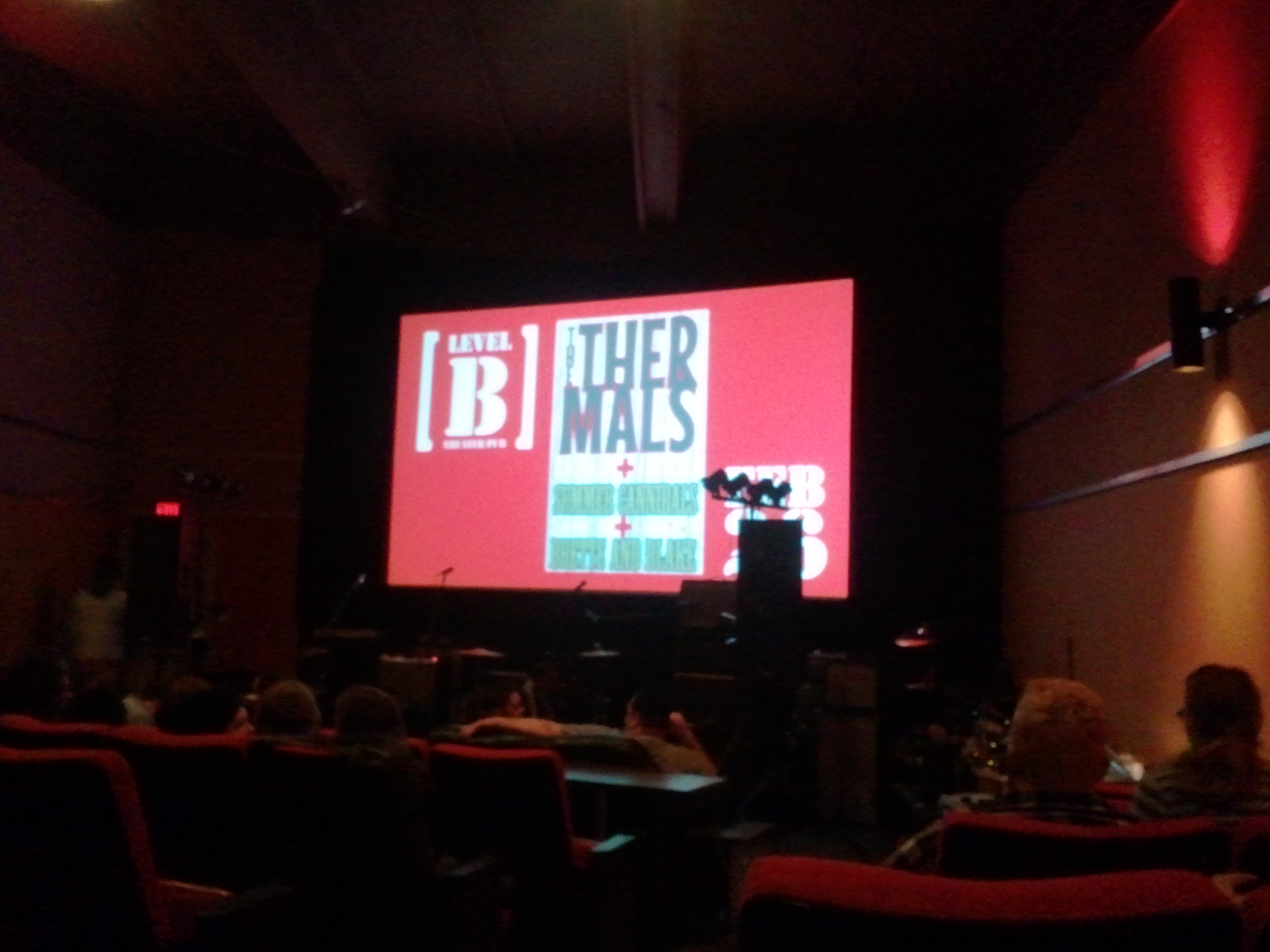
Level B preparing for the show
As it happens, Level B is the same spot where the old independent cinema in town was located, as can clearly be seen by the seats in the picture above. (I want to assure readers unfamiliar with Salem that Salem Cinema is alive and well with a great new location with better facilities, so I still get the chance to watch plenty of great films). I have high hopes for this venue in the future–it should be versatile enough to host different events, which means it’s more likely to stay afloat when it can’t get regular booking from non-local musical acts. They also had an excellent sound system, and all three bands sounded great as a result. And even the inconvenience of having those seats in place have a certain charm, giving the place a certain DIY-vibe of “we’ll play wherever they’ll allow us to play”. Or that could just me spouting bullshit. Either theory is valid.
I knew I was in for a good night (beyond the fact that I was seeing a live act that is consistently great) when two things happened: 1) I got a compliment on my Japandroids shirt (though it would have been nicer if it came from a lady, I’ll take what I can get), and 2) I heard somebody talking to the band before the show about how much he loved their album Fuckin A. That’s an album that I love as well, and by some strange coincidence the band had not performed most of those songs live at the shows I’d been to previously. It seemed like a good signal that we would get the chance to hear more of that album that night.
Aside: I never know how to act when I recognize band members in the audience. It’s always an awkward dance of “should I say something and say, ‘YO I LOVE YOUR STUFF,’ or do I allow them to be normal people for a few minutes?” I think I usually go for the worst option, where I’m pretty sure I end up staring at them far more than what is comfortable.
When I heard the opening drumbeat of “Our Trip” early in the set, my hopes for some Fuckin A songs officially materialized. The band then blistered through a high-energy set filled with tracks from their latest Desperate Ground, Fuckin A, and the now-classic The Body, The Blood, The Machine, sprinkling in favorites like “I Don’t Believe You” and “Now We Can See”. The set seemed to mirror the attitude from Desperate Ground itself, which seemed to be constructed as a reaction to the more muted reception of Personal Life. Personally, I am a big fan of Personal Life, which in many ways was an album that the band needed to make to shake up their formula and stretch their songwriting. It’s an album filled with a lot of mid-tempo numbers that are great to listen to on the stereo, but can sometimes kill the flow of a set, so I have no problem if some of those songs don’t get played, no matter how great they are.
The super-fast and hard-charging songs of Desperate Ground make for a great live set, though it takes a lot of listens before you can appreciate the nuance of each song (which is just a fancy way of saying “it’s hard to remember which song is which, but you KNOW it comes from that album”). It doesn’t help that those songs are missing some of the great guitar solos from Hutch that were a hallmark of their earlier work (not showy, but very melodic and building on the melodies within the song and brilliant with their subtlety), though Kathy’s bass often takes a lead role with some of the fills. Knowing this, it made Hutch’s remark after diving into the crowd during “The Sunset” for the last half of the song that he “nailed the solo” all the more hilarious.

When all else fails, shoot in black and white.
So yeah, it was a pretty fantastic show. Any night where you get to hear excellent songs like “St. Rosa and the Swallows”, “A Stare Like Yours”, and “A Pillar of Salt” (a fan favorite that got legitimate airplay (at least in New Hampshire/Vermont) back when I worked in radio), it’s going to be a good night. And the fact that I could plan my evening without budgeting a two-hour round-trip car ride made it even better.
Stray Facts and Observations
1. The drumbeat to “Our Trip” and “Here’s Your Future” are the exact same, meaning that those two albums start off the same. Is it a coincidence that these might be their best two albums? Probably.
2. The chord progression to “A Pillar of Salt” and “Returning to the Fold” are exactly the same, just at different tempo. Since they are back-to-back on the album, you can bet this was intentional. And it’s brilliant.
3. The Body, The Blood, The Machine is a concept album that doesn’t suck. Give The Thermals kudos for pulling off the nearly-impossible.
4. There’s no reason why “I Don’t Believe You” shouldn’t have been playing on rock radio. It’s a perfect pop-rock song.
5. There’s no reason why KNRK in Portland shouldn’t be playing The Thermals in their normal rotation. They need to substitute one of the hundreds of times that they play The Lumineers or Muse with these local heroes instead for once.
6. The last time I was at the venue it was still Salem Cinema, and I went with my family to watch My Big Fat Greek Wedding. Those who know me are free to laugh now.


 Rust Is Just Right