Author: symeo

The Antlers, Live at the Crystal Ballroom

You might not expect it, but The Antlers can really bring the thunder live.  The band may be famous for its delicately gorgeous ballads, but they certainly know how to build to a climax and drop the hammer, and it makes for an excellent show.  I was excited to see the band headline the Crystal Ballroom last night, since I was finally getting to see them play a full set–previously, I had only seen them play a quick SXSW showcase event and half of a shortened set at MusicFestNW, and each time they had left me wanting more.  It turns out that even ninety-plus minutes is not enough either.

Up close and personal with The Antlers

Up close and personal with The Antlers

The crowd was disappointingly sparse, though those who did show up were often enthusiastic in their response.  Previously the band had played the Doug Fir, and the jump up to the cavernous Crystal Ballroom may have been a bit overzealous; if they booked the show at the Wonder Ballroom, it would have been much closer to a sellout.  The good news is that the acoustics and sound system of the Crystal, which often frustrate and stymie even the most experienced acts, proved to be a good fit for the band’s haunting chords and gorgeous melodies.  Occasionally Peter’s guitar would find itself buried in the mix or a trumpet would pop a bit too much, but these were very minor concerns.

The band overall played brilliantly, with Darby and Tim mesmerizing the crowd with their ability to simultaneously play keys and horn parts, and Michael Lerner serving up some bombast with his work behind the kit.  The drums are often overshadowed on the album by the other instrumental parts, but they help the songs take on a whole new dimension live, giving real weight to the low end and providing unexpected rhythmic kicks–for example, in their stunning performance of “I Don’t Want Love” from their previous album Burst Apart, Lerner would add an extra beat on the kick drum leading into the chorus that helped drive the anticipation for its big release, and helped create some great tension by utilizing a snare pattern that danced around the expected beat with the final chorus.  Peter also showed signs that he is an underrated guitarist with some sneaky displays of his chops, ranging from a couple of excellent and tasteful guitar solos to a one-handed pull-off chord technique that helped spark even more intensity from their performance of “Putting the Dog to Sleep”.
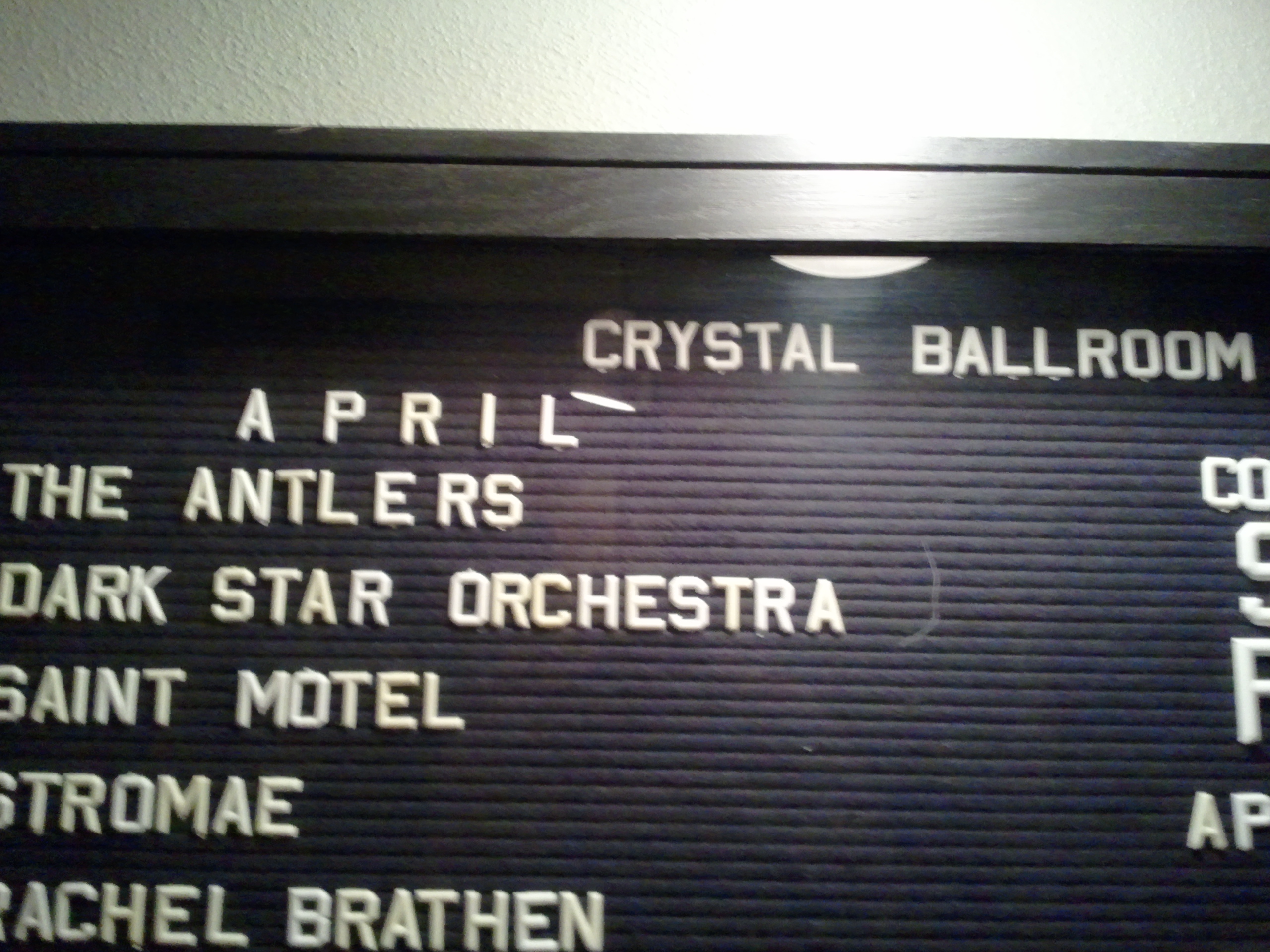
The Antlers up on the big board.

The Antlers up on the big board.

The band took an intriguing approach to their setlist, primarily running through their latest album Familiars front-to-back, with older songs filtered in on occasion.  There were murmurs in the crowd for older material, namely from their classic album Hospice, but they still showed their appreciation for the newer material.  As the night went on, the band gradually loosened up in their interactions with the crowd, including a memorable exchange where Peter acknowledged the “holiday” and pulled an April Fool’s Day prank by signalling that they were about to play a new song, before quickly correcting the record.  What made this simple joke even better was Darby’s confession soon after that he had panicked a bit, wondering what it could possibly be that they were playing since they had not written any new material yet, as well as Peter’s suggestion that the audience come up with better stories of the “prank” the band had pulled.

Though The Antlers never played “Two” or “Bear” as some members of the crowd requested, the show did feature intense performances of “Kettering” and the heart-wrenching “Epilogue”, and the arrangements of the newer songs also infused them with an extra vitality.  Perhaps word of mouth will lead to a better turnout the next time the band plays Portland.

I didn’t get a chance to see the first band, but the second openers Shaprece was pleasantly delightful.  She had a wonderful voice, and the use of a cello helped add an extra dimension to the glitch-pop R&B that other artists like fka Twigs are popularizing.

The Brilliance of The Wrecking Crew

The session musicians were the unsung heroes of the early days of rock and roll, often breathing life into the hit records that made up the soundtrack of the 50’s, 60’s, and 70’s.  The singers were the stars who got all the glory and attention, while the people who provided the backing music that drove the songs remained relatively faceless.  What audiences did not realize was that it was mainly only a small group of highly talented musicians that were behind most of the big hits of the era, a loose collective that would become known as “the Wrecking Crew.”  They were never a formal group, but together they played on hundreds of songs and provided the instrumentals for stars like The Righteous Brothers, Sonny & Cher, The Ronettes, and more.  To be sure, most people realized at least in the backs of their minds that someone was playing on those records, but they almost certainly did not know that these same musicians were also laying down the tracks for the albums of other touring bands, like The Beach Boys.

These fantastic musicians are finally getting some long-overdue recognition with the release of the documentary “The Wrecking Crew”, a project that has been years in the making and is finally seeing a release in theaters and online.  The film was directed by the son of one of the Wrecking Crew’s guitarists, Tommy Tedesco, and features interviews not only with several of the members of the “group” but with many of the artists and producers as well.  And of course the movie is filled with tons of great music, a veritable jukebox of legendary songs that you had no idea had this common connection.

The film does an excellent job of providing excellent insights into the dynamics of the music industry at the time as well as the recording process, especially the mechanics that went into creating Phil Spector’s famed “Wall of Sound.”  We get a chance to see the insides of his legendary recording studio, and see how all the musicians would crowd together in the same tight space with dozens of microphones perched all over the place. One of the nuggets that we learn is that an essential component to the sessions was running the musicians through hours and hours of takes, so that in the end the feel had just the right amount of looseness and raggedness to feel effortless.  It was also fascinating to learn that although most of these musicians are expertly trained in jazz, they earned their places in the Wrecking Crew because unlike the previous generation they were willing to work on this “dumbed-down” form of music; many of the musicians successfully make the argument that it really was not much of an artistic sacrifice at all, that “work was work” and that they still performed at the highest level.

Along with various great moments from Tommy Tedesco, the documentary provides multiple in-depth looks at other performers, including the legendary drummer Hal Blaine and the brilliant bassist Carol Kaye.  I always love learning about the work of Blaine, especially his memorable performance on the classic “Be My Baby”, and he is an especially engaging presence in the film.  I would have preferred an even more extensive look at the song which features the most memorable drum intro of all-time, but then again the story of its recording could probably fill up an entire documentary on its own (for some additional information, here’s a great article that provides even more details about the recording of the song).  The interviews with Kaye are also a highlight, as not only does she pick up her bass and shows an example of how the Wrecking Crew would come up with their own arrangements from what was written, she also illuminates some of the intra-group dynamics, including the fact that she was treated as “one of the guys” as a fellow musician.

“The Wrecking Crew” does have some flaws, namely that for the most part it lacks a definite structure and a sense of flow, and is more of a hodgepodge of engaging anecdotes.  To be fair, other recent music documentaries suffer from this problem, most notably recent Best Documentary winner “20 Feet From Stardom.”  But the passion is apparent on the screen, and the numerous wonderful stories that the performers provide make it a film worth watching for any music fan.

Review: Kendrick Lamar – To Pimp a Butterfly

Kendrick Lamar instantly launched himself into the ranks of the elite MCs with the release of his stellar album good kid, m.A.A.d. city, where he weaved with exceptional skill a complex narrative of a young man’s struggle to escape from all the various negative influences trying to entrap him.  good kid managed to avoid the primary problem that plagues most concept albums, as it never felt weighed down by the potential constraints of its central narrative; it was an album filled with hit singles (“Backseat Freestyle”, “Swimming Pools (Drank)”, and “Bitch, Don’t Kill My Vibe” are just three of the record’s modern classics) that could be enjoyed on their own, but gained an additional weight when placed in context with the underlying story.   Kendrick’s technical skills as both a rapper and a writer ensured that there would be heavy anticipation for its follow-up, and for months fans and critics were on the edge of their seats with each revelation.

To be sure, To Pimp A Butterfly meets and possibly exceeds all these expectations.  It is more ambitious than its predecessor, moving from documenting a personal struggle to a more universal one, as Kendrick analyzes the trials and tribulations that face black people in America today.  The result is a denser, less accessible album than good kid, but represents a true artistic statement.  It might best be explained by using the old music critic cliche of the analogous connection to a completely unrelated artist: if good kid, m.A.A.d. city is Kendrick’s The Bends, then To Pimp a Butterfly represents his OK Computer.

The music on Butterfly is a heady and thrilling mix of numerous jazz, funk, and R&B influences, veering from one style to the next and capturing a gamut of emotions and moods.  Though Flying Lotus is only credited as a producer for one song, it seems as if the experience of their previous collaboration rubbed off on Kendrick, with the free mix of jazz and electronic elements dominating a significant portion of the record.  As the album progresses, the music shifts from a smoother, freer feel to a more deliberate beat, and provides an excellent counter to Kendrick’s growing anger. Spoken word passages also play a significant role, with Kendrick periodically adding lines to a poem that begins each time with “I remember you was conflicted”, and it creates an interesting effect of breaking the album into sections while also providing a connective tissue with narrative thrust.

Butterfly is an album that takes a lot of effort to unpack, but the effort is worth it; though it runs close to eighty minutes, it never feels like a chore to listen.  There are not a wealth of singles like good kid, with most of the tracks sounding better in context; “i” works as a single, but it sounds even better as a culmination of the album’s themes and as a response to “u”.  As a result, in the future I can see most people (including myself) throwing on the other album more often, but the times we do listen to Butterfly will still be appreciated.  After all, this is an album that ends with Kendrick “interviewing” Tupac, and it makes perfect sense that the legend finally has a true successor.

Over the Weekend (Mar. 30 Edition)

News, videos, and other fun stuff for your possible recovery from Spring Break…

Built To Spill is gearing up for the release of their long-awaited eighth album, Untethered Moon, and they recently posted the video for its first single, “Living Zoo”.  Be sure to read the Noisey interview with Doug Martsch that accompanies it for an insight into what the band has been up to in the past few years and how the current lineup was formed.

Mini Mansions is a new project featuring Michael Shuman, the current bassist from Queens of the Stone Age, and they just released a new video featuring Alex Turner from the Arctic Monkeys.  Pitchfork has the video and some more background on the shoot, though as the link indicates, it is probably NSFW due to reasons of nudity.  As for the music, the song has the same Gothic vibe that can be found in QOTSA’s groovier work, and is pretty catchy as well.

Death Grips is releasing jenny death, the second half of The Powers That B tomorrow, and it is certainly a different animal from the first half that was shared last year.  Check out the GoPro-type video for the bone-rattling “I Break Mirrors With My Face in the United States”, featuring footage from Zach’s drumstick and MC Ride’s mic.

…And You Will Know Us By The Trail of Dead shared the video for “Lie Without A Liar” from their recent album IX, depicting a fantastical suburban child warrior.  Or something.

Ad-Rock, subject of a recent GQ profile that we linked to on Friday, stopped by The Tonight Show to discuss his recent movie role as well as his poor appearance.

Elsewhere on the late night circuit, Modest Mouse became the first band to perform on the newest incarnation of The Late Late Show, now hosted by James Corden, where they performed “Be Brave” from Strangers to Ourselves.

Stereogum has a helpful guide to getting all your “beach” bands straight, which is probably worthy of consultation as the weather gets nicer.  I wonder if they had similar guides when “Deer” and “Wolf” bands were popular.

And finally, enjoy the contributions of this musical dog to some well-known rock songs.  It’s the perfect thing to help kickstart your week.

Catching Up On The Week (Mar. 27 Edition)

Some #longreads for those still in the throes of March Madness…

After a relative paucity of reading material in recent weeks, this week saw the publication of numerous worthwhile interviews and discussions.  For those who want insight into older music, there’s the Rhino interview with Big Star drummer Jody Stephens and The Guardian behind the scenes look with The Strokes on the making of Is This It.  As for those who are looking ahead, there is Nate Mendel of the Foo Fighters talking with Consequence of Sound about his upcoming solo album as “Lieutenant” and Death Cab For Cutie revealing to Radio.com the background behind the making of their new album.

For those who are looking for more weightier fare, there is a roundtable discussion about the social context of works like the recent albums from D’Angelo and Kendrick Lamar and a Vox op-ed about the prejudicial treatment of rappers and the double standard that is given to rap lyrics by legal authorities, co-authored by Killer Mike.

Finally, GQ has an extended profile of Adam Horovitz, providing a personal in-depth look at the man you probably know as Ad-Rock, as he transitions into his post-Beastie Boys life and looks back on his career.


A Recap of the Time a Music Publication Mocked Me With My Own Writing

Insecurity can spur people to commit reckless deeds, including going above and beyond to lash out at perceived threats.  I can understand the desire to protect one’s reputation and integrity, but I will never comprehend the extent to which it motivates some to create mountains out of molehills.  As you may expect, the stupidity began where you would expect it most these days: Twitter.

Two weeks ago, a few folks I know in Twitter ended up getting into an argument with an online music publication, and upon witnessing their treatment by this supposedly professional organization I inevitably waded into the muck to defend their honor.  Their unforgivable sin was to share a link of a particularly bad review and to comment on its alleged quality; the publication saw their interaction, and proceeded to insult them for their opinions.  What made this a particularly bizarre interaction was that neither party had included the publication’s Twitter handle in their discussion, yet the company decided to interject anyway and express their displeasure.

It is one thing to defend your honor, but it is another to go out of your way to impugn someone else for providing their opinion.  The publication then doubled down on their rude behavior by browsing through the profiles and timelines of these folks to use as fodder for insults.  I was appalled at this trollish behavior, and specifically called out the company for engaging in such petty tactics.  I want to stress that it was not the author of the review that was officially engaging in this behavior at this point, but the person who ran the Twitter account for the entire publication, a person who felt that it was a good idea to drag the name of the entire company through the mood to harass others.  At a certain point, this person then directed some insults in my direction, and condescendingly attempted to explain how internet searches and Twitter works, as they apparently took offense to my acknowledgment of their shady behavior.  Their final reaction was the coup de grâce, as they proceeded to look up this site (which is linked in my personal Twitter bio, for the record), and then spit back to me the first line of the review that was at the top of the page.

Let us review: Company engages in shady behavior, gets called out on it, proceeds to mock person for calling out said behavior, then engages in the very same behavior in order to taunt the critic.  Excellent work all around.

So, what sparked this entire nonsense that took up several people’s afternoons?  A terrible album review.  Rest assured, it was an absolutely awful piece of writing, and as a service, we will provide some constructive criticism.

* * * * *

– Roughly half of the review centers around “cum” and its use in the very first line of the album, and the term is mentioned in all four paragraphs of the review, as if its presence is emblematic of the whole.  Despite the paragraphs dissecting its particular usage, the case is never made why the reader should care that Father John Misty mentions it or how its use represents the album.  In other words, the author assumes the argument has been made merely by bringing it up, but does not make any relevant connections himself.

– Xiu Xiu should never be used as a positive example.  If you are unfamiliar with Xiu Xiu, they are the embodiment of every negative connotation that one has when he/she hears the term “performance art”; creating worthwhile music is definitely not their goal.  Back when I worked in radio, I played one of their songs for our new music show, which deviates from the usual playlists and allows us to temporarily indulge in numerous offbeat tastes, and it was the one time I had a listener call in and say terrible things about what we were playing.  And that guy was totally right.

– If we are to indulge in the comparison of the use of “cum” by each act and look at the reviewer’s argument on its face, it is unclear what kind of distinction is being made.  In both cases it is an attempt to juxtapose the sacred and the profane, and in both songs it is used literally to convey a particular image.  It seems to be merely the author’s opinion that Xiu Xiu did a better job of this, which is fine, but there is no objective distinction in the two cases.

– The reviewer attempts to mock Father John Misty by claiming that the use of the term “Rorschach” was a pretentious attempt to display intellectual superiority says more about his impression of basic psychological concepts than FJM’s.  The reviewer gets this completely backwards, since it is much more likely that “Rorschach” was used not to impress the listener, but as a descriptor that is universally known.  Who is unfamiliar with Rorschach ink blots?

– It is hilarious that the reviewer attempts to call out FJM for his “PSYC101” analysis, when the fact that so much of this review is devoted to “cum” indicates that the author has some sort of obsessive fixation.  Or do they not cover Freud in PSYC101?

– The use of “Bro?” as a complete thought says way more about the review and the reviewer than anything else he has written.

– Hidden in the third paragraph is a legit criticism about irony and the nature of the “Father John Misty” character.  Many can find the different levels exhausting, as it can seem to be an attempt by the artist to always be able to escape criticism.  Tillman walks a fine line, and the fact that some say he crosses it is fine.  Personally, I think he comes close several times, but I am ultimately swayed by the record’s charms.

– The reviewer spends half of the final paragraph completely botching the analysis of a particular song because he spent no time doing any actual research on the record and neglected to include a key lyric in his assessment.  I Love You, Honeybear is a concept album of sorts loosely based on Tillman’s recent marriage, so the fact that he is undercutting himself in the lyrics to “The Ideal Husband” carries more weight than for which the reviewer gives credit.  The author does acknowledge the fact that Tillman is purposefully undercutting himself, but he is clumsy in his criticism by calling out “a dumb lyric about ‘putting a baby in the oven'”, since in the song itself Tillman sings, “said something dumb like ‘I’m tired of running.  Let’s put a baby in the oven.'”  I can see the point the author is trying to make, but when you call out a lyric for being dumb when the singer himself says it is dumb, it makes you look like an idiot.

– As you may expect, seeing “a hodgepodge of Suburbs (2010)-era Arcade Fire strumming” makes me want to scream.  FOR FUCK’S SAKE, ARCADE FIRE DID NOT INVENT GUITAR STRUMMING!  IF THEY HAD A DISTINCTIVE SOUND, THE WAY THAT THEY STRUM THEIR FUCKING GUITARS WOULD NOT BE A PART OF IT!

– “Did you know Joe Strummer got his name when he heard an Arcade Fire song?  He actually came to the future, heard one of their songs, asked ‘what is this?’ and when told it was ‘strumming’, he went back in his time machine and recorded The Clash’s debut album.”  I imagine this is the exact belief of this idiot.

– To sum up, the entire review consists of an analysis of a single line whose significance is never established, and the one reference to the actual music involves a band to which there is no actual resemblance and involves a comparison that sheds no light whatsoever.  It is not as if it is impossible to compare Father John Misty’s music to anyone, but it may involve looking back further than 2010.

* * * * *

I hope that the professional music publication which created this entire mess is now satisfied that it now has constructive criticism as to why its review was completely awful.  I also hope that someone somewhere within that company learned that it is probably unwise to act like a complete dick on Twitter.  But I am also a rational person, and I doubt that either of those hopes will come to pass.

I Saw Them Live! Memories From a Godspeed You! Black Emperor Show

With the release next week of Godspeed You! Black Emperor’s new album Asunder, Sweet and Other Distress (which is now available to stream), this is the perfect opportunity to reflect on one of the most remarkable concerts I have ever experienced.  Seeing Godspeed live was such a mind-blowing event that I spent weeks after the show contemplating the fundamental nature of music.  When a band forces you to engage in philosophical debates with yourself, it means that it was a pretty special performance.

For years, I was only a moderate fan of Godspeed You! Black Emperor; I was intrigued by the unusual name (including the shift in the exclamation point over the years) and the odd facts I had read about the group, from the fact that they were some sort of amorphous collective that conducted “post-rock” songs to the claim that the band trafficked in extreme politics despite the fact that their songs were strictly instrumental.  I picked up a few of their records in college and was often content to leave them playing as ambient drone music during study periods, rarely fully engaging myself with the individual songs.  It was pleasant background music, but I often struggled to maintain any focus on the individual songs during my attempts to listen with greater intent.

The band had fallen off my radar when they went through their lengthy post-Yanqui U.X.O. hiatus, but when they announced they were reuniting to go on tour in 2011, I immediately decided to snatch up a ticket.  I had heard excellent reports about their live show, and the fact they were playing an unusual venue (a Masonic Temple in Brooklyn, I believe) indicated that it would be a memorable experience.  However, my excitement was short-lived, as circumstances changed and I ended up missing the concert–I attended South by Southwest instead, the thought being that the thirty shows that I would end up seeing would make up for the one that I had missed.

Soon after the initial success of the reunion tour, the band released the fantastic comeback album ‘Allelujah! Don’t Bend! Ascend!  Unlike previous albums, I had a much more instantaneous appreciation of ‘Allelujah, and it made me reconsider my assessment of the band.  The band announced a tour in support of the album, and I finally had the chance to atone for my previous absence.  GY!BE swung their way through Portland’s own version of SXSW, performing at the Roseland Theater for two nights during MusicFestNW.  Back in 2013, the “festival” was still a week-long affair of loosely-affiliated shows at venues all across the city, and because of the necessity of tickets for each show and the vast distances between them, it was a significant decision to choose a specific show like this because of the additional opportunity cost.  The stakes were high.

Initially, it seemed that I had made an unwise gamble with my time and money.  The band took its time getting to the stage, arriving one at a time, and once they were there spent several minutes seemingly attempting to get in tune, creating a cacophonous drone that gradually enveloped the theater.  For a good ten minutes I was having serious doubts about whether or not it was a good idea to see a band for whom I had previously only mild feelings, knowing full well that the live experience could very well end up being a compilation of the most boring aspects of the band.  Then, there was a sudden shift, and the music coalesced into something that can only be described as pure beauty.

“Mladic” may be the closest that Godspeed has ever come to writing a “hook”, with a melody that evokes Slavic motifs that bring to mind my own Mediterranean roots.  With this melody stuck in my head, I now had a toehold within the morass from which I could explore wherever the band ventured.   In other words, there was now a purpose in the noise.  Once I had this realization, I began to analyze the sounds circling around venue, and began questioning my assumptions as to what constituted “rock” and what defined “music” itself.

Godspeed You! Black Emperor has often been described as a “post-rock” band, a term with little meaning to most people, but it was at that moment that it seemed that the band had embodied the meaning of the signifier; it seemed as if the band was commenting on the nature of the form, a hallmark of “postmodernist” movements.  Godspeed eschews the verse-chorus formulation, but simulates their effect by playing with dynamics, utilizing huge crescendos that build over several minutes and sudden diminuendos.  The band also explores dissonant tones and plays around with pure cacophony, with several members playing extremely disparate parts that seemingly have no relation, but will gradually blend into recognizable melodies.  The result is music that creates the effect of a rock show, without including many of the more recognizable elements that one would expect from “rock”.

By the end of the show, as the band exited in a similar manner as they had entered, screen flickering all the while, I had a completely different opinion of the band.  Now I can’t wait to see them again.

Review: Modest Mouse – Strangers to Ourselves

It may be tough for some fans to accept, but Modest Mouse in 2015 is not the same band that it was in 1996 when it released its debut album.  This is not a criticism at all, but a statement of fact–a band that began as a bare-bones, ramshackle trio playing dive bars has now evolved into an amorphous collective that headlines festivals.  Strangers to Ourselves is light years from the type of album that the band made in their K Records days, but underneath the polished sheen and layers of instrumentation the listener can still find the idiosyncratic character that undeniably defines this as a Modest Mouse record.  Not only are the oddball sensibility and humorous cynicism that are prevalent in their old releases still run rampant, but Isaac Brock and company continue to poke at the boundaries of what one expects musically from an indie rock record.

The album begins with the gorgeous title track, an ode to the ability to forget that is marked by a lovely string melody and dotted with countless instrumental ornamentations from the menagerie of supporting players, a moment of tranquility that recalls previous triumphs like “Gravity Rides Everything” and “The World at Large”.    Lead single “Lampshades on Fire” follows, and musically it sounds like modern-day Modest Mouse in a nutshell–there are the bent harmonics, the ba-ba-ba backing vocals, the splashes of color from quirky instruments, but performed in a compact and cohesive manner.  The lyrical theme covers classic Modest Mouse territory, with an overall narrative of escalating disasters that culminates in a plea of this-planet-is-fucked-so-let’s-move–“Pack up again head to the next place, where we’ll make the same mistakes.  Burn it up or just chop it down this one’s done, so where to now” share space with non sequiturs like “our ass looks great inside these jeans,” with both sentiments inspiring the same deep contemplation from the listener.

Songs like the menacing “Shit In Your Cut” and the backwater circus-evoking “Sugar Boats” already have fit seamlessly into the band’s setlist, and the bouncy “The Ground Walks, with Time in a Box”, which features a groovy bassline that brings to mind “Tiny Cities Made of Ashes”, is destined to be a future live favorite, especially with an outro that begs to be extended and embellished.  The delicate ballad “Coyotes” is another highlight that shows the band’s deft touch, especially as it swells into its final sing-along chorus with a lovely flourish of guitars.  The Jeremiah Green-penned “God is an Indian and You’re an Asshole” should also delight fans of the band’s more peculiar tendencies that works as a great palate-cleanser and sets up the album’s final trio of the songs that concludes the album with a strong flourish.

Though the band hits on several aspects of their sound that should delight multiple segments of their fanbase, Modest Mouse does not provide a mere rehash of their previous work and continues to experiment, with the results having varying degrees of success.  The bright, steel-drum-inflected “Ansel” and the skittering “Wicked Campaign” fit in comfortably with the rest of the album, whereas the spit-up and chewed-out “Pistol (A. Cunanan Miami FL. 1996)” threatens to stop Strangers dead in its tracks early on.  The latter grows on the listener with repeated listens once the initial shock wears down and is an example of the band’s bravery in confronting the listener’s expectations, but it is also the obvious candidate for most-skipped track on the album.

Strangers to Ourselves is overstuffed at fifteen tracks, but this has long been a trademark of Modest Mouse albums, including classics like The Lonesome Crowded West and The Moon & Antarctica; fans look back fondly on those albums as a whole, but even on those records there are some rather weak tracks, though over time they help contribute to the group’s “anything goes” feel.  Ever since “Float On” broke through into the mainstream, Modest Mouse has faced the charge from some fans that they “sold out”, though that is an unfair complaint–the band is as delightfully weird as ever and clearly follows their own muse, and their resultant popularity is not the product of a calculated shift to accommodate for more pedestrian tastes.  Though the group as currently constructed cannot write a loose and rambling classic like “Trailer Trash”, sacrificing some freedom for some semblance of structure, but they can still venture into some pretty wild places.

It may not reach the heights of their landmark albums, but there is a consistency to Strangers to Ourselves that makes it a marked improvement over We Were Dead Before the Ship Even Sank, which could be a slog to get through at times.  It may not completely make up for the amount of time we’ve been waiting for a new Modest Mouse album, but we can at least take comfort in the fact that the next one should be coming very soon.

Over the Weekend (Mar. 23 Edition)

Some news, new music, and new videos as you get over your post-SXSW hangover…

Modest Mouse stopped by CBS News on Saturday morning to perform songs from their latest album Strangers to Ourselves, with frontman Isaac Brock also sitting down for a quick interview to go over what happened in the time since the release of We Were Dead Before the Ship Even Sank.  Though many sites have posted videos of a couple of the songs they performed, the band’s Facebook post has links to all three performance videos and the interview.  The band also released the official video for the single “Lampshades on Fire”, featuring a lot of jump-cuts and one crazy party.

Though “Lampshades” was the first single released from the album, it strangely is the second video, as the video for the ballad “Coyotes” was previously released.

Blur shared another track from their upcoming Magic Whip, and “Lonesome Street” should please fans with fond memories of the band’s Parklife era.  Of course, Blur’s albums are fairly diverse affairs, and the singles released by the band so far proves that Magic Whip will be no different in this regard.

Built To Spill has released another song from Untethered Moon, the sweet and poppy “Never Be The Same”; it is available instantly along with the previously released jam “Living Zoo” when you pre-order the album now, which is available on vinyl for Record Store Day this year and on disc on April 21st.

Action Bronson is releasing his major-label debut this week, and right now Mr. Wonderful is available for streaming, if that is your preferred method of consumption.  This brief interview Bronson did with GQ should convince you to check it out.

Speaking of streams, a couple of major albums that will be released next week can now be streamed, with Death Cab for Cutie’s Kintsugi available on NPR and Sufjan Stevens’s Carrie & Lowell available at multiple sites.

Finally, enjoy this video from last week’s South by Southwest of comedian Hannibal Buress sitting behind the kit for Speedy Ortiz in a terrible, terrible performance of “MKVI”.

Catching Up On The Week (Mar. 20 Edition)

Some #longreads as you enjoy the first day of spring…

Most of the music world spent this week dissecting and analyzing Kendrick Lamar’s new album To Pimp A Butterfly, a record that will singlehandedly keep the thinkpiece industry afloat for the next several months.*  We are going to be judicious in our selection of Kendrick-related material to link to in the near-future, but we imagine that this piece from Stereogum highlighting the important contributors to the record should be worth your while.  We cannot offer the same judgment for Rolling Stone’s upcoming cover story, since the magazine has only released this short preview.

However, Rolling Stone does have an extensive interview with M.I.A., revolving mainly around the ten year anniversary of her debut album, Arular.  As is the case with most interviews with M.I.A., this feature goes all over the place and explores a variety of topics, in alternately entertaining and confounding ways.

Speaking of ten year anniversaries, Stereogum has a profile on Picaresque from The Decemberists.  It’s an uneven essay, with an oddly revisionist bent about the music scene from the previous decade, though it does take the time to acknowledge how this was the beginning of the influential band’s musical peak.

Earlier this week we shared one introductory course in understanding Modest Mouse, and today we have another courtesy of the AV Club.  Unlike the Consequence of Sound piece which focused on songs, Primer focuses on the essential Modest Mouse albums and examining them in context.