Author: symeo

MusicFestNW 2014

Portland celebrated MusicFestNW this past weekend, and it looked a little different than it had in past years.  Instead of a colder, wetter version of SXSW (with a city more equipped to handle the traffic), we got a Northwest version of the current incarnation of Lollapalooza and other similar festivals.  We didn’t have to buy tickets to multiple venues and plan across a whole week, but instead had a two-day festival in a specific part of the gorgeous Waterfront Park, soaking in that last bit of summer before the inevitable gloomy fall.

We decided to skip the first day since there were no acts that seemed worthy of shelling out the extra money for another day of tickets (with all apologies to Run the Jewels, for whom it would probably be worth to pay a full-day’s admission to see on their own).  I’m going to avoid the opportunity to talk smack about bands for whom I don’t particularly care, because we here at Rust Is Just Right try to set ourselves apart by not indulging in condescending snark and instead promote what we enjoy.  But in private, let’s just say there were a lot of good burns that were shared.

Portland's Waterfront Park, on a non-MusicFest day.

Portland’s Waterfront Park, on a non-MusicFest day.

Our plan on Sunday was to catch the lineup starting from The Antlers until the end, but thanks to several accidents on I-5 our ETA was delayed by about an hour.  Luckily, we still caught the last few songs of The Antlers’ set, a circumstance which mimicked my previous limited encounter with their live show when they only performed a short showcase at SXSW.   One would think that their delicate and fragile songs would not be ideal for a live show, especially in a large festival setting, but once again I came away extremely impressed with their performance.  We were caught wandering around the backside of the cordoned-off grounds for “I Don’t Want Love” (mistaking beliving that there would be entrances on the bridge side), but we were still able to hear the devastating power of the song even filtered through the backstage equipment.

The Antlers: "Music Band Northeast, glad to play Music Fest Northwest."

The Antlers: “Music Band Northeast, glad to play Music Fest Northwest.”

Once we finally settled in to the proper area, we heard a couple of songs from their latest album Familiars.  I haven’t yet internalized the nuances of those songs, but I can assure you that they come off very well in a live setting.  Perhaps the biggest surprise was their last song, “Putting The Dog To Sleep”.  It’s a great closer on Burst Apart, but given the specific nature of the song, it wouldn’t appear to be the most natural way to end a set.  The song was as cathartic as expected, but the band added an additional musical twist: first they began the natural breakdown of the song, taking pains to stretch out the chord progression while keeping the resolution slightly out of reach, but then building the song back up with an extended instrumental section that dazzled the crowd.

You know this was from early in the set because Damian Abraham's shirt is still on.

You know this was from early in the set because Damian Abraham’s shirt is still on.

We then made our way to the other end of the park, where Fucked Up was set to perform next–a transition that ranks among the most jarring ever scheduled at a music festival.  Here is a great opportunity for praising the new setup of the festival, as this allowed minimal time wasted between different acts as they had the necessary amount of time to setup without holding the crowd hostage, and the distance between the two sets was both short enough for the walk to not be burdensome while long enough so that there was not any bleedthrough between the two stages.  Someone deserves some extra kudos for that solid planning.

We’ve shown our love before with our glowing review of Glass Boys, but even we were taken aback at just how awesome Fucked Up’s set was at MusicFest.  I’m willing to claim that their hour-long set alone was worth the price of admission for the full day’s lineup.   There’s really nothing quite like seeing the giant hulking mass of positive energy that is Damian Abraham working his way through the crowd, giving hugs to folks passing by, climbing on top of the fence to sing out to the people on the river, and high-fiving a baby as the band ferociously kept up and played in lockstep.  Seriously, Pink Eyes high-fived a baby–that immediately became an all-time top-five concert moment for me personally.
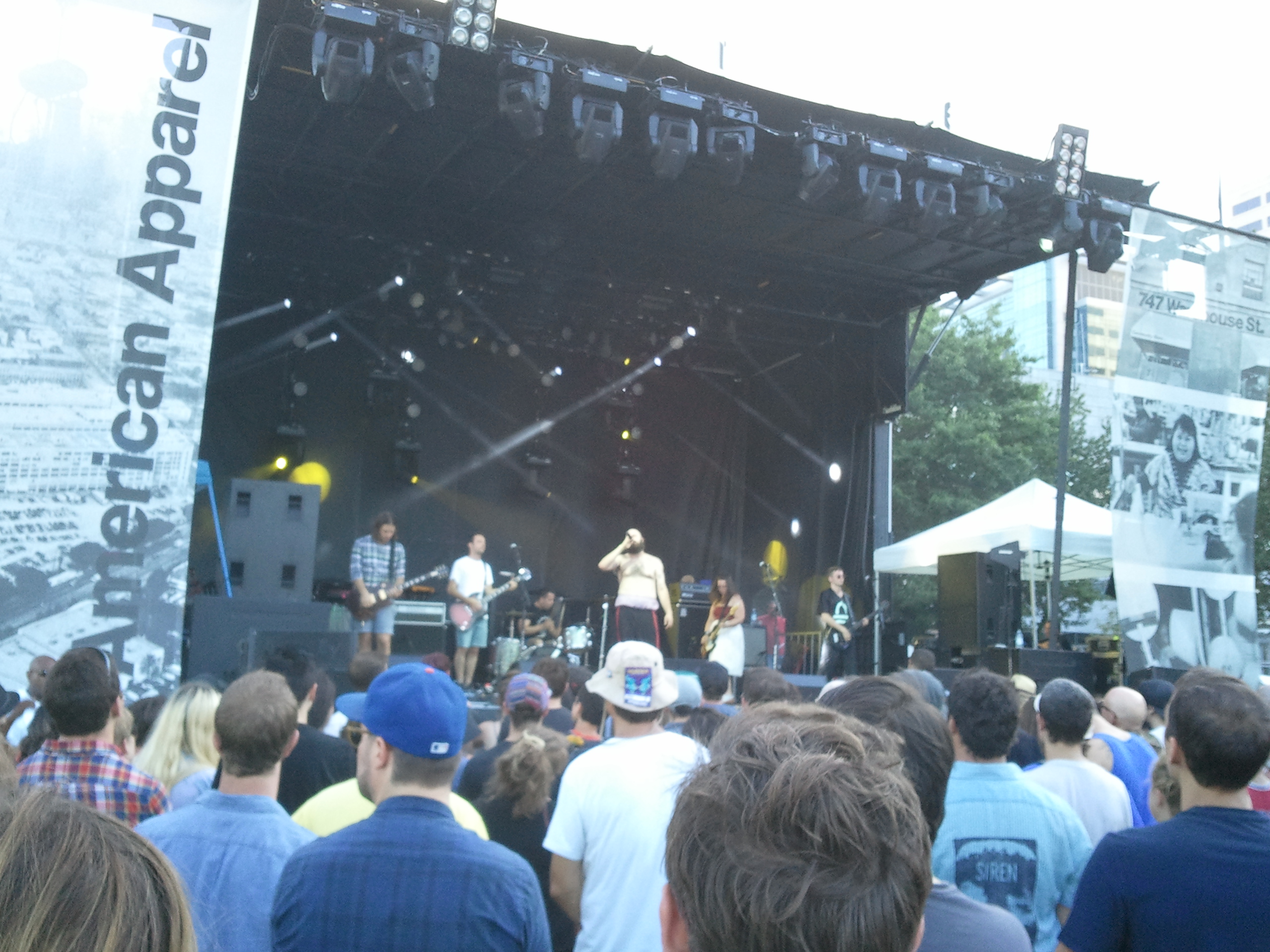
Pink Eyes, now sans shirt.

Pink Eyes, now sans shirt.

I believe most of the set was from Glass Boys and David Comes To Life, though I will admit that sometimes it can be difficult to tell certain songs apart.  At least none of my personal favorites from The Chemistry of Common Life came up, though the rarity “I Hate Summer” made a welcome appearance, with a thoughtful introduction from Abraham on how one shouldn’t listen to personal attacks from others who are merely trying to shame people for no good reason.  He also at other times mentioned the healthful benefits of weed and the terrible events occurring in Ferguson, MO, with each speech receiving thunderous applause.  The band was tight, as I mentioned, but also could have benefited from an extra volume boost to help compete with Abraham’s sharp bellow, and also to help distinguish between the various components of their three-guitar attack.  Unfortunately, it seemed that the raucous set eventually drove the crowd away, as it seemed after their initial welcome that many people grew tired of listening to an hour of hardcore, and eventually made their way back to the other end of the park.  Then again, perhaps it was the heat finally getting to a few people, and the need to stock up on food.  I hope it was the latter, because Fucked Up deserved a new wave of fans after that performance.

A glimpse of the color of tUnE-yArDs

A glimpse of the color of tUnE-yArDs

We had previously seen tUnE-yArDs when they opened up for The National only a few months ago, and in between it seems the set morphed from less a capella and looped percussion to more synths and live percussion.  That’s not to say that the music was any more conventional–there is still a dominant left-of-center sensibility.  For those who are unfamiiliar, the music of tUnE-yArDs is filled with complicated rhythms and tribal influences with world music type lyrics.  In other words, at many points through the set I thought I was living through a real-life Portlandia sketch.  Despite this vague feeling of uneasiness, I still really enjoyed the tUnE-yArDs set, as did the hundreds of other people that packed the listening area.

I ate a lamb gyros.

I ate a lamb gyros.

We ate dinner during HAIM.  Mine was delicious.

I save my worst photography for last.

I save my worst photography for last.

Spoon closed out the festival with a fantastic headlining performance, with a setlist that went deep into their catalog.  You may have noticed that we here at this site love the band quite a bit, and let’s just say that we loved every minute of their show.  Britt Daniel, former Portland resident (who gave a shoutout to SE during “Black Like Me”), remarked that it had been a long time since their last show in the city, back when they performed at the Crystal Ballroom in 2009; as an attendee of that concert, I could only shout out “too long!”

Just to show that the festivities extended into the night.

Just to show that the festivities extended into the night.

In their live show, Spoon manages to perfectly balance between precision and spontaneity, as the band can maintain both a perfect verisimilitude of their albums and allow for individual players to freak out and revel in the moment.  The band mixed in a healthy amount of their stellar new album They Want My Soul, and even some of the more experimental tracks like “Outlier” and “Inside Out” sounded perfectly at home within the set.  The crowd roared when they heard old favorites like “Small Stakes” and “I Turn My Camera On”, but saved their most appreciative response for the hits from Ga Ga Ga Ga Ga like “Don’t You Evah” and “The Underdog”.  Personally, I was glad to finally hear some of Transference live, including an extremely passionate performance of “Got Nuffin'”, and to witness at least one Girls Can Tell song, the sublime “Anything You Want”.  The only odd part was that besides Britt there seemed to be several band members that wanted to get out of the show in a hurry–the band ended up doing two encores, which seemed to be partly the result of some poor time budgeting.  It may have been the result of getting used to one-hour slots on various festivals and not properly adjusting to a headlining 90-minute slot, but from a distance I could see the look on some of the faces of the band members that they were hoping to cut things shot.  Despite this, Spoon more than justified taking the top spot on the bill; I’m just hoping for a proper show at some point from these guys in the near future.
Over the Weekend (Aug. 18 Edition)

Kicking off the week with a ton of new music and exciting news, as summer slowly morphs into fall…

It began with cryptic message from a giant blimp, but it’s official: Aphex Twin is releasing a new album.  Richard James most recently released music as AFX, (with the vinyl-only release of Analord, though a compilation of selected tracks was later sold as an Aphex Twin/AFX release on CD called  Chosen Lords), but even then it’s been a long time since we heard new music from him as those records were last released in 2006.  Syro will be the first Aphex Twin album since 2001’s Drukqs; no word on whether we’ll have any more creepy music videos, but the artwork announcing for the release seems to suggest as much.

Fans of the site should be well-aware of how excited we are for Death From Above 1979’s upcoming reunion, and a warm-up show brought us some additional material to help whet our appetite.  A fan has uploaded another track scheduled to appear from the new album The Physical World, courtesy of a free CD handed out to fans at the show.  “Government Trash” lives up to its name, as the song shows the harder-edged roots of the band, and is a perfect example of trashy punk.

Interpol today gave us another taste of El Pintor with the release of “Ancient Ways”.  It’s an uptempo track that shows that the band is really intent on piling up instruments on top of each other, similar to the style of Interpol, but with some of the edge of their earliest work.

KEXP has been uploading videos from a number of different groups that have stopped by their studios, and they’re definitely worth the time to watch all the way through.  So far I’ve watched Peter Matthew Bauer perform an excellent set with a full cast of backing musicians (which is sure to irk Rick Moody, since it contradicts his point) and Cloud Nothings rip through their latest, and I’m looking forward to checking out the Broken Bells and Wye Oak sets soon enough.

It’s always fun to hear bands talk shit about one another, and Kim Thayil provides quite a bit of it with these recent rips on Billy Corgan and the Smashing Pumpkins.

And finally, some sad news as Rick Parashar, a producer and engineer known for his work with the early years in the grunge scene in Seattle died a few days ago.  He helped out with Ten and the Temple of the Dog album among others, a contribution that which we all appreciate very much.

Catching Up On The Week (Aug. 15 Edition)

Some #longreads for your weekend as we try not mention Spoon for the first time this week.  Oh…goddammit.

Well, we might as well keep the streak up and talk about Spoon again.  But we have a really good reason this time, as Britt Daniel talks to Pitchfork about a number of songs from the entirety of their career, and provides some great insight into the songwriting process and explains a lot of the specific references in their songs.

And while you’re hanging around Pitchfork, be sure to take a look at the story behind the legendary underground hip-hop album Madvillainy, and this piece that looks at why older artists are now hitting the top spot on the albums chart.

Slate has an article that discusses the neuroscience behind people’s natural inclination to adore the songs of their youth, despite the fact that objectively they realize the songs are not very good.  This inspired me to take a look through my collection to see if there was anything that I should be ashamed of, and I really didn’t come up with anything.  But I’m going to post this video of N.E.R.D.’s “Rock Star”, because how often will I have the chance?  I wonder what Pharrell ever did after this…

Continuing with the theme of articles of a more analytic nature, FiveThirtyEight has a look at the regional differences in playlist construction of Classic Rock Stations.

Rolling Stone has a couple of pieces that should provoke some interest.  First, there’s an investigation behind a lost classic by the Beastie Boys from the Paul’s Boutique days.  Then there’s a look behind the recording of Mother’s Milk for its 25th anniversary, an album that remains my favorite from the Red Hot Chili Peppers.

Impose Magazine has an interview with clipping., as they argue against being pigeonholed as “noise-rap”.

And finally, there’s a profile of The New Pornographers in the Wall Street Journal of all places.  Wrap your head around that concept for a second, then go ahead and read the piece.

Feats of Strength: Spoon

We might as well finish things off this week with our Band of the Week, Spoon.  You would think that after all this time spent carefully analyzing the band’s albums and career over the past few days that we had covered everything, and to tell the truth, you would be partially correct: we did mention this particular moment on Tuesday.  But indulge us and allow us to examine a particular moment of brilliance from the band, the spastic guitar solo from “The Beast and Dragon, Adored”.

[For listening purposes, the solo occurs at around the three minute mark]

To the untrained ear, the guitar solo in this song is reminiscent of what many people say when confronted with modern art–“My kid could paint that.”  It’s true that on a superficial level the guitar solo sounds like a rather amateurish effort–similar to our previous Feats of Strength, in which we paid tribute to “shitty drumming”, but not quite.  It sounds like the kind of solo that a novice would attempt when he/she gets tired of practicing scales and wants to just rock out for a few seconds and unleash that rawk-n-roll spirit.  In other words, it sounds a lot like aural hot garbage.

In reality, it takes a lot of skill to sound that “bad”.  Take it from a musician who’s played guitar for dozens of years and is still more comfortable with writing a traditional fretboard-burner than a freakout like this one.  It may sound like a mess of random notes, but that’s not really accurate; the exact notes were not planned out, but the general plan was determined well in advance.  The use of dissonant tones and a chromatic scale were pre-planned, and Britt’s rhythm is spot-on, speeding up and repeating notes as necessary.  It is the definition of “controlled chaos”.

The solo also needs to be considered within the context of both the song and of Spoon’s music in general.  The band has a reputation for absolute precision, with each part carefully constructed to fit within the perfect space in the music.  Even on their more energetic and rocking songs, the band never loses control of the music, and they always maintain a tight feel.  This is present in the song as well–aside from the lead guitar, every instrument is locked into place, and played at a measured and precise tempo.  The lead guitar then comes in and shocks the listener, disturbing the previously imagined order.  If another band had attempted the same trick, it wouldn’t have the same resonance or power because this moment goes against everything we’ve expected from Spoon.  It makes for an incredibly compelling live performance as well, as this is one of the few moments where the audience sees Britt completely lose himself to the music as he falls to the floor to wring out all the emotion possible from the solo.  At this point, the audience now understands that when they believe, they call it rock’n’roll.

Review: Spoon – They Want My Soul

We’ll just get this out of the way early: They Want My Soul is a fantastic album, and is a worthy addition to the Spoon canon.  Once again, the band pulls off the incredibly difficult trick of writing a record that is true to their song, without sounding as if they’re recycling the same old ideas.  Each track that reminds the listener of an older Spoon song doesn’t come off as a retread but instead forges new territory, and then the other songs finds Spoon branching off into new and exciting territories while still maintaining their identity for articulate, incisive music.

Each Spoon album reveals itself over time to have certain musical themes–Girls Can Tell focused on quiet, somber reflections, Kill The Moonlight found an edge through its use of piano, Gimme Fiction pulled back with its use of guitar, Ga Ga Ga Ga Ga was straight pop music, and Transference deconstructed pop music.  If I were to pinpoint a musical theme with They Want My Soul, it’d be something along the lines of seeking to revive one’s inner spirit.  It seems self-evident if one looks at the album title itself, and the fact that for the first time in their career have a song and album share the same title seems to underline this.  The song itself brings to mind a similar sentiment expressed in Wilco’s classic “Theologians”, but done this time with a bit more aggression and rebelliousness–not just in the lyrics, but in the attack of the guitars.  There similar strains of this sentiment throughout, such as in the swagger of a song like “Rainy Taxi”, or in the defiance of “Inside Out”, with its aversion to “holy rollers”.

Spoon even is able to accomplish something that most rock bands at the turn of the century could only hope to pull off, and that’s to incorporate dance and electronic elements without coming off as gimmicky.  “Outlier” is what Better Than Ezra was trying to accomplish with their album How Does Your Garden Grow? (and that’s coming from a rare fan of that album), in that the electronic percussion and dance beat seem to be an organic part of the song, and the processed guitars and keyboards actually enhance the song by providing both neat-sounding noises and actual melodies.  “New York Kiss”, a collaboration with Semisonic’s former leader Dan Wilson (and the writer who helped Adele into a sensation, most notably with “Someone Like You”; a collaboration that’s hardly been mentioned in most reviews for the record) is an even deeper foray into dance territory, and is an irresistible pleasure to boot.  My only issue is that I can’t think of the specific early-2000’s rock act that it reminds me of, but that in and of itself does not detract from the joy that naturally comes through when bouncing around to its beat.

Considering those two songs, it then becomes extremely irritating when you find critics complain that TWMS sounds like a typical Spoon record; go back and listen to those two songs, and then remind me again where Spoon delved into those styles previously.  And these are people that are actually paid to write about music and presumably have ears.  That said, when Spoon goes into their wheelhouse, they can still pack a punch.  There’s their usual excellent cover, this time a version of Ann-Margret’s “I Just Don’t Understand”, where the band once again adopts that smokey and dark jazzy swing that they do so well, as well as their own brilliant original “Do You”.  I’m glad that radio has switched over to this single instead of “The Rent I Pay” (a song where the previous criticism of repetition was more valid, but a song whose quality is strengthened when placed within the album as a whole than as a stand-alone track), since it’s hard to get enough of that deep groove and those ooh-ooh-ooh-oohs.  Careful listens eventually reveal nifty little details, like the delicate layering of subtle background synth parts or the parabolic nature of the ooh-ooh parts, all while maintaining an infectious melody throughout.

That pretty much encapsulates the album as a whole as well–it’s been playing constantly in my car, on my stereo, and on my iPod since its release, and like all the Spoon albums before it, it’s unlikely to wear out its welcome anytime soon.

The Spoon File, Part 2

In Part 1 of our Spoon feature last week, we went over the elements that make up the Spoon “sound” as well as their early work.  In Part 2, we’re closely examining Spoon’s brilliant stretch of work from Girls Can Tell to Transference, making sure to highlight key tracks and themes.

Kicking off one of the most impressive hot streaks in rock history, Girls Can Tell is an artistic triumph that remains one of the greatest records released since the beginning of this century.  It’s an album that is truly timeless–it sounds as fresh today as it did back in 2001, and has a classic sensibility that would have fit into the music scene at any point in the past 30 years, but would not have a “dated” quality that would make it sound like a product of a particular era.  Its themes and sensibilities make it the perfect late night album, as the songs explore and evoke feelings of quiet contemplation and reminiscences tinged with slight regret; it’s nostalgic without being overbearingly so, a quality that is rare to find these days.

The album also marked a stylistic shift into the now classic Spoon sound, as the band brought in pianos and keyboards while placing the guitar more in the background.  This change is clear from the classic opener, “Everything Hits At Once”, which begins with a light bouncy keyboard figure with the guitar used sparingly to provide accents to melodic ideas.  The memorable first lines set the tone for the album: “Don’t say a word–the last one’s still stinging.”  The directness of that command is a jarring emotional cut for the listener, and exposes feelings of not just anger from the narrator but vulnerability as well.  While seemingly a traditional tale of moving on from an unpleasant breakup, the words take on a second meaning when considered against the backdrop of the band’s release from their record label prior to the recording of this album.  Though you can sense the bitterness throughout, there is still some hope, as Britt repeats the lines “I can still change my mind tonight.”

Girls Can Tell is filled with perfect segues, including how “Everything Hits at Once” merges beautifully into “Believing is Art”.   The song modifies some of the melodic figures of the previous one by adding a bit more jagged guitar as well as a quicker beat, two elements that help set up songs later in the album.  “Lines in the Suit” and “The Fitted Shirt” form another inspired combination, both thematically (in obvious and not-obvious ways) and musically.  “Lines” alternates between a bouncy verse and a disheartening chorus, and again works as a commentary on their response to the pitfalls of the music business, with the resulting feelings of being young yet washed up (there’s a direct reference to their early work with the lines “I’m listening to ‘Mountain To Sound’ [from the Soft Effects EP] and the way it’s panned is cool”).  However, it’s the powerful vignette that Britt depicts in the bridge, where he introduces a previously unmentioned character, that is most memorable:

“The human resource clerk has two cigarettes and back to work; she eats right but hurts.  And she says it could’ve been good by now–it could’ve been more than a wage.  How come she feels so washed up at such a tender age now?  It could’ve been easier.”

The listener can instantly form a mental picture of this woman and immediately grasp at her inner emotional turmoil, all in the span of a couple of lines, proving that Britt Daniel has skills that most songwriters only wish they could have.  With “The Fitted Shirt”, Spoon flips the imagery, with the fancy clothing no longer being a target of ire but instead a totem of a warmly remembered past with his father.  Musically, the repetitive guitar figure in the verse does a great job of mirroring the drudgery of the everyday rat-race, and the descending line in the chorus helps emphasize the feelings of nostalgia.  Lyrically, the band capably manages to romanticize the past without sounding like bitter/naive old men, and somehow make the act of wearing an old fitted shirt an act of rebellion–a sentiment matched by the increased fury of the music.

The album ends with another excellent pairing, with the instrumental “This Book Is A Movie” providing an excellent introduction to the closer “Chicago At Night”.  It helps settle the listener after the (relatively) raucous “Take the Fifth”, and with the help of a few deftly placed mysterious guitar chords helps set the mood for the aforementioned enigmatic track.  “Chicago At Night” helps capture the feelings of alienation lurking throughout the album, with its constant references to a wall and its repeated mantra of “Everybody’s at disadvantage speaking with their second language.”  It’s almost sinister, and by any objective evaluation should be considered to be a downer of an ending, but somehow Spoon makes the listener comfortable with its ambiguity, and satisfied with the album’s conclusion.

And to think, I didn’t even get the chance to mention “Me and the Bean”, a personal favorite and a song that’s so great that most people don’t even realize it’s a cover, since it sounds in many ways like a typical Spoon track.  Even the cover is chosen with great care, as it also explores looking back through the past through the eyes of a partnership between an older man and younger woman.  The initial dismissal by the former turns into acceptance of the importance of the latter, first as a symbiotic relationship (“I’ll bring you cover when you’re cold; you’ll bring me youth when I grow old”) and then total dependence (“I am your shadow in the dark; I have your blood inside my heart”); with three short verses (and no real chorus, besides some oh-o-o’s), we get the entire relationship between two people over a lifetime.

Kill The Moonlight followed the template established in Girls Can Tell, but cleaned up the production a bit and added a bit of an edge to most of the songs.  Tempos picked up on several songs, and even on some of the softer tracks the band approached their instruments with a bit more ferocity.  Piano/keys began to take an even more dominant role in the music, as evidenced by the opener “Small Stakes” which focuses on different variations of a playful organ riff (save for a tambourine), reserving the entrance of a chaotic drumset for the end.  “The Way We Get By” is probably the song that most people know from the album, which again uses the piano as its driving force, this time opting for a jazzier/swingier vibe as Britt spins tales of misfits growing up tying various references to Stooges songs (“Shake Appeal”, “Some Weird Sin”, and “Down on the Street”, for the record) to certain rites of passages.

The band also begins to show their eye for experimentation, like with the studio-processed percussion of “Paper Tiger” and “Stay Don’t Go”, or the various production tricks of “Back to the Life”.  Spoon manages to make these oddball touches sound almost organic, and never like mere gimmickry, and they’re able to fit right alongside more classic sounding songs like “Someone Something” or “All The Pretty Girls Go To The City”.  The true heart of the album may be in the raging “Jonathon Fisk”, whose emphasis on a driving guitar call back to the earlier incarnation of the band, except for perhaps the horn lines that pop up at certain points in the track that indicate their newfound appreciation for jazzier influences.  And just as they did before, Spoon ends the album with an excellent ballad, “Vittorio E.”, a song that to the listener provides a fitting resolution to the album, with its delicate acoustic guitar (mirrored by piano) and looping melodies, even as it ends with the repeated line of “It goes on.”

My first introduction to Spoon was with their next album Gimme Fiction and its unconventional lead single “I Turn My Camera On.”  I was working in radio at the time, and I remember being utterly bewildered when I heard it for the first time, wondering to myself how it could be these guys that I had heard so much about from music critics.  But I quickly came to appreciate the charms of Britt’s falsetto and marvel how the band could make a song with such an insistent straight beat sound so funky.  I made sure to quickly grab a copy of the rest of the album, and it soon became a favorite of mine.

The opener “The Beast and Dragon, Adored” gave a clue that Spoon was now interested in deconstructing a lot of the basic elements of rock and putting them back together in an unconventional manner.  When listening to the song, the structure seems relatively normal, but when you learn the music you realize that the different verse and chorus figures never follow the same pattern, and instead add and drop chord progressions at random.  It gives the whole song a disorienting feel that would be otherwise impossible to determine.  The melodies themselves are great at building up a mysterious, foreboding air, and the band writes great lyrics that give an almost-mythic sense to the music.  The line “When you don’t feel it, it shows, they tear out your soul–And when you believe they call it rock and roll” is one of my all-time favorites and gives the sense that Spoon is fighting for the future of rock music as we know it, and is a brilliant setup for Britt’s spastic guitar solo that is the very definition of controlled chaos.  It may sound like random noise, but it takes serious musical skill to pull off something that dissonant and make it still fit the song.

Even with more conventional rockers like “Sister Jack”, Spoon tweaks the formula in subtle ways that help capture the listener’s attention.  The chord progression elongates some of the time spent on certain chords (a technique that is more clearly heard in the last few iterations in the song), providing some added tension, and helping to underline the emotions of betrayal that are evident from the lyrics (“But I can’t relax with my knees on the ground and a stick in my back”).  Then there is the absurdity of the title character, “Sister Jack”, which is never actually explained in the lyrics.  The tweaking of gender identities is found elsewhere on the album, most notably in “The Two Sides of Monsieur Valentine”.  It took the video for me to realize the storyline that was hidden in plain view, but a subtle tweak between the first and third verses provides the plot twist: in the first verse, the role that M. Valentine wishes to play “gets to sword-fight the duke, he kidnaps the queen”, but in the third verse “he makes love to the duke, he sword-fights the queen.”

Musically, the band places less emphasis on keys, though “My Mathetmatical Mind” proves to be an exception to the rule as its jazzy piano drives the tune, and in many ways represents the quintessential Spoon track.  In fact, there were a few times I heard commercials with backing music that imitated the song, surely the result of some ad executive demanding something Spoon-esque but unable to pay the licensing fee for the real deal.  Instead, acoustic guitar takes a more prominent role in many songs, like the excellent “I Summon You” and “The Delicate Place”, though the band makes sure that each strum is heard cleanly and doesn’t bleed from one stroke to the next.  It still sounds like “Spoon”.

Spoon would return with the tight and poppy Ga Ga Ga Ga Ga, which is probably best-known for its ebullient single “The Underdog”, a song whose effervescent horns recall for many Billy Joel, and not in a punchline kind of way.  It has an infectious bounce and great incisive lyrics that help propel its positive message, and if you listen to it when you wake up it’s a great way to start your day.  Another standout track is the buoyant and irrepressible “You Got Yr. Cherry Bomb”, whose driving beat and soulful beat lift up the spirits of the listener, but mask what is actually a downer of a song.  The music sounds so joyful, but the lyrics are all about the end of a relationship; even the central conceit of the cherry bomb is a reference to this, as the mentions of blowing out the cherry bomb are surrounded by lines like “We lost it long ago”, ‘I watched you start that drive alone”, and “Get yourself to bed”.  It’s the happiest song about a breakup you’ll probably ever hear

The five best songs from Ga Ga Ga Ga Ga (“Don’t Make Me A Target”; “Finer Feelings”; “Black Like Me”; and the two previously mentioned ones) rank up with the best that Spoon has ever done, but on the whole I always have difficulty recommending this album over any of their others.  The issue is not that the other five songs are bad–they’re all quite good, aside from “Don’t You Evah” which I would appreciate much more if the local radio station had chosen any other song on the album but that one to drive into the ground–it’s just that the Fab Five are so much better, that it creates an imbalance that you don’t really find on their other albums.

“Don’t Make Me A Target” initially sounds like a remake of “The Beast and Dragon, Adored”, but the fact that the entire song revolves around variations of the same riff, played differently according to the emotional mood of the lyrics, instead of the unsettled progression as outlined above, makes it an entirely different animal.  That said, the breakdown into the guitar solo is a great partner to the Gimme Fiction track, and both are highlights of any Spoon show.  “Finer Feelings” is simply a perfect pop song, filled with memorable lines like “A hundred yard stare of a kiss–Lord, I know I’ll never miss it” and “I was part-time at the Tasty Prawn–that and moving furniture and cutting lawns”, as well as the ingenious wordplay of using the Memphis newspaper Commercial Appeal in the chorus.  Musically, the bass does a great job of locking into a bouncing groove, the guitar does a great job of providing the right rhythm accents and then twisting it into the chorus melody, and the fun studio tricks of using different samples and incorporating the talkback in the studio between the room and the performance area provide a nice color to the song without overwhelming it.   And the closer “Black Like Me” is a great lovelorn ballad, one that plays the cruel trick of seeming to be just about to explode when the song suddenly stops, but somehow it works.  “All the weird kids up front, tell me what you know you want–someone to take care of tonight.”

Spoon then closed out the decade with Transference, and it was at this point that it seems that critics got tired of writing praise for a consistently brilliant band and began taking them for grand.  I feel like I need to start a support group for fans of this underrated album–well, as underrated an album can be when it still maintains a rating of universal acclaim at 80 on Metacritic.  In many ways, it’s almost a reaction to the easygoing nature of Ga Ga Ga Ga Ga, but there are gems that are ready to be found.  Part of the allure is that there are so many subtly subversive tricks to the album that delight music obsessives; for instance, the band put the lead single and biggest rocker “Got Nuffin'” as the tenth track of an eleven track album.  The band also indulges in some of the studio trickery that they had only previously dabbled in, incorporating more talkback in different songs as well as switching between demo instrumental tracks (the rougher sounding spots) and regular studio tracks.  It gives the album a really great raw and stitched-together feel, and is an excellent rebuttal against their earlier meticulous production.

There are some truly great songs on Transference that should rank high on any Spoon fan’s list, like the energetic and spirited “Trouble Comes Running”.  In many ways, its pop sensibilities would be perfect for Ga Ga Ga Ga Ga, but there are subtle tweaks that make it a natural fit for Transference; there’s the mix between demo and studio guitar for one, but then there’s the general approach of keeping the guitars as thin as possible when the natural melodic pull of the song would push other artists to fatten it up as big as possible.  “I Saw The Light” uses its initial 6/8 triplet feel to create some excellent tension, and Jim Eno deserves a great amount of credit by switching on a dime to a straight-ahead 6/4 time signature, and seemingly cutting the climax at its knees.  The fact that the lyrics cut out as soon as this time change occurs should be a signal to the listener that this is the exact moment that the narrator “saw the light”.  But the outro almost raises more questions than it answers, as the chords continues to follow a descending pattern, while the guitars and piano hit on odd beats, so the listener is left to wonder exactly what it is the narrator “saw”.  The album also includes two of the finest ballads of the band’s career with the gorgeous “Out Go The Lights” and the delicate and touching “Goodnight Laura”, songs which unfortunately have seemed to have gone overlooked in the years since the album’s release.

Where does They Want My Soul stack up within this great run?  We’ll have the full review tomorrow, but we’ll say this now: it is definitely a fitting companion.

Over the Weekend (Aug. 11 Edition)

Videos, rare tracks, and lists to help get your week started…

We here at Rust Is Just Right love Red Fang, aka Portland’s Greatest Metal Band, and especially enjoy their goofy music videos.  Their latest for “The Meadows”, which is found on a free new EP, is pretty simple: the band dresses up in some of their best suits and spends the budget for their video on a big feast, often shooting in slow motion.  The video ends at what is probably my favorite pizzeria in Portland, so at least it has that going for it.

Speaking of favorite Portland bands, The Thermals posted a video this morning from their KEXP performance a few years back, playing a B-Side I hadn’t heard before called “I Can’t Let Go”.  Judging from the time of the video and the style, it sounds like it’s from the Personal Life era.

The Flaming Lips side-project Electric Würms (where Steven Drozd takes over frontman duties and Wayne Coyne moves to the background) released two new songs today from their upcoming EP, Musik Die Shwer zu Twerk.  You can find “The Bat” over on Bilboard, while NPR has “I Could Only See Clouds”.  If you want a quick summation of their sound, it’s along the lines of their recent album The Terror, but even trippier.

Foo Fighters uploaded a quick teaser video last week for their upcoming album, and this morning released the full details about the release of Sonic Highways.  The number “8” is prominently featured in the materials (even adding up the digits of the running time of 44 minutes).  The coolest bit of news is that the LP version includes nine covers, including one for each city in which the album is recording (biting an idea that I had for my own band, but considering we never toured, I’m okay with giving Dave Grohl the credit).

Rolling Stone has a fun list with the Buzzfeedian title of “20 Insanely Great David Bowie Songs Only Hardcore Fans Know”; personally, I’m quite a big fan of most of Bowie’s catalog, but I know just how deep some people’s obsession with the man can be, so I’m taking this to be a learning experience.

And finally, The New Pornographers stopped by The Current Studio in Minneapolis and played a handful of songs, which you can check out right here.

Catching Up On The Week (Aug. 8 Edition)

Some reading material as you argue that August 9 is totally inappropriate for “Boring and Dull Day”

We neglected to mention this article last week, but Pitchfork has a really excellent look at the business of making vinyl, delving into the specifics of the industry and their relationship with different record labels.  They argue that the trendline shows that the vinyl “resurgence” is likely here to stay, but its ceiling is probably capped due to the physical capacity of the pressing factories at the very least.

Pitchfork also recently did an interview with Cymbals Eat Guitars, an underrated indie band that’s gearing up for a new album set to be released in a couple of weeks.  Lenses Alien was a pretty solid release, but their debut Why There Are Mountains is definitely worth seeking out.  Check out the first track of that one, “And the Hazy Sea”:

The Quietus has a couple of features worth reading this weekend.  First, there’s an interview with Jody Stephens, the last surviving member of the brilliant group Big Star, along with John Fry, who helped engineered those albums.  The two provide some great anecdotes and background about working on those records, as well as a first-hand account of the intra-band dynamics.  Then there’s this tribute to Teenage Fanclub’s classic Bandwagonesque, an album that’s unfairly known more as the answer to a trivia question these days in the US than for its great quality.

And if you find that you still have time available this weekend, Interpol provided the entirety of their recent set at Lollapalooza on YouTube.  That’s mighty kind of them.

The Spoon File, Part 1

With the release this week of They Want My Soul, now is an excellent opportunity to take a look back at the remarkable career of Spoon.  We here at Rust Is Just Right want to give novices a look at the elements that make up the Spoon sound, and how the band was able to become so reliably brilliant over the years that it was named the Metacritic Band of the Decade.  In addition, we want to point out our favorite highlights of each album, so you know what to look for when listening through their discography this weekend.

It’s hard to pinpoint what exactly constitutes the Spoon “sound”, but the band has developed a general style over the years that is identifiable to the trained ear.  I’ve read in a few interviews with the band how critics would deem their music “minimalistic”, but that’s not quite accurate; there are dynamics, melodies, and chord progressions, unlike the true “minimalist” music that’s more experimental in nature.  The better descriptor is “sparse”–Spoon doesn’t load up their songs with a lot of unnecessary filler, allowing the notes that each member plays to have room to breathe.

First, the band uses only a handful of tracks per song; there are not layers of guitars and keyboards and strings in a Spoon song.  Second, as Britt noted in an interview with The Guardian, the band early on took out the rhythm guitar in most songs, so that it doesn’t clog the music, and this philosophy extends to the other instruments as well.  The drums rarely rely on a ride cymbal or hi-hat to keep continuous track of the beat; the groove is felt through the precise emphasis of the rhythms of the bass and drums.  The  rhythms themselves aren’t particularly complex, but Spoon does a wonderful job of varying the way that they’re hit, shifting from drums to cymbals to tambourines to shakers and so on.  As for the “rhythm” guitar, it’s deployed in the same way as the bass and the drums, usually as a counterpoint, with the additional responsibility of providing the occasional burst of color with the odd chord or novel tone; pianos and keyboards are often deployed in the same way as well.  From these basic elements, Spoon has proven that it’s possible to assemble a wide variety of songs without repeating themselves; it also helps that the band also knows their way around a great melody or two.

The Spoon sound didn’t come fully developed; their debut Telephono almost sounds like the work of a completely different band, one that was much more indebted to 90’s alternative rock and 80’s post-punk.   A lot of critics compared this album to the Pixies, but the comparison is really only accurate in describing their emphasis on short songs and oft-kilter stories.  It’s much less oft-putting than the Pixies are on first listen, and filled with catchy hooks.  The band hadn’t developed the philosophy to rhythm guitar as mentioned above, so it’s much more prevalent on Telephono than on any of their later work.  Over the years, songs from Telephono gradually fell out of the band’s setlist, though songs like “Plastic Mylar” and “Don’t Buy the Realistic” still sound great today.  The follow-up Soft Effects EP continued in a similar vein, and “Mountain to Sound” and “I Could See The Dude” get the occasional spotlight in a set, and represent a key point in the early evolution of the band.

The band’s major label debut A Series of Sneaks saw the band smooth out some of the rough edges of their debut, cutting out some of the fat and sticking to the hooks.  It’s an album that still holds up well to this day, though it’s clearly of a different period than the traditional Spoon album.  But you can tell there’s a clear connection between many of the songs on Sneaks and their later work; “Car Radio” or “Utilitarian” can pop up in the middle of a Spoon show and it wouldn’t sound out of place at all, even if the piano player has to figure out something to do for a couple of minutes.  However, due to lackluster sales and turmoil at the record label, Spoon was dropped and left to their own devices to figure out what to do next; part of their thought process is heard on the re-release bonus tracks “Laffitte Don’t Fail Me Now” and “The Agony of Laffitte”, detailing their anger and feelings of betrayal.

The band responded to the lowest moment of their career (and to circumstances which would have killed most bands), with one of the greatest albums of the new millennium, Girls Can Tell.  While Telephono and A Series of Sneaks are fine efforts (especially the latter, which is unfortunately often forgotten when discussing the band’s oeuvre), they are a cut below the brilliant hot streak that would follow in their wake.  In our next and final part, we will discuss each of these albums in depth, which will hopefully serve as a bit of an appetizer to our review of their newest record, They Want My Soul.  But to give a taste of what to expect, here’s the definitive ranking of Spoon albums according to Rust Is Just Right, which should certainly end any such debates from ever occurring again.

1. Girls Can Tell

2. Gimme Fiction

3. Kill the Moonlight

4. Transference

5. Ga Ga Ga Ga Ga

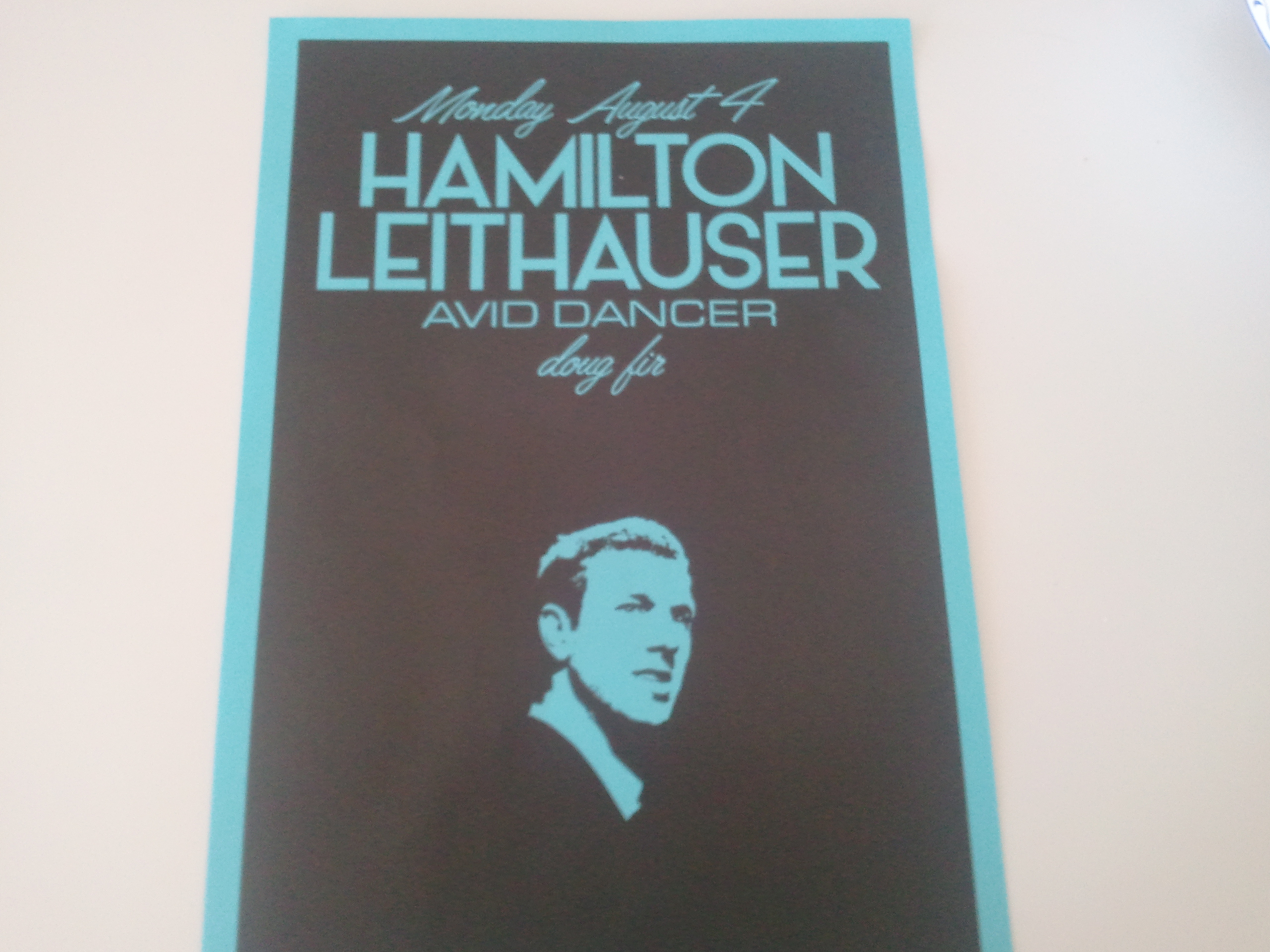
Hamilton Leithauser, Live at the Doug Fir

Before heading out on Monday night to the Doug Fir, I thought of a night about ten years ago when I saw The Walkmen perform at the same venue.  To this day, it remains one of my favorite concert memories, as the band tore through a blistering set with such power that it felt like the lounge was ten times bigger than its actual size.  Hamilton would also recall that night fondly, mentioning a couple of times during the set that he remembered having a great time ten years ago.  It turns out we were both a little off in remembering the date (ten years ago I would not have been allowed into the venue–the show actually took place in the fall of 2007), but the performance Monday night was just as brilliant.

"In my younger and more vulnerable years..."

“In my younger and more vulnerable years…”

Hamilton proved once again that the Doug Fir is the best place to catch a show in all of Portland–it’s an intimate space where you can get up close and personal with the artist (there’s not a bad sightline anywhere), and the sound is always fantastic.  There’s never an issue with the mix, and each musical part can be heard with complete clarity–a quality you wouldn’t expect from such a small venue.  Though Hamilton employed a wide range of musicians and instruments on Black Hours, he kept it simple with his live setup–a quartet which featured fellow Walkmen bandmate Paul Maroon on guitar and xylophone, with a bassist and a spare drumset (reminiscent of the type of kit that Matt Barrick favored) filling out the support.  Even with the modest setup, Hamilton and crew captured the sounds of the album and thrilled the crowd.

Hamilton enthralled the crowd from the beginning, kicking things off with the passionate “I Don’t Need Anyone”.  He didn’t hold anything back, as he grabbed the microphone and leaned into the crowd to hit all the high notes with the loudest volume possible, testing the limits of the sound system.  Leithauser seemed to be rejuvenated as a solo artist, eager to fight his way back up through the ranks and prove his talents once again; he had more energy than I had seen in years.

Hamilton had control of the crowd before he hit the first chorus.

Hamilton had control of the crowd before he hit the first chorus.

Black Hours was already one of our favorite albums of the year, and it sounds just as great live, with Hamilton and the band bringing a thunderous energy to the music.  The performance had the added bonus of allowing the audience to see how the different songs and their particular arrangements would capture distinct aspects of Hamilton’s personality.  When Hamilton was just on vocals, it was a more lovelorn, bitter mood and it seemed as if he was baring his soul; when he picked up his acoustic guitar, like with the lead single “Alexandria”, the songs were more uplifting and he added a bit of swagger (with some stage moves that recalled a bit of Elvis, especially with some of the subtle hip thrusts); and finally, Hamilton with an electric guitar signified a more reflective spirit, with an air of contentment.  The variation provided an excellent ebb and flow to the show, which differed from the normal straight run-through of the album.  It also helped that Leithauser included a couple of the bonus tracks from the deluxe edition of the album–a passionate “I’ll Never Love Again” in particular convinced my friend that he needed to purchase the special edition vinyl as quickly as possible.

It was a fantastic performance, and we were talking about the shows for hours afterward.  We had a little bit of fun at the end, as I took a photo for a fan with him and Hamilton, and I hope that he enjoyed the goofy face that Hamilton provided.  It was a neat little detail that capped off one of the best shows of the year.