Author: symeo

Catching Up On The Week (Mar. 14 Edition)

Aeon has a great article exploring the psychological underpinnings of our appreciation of music, specifically discussing the key that repetition plays in our unconscious love.  The article analyzes how the mere act of repetition has a specific psychological effect on our brains, and it can essentially even create the illusion of “music”, even though if we were removed from the process we would not give that objective determination.  It then goes on to discuss the significance of “rituals” and how music mirrors this concept, and their impact on our brains.  I find these scientific explorations fascinating, and I highly recommend reading it–I’m sure I unintentionally bungled some observations and that my imprecise language may have obscured some of the true results.  That said, the article still needs to explain how it could be that Krautrock is not the dominant musical genre of our time.

Josh Homme of Queens of the Stone Age (and many, many other bands) recently did a video where he answered questions from fans, covering such topics as his band’s treatment at the Grammys and the recent dispute with other members of Kyuss over the use of the band’s name.  It’s always fun to hear Josh pontificate, so it’s well worth a listen.

Repetition

Repetition

If you follow our Tumblr, you know we’re at the very least intrigued by Neil Young’s new digital music service “Pono”.   We’re not entirely convinced about its necessity, and to that end we’re looking into posting a discussion with an engineer experienced in the field of acoustics to discuss the technological merits of the service.  But we’ll save the technical mumbo-jumbo for another day–here, you could read an article from The Quietus with some bullshit about the “iPod culture”.  Here’s a frightening quote:

“The spontaneous practice of iPod users then comes to very closely resemble the model developed by researchers working for the Muzak Corporation in the mid-twentieth century.”

A much more enjoyable discussion of music culture comes from the latest entry in the AV Club’s series on punk rock in the 90’s (“Fear of a Punk Decade”), which discusses the impact of different labels on the decade’s sounds.  It looks at the rise of several independent labels, including some that had the impact of major labels (Epitaph and Dischord for example), and the mutual relationship between bands and their labels.

Switching gears, The Oregonian takes a look at the significance of a good van for the touring indie act.  It’s difficult to realize the various struggles that bands have to go through especially with things we take for granted like our own vehicles.

And finally, Wye Oak has a discussion with SPIN about their new album Shriek.  In this interview, they discuss lyrical themes, the move away from guitars for this album, and their (slightly) relaxed touring schedule.  Wye Oak is a band that that is pretty powerful live, though their albums haven’t translated in the same way; we’ll see if that’s the case for Shriek.

Review: Nothing – Guilty of Everything

Metal is a genre that strangely enough, considering its dynamics and intensity, can lend itself to stagnancy and inertia.  The problem is that sometimes no matter how theatrical and ferocious (or if you’re so inclined, fast and furious), it ends up just an echo of the same tricks that you’ve heard numerous times before.  It’s the kind of feeling you might be familiar with after watching generic summer blockbusters year after year.  The mere act of showing an explosion on a screen is not enough to sustain even passing interest for some people (for fuck’s sake, Michael Bay–how could you make giant robots fighting each other so boring?!).

So when a band uses Metal not as an endpoint, but as a pivot into a new direction, I’ll take notice.  Guilty of Everything, the debut album of Nothing, does exactly that.  Nothing combines the power and heaviness of metal with the vocals and lush textures of shoegaze.  Yes, you read that correctly.  True, other bands have been able to mix loud and soft dynamics, intertwining gorgeous vocals with thundering guitars and crashing drums before Nothing, but not necessarily to this extent.  The Deftones have made a career of this, and thankfully have seemed to have influenced a new generation of bands.

Deafheaven received a lot of deserved acclaim last year by mixing black metal with elements of shoegaze and post-rock, and Nothing follows a similar approach, though perhaps working in reverse.  The vocals are incomprehensible on both albums, but while Deafheaven goes in the loud direction with shrieks and howls, Nothing relies on the traditional shoegaze style of  breathy vocals buried within the haze of guitars.  The tempos and drumbeats on Guilty of Everything also are more in line with traditional shoegaze and rock, though I advise against making any assumptions based purely on that description.  In one of the best moments on the album, Nothing recalls the epic breakdown from the Sigur Rós song “Popplagið”, as the drums go nuts underneath a gorgeous wall of guitars in the last two minutes of “B&E”.

The mixture between metal and shoegaze doesn’t always work, but when it does, like in “Somersault” and the title track, Nothing produces some of the most gorgeous music you’ll hear this year.  The heaviness of the guitars combined with the whispery vocals that despite the inherent tension have an almost intoxicating effect, and it’s amazing that instead of working against each other that they blend so seamlessly.  And while you’re enjoying the music, it’s worth reading up on the unusual story of the band.

Review: Real Estate – Atlas

Real Estate is in many ways as close as to what you get to a “known quantity” as you can get in indie rock.  They have a signature sound that is apparent from any track picked at random from their catalog–a laid-back, shimmery guitar rock, but don’t emphasize the “rock” so much, you don’t want to harsh everyone’s mellow.  This is not meant to be a dig on the band at all.  We should be thankful that they’ve managed to be so distinctive and original that a listener can tell instantly whether or not they like the band.  Instead, we should wonder how a band from Ridgewood, NJ is able to recreate the feeling of a lazy Southern California summer day so well.

One can then easily appreciate their sound overall, and their albums as a whole, but it normally takes an effort to distinguish between the individual songs themselves.  For example, when I first listened to their previous album Days, I enjoyed the overall vibe of the record: a perfect soundtrack for relaxing and either reflecting on the pleasant weather outside or maybe just creating an image in my head of what I wish the weather actually was.  But it took several listens before I could pick out the intricacies of the individual songs, even the singles.  The details eventually revealed themselves over several listens, such as the amiable bassline melody of “Younger Than Yesterday” or the slow deconstruction of “All The Same”.  The album was no longer just a congenial haze, but a collection of distinctly gorgeous songs.

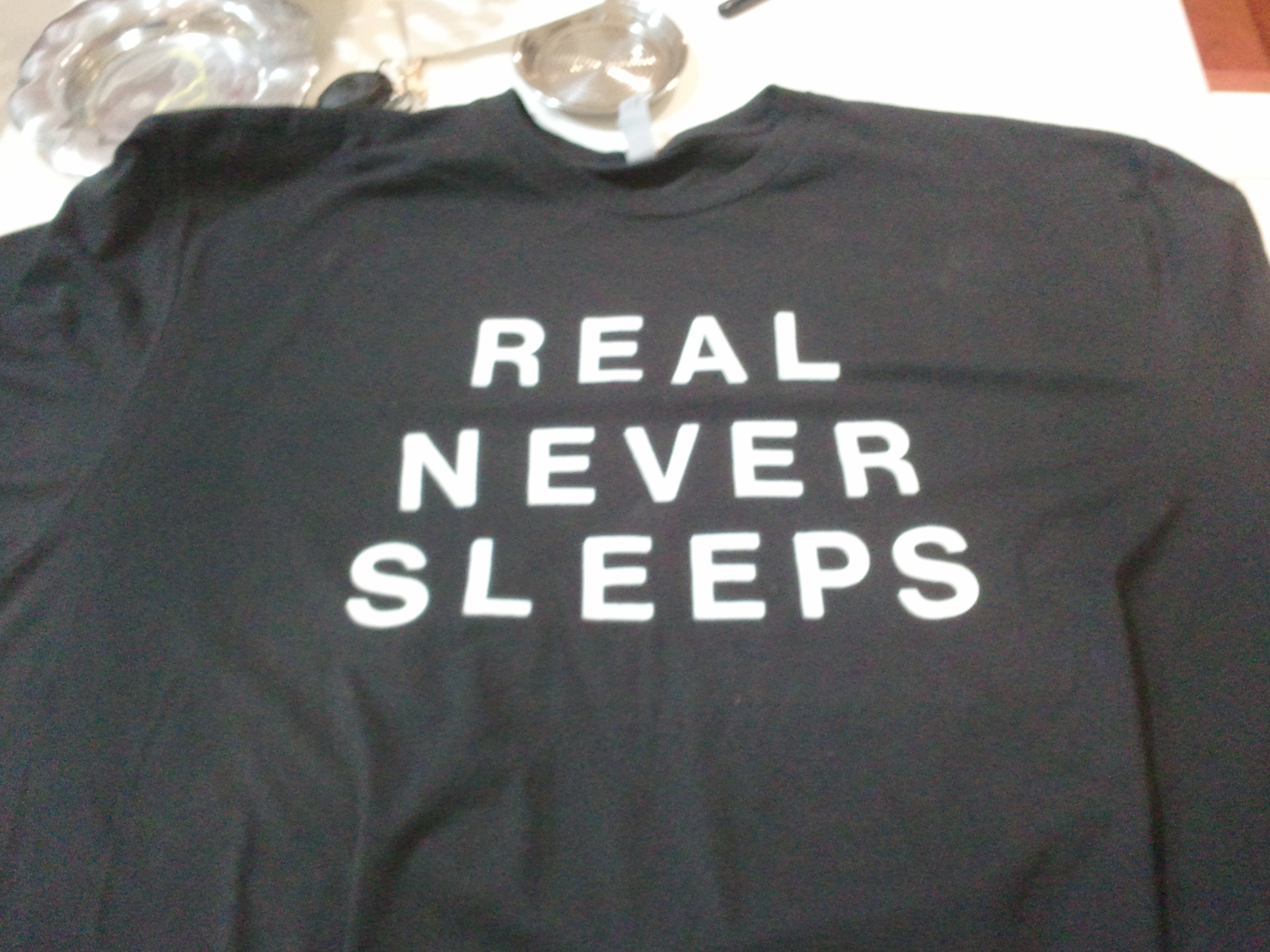
A well-made shirt.

A well-made shirt.

The new album Atlas follows a similar pattern.  It definitely has the same trademark Real Estate sound, which is by design (the band has stated that they’re not interested in radically transforming their style from record-to-record).  One therefore shouldn’t expect any real evolution within the confines of their style.  But there are refinements and new details that make the album worth exploring.  Hell, the band even came up with a really catchy single with “Talking Backwards”, which manages the neat trick of being a perfect encapsulation of the band that’s also presented in a hooky, toe-tapping manner that should capture the ear of any new listener.  Even though the lyrical subject of the need for communication is one that’s been covered many times before, the band still manages to be engaging; sometimes exchanging comfort for originality is a fair trade-off.  Real Estate does an equally good job with ballads as well, though the difference between the ballads and the “rockers” on a Real Estate album are about 10 beats per minute.  Real Estate knows their strengths, and plays to them well.

Feel the good vibrations.

Feel the good vibrations.

However, one gets the feeling that there were some missed opportunities on the album.  One of the highlights of the album is the song “The Bend”, a mid-tempo number that pleasantly chugs along, right up until the moment the tempo suddenly shifts at about four minutes in and the chugging nearly grinds to a halt.  It’s a dramatic moment, as the band stops on a dime, and it immediately grabs the listener’s attention and takes him or her out of their previous groove.  The deliberate beat also gives the lead guitar lines an additional emotional heft, as they wring out as much passion with each note as possible.  It’s a great moment, and since it occurs in the middle of the album, one expects perhaps that the record will shift directions.  The band instead goes right back into their wheelhouse and dives back into their standard jangly guitar rock, which is fine and what I expected when I bought the album, but it still leaves me wondering where else the band could have gone instead.

*There is one complaint that I have from the various reviews I’ve seen: comparing Real Estate to Television is pretty damn lazy.  Both bands have two guitarists and…that’s about where the similarities end.  If anyone wonders why Television is considered punk rock, a quick comparison to Real Estate should give him or her a clue.

A SXSW (P)Review

The big news this week is of course the SXSW Festival, and you’re probably tired of hearing the same stories about the festival over and over.*  They usually follow one of two tropes, and it doesn’t matter which, because they’re both terrible: either the “all of your favorite bands are having a blast here in the LIVE MUSIC CAPITAL OF THE WORLD” or “it sucks now that SXSW has totally sold out, man” (annoying coming from either an Austinite or a music industry lackey, for different but totally valid reasons).  Here’s what you should know: 1) None of your favorite bands, if they are in Austin, TX this week, are having a blast because it’s now a requirement that anyone with new music coming out has to stop by and play crowded bars that haven’t seen an inspection since 1998, and 2) Nobody cares that the festival was awesome before anyone heard about it.

*I’m making a couple of assumptions here: that you like music (why else would you be here, unless you were really into cartography, I guess) and that you have at least enough of a passing interest in music/news that you are aware that there is a festival called “South by Southwest” (SXSW for short) and have seen at least one mention of this gigantic festival.  I would think that these assumptions didn’t need to be stated for the record, but it’s better to be safe than sorry.

Don't believe everything that you read.

Don’t believe everything that you read.

That said, there are tons of pieces out there attempting to provide a preview of this year’s particular incarnation of SXSW, and they’re all fighting for your eyes and clicks.  That means I have to come up with my own original approach, and I think I found the right hook: I’ll be reviewing my previous trip to SXSW in order to give you an idea of what to expect.  Because history repeats itself, and time is a flat circle.

I was lucky enough to attend the festival in 2011, when it lined up perfectly with my Spring Break from law school.  With my sister already in town for grad school, I had a floor for crashing and the toughest part of the trip figured out (a previous attempt to attend the festival back in 2007 when I was still working in radio fell apart because of that detail).  It sure seemed to be a better idea than sleeping in each day until noon and then waiting three hours in line for a Shake Shack burger–now I would sleep in each day until noon and then wait three hours to watch some of my favorite bands (because let’s be honest–I wasn’t going to work on my thesis in either scenario).  I looked forward to a week of sunshine, music, and cheap/crappy beer, instead of a week of cold, traffic, and expensive/crappy beer.

The thing that’s hard to realize about SXSW until you’re there is just how many bands are there, and they’re all playing venues that they would otherwise have no business playing in, whether it be a downward or upward shift in fortune.  Queens of the Stone Age playing in a converted auto-body garage?  Um, if you say so.  Some Brazilian surfer-punk zydeco hybrid band playing a packed two-story bar?  Yeah, you’ll never hear of them again (I think their name started with a ‘Z’), but for a brief moment they were a Next Big Thing at this festival.  You truly can’t comprehend the sheer number of bands.  My one souvenir from the festival was a t-shirt that listed “all” of the bands that played.  I took it out during the course of writing this as a reference to help jog my memory of what bands I saw, but it’s practically worthless in that regard because the half-point font makes reading impossible.  And and all these bands are playing in any possible space that they can find.

They even had a singing saw, but they couldn't play a Neutral Milk Hotel cover?

They even had a singing saw, but they couldn’t play a Neutral Milk Hotel cover?

So to people who are fans of “music” as a concept, this all sounds wonderful; to sane people, not so much.  You walk down Sixth Street, beer in hand, (or as I call it, Bourbon Street Lite) and  hear through the air the strains of 30 different bands playing packed, ramshackle bars.  Oh what glory it is to be alive, as the streets are filled with the sound of music!  Of course, if you’re able to actually pick out through the cacophony that sounds great or at the very least interesting, good luck in trying to actually make it into the venue.  This is something that a normal, sane person would enjoy, but SXSW makes this task very difficult indeed.

SXSW is of course famous for the long lines at its venues.  Of course, as a ridiculously popular festival, it’s to be expected.  However, I thought I had purchased a proverbial golden ticket: the wristband.  A couple of hundred bucks up front, and I had bestowed upon my hand the promise of “access” to nearly all shows without paying additional cover charges and the ability to skip lines.  As anyone who’s been to Disneyland knows, this is truly the only way to travel.  And it’s true, you CAN skip ahead of the lines…well at least part of the lines.  What I didn’t know is that SXSW had created an additional supertier with “badges”.  Those were the people that actually had access and so on–you know, what you thought you were getting with the wristband.  In the end, you realize that your purchase of a wristband was the equivalent of pulling into the gas station and selecting the “Plus” nozzle–additional dollars down the drain, with no real noticeable difference in product.

That means your dreams of seeing someone like Bad Brains were pretty much gone.  You thought you could make it into the shack where Death From Above 1979 had a surprise reunion?  Only one possible reaction.  If you’re aiming to see Queens of the Stone Age put on a show at midnight, well you better get to the venue at 7 and watch random crap for five hours, because there’s no way you’re going to be let back in.  It’s tough shit for the badgeless.

Kim Crowdsurfs

Kim Crowdsurfs

That means your dreams of bouncing from show to show are pretty much shot to shit, no matter how willing you are to zig-zag around town.  You are now forced to plan your time judiciously.  And you were hoping that there was not going to be any homework on this trip–I mean, if i was going to think at all this week, shouldn’t it have been in the course of completing my thesis?  These are not the kinds of reflections that I should be having on Spring Break.  Instead, I’m having to do calculations of “is this band popular enough that I can go see them with minimal hassle, but if there is a line, do I really want to see them?”  At this point, I’m about five seconds away from dumping all relevant information into Excel spreadsheets.
Travel 2000 miles to remind yourself of home

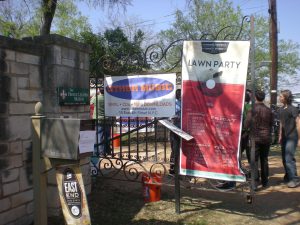
Travel 2000 miles to remind yourself of home

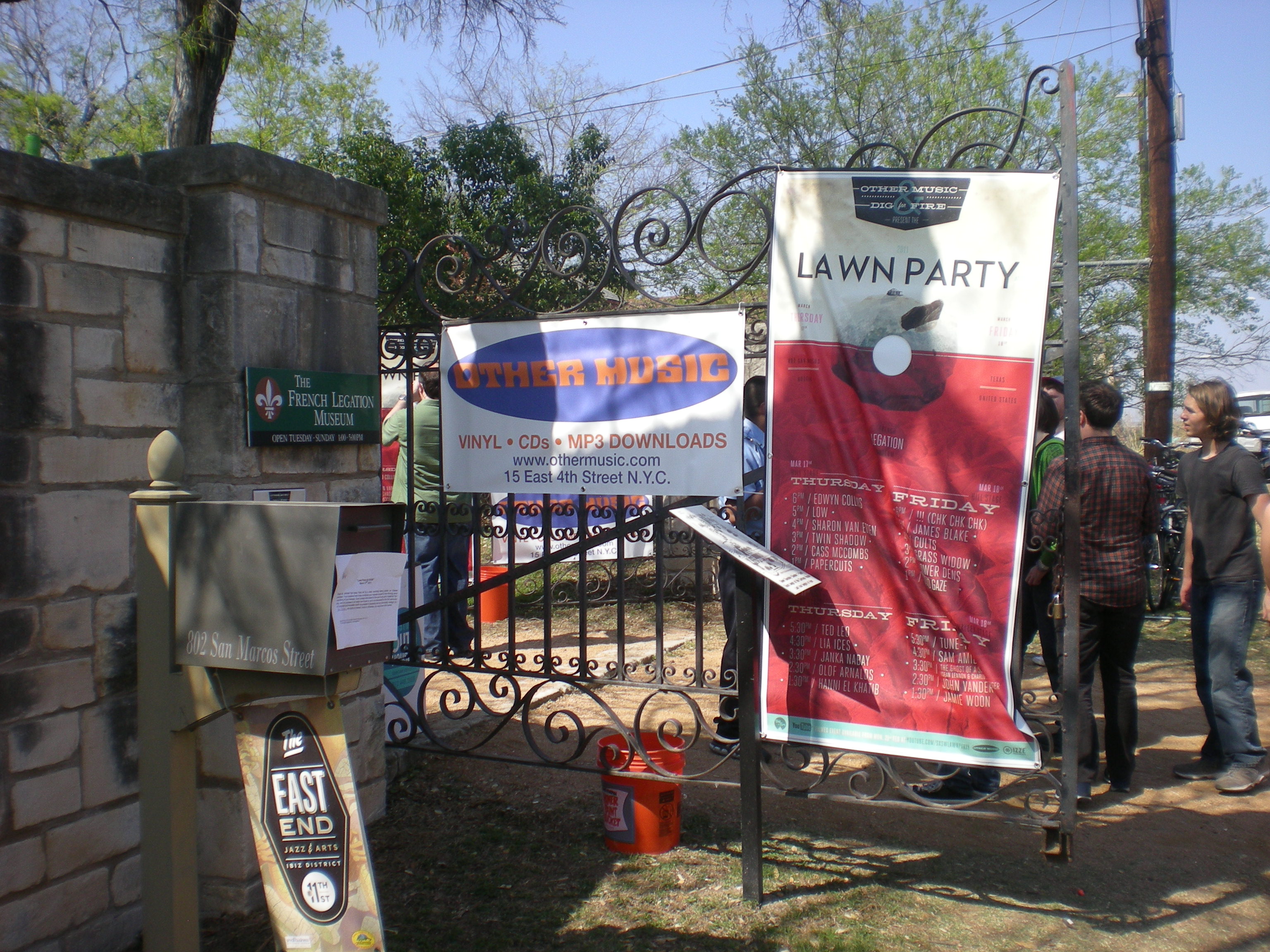
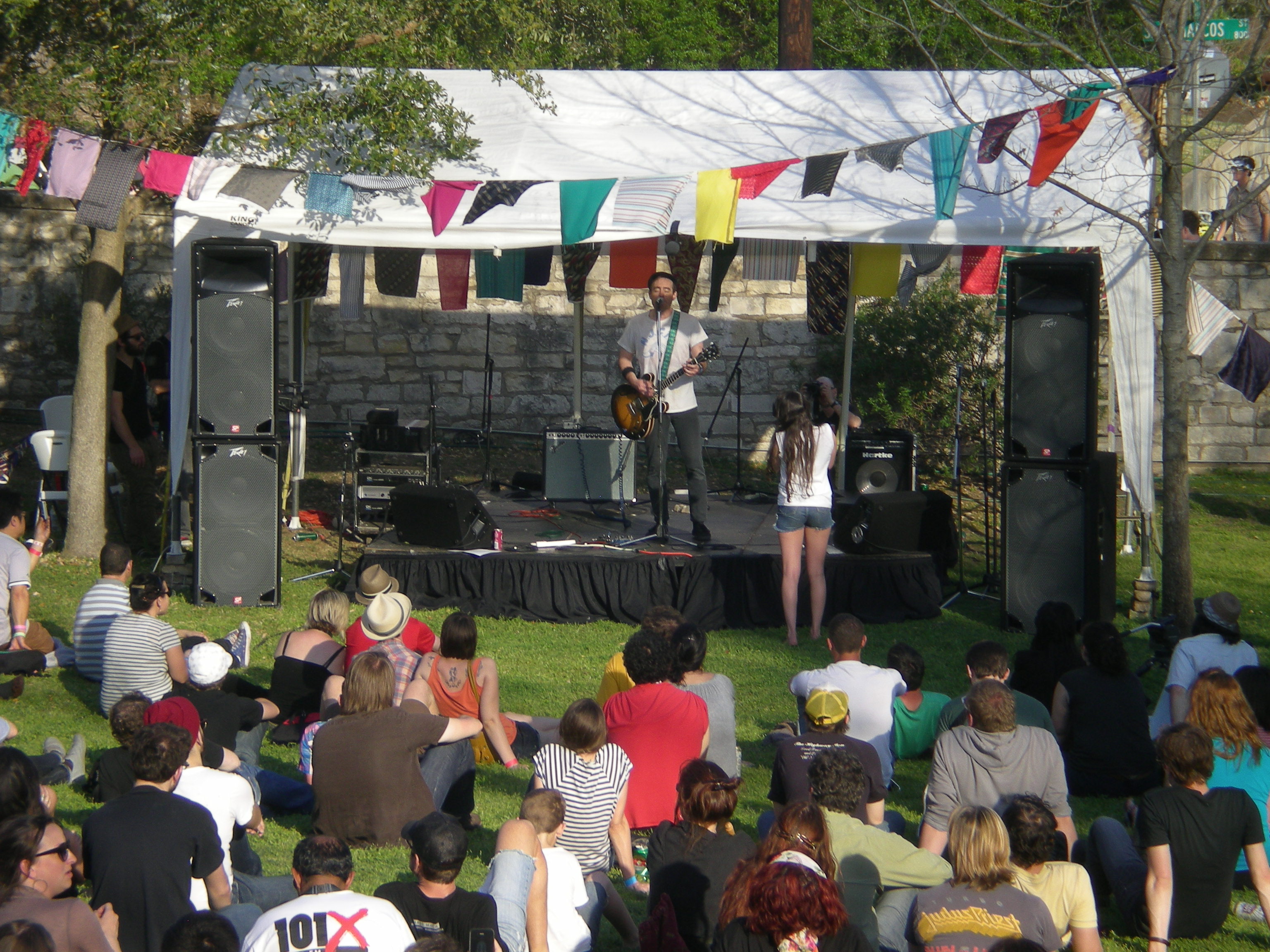
For those looking for the best way to see multiple bands, the lawn parties are really the best way to go.  It amazed me that I traveled a couple thousand miles to see a lawn party hosted by the record store that was across the street from me in New York, but Other Music had a great lineup, and offered a bonus attraction for avoiding the terrible Texas heat: shade.  It’s not the most intimate setting, but I was able to see Low, Ted Leo, and !!! all at the same place, and in relative comfort.  And if I wasn’t so restless, I could’ve seen future favorites of mine Sharon Van Etten and Cults as well.

Lawn party is the way to go, for multiple reasons

Lawn party is the way to go, for multiple reasons

The calculus homework that I did before truly came in handy during the night, when it was more of a crapshoot to determine which shows I could get in.  And here’s my advice: you know those buzz bands that you think you’re so cool for hearing about in the days before the festival?  You’re not special.  There are thousands of other people at this festival that read Pitchfork, SPIN, AV Club, FILTER, and whatever other random music press there is out there.  Hell, a lot of them read specific SXSW previews, so there’s no way that you have a chance of getting into the Toro Y Moi show that’s being held in a 50 person dive.  Unless of course you have a badge, as I mentioned above, but if you’re reading this I’m guessing you don’t.  So that means having to aim slightly lower than the hippest, buzziest bands.  And sometimes, this works very well.  I was able to catch The Antlers perform an NPR showcase that proved that Burst Apart would be a fantastic follow-up to Hospice.  I was able to watch Tapes ‘n Tapes, years after their initial breakthrough, put on a great show and convince me to give them another shot and purchase their third album (and afterwards ate some absolutely kickass Korean BBQ tacos).  And I was able to witness Cloud Nothings blow the roof off a bar as they blistered through material, and showed signs of their potential before Attack On Memory was released.  Plus, I got to hear Dylan Baldi in the last instance ask the crowd if anyone had a place where they could crash, because they just drove down from Ohio with no real plan.  I hope someone picked up the slack.
Cloud Nothings tear roof off of roofless bar

Cloud Nothings tear roof off of roofless bar

I keep emphasizing the crowds, and there’s a good reason.  I’m not claustrophobic by any means, but Andy Richter has the right idea.  Every place is absolutely jammed with people, fire codes be damned (and honestly, if they were strictly enforced, you’d just be pissed that you couldn’t get in to watch the show).  And not only that, these are some of the dipshittiest people that you’ve ever seen.  I cracked that Sixth Street was “Bourbon Street Lite” above, and that’s really the attitude that the seeming majority of festival-goers take–they’re not in Austin for a great music festival, there in town as a substitute for Cancun or New Orleans, hoping to have A FUCKING BLAST, YO!  As a result, I overheard some of the absolute most inane shit possible while spending hours in lines over the course of the week, and I have to be thankful that I can’t remember anything specific.

Which leads me to my next piece of advice: bring a friend.  Of course, it’s always fun to share the experience with someone else, but I’ve managed to go solo to several shows without any problem.  But when you’re stuck in lines for hours on end, it’s best to have someone else with which to engage, or else you will have to endure only in your head what seems like a lifetime of bullshit.  It’s not pleasant.
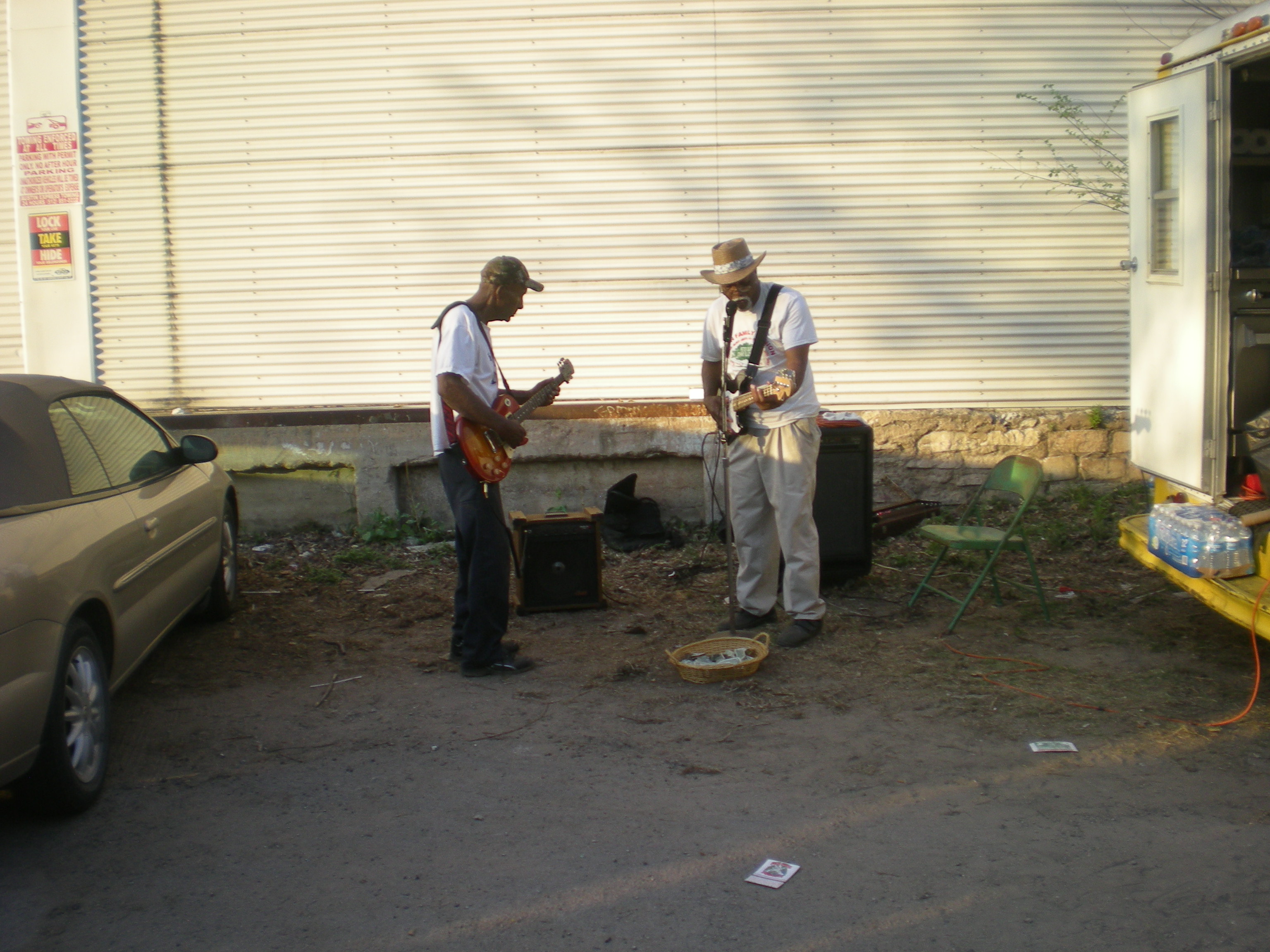
This is even more awesome, knowing this is outside of Odd Future

This is even more awesome, knowing this is outside of Odd Future

In the end, is it all worth it?  I did get a chance to do things like stand five feet away and see …And You Will Know Us By The Trail Of Dead play a hometown show at one in the morning, see random old guys jamming on guitar outside an Odd Future show, and see The Strokes for the first time as fireworks exploded over the Austin skyline during “Last Nite”.  I also saw a ton of forgettable bands and people consistently make such asses of themselves that it would seem to be a productive use of my team to merely weep for the future of humanity.  But in the end, it was probably a fair trade-off–all I missed was a Shake Shack burger (which I’m now told exists in Austin) and a Godspeed You! Black Emperor concert that I had purchased tickets for months earlier.  And I didn’t work on my thesis, but we all know I wasn’t going to work on it anyway.

Anyway, for those who don’t care about history and are here for some advice, here we go, in list form:

1. Bring a friend.  This makes the boredom and idiots tolerable.

2. Buy a badge.  Being rich and important is a good idea for most things in life, SXSW included.

3. Have a plan.  You’re not going to see everything you want.  You’re barely going to see half of what you want.  Deal with it.

4. Find the Korean BBQ Taco truck.  That was delicious.

5. Texas beer sucks.  I didn’t mention this earlier, but just know ahead of time.  Know that the best thing you’ll buy is some off-brand cerveza at the taverna next to the gas station.

https://twitter.com/Vice_Is_Hip/status/442940702872584192

Over the Weekend (Mar. 10 Edition)

Some fun links for your Monday afternoon, as you realize that the name of this site could double for a True Detective fansite.

Let’s begin with a guitar workshop from Alan Sparhawk of Low.  The video begins with the mechanics of an electric guitar and how the sounds are created, which is pretty handy for novices.  Of greater interest to experienced players is the second half of the video, where Alan shows the different effects pedals that he uses, including one with his own added innovation.

We’ve got links to a few new tracks that are worth your time.  First, I recommend listening to this collaboration between Frank Ocean, Diplo, Mick Jones, and Paul Simonon.  The laid-back, island vibe is great for easing into the week, but don’t get too comfortable, because things get a bit more lively.  Frank Ocean will probably need all the good vibes he can get, as he deals with legal issues stemming from a dispute with Chipotle.  And continuing with the theme of seemingly bizarre collaborations, there’s Kendrick Lamar rapping over Tame Impala’s “Feels Like We Only Go Backwards”.  I think it would have worked better with a smoother flow, like the style of “Money Trees” (which is proof that Kendrick can rap with great results over an indie rock track), but if you approach it as a Kendrick Lamar song instead of a remix of Tame Impala, the snarl works better.  And there’s Taylor Hawkins, drummer of the Foo Fighters, who got bit with the side-group bug like Dave Grohl, and his new outfit “Birds of Satan”.  Not only does the name recall Eagles of Death Metal, but the music does as well.  That to me is a good thing.

While we mentioned the 20th anniversary of Superunknown on Friday, it was rather fitting that we didn’t link to an appreciation of The Downward Spiral from Stereogum, which celebrated its anniversary on the same date (I say “fitting” because Soundgarden beat out Nine Inch Nails at the top of the Billboard chart (and to add to the discussion of “fitting”–there is talk of a possible joint Soundgarden/Nine Inch Nails tour)).  There’s some great insight into how important the album was at the time and its place in rock history, especially considering it was the first exposure to “dangerous music” for many kids (I still remember getting nightmares from my first viewing of “Closer”, coupled with the thrill of watching something I knew I was not allowed to see).  However, this piece gets a few demerits for not mentioning the brilliance of “A Warm Place”, especially in between “Big Man With A Gun” and “Eraser” in examining the album’s exploration of the light/dark dichotomy.

Also worth checking out is an interview from The Quietus with Mike Watt where he discusses his favorite albums.  Consider this the best homework assignment ever if you haven’t listened to these albums or are at least familiar with these artists–I can think of few better teachers than the bassist for The Minutemen.  And if you’re unfamiliar with The Minutemen (though I know you know at least one of their songs), track down a copy of Double Nickels on the Dime as quickly as you can.  I’ll expect an essay in my inbox next Monday.

In new album news, The Dandy Warhols are releasing a live album from their recent tour for the 13th anniversary of Thirteen Tales from Urban Bohemia.  I happened to be at one of the hometown shows, though I’m unsure if it was the one that was recorded (or whether the album will be a mix from both shows). That’s an album that should be considered a classic (perhaps the subject of a future TL;DR?), and any time you know that you are guaranteed to hear “Big Indian”, you should take that opportunity.

And while I was typing up this roundup, I saw a message from Spoon on Facebook.  This is great news indeed.

Finally, if you didn’t catch The National on SNL this week, please do so now.

The Curious Case of the Happy Birthday Copyright

Last week, Stephen Colbert did a hilarious segment about the copyright of the song “Happy Birthday”, noting the litigiousness of Warner Music and the way they hound any potential violators.  Stephen’s substitute, an arrangement of “The Star-Spangled Banner” with alternate lyrics, is a particularly genius suggestion, and the bit becomes part of a long comedic tradition of attempts to avoid the wrath of Warner.  By using a song in the public domain like the National Anthem, Stephen is safe, even in his public performance–though imagine if one had to clear each use of the National Anthem or pay a license for every time it was played; that would probably bankrupt most kickball leagues.

Somebody messed with the copyright.

Somebody messed with the copyright.

(Side Note: The technical difficulties graphic that Stephen uses cracks me up every time, though it should be stated that The Critic was the master of that particular gag.  Also, the birthday hat for the silent lawyer was a great touch.  Comedy’s forged in the subtleties, folks.)

So it’s not exactly news to most people that somebody owns the copyright to a song that is familiar to just about everyone, and gets sung thousands of times everyday.  Not only that, it’s also well-known that the public performance of that song has several issues (as I mentioned, there have been numerous comedic bits built on that fact).  But did you know that in the past year that the copyright was challenged?  It shouldn’t be a surprise that a fairly simple song from the early 20th century would have some disputed origins; however it is surprising that somehow despite those dubious origins, the copyright holder has been able to maintain an iron grip on the use and performance of the song.  Right now, the lawsuit is still working its way through the courts, due to the various technical complexities that are bound to arise when law meets art: various state claims are being separated from the federal claims, and arguments over whether the federal statutes preempt any state claims are being heard.  As for the disputed facts of the case, the hook for you and me is that plaintiffs are offering up some interesting evidence that the song was in circulation prior to the registration of the copyright in 1935, using both the original music of “Good Morning To You” (from 1893) with the lyrics we all know, all the way back in 1911.  This would pretty much destroy any claim of originality, a necessary requirement for copyright protection.

The thing to remember is that, “Happy Birthday” notwithstanding, the concept of “copyright” is good.  We want to protect the works of artists, and allow them the ability to be fairly compensated for their work and protect against unauthorized distribution.  Now, whether or not that means that the protection should extend 90 years (or whatever arbitrary number Congress decides when Disney lobbies again to protect the image of Mickey Mouse), or protect works that even giving the benefit of the doubt as “original”, that’s a different story.  Maybe Colbert can do a bit on that.

Catching Up On The Week (Mar. 7 Edition)

This week saw the release of a few albums that we’ll review in the coming weeks, including the latest from the band Real Estate.  They got a lot of buzz and critical acclaim from their previous album, Days, so it’s no surprise that they’re getting the feature treatment from a lot of the rock press.  Rolling Stone has a quick interview with the band, and Pitchfork has a much more in-depth profile as well.

Real Estate as people, not property

Real Estate as people, not property

Another group that is looking to capitalize on a breakthrough 2011 album is The War on Drugs.  Their followup to Slave Ambient will be released on March 18, but there are already features that have been published about the group.  Grantland has a good piece about the band and where they stand today, and Stereogum has an extended profile that I’ll be reading up on this weekend, probably with “Baby Missiles” on repeat.

If nostalgia is more your thing this weekend, Stereogum has you covered there as well, with an appreciative look at the 20th anniversary of Superunknown.  We’ve linked to the info on the upcoming reissue of the album, so you may have already noticed that we’re fans of the album (and of Soundgarden in general).  We may use this piece as a jumping-off point for a broader look at Soundgarden, but it does a good job of focusing on a few interesting details that some may not be familiar with, so it’s definitely worth reading at some point.

NPR has an article reporting that about five percent of the population lack the ability to feel pleasure from music.  Clearly, this is an affliction that is unfamiliar to the people both behind this site and our readers, but it’s fascinating to hear about the scientific reasons behind this condition.

And finally, here’s a cool piece talking about how Alec Ounsworth of Clap Your Hands Say Yeah went on a “living room tour” over the past few months, and I’m not sure if quotation marks are necessary, because living rooms were the exact venues where he performed.  He talks a little about the fun and logistics of the experience, and I’m excited to learn from the article that CYHSY will be releasing a new album in May.

Review: Solids – Blame Confusion

I’ve had a fascination with two-person bands for some time now, and I count many of them among my favorites.  It’s great to see bands like The White Stripes, Death From Above 1979, and The Black Keys attain success over the years and inspire others to start making music even if they can’t find a bass player (or in the case of DFA 1979, stick with the bass and abandon the guitar).  I’ve considered some theories as to why these two-person groups work so well.  One possibility is that it may be that it’s easier to reach consensus as to which musical direction to take with two people (though the lack of a third mediating party may be the reason why after the initial spark of incredible inventiveness these partnerships tend to fizzle out, Local H being a notable exception (though there was a lineup change at one point)).  Another might be that, as I’ve heard Jack White explain, that imposing certain limits allows creativity to flourish.  One can be paralyzed by infinite possibilities, so by setting boundaries you at least are able to realize your limits.  And once you know your limits, you can focus attention on challenging them.  It’s in those attempts to challenge that great music can result, as seen with bands like Japandroids and No Age.

I mention those two bands in particular, because they seem to be the most significant inspirations behind the debut album Blame Confusion from another two-man group, Solids.  Solids follow in the footsteps of their Canadian brethren Japandroids by focusing on energetic, driving rock songs with a guitar that seamlessly blends rhythm chords and inventive leads.  The haziness of the vocals and general attitude bring to mind No Age, though Solids don’t take any of their trademark left turn forays into ambient noise.  The result is a lot of distortion, a lot of riffs, and a lot of fun.

Solids definitely did a great job in choosing their influences, but the question remains if they add anything to the equation themselves.  I’ll give a group a listen if they remind me of some of my other favorite bands, but in order for me to keep listening to their album, they need to offer something up themselves, or else I’m going back to the tried-and-true.  Fortunately, Solids seems to have pulled off this task.  I find myself singing along to the great lead melodies, usually making up my own words because a lot of the vocals are pretty indecipherable.  I’ve read more than a few comparisons to Dinosaur Jr, which makes a certain amount of sense especially considering the guitar tones on the record, but you won’t find any of J. Mascis’s trademark solos on Blame Confusion.  That’s not to diminish the guitar playing on the record at all–there are ton of great riffs to be found.  The drums also do a great job of driving the beat when needed (like in “Traces”) or providing a rhythmic counterpoint to the caterwauling guitar.  And sometimes it helps when Solids throws in the traits of another band to the mix, like …And You Will Know Us By The Trail of Dead in “Cold Hands”.

Blame Confusion is a very good debut, and it’s easy to see that it would be a lot of fun to see Solids live.  I’ll definitely be looking forward to seeing what these guys do next, and hopefully we’ll see an artistic leap forward like the Japandroids did with Celebration Rock.

*Note: In a perfect bit of symmetry, famous two-man band Suicide came up on my iTunes as I was writing this review.  So this review comes courtesy of their 1977 performance live at CBGB’s.

Review: Beck – Morning Phase

We spent a long time analyzing Beck’s career recently here at RIJR, all in preparation for the release of his latest album.  And to put it simply, Morning Phase was worth all the fuss and effort.  It’s an absolutely gorgeous album that finds Beck creating some of the most beautiful music of his career.

In the weeks before its release (and in the initial reviews), a lot of comparisons were made to Beck’s previous album Sea Change, with some going as far as to call Morning Phase a sequel.  Initially, this seems to be a pretty fair comparison, at least from a superficial perspective.  Beck practically dares the comparison, with the opening acoustic strums of “Morning” being a near-copy of Sea Change‘s “The Golden Age” (this mirroring was a trick that Beck has pulled before with Guero and Odelay).  Even the opening lead melody from the keyboards seem to be a variation of the glockenspiel line from the earlier song.  But the differences between the two quickly become apparent, and are indicative of the albums as a whole.

In “The Golden Age”, after Beck’s initial lines of “Put your hands on the wheel/Let the Golden Age begin”, the mood quickly dampens, as the lyrics take a darker turn by depicting someone closer to the end of the rope rather than willing to take on a new challenge, giving those opening lines a dark irony.  The melancholic tone is summed up with the chorus of “These days I barely get by/I don’t even try”, an attitude that is reinforced by Beck’s weary vocal performance.  By contrast, Beck paints a more serene image in “Morning” with lines like “oceans of diamonds always shine, smooth out below”. leading into a triumphant chorus where he repeats the line “This morning”.  Here, the narrator actually sounds ready to push ahead even when confronting the past, asking “Won’t you show me the way it used to be?” and “Won’t you show me the way it could’ve been?”

Morning Phase then plays out not as a sequel to Sea Change, but more like opposite sides of the same coin; using a similar sonic palette of acoustic guitars, strings, and warm keyboards, Beck is not looking at the devastating end of a relationship but the potential fulfillment of marriage and fatherhood.  Does that mean that Morning Phase sounds like a post-Sky Blue Sky Wilco record, another in a long line of “dad-rock” records (a term that I generally despise, if you want to know)?  Not exactly, though there are certain moments on the album that echo the apprehension to this new phase in life like you would find on an album from The National, at least thematically.  You’ll find this in “Wave”, which builds upon the slowly-changing strings from the opening instrumental “Cycle”.  The use of Jim James-level reverb adds to the haunting nature of the song and complements the lyrics.  Lines like “If I surrender and I don’t fight this wave/No I won’t go under, I’ll only get carried away” take on an added poignancy as a result.  And the combination makes for a powerful performance, as seen from the clip from “Saturday Night Live” above.

These darker moments make up only a small part of the album, residing mainly in an introspective middle section.  The rest of the album is buoyant by comparison, shuffling through warm folk and slower country-tinged songs that evoke the album title itself.  There are no fun dance numbers or energetic rockers, but the album does end on an ebullient note with “Waking Life”, which culminates with a gorgeous guitar solo that cuts through and puts an exclamation point on the album.  The album as a whole is filled with brilliant sonic touches that for once will make your investment in high-end headphones  seem like a good investment and not just a foolhardy fashion statement.  And to think, this may not be the only Beck album we get to hear this year.

The Thermals, Live at Level B

Living in Oregon, we get the opportunity to see a lot of great acts.  We’re just big enough to attract the biggest headliners, but we’re also just weird enough to get a lot of up-and-coming groups as well.  It’s just that usually they come through Portland (and to a much lesser extent, Eugene).  It makes sense–there are a ton of venues and young people around, so it makes booking an easier bet.  On the other hand, we in Salem have old people and…the Armory.  For those of you who are unfamiliar with Salem, “The Armory” is not some cute name–that was its function.  You can imagine the kind of shows that get booked there.  I’ll just say that metal shows are the only ones are able to…take advantage of the acoustics.

So when I heard that one of the best punk bands around today (and a personal favorite) was coming down to Salem, I was more than a little excited.  Granted, The Thermals are from Portland themselves, so it’s not exactly like they’re venturing far from home, but let’s at least give Salem some credit, because it was not a one-off show but part of a tour.  And they were playing a venue that was not the Armory, but a spot that I hadn’t heard of before called “Level B”.  I’ve seen The Thermals plenty of times before (strangely enough, I saw them multiple times in New York before I got the chance to catch a hometown show), but never in my hometown.

Note: if you are unfamiliar with The Thermals or disagree with my assessment of their merits, you are free to stop reading and take a listen to their album The Body, The Blood, The Machine right now.  Then you can come back and finish this review.

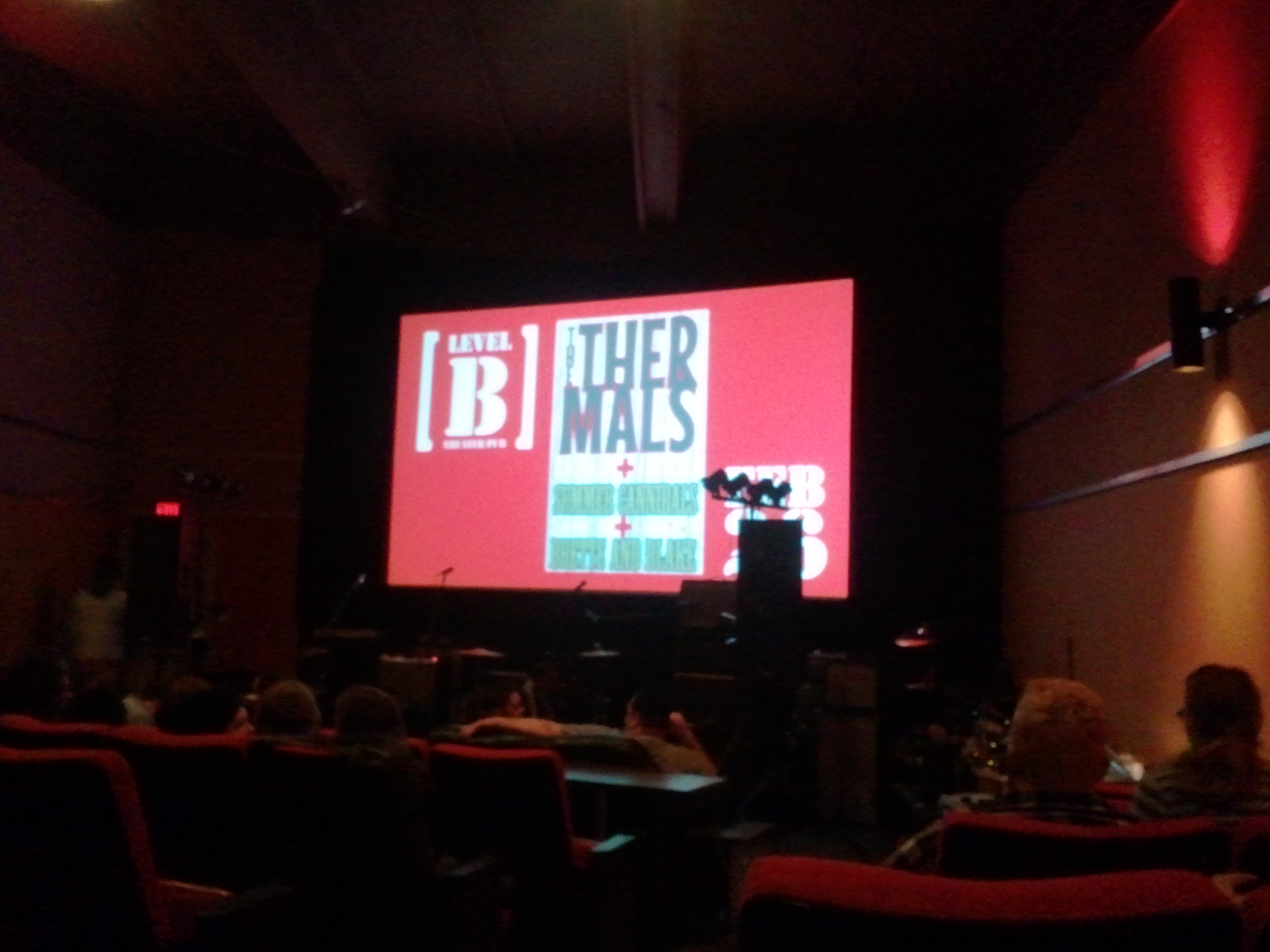
Level B preparing for the show

Level B preparing for the show

As it happens, Level B is the same spot where the old independent cinema in town was located, as can clearly be seen by the seats in the picture above.  (I want to assure readers unfamiliar with Salem that Salem Cinema is alive and well with a great new location with better facilities, so I still get the chance to watch plenty of great films).  I have high hopes for this venue in the future–it should be versatile enough to host different events, which means it’s more likely to stay afloat when it can’t get regular booking from non-local musical acts.  They also had an excellent sound system, and all three bands sounded great as a result.  And even the inconvenience of having those seats in place have a certain charm, giving the place a certain DIY-vibe of “we’ll play wherever they’ll allow us to play”.  Or that could just me spouting bullshit.  Either theory is valid.

I knew I was in for a good night (beyond the fact that I was seeing a live act that is consistently great) when two things happened: 1) I got a compliment on my Japandroids shirt (though it would have been nicer if it came from a lady, I’ll take what I can get), and 2) I heard somebody talking to the band before the show about how much he loved their album Fuckin A.  That’s an album that I love as well, and by some strange coincidence the band had not performed most of those songs live at the shows I’d been to previously.  It seemed like a good signal that we would get the chance to hear more of that album that night.

Aside: I never know how to act when I recognize band members in the audience.  It’s always an awkward dance of “should I say something and say, ‘YO I LOVE YOUR STUFF,’ or do I allow them to be normal people for a few minutes?”  I think I usually go for the worst option, where I’m pretty sure I end up staring at them far more than what is comfortable. 

When I heard the opening drumbeat of “Our Trip” early in the set, my hopes for some Fuckin A songs officially materialized.  The band then blistered through a high-energy set filled with tracks from their latest Desperate GroundFuckin A, and the now-classic The Body, The Blood, The Machine, sprinkling in favorites like “I Don’t Believe You” and “Now We Can See”.  The set seemed to mirror the attitude from Desperate Ground itself, which seemed to be constructed as a reaction to the more muted reception of Personal Life.  Personally, I am a big fan of Personal Life, which in many ways was an album that the band needed to make to shake up their formula and stretch their songwriting.  It’s an album filled with a lot of mid-tempo numbers that are great to listen to on the stereo, but can sometimes kill the flow of a set, so I have no problem if some of those songs don’t get played, no matter how great they are.

The super-fast and hard-charging songs of Desperate Ground make for a great live set, though it takes a lot of listens before you can appreciate the nuance of each song (which is just a fancy way of saying “it’s hard to remember which song is which, but you KNOW it comes from that album”).  It doesn’t help that those songs are missing some of the great guitar solos from Hutch that were a hallmark of their earlier work (not showy, but very melodic and building on the melodies within the song and brilliant with their subtlety), though Kathy’s bass often takes a lead role with some of the fills.  Knowing this, it made Hutch’s remark after diving into the crowd during “The Sunset” for the last half of the song that he “nailed the solo” all the more hilarious.

When all else fails, shoot in black and white.

When all else fails, shoot in black and white.

So yeah, it was a pretty fantastic show.  Any night where you get to hear excellent songs like “St. Rosa and the Swallows”, “A Stare Like Yours”, and “A Pillar of Salt” (a fan favorite that got legitimate airplay (at least in New Hampshire/Vermont) back when I worked in radio), it’s going to be a good night.  And the fact that I could plan my evening without budgeting a two-hour round-trip car ride made it even better.

Stray Facts and Observations

1. The drumbeat to “Our Trip” and “Here’s Your Future” are the exact same, meaning that those two albums start off the same.  Is it a coincidence that these might be their best two albums?  Probably.

2. The chord progression to “A Pillar of Salt” and “Returning to the Fold” are exactly the same, just at different tempo.  Since they are back-to-back on the album, you can bet this was intentional.  And it’s brilliant.

3. The Body, The Blood, The Machine is a concept album that doesn’t suck.  Give The Thermals kudos for pulling off the nearly-impossible.

4. There’s no reason why “I Don’t Believe You” shouldn’t have been playing on rock radio.  It’s a perfect pop-rock song.

5. There’s no reason why KNRK in Portland shouldn’t be playing The Thermals in their normal rotation.  They need to substitute one of the hundreds of times that they play The Lumineers or Muse with these local heroes instead for once.

6. The last time I was at the venue it was still Salem Cinema, and I went with my family to watch My Big Fat Greek Wedding.  Those who know me are free to laugh now.