New Shit

Review: Parquet Courts – Sunbathing Animal

As you may have noticed with our various features and mentions of the band, we here at Rust Is Just Right are big fans of the band Parquet Courts.  Their album Light Up Gold made our Best Of 2013 list*, and when we heard that a follow-up was coming this year we were extremely excited.  We loved their incisive blend of Pavement-meets-Minutemen smart-ass punk, and were hoping for another quick blast of their nervy, no-frills guitar rock.  However, it seems that these expectations have only set us up for disappointment, and while Sunbathing Animal has its moments, too often it seems like we have to work to get its full rewards.

Part of what made Light Up Gold work so well was the willingness of the band to get to the point and then get out of the way.  Parquet Courts would write a couple of quick hooks, say their piece, and then end the song–Light Up Gold was a lightning-quick 15 track/33 minute album, with several songs less than two minutes.  When the band would stretch out on certain tracks, like “Master of My Craft” or “Stoned and Starving”, there was enough momentum to sustain your attention, and enough interesting ideas that made it worth your while to stick with it (we wrote a feature specifically about the latter’s use of making the mundane seem epic, and how the band used the relatively epic track length in comparison to the rest of the album to its advantage in our Feats of Strength feature).  On Sunbathing Animal, many of the tracks seem to stretch out a minute or so too long, at least if you have the Light Up Gold template on your mind.

There’s still a lot to recommend on Sunbathing Animal, however.  Yes, the comparisons to Pavement’s slacker-ish attitude and careful tunelessness are still apt, and those trebly guitars with minimal distortion are still on full display.  Songs like “Vienna II” and “Always Back in Town” keep up the uptempo, ramshackle spirit of their earlier work, and songs like “Black and White” and “What Color is Blood” show that the band can find new areas to explore within a similar sound.  It’s in songs like the title track that you can see the new emphasis of Parquet Courts, focusing on ideas like repeating patterns and unbreakable cycles.  “Sunbathing Animal” is one song where the longer-than-expected song length eventually works to its advantage, with the anticipation of some sort of resolution continually delayed, increasing the tension that the listener feels as the band bashes away and vamps on a single chord with barked-out vocals.  By the end, you’re ready to sing along with the words of the title, and somehow it provides a satisfactory conclusion even though the music itself doesn’t seem to resolve as you would expect.

But even knowing in advance the emphasis on repeated patterns can make the album a slog in certain places; the album practically dies with “She’s Rolling” in the middle, and “Raw Milk” kills all the momentum from the goofily fun “Ducking & Dodging”.  Then again, one of the highlights is “Instant Disassembly”, which somehow manages to ride a simple melody played at a languid pace over the course of its seven minute long running time; it certainly helps that while it may be basic, the melody is still catchy.  I imagine that the band had in mind the irony of naming their longest song “Instant Disassembly”; it’s possibly also why they named the song that almost stops the album dead in its tracks “She’s Rolling”.  I can admire their intent, but as a casual listener it’s not always a successful approach.  While Sunbathing Animal has grown on me with repeated listens, it’s unlikely to take the place of Light Up Gold in my car’s stereo.

*We know that technically Light Up Gold was released in 2012, but it was such a limited run that most people didn’t hear it until its 2013 re-release.  And if you claim that you were one of those few people who did hear it in 2012, you’re probably a liar.
Review: Fucked Up – Glass Boys

My introduction to Fucked Up was through their album The Chemistry of Common Life, and that initial listen was the first time since Refused’s The Shape of Punk to Come that I was excited about the direction of punk rock.  It’s hard to forget that opening of “Son The Father”, with the faint strains of flute dissolving into a gradual cascade of guitars to form an immense wall of sound, only to be punctured by the howling screech of Damian Abraham.  It was then that all hell broke loose, and the assault didn’t let up for the rest of the album.  It was amazing to hear hardcore punk escape from the box that it had built around itself over the years–here we had all the aggression and fury of the classics, but with music that didn’t focus on the same drumbeat or the same tired melodies.  It was clear Fucked Up wasn’t content with repeating the same old formula, and that’s what made them so exciting.

They reached for the stars with their next album, David Comes To Life, an epic rock opera with a complex and detailed storyline.  It scored rave reviews from critics, but personally I never fully connected with the album, simply due to its sheer length.  It may speak more to my diminished attention span more than anything, but it’s hard to keep engaged with an album that is going 110 mph for 80 minutes; after an initial giddiness that comes from listening to the first third of the record, songs started to bleed into each other and it became a chore to finish the album.  For someone like me who prefers to listen to full albums at a time, this is a problem.

Thankfully, Glass Boys is a leaner machine, and it works to the album’s benefit.  “Echo Boomer” begins the album in much the same way that “Son The Father” did, using an initial soft touch before packing a wallop; this time, with the flute replaced by a toy piano before the guitars kick in.  There’s a better sense of balance throughout the album as a whole, with a natural ebb and flow in tempo and dynamics.  “Sun Glass” opens up with the strumming of a summery acoustic guitar, before it kicks the door down with its call-and-response chorus.  “Sacred young, feel the sun, vermillion” are not the usual lyrics to a hardcore song, but it speaks to how the band is deciding how to view their place within the hardcore scene; later on, the line “We all get replaced, retconned and upstaged, life turns a page” states the fear directly.  It’s also one of the best lines I’ve heard all year.

The album hits a rough patch in the middle; the songs individually are fine, but when listening in context with the rest of the album and after the rousing opening, they suffer in comparison.  However, the album picks up again with the thrilling final three tracks.  “Led By Hand” has an intriguing minor-key melody that’s elevated by it’s sing-along background vocals, reminiscent of The Men in the Open Your Heart era.  “The Great Divide” ramps the tempo up and it sounds like it’s the most fun the band has had in years.  And the title track finishes the album with a blast, keeping the energy up but providing the cathartic resolution that the album needs with each repetition of “Glass Boys”.  The album ends as it began, with solo piano, but it captures a more subdued mood (if anything, it reminds me most of the end to Faith No More’s “Epic”–if that’s the inspiration, then it’s the perfect nod to conclude the album).

Glass Boys ends up being the album that fulfills the promise of The Chemistry of Common Life better than David Comes to Life did.*  Whereas Refused’s magnum opus showed how punk rock didn’t have to be confined to a specific genre, and could incorporate musical ideas ranging from electronica to jazz, Glass Boys shows that you can have all the intensity of hardcore without being constrained by the same formula time and time again.  Yes, Damian Abraham’s gruff bark will be the first thing that gets the neophyte’s attention, as well as the ferocity of the attack from the music.  But there is scope and sweep to the album behind it that helps amplify the band’s search for meaning, as they reflect on their place within the music world and their relationship with their audience.  It’s a coherent, cohesive statement, and despite the themes of the album, hopefully this is the beginning of a new chapter for Fucked Up.

*I saw this pointed out somewhere on the internet, but it is rather interesting that the artwork of David Comes to Life and Glass Boys seem to have been switched–the statue of David is used for Glass Boys, and two glass light bulbs are used for David Comes to Life (in the shape of a heart (fitting the Queen of Hearts character) or testicles (if held upside-down)).  Considering the time in between the albums and the tension within the band during that time period, it would be amazing to find out if this was indeed planned.

Review: Hamilton Leithauser – Black Hours

In a week filled with great new releases, it’s Hamilton Leithauser’s Black Hours that outshines them all.  The debut album from the former frontman of The Walkmen masters the tricky conundrum that plagues every artist that goes solo: satisfying old fans while justifying the decision to go solo.  Hamilton indulges enough touches and signifiers that recall the unique sound of The Walkmen, while experimenting with new ideas and leaving enough of his own personal imprint that makes Black Hours a work distinct enough from his previous output.

Hamilton’s voice is one of the most recognizable in indie rock, and the full range of his rough-around-the-edges style is showcased throughout Black Hours.  He switches effortlessly between an exuberant bark (“Alexandra”), to a joyful serenade (“11 O’clock Friday Night”), to a delicate croon (“St. Mary’s County”), and that’s within the space of three songs.  The performance on Black Hours is reminiscent of the more recent Walkmen albums, where Hamilton learned to use the right amount of restraint with his voice, and not let its power get out of control.  That said, he can still let it out when he needs to, as he does on the exhilarating “Alexandra”.

Listeners should be able to pick out specific instrumental touches throughout Black Hours that evoke the trademark work of The Walkmen.  Most notably, there is the clean, trebly guitar that appears in songs like “I Don’t Need Anyone” and “Bless Your Heart”, so it should be no surprise that it’s former bandmate Paul Maroon that helps out with guitar, strings, piano, and organ on eight of the ten tracks.  There are other small callbacks that should grab the attention of Walkmen fans, most notably a chorus form “11 O’clock Friday Night” of “You and me and everybody else” that seems designed to specifically evoke one of their best-received albums.

Even with all these details that hearken back to his previous band, Hamilton does enough to separate Black Hours from his previous work.  “5 Am” is a spare, haunting ballad that would fit nicely in Leonard Cohen’s back catalog, and “The Silent Orchestra” continues with that retro-ish feel with the use of a playful backing orchestra, a style befitting that of a classic Dean Martin or Sinatra record.  There’s the goofy marimba from “11 O’Clock Friday Night”, which sets the tone with a melody that rips off the old “Updated Score” sound from ESPN’s BottomLine ticker, and is soon matched by a prominent bass and embellished by the guitar.  The careful use of strings throughout the album add a new dimension to many of the songs, but most effectively on “Self-Pity”.  In the end, Hamilton doesn’t fully escape the identity of his old band; album closer “The Smallest Splinter” would fit perfectly within the tracklist for Heaven, and the careful, midtempo ballad is one of the highlights of the album.  But that’s okay–when you were a member of one of the best indie rock bands of the past decade, no one should complain that the new music sounds a little bit like the old stuff.

Review: Sharon Van Etten – Are We There

I remember first hearing of Sharon Van Etten back when her previous album Tramp was released.  In reading the press materials for the record, the mentions of The National and The Antlers immediately grabbed my attention–Aaron Dessner of the former produced the album, and she provided the haunting vocals on the latter’s “Thirteen” from Hospice.  Add in the fact that she had a habit on stopping by the AV Club for their “Undercover” series, and I was sold.  I picked up Tramp and was entranced by her unique voice, a sweet yet vulnerable timbre equipped with a slight countryish tinge.  Songs like “Warsaw” and “Magic Chords” would stick in my head for days, but for many “Serpents” was the song that got people’s attention (it helped that it was used for a promotion for “The Walking Dead”, but hey, who am I to knock where people first hear great music?)

Are We There turns out to be an excellent showcase for the musical growth of Van Etten.  Before, most songs would reveal themselves at the beginning and consist of mainly basic elements; you would hear the verse and the chorus, usually using the same instruments, and have a good idea for how the rest of the song goes.  On Are We There, Van Etten instead opts for the “slow-reveal” approach, gradually building songs from the ground-up, slowly adding layers and building to thrilling climaxes.  Often these climaxes are mirrored by a cathartic release as Van Etten shares especially painful and confessional lyrics.  The ending of “Your Love Is Killing Me” is an unforgettable example, as she expands on the chorus to reveal that “You love me as you torture me; you tell me that you like it” as the band swells around her.

Van Etten also branches out with different instrumentation, moving beyond more traditional folk/rock standards.  Piano and guitar is still present, but are augmented by careful touches of strings and horns (as in the sublime “Tarifa”) or the occasional use of a drum machine or other programming (“Our Love” bears more than a passing resemblance to a Beach House song with the minimalist programming and soft female vocal).  The single “Taking Chances” makes use of the latter, building on a programmed drum beat with mellow keyboard, with the guitar saved for accented hits during the chorus.

Still, the selling point remains Van Etten’s uniquely beautiful voice and her personal songwriting.  The album is often dark, though there are moments of black humor that provide a bit of levity, as seen in the album closer “Every Time The Sun Comes Up”, where she stretches lines like “People say I’m a one-hit wonder, but what happens when I have two?  I washed your dishes then I shit in your bathroom” out to great effect.  Even so, the saddest and bitterest songs leave the greatest impression, with the effects of “Your Love Is Killing Me”, “I Know”, and “You Know Me Well” lasting long after the album is over.  Are We There doesn’t have the same evenhanded flow as Tramp, but the peaks are often higher.

And you have to appreciate an artist that provides a list of “Recommended Listening”, and includes the likes of The War On Drugs, Suicide, Spiritualized, Kurt Vile, and The Men, among several others.  Thanks Sharon, now I have additional homework to do.

Review: The Black Keys – Turn Blue

It’s a bit odd that for a band that got its start and first achieved fame as a blues band, that it wasn’t until their eighth album that anyone would call an album by The Black Keys “sad”.  Part of that is the nature of the blues: even when you’re writing about how life has done you wrong, the goal is to keep it from letting you stay down for too long.

Turn Blue isn’t a typical “sad” album however.   There is no overwhelming aura of depression or melancholy; it’s marked more by a sense of restraint and internal contemplation, especially compared to their most recent work (most notably the built-for-arena-touring El Camino and their crossover breakthrough Brothers).  Instead of outsized swagger and riffs, the album relies on intimate grooves and swirling psychedelic touches.  It’s definitely of a piece of their post-Magic Potion work (i.e., it’s not the down-and-dirty two-man grimey blues of their early work), but it’s examining a different aspect of that style.

The album kicks off with the fantastic “Weight of Love”, a slow-burner that begs for repeated listens–a desire that I’ve indulged in several times already.  A ballad that takes its time to gradually build over six minutes before carefully fading away, it serves as a great mission statement for the album.  The song signals the return to prominence of guitar to The Black Keys’ sound, with three separate, gorgeous solos from Dan Auerbach, culminating in a thrilling double-tracked ripper at the climax.  While the solos are definitely worthy of being singled out for praise, the song works so well because of the efforts of all the musicians involved.  The breakdowns to the bare grooves of the verses lead into gorgeous swells of the chorus and climax as instruments are added to the mix, and Patrick Carney’s fills in the solo mark some of his finest work to date.

[There originally was a YouTube clip of the song included in this post, but it has since been taken down.  We will attempt to post a replacement when one becomes available.]

The album maintains a mysterious, somewhat ethereal mood throughout, with 60’s/70’s soul replacing the blues and classic rock as the primary influence this time around.  It’s noticeable even on the tracks meant to get the crowd moving, like on the lead single “Fever”.  The keyboard melody is catchy, but there is a slight air of disturbed menace that gives the whole song a delirious quality, especially considering the lyrics.  Though it has escaped attention from most people, the ending should be given some special praise, as it does a great job of inverting the melody to build up the mild paranoia evoked in the song before falling apart at the end.

The blues influences haven’t completely disappeared, however.  “It’s Up To You Now” relies on a similar groove to The Stooges’ “1969” (with the addition of typical eighth-note drum hits from Carney to accent the end of each phrase), and the halftime breakdown features an especially sleazy guitar solo.  The ingratiatingly fun closer “Gotta Get Away” is the closest the band gets to big dumb classic rock, and it serves as an excellent epilogue to the seriousness preceding it.  Considering how easily it puts a smile on your face, it wouldn’t be a surprise if it ended up being a single down the line.

Danger Mouse contributes a lot of his signature touches to the album, but his production doesn’t overwhelm the group.  Some of his trademarks do show up, like the muted staccato bass, the subtle organ flourishes, and the spaghetti western-influenced strings (the last of which is most clearly heard in “Year in Review” and “10 Lovers”).  But the band has incorporated a lot of these aspects into their sound already at this point, and they never push Dan’s guitar and vocals away from the spotlight.  It’s clear that since Danger Mouse’s initial contributions to Attack & Release that the group has evolved into a different entity; at the time, it was a necessary injection of new blood, as the original formula had begun to deliver diminished returns (though I believe that Magic Potion doesn’t deserve the poor reputation that it seems to have received).  Though the sound of present-day Black Keys differs in many ways from the Rubber Factory and thickfreakness days, one can still feel the basic DNA of their sound still present in the music, that it’s simply exploring different sonic territory through their own unique lens.

Review: Cloud Nothings – Here and Nowhere Else

It’s been a real fun ride watching the continued evolution of Cloud Nothings over the past few years.  I started keeping my eye on the band back when it was still a weekend project of Dylan Baldi, having fortuitously downloaded the initial bedroom recordings of Turning On on a whim.  Baldi’s strengths had been his great melodic sensibilities and a knack for strong hooks, so few would have expected the direction that he took with the Steve Albini-produced Attack on Memory, which added a healthy dose of grit and bitterness to the mix.  Attack on Memory was an often great album that was a significant step forward for the band, even after taking some of its unevenness into consideration.  The question was then what direction the band would take next.

Here and Nowhere Else sees Cloud Nothings increasing the aggression and upping the angst even more, and the result is a voracious blast of pure intensity that doesn’t let up over the course of its half-hour runtime.  However, some of the ambition found on Attack on Memory, which can partially be explained by Baldi pulling double duty and handling both rhythm and lead guitar parts.  The songs don’t have the same obvious surface complexity as those on Attack on Memory, though that’s not necessarily true from a structural songwriting standpoint, as several tracks venture into unexpected directions.  The real strength of the album is that it’s clear that the band has become an even more cohesive unit during the intervening years of touring.  There are several nice melodic basslines that snake their way throughout the album and Jayson Gercyz’s drumming is a real standout from front to back, as he is able to change tempos at the drop of a hat as well as match the mood with subtle dynamic touches.  Listen in “Psychic Trauma” to how seamlessly Gercyz switches from a steady groove to a raucous attack, culminating in an absolutely ferocious final climax.

https://www.youtube.com/watch?v=qR7hJ6AGKTs

There is no equivalent to the Wipers’-influenced “Wasted Days” on Here and Nowhere Else, but “Pattern Walks” comes close.  It’s a nice touch that the chorus benefits from the purposefully lo-fi mix that can have the listener mistaking the title for “padded walls”, giving an extra edge to the song.  It devolves into a glorious mess, with swirls of keyboards, but it lacks the intricate guitar lines, the groovy solo section, and the perfect shout-along of “I thought I would be more than this” from “Wasted Days”.  The album does end on a high note with the excellent “I’m Not Part of Me”, which proves the perfect bridge of the early bedroom days of the band and the new aggro-punk leanings of the current incarnation.

Review: The War On Drugs – Lost In The Dream

There were high expectations for the latest album from The War on Drugs as they followed up their breakthrough Slave Ambient, a fixture of many 2011 year-end lists.  It’s safe to say that not only has the band met the challenge with Lost In The Dream, but they’ve exceeded even the most ambitious projections.  The band has further honed their distinct style of 80’s Americana pitched through the hazy lens of shoegaze, finding even more common ground between what had seemed to be two unconnected genres.  The combination helps make Lost In The Dream simultaneously one of the most comforting and thrilling releases of the year.

The exciting lead single “Red Eyes”  gave us a clue as to the direction of the album, with the punch of an upbeat rocker that is reminiscent of Slave Ambient highlight “Baby Missiles”.  Instead of keeping the intensity at 11 for the duration of the song though, the song slowly builds and builds, gradually adding layers and volume; the performance is captured so well that the listener can feel it down to each and every snare hit.  On Slave Ambient, “Baby Missiles” served as the climax for the whole album–the band shuffled between shimmery ambient melodies and reverb-soaked folk before coalescing into the big kick of that single.  The War On Drugs took the template of the album and applied it to each song on Lost In The Dream, giving the album a forward propulsion even amid the natural emotional ebb and flow.  This skill allows the band to indulge in longer songs without ever losing momentum.  Opener “Under the Pressure” is a perfect example of this, which even though it runs nearly nine minutes long, it keeps the listener’s attention the whole time.

With their previous work, The War On Drugs were eager to explore dreamier soundscapes, which while pleasant, gave some of their work an unfocused aspect that allowed the listener’s attention to drift before a more fully-formed song would appear from the haze.  With Lost In The Dream, the band has moved into a much more song-based approach (save the instrumental interlude “The Haunting Idle”).  One may attribute this shift perhaps to the absence of Kurt Vile; one can almost sense a split in the identity since that album, as Vile has continued to mine that vein in his subsequent solo work.  It’s not a drastic difference–the trademark style of The War On Drugs is definitely still evident.  There is still a heavy dose of reverb-soaked guitars and vocals, with synth lines that thicken up folk-tinged rock songs that don’t rework old Springsteen and Tom Petty, but captures their spirit.  One can even hear the influence of Bob Seger, right down to the title, in “Eyes to the Wind”.

Throughout the course of the album, the band displays an incredible knack of building complex songs and evoking strong emotions from simple elements.  Most songs are built on the basic rock beat with an emphasis on the 2 and 4 by the snare, with only slight deviations from that formula (for example, the added delay/reverb effect added to the kick and snare on “Disappearing”).  It seems that the band took Homer’s advice of “Why have burger when you can have steak?” to heart, since they know that the beat gets the job done–it forever moves the song forward, pushing the listener’s anticipation into the next phrase.  They manage to keep this repetition from getting stale mostly through the use of dynamics, enhancing the natural push of the rhythm and allowing the song to build organically.  “An Ocean In Between The Waves” is a perfect example of this, and one can imagine how the crowd will eat it up when they hear it live.

It’s amazing how organic the album sounds, as if it was done by a band recording live, when it was actually mainly a solo record.  Stereogum has an excellent behind the scenes look at the making of the album, which is definitely worth reading.  There was an incredible amount of effort that went into the making of Lost In The Dream, and it paid off with what is surely one of the best albums of the year.

Review: The Men – Tomorrow’s Hits

Some bands take their time between albums and spend countless hours on crafting each sonic detail.  They think deeply about how each song fits within the general themes of the album.  Perhaps they also ponder how their latest release will fit within their oeuvre overall, and what kind of comment they could possibly be making on their genre or their industry as a whole.  Then there’s The Men, who see that it’s a new year once again, so that means it’s time to put out another album.

The underground punk roots of The Men still shine through in their sound as well as their prolific pace, and they have managed to keep that spirit alive even as their sound has evolved.  The days of the pure noise and cacophony of Leave Home are closer to becoming a distant memory, but The Men still believe in no-bullshit rock, even when they’re clearly bullshitting you (as seen in the lyrics to the opener “Dark Waltz” (which isn’t even a waltz): “My mom gave me this guitar in 1974, and it’s true”–a timeline that paints the band as being about a decade older than reality).  Over the course of the album, the band continues to play whatever strikes their interest, whether it be some Americana-influenced 80’s boogie, complete with backing horns (“Another Night”) or a winsome country-tinged ballad (“Settle Me Down”–a song that will probably make it the second year in a row that The Men will have released my favorite country song).  The standout track is “Different Days”, which manages the neat trick of morphing the keyboard line of “Walk of Life” into the hook of a blistering punk blast.

https://www.youtube.com/watch?v=-NoI1MFQcuo

Everything about Tomorrow’s Hits gives the listener the feeling that they’re hearing a bar band playing a rundown of the  Most Played Songs of that dive’s particular jukebox, from the title itself to the neon light cover art.  The Men even look to their own recent material for inspiration, re-working the riff of “Half Angel Half Light” from last year’s New Moon into “Going Down”, exchanging the lo-fi swing of the former for more hard-charging straight-ahead rock.  Some older fans of the band will complain that they’ve softened or mellowed out since the Leave Home era, but as someone who was first introduced to The Men with the stellar Open Your Heart, I have no problem with the shifts in style within and between albums.  It’s not an issue that they’ve traded in Dinosaur Jr. and Sonic Youth influences for Crazy Horse and Tom Petty, because no matter what it’s still clear that the band is having fun.

There’s a looseness and a joy to the music, even when they’re pushing the tempo or stepping back for some reflection.  It’s just a whole lot of…fun.  And while the title Tomorrow’s Hits is at most wishful thinking and most likely meant to be ironic and tongue-in-cheek, I would be glad if its prediction held true and I was getting a nice blast of “Pearly Gates” as I flip on my radio and hit the highway.

That said, what I find most amusing about The Men is the way that they’ve become the focus of a bunch of ridiculous thinkpieces for more than a few rock critics.  These listen to an album of straightforward rock, and then look at a no-nonsense band, and then think that they need to ask “What does it all mean?”  This is a band that has no social media presence (Facebook, Twitter, etc.), doesn’t print out a lyric sheet, have a name that’s practically useless to Google, and plays whatever style fits their mood at the moment–all this points to a group that really doesn’t give a fuck about “their place in the industry”.  You read reviews like this and you just have to wonder who the author is trying to impress with this pseudo-intellectual nonsense.  Just grab a beer and have some fun as the band decides to have some fun.

Review: Nothing – Guilty of Everything

Metal is a genre that strangely enough, considering its dynamics and intensity, can lend itself to stagnancy and inertia.  The problem is that sometimes no matter how theatrical and ferocious (or if you’re so inclined, fast and furious), it ends up just an echo of the same tricks that you’ve heard numerous times before.  It’s the kind of feeling you might be familiar with after watching generic summer blockbusters year after year.  The mere act of showing an explosion on a screen is not enough to sustain even passing interest for some people (for fuck’s sake, Michael Bay–how could you make giant robots fighting each other so boring?!).

So when a band uses Metal not as an endpoint, but as a pivot into a new direction, I’ll take notice.  Guilty of Everything, the debut album of Nothing, does exactly that.  Nothing combines the power and heaviness of metal with the vocals and lush textures of shoegaze.  Yes, you read that correctly.  True, other bands have been able to mix loud and soft dynamics, intertwining gorgeous vocals with thundering guitars and crashing drums before Nothing, but not necessarily to this extent.  The Deftones have made a career of this, and thankfully have seemed to have influenced a new generation of bands.

Deafheaven received a lot of deserved acclaim last year by mixing black metal with elements of shoegaze and post-rock, and Nothing follows a similar approach, though perhaps working in reverse.  The vocals are incomprehensible on both albums, but while Deafheaven goes in the loud direction with shrieks and howls, Nothing relies on the traditional shoegaze style of  breathy vocals buried within the haze of guitars.  The tempos and drumbeats on Guilty of Everything also are more in line with traditional shoegaze and rock, though I advise against making any assumptions based purely on that description.  In one of the best moments on the album, Nothing recalls the epic breakdown from the Sigur Rós song “Popplagið”, as the drums go nuts underneath a gorgeous wall of guitars in the last two minutes of “B&E”.

https://www.youtube.com/watch?v=LEdFLOfWiOQ

The mixture between metal and shoegaze doesn’t always work, but when it does, like in “Somersault” and the title track, Nothing produces some of the most gorgeous music you’ll hear this year.  The heaviness of the guitars combined with the whispery vocals that despite the inherent tension have an almost intoxicating effect, and it’s amazing that instead of working against each other that they blend so seamlessly.  And while you’re enjoying the music, it’s worth reading up on the unusual story of the band.

Review: Real Estate – Atlas

Real Estate is in many ways as close as to what you get to a “known quantity” as you can get in indie rock.  They have a signature sound that is apparent from any track picked at random from their catalog–a laid-back, shimmery guitar rock, but don’t emphasize the “rock” so much, you don’t want to harsh everyone’s mellow.  This is not meant to be a dig on the band at all.  We should be thankful that they’ve managed to be so distinctive and original that a listener can tell instantly whether or not they like the band.  Instead, we should wonder how a band from Ridgewood, NJ is able to recreate the feeling of a lazy Southern California summer day so well.

One can then easily appreciate their sound overall, and their albums as a whole, but it normally takes an effort to distinguish between the individual songs themselves.  For example, when I first listened to their previous album Days, I enjoyed the overall vibe of the record: a perfect soundtrack for relaxing and either reflecting on the pleasant weather outside or maybe just creating an image in my head of what I wish the weather actually was.  But it took several listens before I could pick out the intricacies of the individual songs, even the singles.  The details eventually revealed themselves over several listens, such as the amiable bassline melody of “Younger Than Yesterday” or the slow deconstruction of “All The Same”.  The album was no longer just a congenial haze, but a collection of distinctly gorgeous songs.

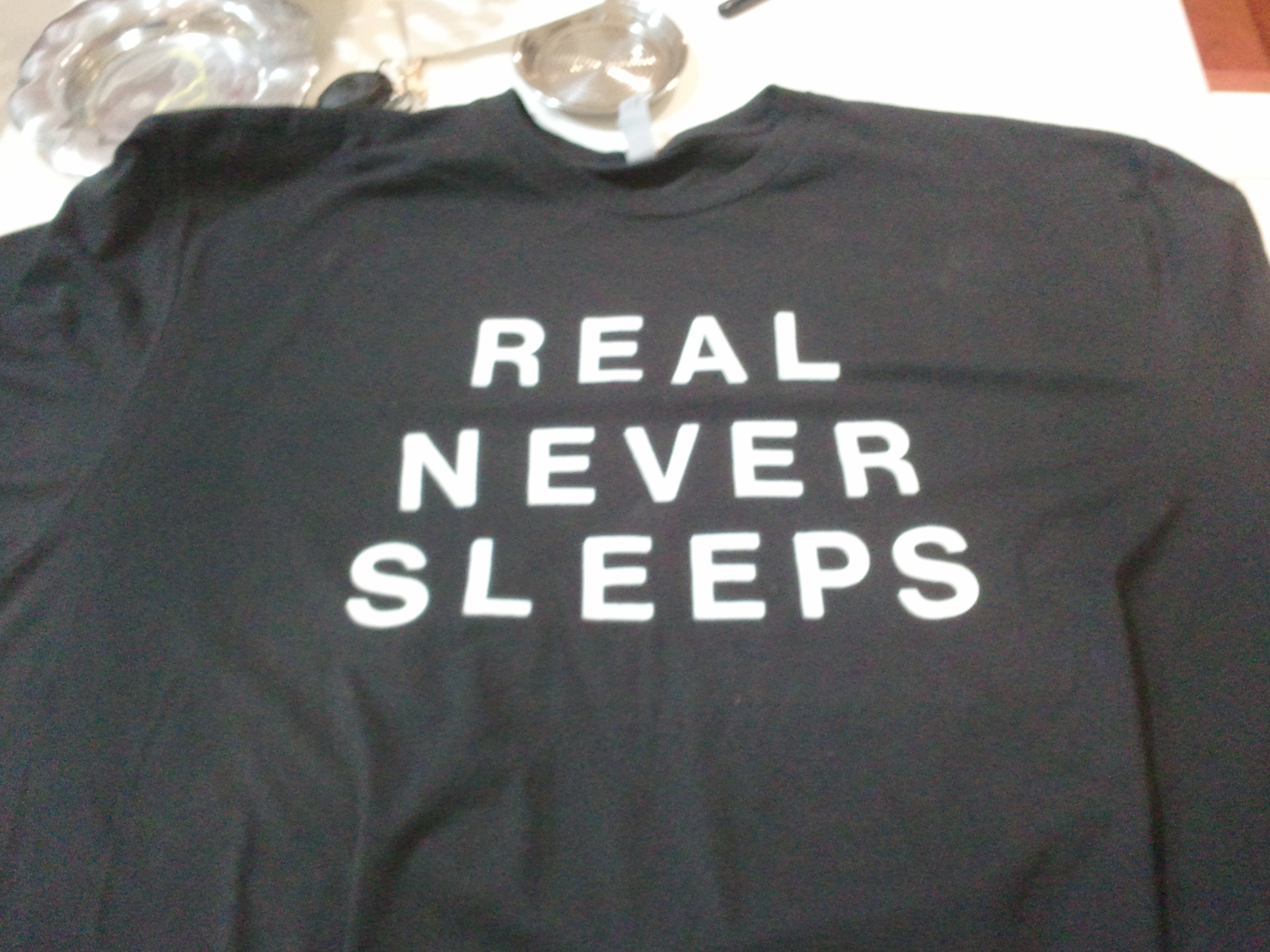
A well-made shirt.

A well-made shirt.

The new album Atlas follows a similar pattern.  It definitely has the same trademark Real Estate sound, which is by design (the band has stated that they’re not interested in radically transforming their style from record-to-record).  One therefore shouldn’t expect any real evolution within the confines of their style.  But there are refinements and new details that make the album worth exploring.  Hell, the band even came up with a really catchy single with “Talking Backwards”, which manages the neat trick of being a perfect encapsulation of the band that’s also presented in a hooky, toe-tapping manner that should capture the ear of any new listener.  Even though the lyrical subject of the need for communication is one that’s been covered many times before, the band still manages to be engaging; sometimes exchanging comfort for originality is a fair trade-off.  Real Estate does an equally good job with ballads as well, though the difference between the ballads and the “rockers” on a Real Estate album are about 10 beats per minute.  Real Estate knows their strengths, and plays to them well.

Feel the good vibrations.

Feel the good vibrations.

However, one gets the feeling that there were some missed opportunities on the album.  One of the highlights of the album is the song “The Bend”, a mid-tempo number that pleasantly chugs along, right up until the moment the tempo suddenly shifts at about four minutes in and the chugging nearly grinds to a halt.  It’s a dramatic moment, as the band stops on a dime, and it immediately grabs the listener’s attention and takes him or her out of their previous groove.  The deliberate beat also gives the lead guitar lines an additional emotional heft, as they wring out as much passion with each note as possible.  It’s a great moment, and since it occurs in the middle of the album, one expects perhaps that the record will shift directions.  The band instead goes right back into their wheelhouse and dives back into their standard jangly guitar rock, which is fine and what I expected when I bought the album, but it still leaves me wondering where else the band could have gone instead.

*There is one complaint that I have from the various reviews I’ve seen: comparing Real Estate to Television is pretty damn lazy.  Both bands have two guitarists and…that’s about where the similarities end.  If anyone wonders why Television is considered punk rock, a quick comparison to Real Estate should give him or her a clue.