Recs

Review: Modest Mouse – Strangers to Ourselves

It may be tough for some fans to accept, but Modest Mouse in 2015 is not the same band that it was in 1996 when it released its debut album.  This is not a criticism at all, but a statement of fact–a band that began as a bare-bones, ramshackle trio playing dive bars has now evolved into an amorphous collective that headlines festivals.  Strangers to Ourselves is light years from the type of album that the band made in their K Records days, but underneath the polished sheen and layers of instrumentation the listener can still find the idiosyncratic character that undeniably defines this as a Modest Mouse record.  Not only are the oddball sensibility and humorous cynicism that are prevalent in their old releases still run rampant, but Isaac Brock and company continue to poke at the boundaries of what one expects musically from an indie rock record.

The album begins with the gorgeous title track, an ode to the ability to forget that is marked by a lovely string melody and dotted with countless instrumental ornamentations from the menagerie of supporting players, a moment of tranquility that recalls previous triumphs like “Gravity Rides Everything” and “The World at Large”.    Lead single “Lampshades on Fire” follows, and musically it sounds like modern-day Modest Mouse in a nutshell–there are the bent harmonics, the ba-ba-ba backing vocals, the splashes of color from quirky instruments, but performed in a compact and cohesive manner.  The lyrical theme covers classic Modest Mouse territory, with an overall narrative of escalating disasters that culminates in a plea of this-planet-is-fucked-so-let’s-move–“Pack up again head to the next place, where we’ll make the same mistakes.  Burn it up or just chop it down this one’s done, so where to now” share space with non sequiturs like “our ass looks great inside these jeans,” with both sentiments inspiring the same deep contemplation from the listener.

Songs like the menacing “Shit In Your Cut” and the backwater circus-evoking “Sugar Boats” already have fit seamlessly into the band’s setlist, and the bouncy “The Ground Walks, with Time in a Box”, which features a groovy bassline that brings to mind “Tiny Cities Made of Ashes”, is destined to be a future live favorite, especially with an outro that begs to be extended and embellished.  The delicate ballad “Coyotes” is another highlight that shows the band’s deft touch, especially as it swells into its final sing-along chorus with a lovely flourish of guitars.  The Jeremiah Green-penned “God is an Indian and You’re an Asshole” should also delight fans of the band’s more peculiar tendencies that works as a great palate-cleanser and sets up the album’s final trio of the songs that concludes the album with a strong flourish.

Though the band hits on several aspects of their sound that should delight multiple segments of their fanbase, Modest Mouse does not provide a mere rehash of their previous work and continues to experiment, with the results having varying degrees of success.  The bright, steel-drum-inflected “Ansel” and the skittering “Wicked Campaign” fit in comfortably with the rest of the album, whereas the spit-up and chewed-out “Pistol (A. Cunanan Miami FL. 1996)” threatens to stop Strangers dead in its tracks early on.  The latter grows on the listener with repeated listens once the initial shock wears down and is an example of the band’s bravery in confronting the listener’s expectations, but it is also the obvious candidate for most-skipped track on the album.

Strangers to Ourselves is overstuffed at fifteen tracks, but this has long been a trademark of Modest Mouse albums, including classics like The Lonesome Crowded West and The Moon & Antarctica; fans look back fondly on those albums as a whole, but even on those records there are some rather weak tracks, though over time they help contribute to the group’s “anything goes” feel.  Ever since “Float On” broke through into the mainstream, Modest Mouse has faced the charge from some fans that they “sold out”, though that is an unfair complaint–the band is as delightfully weird as ever and clearly follows their own muse, and their resultant popularity is not the product of a calculated shift to accommodate for more pedestrian tastes.  Though the group as currently constructed cannot write a loose and rambling classic like “Trailer Trash”, sacrificing some freedom for some semblance of structure, but they can still venture into some pretty wild places.

It may not reach the heights of their landmark albums, but there is a consistency to Strangers to Ourselves that makes it a marked improvement over We Were Dead Before the Ship Even Sank, which could be a slog to get through at times.  It may not completely make up for the amount of time we’ve been waiting for a new Modest Mouse album, but we can at least take comfort in the fact that the next one should be coming very soon.

Review: Moon Duo – Shadow of the Sun

With their latest album Shadow of the Sun, Moon Duo takes the listener on a psychedelic journey whose thrills are often laced with a subtle menace.  Underneath the hazy guitars and bright keyboards, the band traffics in Krautrock-inspired motifs, with the recurring figures alternately grounding the songs and pushing them forward with an ever-insistent beat.  Though the constant repetition can have an overpowering effect of grinding down the listener if their attention is focused too much on the details, Shadow of the Sun is perfect background music for getting lost and zoning out.

Most of the songs revolve around a simple bouncy riff built atop the sparest of chord progressions; a catchy introductory melody ensnares the listener, but the lack of deviation creates an almost unbearable tension that can only be pierced by the addition of a new chord or a solo of some sort.  Moon Duo does a fantastic job of crafting specific melodies like the keyboard line in “Zero” that are seemingly self-contained but in fact keep the listener anticipating a true resolution.  However, the lack of a true conclusion to most of the songs works against the album as it often leaves the listener feeling unsatisfied.

Shadow of the Sun consistently evokes the work of Suicide, as each song is anchored by straightforward and persistent drumbeats that help give the impression of a dark undercurrent lurking beneath the surface.  The consistent repetition of simple patterns mirrors the mechanistic nature of the drum machines that help characterize Suicide, but Moon Duo distinguishes itself with the addition of live drummer John Jeffrey*, who helps add a touch of vitality to the music.  Other influences pop up as well, some more obvious than others.  One can easily hear the impact of the neo-psychedelic forays of The Dandy Warhols circa-Come Down, and a song like “Slow Down Low” is dominated by a vamp on a single chord that brings to mind the Velvet Underground’s “Sister Ray” so much that one could easily sing “I said I couldn’t hit it sideways” as it bounces merrily along.  The delicate “In a Cloud” helps break the potential for monotony on the album and is a welcome change of pace, but is also the source of the most unexpected connection of the album, as its simple two chord progression bears a striking resemblance to Grizzly Bear’s “Knife”; Moon Duo add enough of a personal touch of their own, but I did spend a large amount of time racking my brain trying to pin down where I had previously heard the melody.

Moon Duo does a great job of blending the elements of psychedelic drone and Krautrock repetition to create an overall heady experience.  However, Shadow of the Sun does not exactly stand up to strict scrutiny, as the repetition of only a handful of ideas and motifs can potentially bore the listener; the album works best when the band keeps the mood as light as possible, as in the lively opener “Wilding” or the energetic finale “Animal”.  Nevertheless, Moon Duo has crafted an album that is one of the more pleasant surprises of the year so far.

*His presence increases the number of members of the group to three, making their band name a complete lie; if they wanted to be more accurate, the band should be called Earth Trio.

Review: King Tuff – Black Moon Spell

King Tuff wrote the best T. Rex song you’ve heard in decades with “Black Moon Spell”, the title track off of their recent album, and for five minutes the listener is transported back to the early-70’s and the heyday of glam rock.  It was one of the best singles of 2014, and while the rest of Black Moon Spell doesn’t quite reach the heights of its opener, the record still has its charms.  Kyle Thomas (aka King Tuff himself) shows a knack for writing fun and infectious melodies that are quick and to the point, and knocks out dozens of memorable fuzzed-out guitar lines that will rattle around in your mind long after the record has finished playing.

I first heard King Tuff when they opened for Wavves on their Afraid of Heights tour, and one can easily see how those two groups could find common ground, as they share an irreverent attitude and a commitment to stoned-out rock.  King Tuff ingratiated themselves with the crowd that night with displays of both their humor and musicianship, and I made a note to keep an eye on them for the future.  “Black Moon Spell” made the effort worthwhile, as I quickly fell into the spell of its captivating groove, with its memorably hypnotic riff that brilliantly plays around the contours of its chord progression.  It may not be high art, but goddammit does it ever rock, and most of the album follows that template.

Most will point to the obvious inspirations of Diamond Dogs-era Bowie and the aforementioned T. Rex, but it is the unexpected influence of another generation that helps make Black Moon Spell sound fresh enough for modern audiences, that of mid-90’s indie rock.  King Tuff filters the touchstones of glam-rock through the lens of the Elephant 6 sound, namely the psychedelic pop experimentation of The Apples In Stereo and the Olivia Tremor Control.  The bright and sunny attitude that is prevalent throughout the album immediately recalls Robert Schneider and his group, while elements as diverse as the lo-fi “I Love You Ugly” and the quick sound collage from the mesmerizing ballad “Staircase of Diamonds” bring to mind memories of the latter band, with King Tuff’s vocals emphasizing the melodic sides of both bands.

King Tuff’s approach of glam-via-the-garage makes helps make Black Moon Spell an intriguing and often-exciting album, but it does drag a bit in spots, even with most songs racing by at around two minutes apiece.  The album sags a bit toward the end, which is why this recommendation is being published months after its initial release; though many of the songs are not intended to leave much of a lasting impression, a lot of the songs after the mid-way point end up being rather disposable and probably should have been excised.  However, even these tracks grow on you after multiple listens, so even this minor caveat should not discourage you from throwing on some face paint rocking some platform shoes with King Tuff, at least for forty minutes or so.

The Thermals, Live at Level B with Years and City of Pieces

I woke up this past Saturday morning with absolutely no plans for my weekend, but after a quick perusal of my Facebook feed, the circumstances changed dramatically.  The Thermals posted a flyer for a show they were doing that night at Level B, having decided to make the trip from Portland down to the Capital City to bless us with their presence.  So with the choice now between “doing nothing” and venturing downtown to see one of my favorite bands play an intimate show in my hometown, I easily decided to go with the latter.  Despite a rather sparse showing from my fellow Salemites, the band did their usual excellent work and hopefully had as great a time as I did.

A personal souvenir from the show

A personal souvenir from the show

Since this is the third time we’ve covered a Thermals show in a year*, we’re not going to spend too much time discussing the intricacies of their set.  The band focused mainly on their most recent album, sprinkling several cuts from Desperate Ground throughout the set, while making sure to cover crowd-favorites from their classic The Body, The Blood, The Machine; a personal highlight was hearing “Power Lies” from the underrated Personal Life make an appearance.  The group has been hard at work writing material for a new album, and I’m glad to say that it looks like there was good reason that I had trouble recognizing a couple of songs, since the setlist confirms new tracks “The Walls” and “I Will Find My Way”.  The new songs definitely did not represent any drastic change in style, and instead fit naturally into the band’s set, which should provide comfort for their fans.

Throughout the show, a reel of “Betty Boop” cartoons was shown by a projector behind the band, seemingly selected at random.  The resulting juxtaposition provided a couple of noteworthy moments**, the highlight being that an Alice in Wonderland-themed episode appeared as the band played their cover of “White Rabbit” in an alarming moment of synchronicity, something that which Hutch himself remarked and Kathy noticed as well.  Though the crowd was not nearly as raucous as they were the last time The Thermals came through town, we were able to convince the band to indulge us with old favorites “Overgrown, Overblown!” and “No Culture Icons” for a mini-encore.  After the show, it was great to see Hutch and Kathy and Westin hang out with the crowd and appear sincerely grateful for those that turned up; hopefully the band will make this a regular gig, though it may help to do a bit more advance notice for a Salem gig.

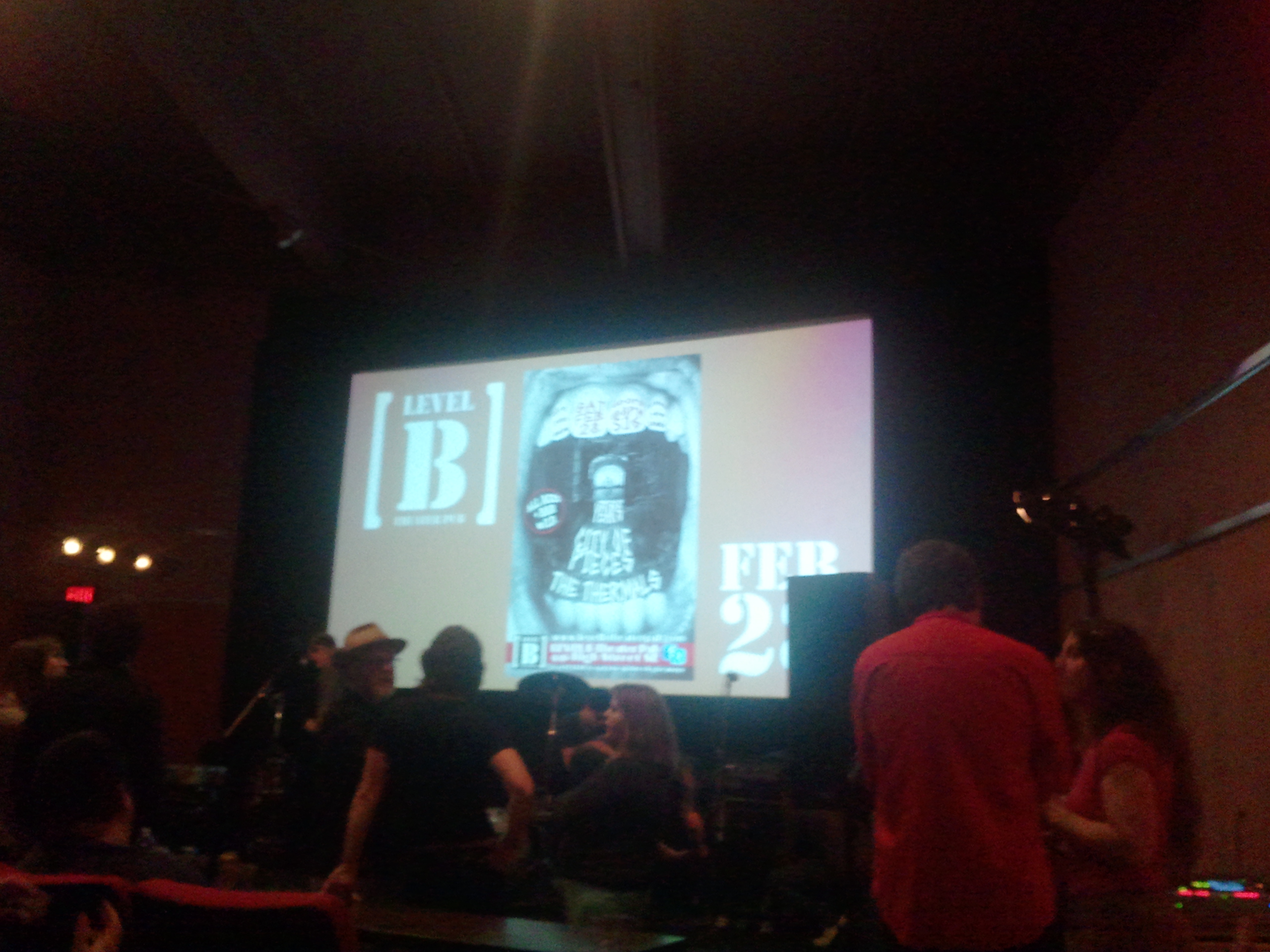
A view inside of the theater with the ad for the show

A view inside of the theater with the ad for the show

As for the openers, they represented both the old and the new of the Salem scene.  Years (the young folks) performed a set of catchy 90’s-era punk with what I assume is some heavy influence from Pavement, while City of Pieces (the old folks) taught the crowd some lessons on the classics, with a style that was reminiscent of The Cramps with their tinge of psychobilly.  Years could use some seasoning, not necessarily to brush up their chops but to work on their songcraft a bit, yet they probably have a bright future ahead of them.  However, City of Pieces was a blast, and I’m looking forward to seeing more of their sets around town, as their presence assures that it will be a fun night.

*Not only did we see The Thermals play Level B last year, but they were also part of the extensive Project Pabst lineup.

**The selection of cartoons included a rather racist episode made things uncomfortable for those paying attention (though the band was thankfully too busy to notice).

Review: Ought – More Than Any Other Day

Rust Is Just Right is not a very large operation, so we may overlook some albums when they are first released.  However, when we eventually catch up and listen to some of these records, we are not going to let the fact that we are ten months behind stop us from writing a review.  The point of all this introductory nonsense is to explain why we are reviewing the debut album from Ought in February of 2015 even though it was released in April of 2014, but the only necessary reason should be that More Than Any Other Day is a fantastic rock record that electrifies the listener with both its furious energy and its thought-provoking experimentalism.

The quickest description that I could use to describe Ought’s sound is “Alec Ounsworth fronting a Fugazi-inspired punk band”, but as you should expect, relying on the reductionist rock-crit namedrop cliche does not paint a full picture.  Tim Beeler’s vocals do mostly recall Clap Your Hands Say Yeah, but that doesn’t cover the spectrum of emotions and contortions that his voice undergoes to match the twists and turns of the music.  For instance, Beeler’s use of dynamics in songs like “Clarity!” bring to mind the theatrics of the Violent Femmes, and that dramatic touch helps create a memorable, slow-burning epic.  He may not have the the most extensive vocal range, but his speak-sing style is effectively used in a song like “Around Again”, as when the band stops and Beeler asks “Why is it you can’t stare into the sun but you can stick your head into a bucket of water and breathe in deep?”

Musically speaking, Ought blurs the line between punk and post-punk, and in the process does an excellent job of making the lives of critics that much more difficult–in other words, it is not as easy to define the distinction as it is with, say, Viet Cong.  Ought often does engage in the full-fledged fury of a more traditional punk band, but they still allow room for experimental sonic elements that makes it hard to pin down to a single genre.  Consider the catchy and frenetic “The Weather Song”, which veers from a jittery verse into frenzied finish that is reminiscent of Wolf Parade (especially with the unusual presence of keyboards), as well as “Forgiveness”, whose use of a violin as a drone adds in a touch of the Velvet Underground to the band’s sound.  I am unsure what is more impressive: the fact that from song to song, it is almost impossible to pin down where Ought will go next, yet the band switches gears in a way that doesn’t give the listener whiplash, or the fact that despite the fact one can spot all these diverse influences rather easily, the band organically incorporates these elements into their sound so well that one cannot pin the “copycat” label on them.

Though only eight songs long, More Than Any Other Day is a dense but rewarding album that reveals itself on multiple listens.  Initially, the most striking element of “Today, More Than Any Other Day” is probably its dramatic tempo and stylistic shifts.  Then you may notice the odd lines of “I am excited to go grocery shopping.  And today, more than any other day, I am prepared to make the decision between 2% and whole milk” that is referenced in many reviews, but you go back and see that it’s not merely a non sequitur but in fact a riff on the previous line that “I am excited to feel the Milk of Human Kindness”, either an allusion to Macbeth or the Caribou album, and now you have to reconsider how all these elements fit together.  The good news is that the album is so great that it is worth the extra effort.

Review: Father John Misty – I Love You, Honeybear

Father John Misty’s debut album Fear Fun was a delightful surprise–few expected that a solo album from the former drummer of Fleet Foxes would be such a musical revelation.  The best case scenario was that Fear Fun would be a pleasant diversion, but Joshua Tillman’s adopted persona of a modern-day hipster-shaman created folk rock tunes that have held up remarkably well over the years.  Fast-forward three years, and while we are still waiting to hear anything new from Fleet Foxes, Father John Misty has returned with a stellar new album that will force people to stop name-dropping his former outfit.

I Love You, Honeybear is a stunningly gorgeous album, one that expands the scope of its predecessor with lush strings and intricate arrangements, but also one that delights in intimate personal details.  Father John Misty has always had a deft touch with his lyrics, often evoking a wry smile or two, but lines like “She says, ‘Like, literally music is the air [she] breathe[s],’ and the malaprops make me wanna fucking scream…I wonder if she even knows what that word means; well it’s ‘literally’ not that” from “The Night Josh Tillman Came To Our Apt.” elicit an actual laugh every time its played.  Tillman’s recent marriage is a defining influence on the album, but Tillman is careful to balance any sweetness with just the right amount of cynicism; a great example comes from the closing lines of “Holy Shit”: “Maybe love is just an economy based on resource scarcity–but what I fail to see is what that’s got to do with you and me.”

At times, it seems that the music could veer dangerously close to the emptiness of late 70’s AM Radio/yacht-rock (or perhaps worse, playing up the conventions of the genre with too much irony), but Father John Misty employs a nimble hand throughout the album, and simply writes melodies that are too good to be associated with such vapidness.  Honeybear‘s laid-back ballads are enhanced by extravagant string arrangements that add both depth and ornamentation, and songs like the relaxed swing of “Nothing Good Ever Happens at the Goddamn Thirsty Crow” and the achingly beautiful “Chateau Lobby #4 (In C for Two Virgins)” are enhanced by the expert addition of wind and horn melodies.  It is difficult to select any standout songs from this consistently great album, but the euphoric triumph of “Chateau Lobby #4” is one that will be easily remembered.

The album is mainly made up of mid-tempo numbers, but the good news is that I Love You, Honeybear never really drags.   The one real rocker (and a soon-to-be favorite of the live set), “The Ideal Husband”, appears two-thirds of the way through and gives the musicians a chance to really thrash about on a fun blues stomp, but otherwise things are generally calm.  A trio of ballads follows, beginning with the sarcastic ode “Bored in the USA” that perfectly sums up the sentiment of a generation coping with the readjusted education/benefits equation, and ending with the sweet lullaby “I Went to the Store One Day” which recounts the circumstances that led to the romance that inspired the album.  If only all great outcomes could result from a simple line like “I’ve seen you around–what’s your name?”

Note: The CD version of the album comes with a booklet entitled Exercises for Listening.  I highly recommend that you read these directions; obey them at your peril.

Review: The Decemberists – What a Terrible World, What a Beautiful World

The Decemberists have returned from the longest absence of their career with an album that is the perfect encapsulation of their evolution to this point.  What a Terrible World, What a Beautiful World splits the difference of the sprawling, proggy The Hazards of Love and the return-to-our-roots folk-rock of The King Is Dead, but does not necessarily feel like a compromise between the two versions of the band.  The combination results in an album that is filled with wonderful, catchy moments that are meticulously crafted and brilliantly arranged, making full use of the band’s instrumental prowess in creating gorgeous, digestible songs.  In other words, no overlong multi-part epics, but no stripped-down basics either.

Many critics have emphasized the lyrics in their reviews, which is an understandable approach considering the band’s hyper-literate reputation were what brought fans on board in the first place.  On What a Terrible World, the focus is less on 18th century peasant life or swashbuckling sailors, trading in allegory and metaphor for more direct commentary on personal topics like love and growing up, a noticeable shift in the band’s lyrical technique.  This is why when Colin Meloy seemingly makes a song into meta-commentary as he does with the opener “The Singer Addresses His Audience”, the critics focus on lines about selling out for Axe commercials, instead of remarking on the fantastic build into the song’s climax, anchored by a thundering performance by John Moen.  However, it is the band’s less-recognized musical prowess that carries the album and deserves more attention, with each member making vital contributions on a multitude of instruments.

Though the band doesn’t indulge in individual songs that are the kind of multi-genre exercises that characterized albums like The Crane Wife, they do stretch out over the course of the album.  Sometimes the explorations misfire, as in the accordion swamp-stomp of “Anti-Summersong” that unfortunately brings back nightmares of that godawful Kongos song from last summer.*  Thankfully, those moments are rare, and the listener can enjoy instead when The Decemberists recall the gothic Americana of Black Rebel Motorcycle Club’s Howl era with songs like “Carolina Low”, or revel in the bright horns of the rousing “Cavalry Captain” that are reminiscent of Guster.  Though these deviations are welcome, it’s when the band goes back to their wheelhouse of rousing folk-rock that the band truly shines, as they do on their first single–“Make You Better” may not only be the album’s highlight, but once the song hits that climax after the guitar solo, it may possibly the best moment of their career.

What a Terrible World, What A Beautiful World is a bit too long at fifty-three minutes, sagging at around the three-quarters mark, though considering their previous absence it is understandable that the band felt that they had to leave in as much material as possible.  Despite the lull, the album still finishes with a flourish due to the touching “12/17/12” and the uplifting “A Beginning Song”, leaving the listener far from disappointed after that slight setback.  What a Terrible World represents some of the best of The Decemberist’s late-era work–they have combined the instrumental adventurousness of The Hazards of Love while learning to rein in its potential excesses by keeping a song-based focus as they did on The King Is Dead.  It may not seem like a risky move, but it was an incredibly tricky maneuver and The Decemberists pulled it off beautifully.

*It’s a damn shame that this is my first instinct to reference, considering I grew up in an area where zydeco was a significant part of the culture.

Underrated Gems: Bloc Party – A Weekend In The City

Bloc Party’s reputation was built on the strength of its masterful debut Silent Alarm, which remains one of the greatest albums of the indie rock mini-boom at the beginning of the century.  They channeled a ferocious energy through a combination of spiky, angular guitars and lyrics that zeroed in on battles both external and internal, creating a perfect mix of hard-edged rockers and introspective ballads.  Silent Alarm was both a critical and commercial success, and remains the most beloved album for many of its fans; any follow-up was bound to be met with some resistance, and indeed reception to A Weekend In The City was widely split.  There were many critics that saw Weekend as the beginning of the end of Bloc Party, but there was also a small passionate contingent that has for years fought against this perception, and who instead insist that it’s a classic that is in many ways equal (or even superior) to Silent Alarm.  Guess where Rust Is Just Right falls in this argument.

In many ways, A Weekend In The City was a huge gamble on the part of Bloc Party, and represented a bold change in musical direction.  The strengths of their debut lay in their innovative interpretation of early-80’s post-punk guitars from bands like Gang of Four as well as the brilliant and manic drumming of Matt Tong.  The guitar hooks of a single like “Helicopter” drew in the average listener, but it was the relentless attack of Tong’s drums in “Like Eating Glass” that mesmerized listeners and created fans.  The band chose to de-emphasize these aspects of their sound in Weekend, opting instead for more electronic instrumentation and building more songs around Kele Okereke’s delicate (but potentially divisive) vocals.  It’s understandable that many fans were turned off by this decision, but even if they were turned off by this general approach, the band’s harshest critics would have to agree that the moments when Bloc Party veered into its more “classic” sound are some of the band’s best work, like the furious opener “Song For Clay (Disappear Here)” and the buoyant  “Waiting For The 7:18”.

A chief complaint of many detractors of Weekend was the unconventional sequencing of the album’s tracks.  Silent Alarm had its fair share of slow songs and ballads, but their cumulative effect was muted because they were paired throughout with the more energetic tracks, allowing the album to avoid any lulls.  With Weekend, the band packs the rockers at the beginning, adding a few tracks that alternated moods before piling the introspective sad songs for the last third, which created the sense for many that the album peaked too early and dragged towards the end.  However, the critics of the track order fail to consider the thematic concept of the album as a whole, that in this case the title A Weekend In The City is more than a mere placeholder–it’s a declaration of narrative intent.  The album does an excellent job of mirroring the varying moods as one experiences the weekend: the initial thrills of getting off work on Friday and partying into the night, the attempts to keep the energy up with varying degrees of success on Saturday, and finally the letdown and regret of Sunday.  It’s a brilliant musical representation of a common shared experience, though must of us could only wish to feel an epiphany like the thrilling climax of “SRXT”.

By viewing the album as a running narrative of a weekend, the listener can dig out subtle nuances and derive interesting new meanings by placing songs in context, but each song is still able to stand on its own without losing any significance.  Throughout the running storyline of “the weekend”, Bloc Party interweaves separate statements about drugs and partying (“Song For Clay”, “The Prayer”), racism and terrorism (“Hunting For Witches”), as well as regret and depression (“Sunday”, “SRXT”).  Instead of invoking abstract expressions like in Silent Alarm, Kele splices in specific references in his lyrics this time around, giving a personal touch to each of these songs.  Some people may be taken out of the moment by hearing an odd mention, but others prefer having a specific grounding point; for instance, I’ll always remember the line “I’d pick and eat more wild blackberries” because it conveys a more personal memory and sentiment, even if it appears a bit goofy on its face.

A Weekend In The City works not only as a cohesive whole, but as an excellent collection of songs.  The moments when the band plays to its strengths are thrilling (like the end to “Waiting For The 7:18”), and when Bloc Party challenges itself to stretch beyond its comfort zone, it is able to rise to the challenge (“On”, “Sunday”).  Instead of viewing the album as the beginning of its decline, it should instead be seen as an example of a band maturing and growing musically.  Over the years, the reputation of Weekend hasn’t really improved, as the band has moved further in the direction of dance music and electronic influences, much to the dismay of many of its fans.  However, it’s an album that’s held up surprisingly well over the years and is well worth revisiting, if you need to revise your original opinion.

Review: Sleater-Kinney – No Cities To Love

Though this is difficult to hear, every year we get more evidence that it may be a good idea to break up your band for a decade, even if they are at their creative peak.  Last year, Death From Above 1979 came back and wowed us with the stellar The Physical World; the year before that saw the surprisingly wonderful return of My Bloody Valentine; and then there is Dinosaur Jr., who have released three excellent albums after the reunion of their original lineup after nearly twenty years apart.  Sleater-Kinney has pulled off the same trick with the excellent No Cities To Love, a furious and catchy album that is both an artistic step forward as well as a classic example of the trademark S-K sound.

The frenetic “Price Tag” kicks off the album, pairing an off-kilter looping Sleater-Kinney riff typical of their early years with ferociously political lyrics; not since the heyday of Rage Against The Machine have we heard a song that targets economic inequity and middle-class complacence.  “Fangless” follows and throws a bit of a curveball with its mixture of funk rhythms and new-wave guitars, as well as featuring a prominent bass counterpart that was previously a rarity in light of S-K’s usual twin-guitar attack.  The track is indicative of the kind of musical adventurousness found throughout No Cities To Love as well as what makes the album so much fun.

No Cities To Love features some of the best hooks of Sleater-Kinney’s career, including the peppy title track and the bouncy “Hey Darling”; the descending chorus melody in the latter immediately brings to mind something Ted Leo and the Pharmacists would have concocted circa Hearts of Oak.  “A New Wave” has some fun with the bass riff from Nirvana’s “Love Buzz”  before shifting into a sing-song chorus that makes perfect use of the unique vocal harmonies of Brownstein and Tucker.

Sleater-Kinney has been a band that has long been beloved by critics and pushed by their most passionate fans as all-time greats, but rarely have I ever felt that this type of hype was fully justified.  I’ve certainly have enjoyed their albums over the years (after overcoming an initial reluctance due to their unconventional vocals) and recognize the impact that the group has had musically and culturally over the years (they have been arguably as far-reaching in their influence as Pavement in the past couple of decades), yet never had them break into my regular rotation nor would put them in that upper echelon of groups.  However, even considering Sleater-Kinney’s excellent discography as a whole, No Cities To Love is a cut above, and will certainly invite not only repeated listens but end-of-the-year list consideration.  Not bad for a January album.

Review: TV on the Radio – Seeds

It’s almost absurd that I have waited this long to formally write up a review of Seeds considering how often I have listened to it since it was released last month.  This can be explained by the tension between how difficult it has been for me to attempt to intellectualize my love this album and how easy it has been just to cue it up on my iPod or keep it playing in my car stereo.  So while I struggle where to objectively rank it within the TV on the Radio discography, I will at least declare how goddamn fun and beautiful and brilliant this album is.

TV on the Radio kick off Seeds seemingly mid-song with “Quartz”, a seemingly sly acknowledgement that while this has been the longest gap between records in their career so far, they have still been busy in the meantime, upheaval within the group and all (and taking it a step further from their similar gambit from Nine Types of Light, which began with “Second Song”).  From there, the band slides easily into a joyous and ebullient first half, with the one-two punch of the sweet “Careful You” and the jubilant “Could You”.  The latter is possibly the most irrepressible song in the band’s deep catalog, with its catchy melody line and brash backing horns (as well as an early lead guitar line that mimics those horns beautifully in a nifty bit of foreshadowing).  “Happy Idiot” follows, and though not the highlight of the album, it’s easy to see why it was chosen for the lead single–it has a great hook, nice groove, and a driving beat that fits comfortably within a radio playlist but is still able to distinguish itself with some subtly intriguing touches (such as the “hey-hey-hey”-like sound effects leading into the chorus).  Looking at the song from the context of the album as a whole, it also serves as a fulcrum between the different halves of the record, as one can sense some of the tinges of sadness that dominate the second side.

Seeds lulls a bit in the middle with the trio of “Test Pilot”, “Love Stained”, and “Ride”, though this is intentional.  “Test Pilot” is a touching ballad that rests in a downbeat groove, with “Love Stained” tweaks the formula by riding an illusory double-time hi-hat/half-beat groove combo, creating an undercurrent of tension and serves as one of several instances of a push-and-pull dynamic that is found throughout the record.  “Ride” is seemingly set up as the centerpiece of the album, with its two distinct halves–the first part is a slow gorgeous instrumental ballad that recalls a major chord version of Nine Inch Nails’s “The Frail” mixed with the lushness of the band’s own “Family Tree”, before switching gears into a second part that’s a bouncy and buoyant pop rock song, driven by an insistent Krautrock-like motorik drumbeat that brings to mind early-era Secret Machines that sets up the rest of the album.

With their buzzsaw guitars, “Winter” and “Lazerray” find TV on the Radio rocking out harder than ever.  The former uses a half-time beat in a similar fashion to “Love Stained”, creating the illusion as if the band is fighting through an invisible force attempting to drag them down, while the latter finds the band just flat-out letting loose in the most punk-rock fashion they’ve done since “Wolf Like Me”.  The album closes out with the bittersweet “Trouble” and the hopeful title track, and it’s then that the album’s true theme pushes through, that of rebirth in the face of loss.  After the death of bassist Gerard Smith, it wasn’t set in stone that the band would return, but it’s clear that TV on the Radio are working through the loss of a beloved friend.  The overall result is a record that hits all possible emotions, but in a way that is consistently engaging and repeatable.

As for the original conundrum, I’m still not sure it matches the creative brilliance of their debut desperate youth, blood thirsty babes or Dear Science, it’s still more consistent than Return to Cookie Mountain and Nine Types of Light, though there is no single song that is the equal of “Wolf Like Me” or “Killer Crane”.  I find it surprising that while the reviews of the album are still quite good, critics are ranking Seeds significantly below their previous work.  Despite this, my prediction is that as people play the album more and more, its charms will become more apparent and its reputation will grow.