Author: symeo

A Defense of Live Music, Which Is Apparently Necessary

A few weeks ago, we linked to a piece from Talking Points Memo that featured the inflammatory headline “Face It, Live Music Kinda Sucks.”  As expected, the article does not improve from its initial comparison that “live music is the grownup birthday dinner of cultural events”, and it certainly does not fulfill its stated promise of providing an “airtight case” of that assertion.  Sometimes an essay can overcome its terrible arguments with some creative and compelling commentary, but there is absolutely nothing in the article that resembles anything that can be construed as entertaining.

Here is a breakdown of the author’s argument: 1). People don’t want to hear bands they don’t know; 2). Musicians can be boring/play for too long/other people suck; 3). Live music isn’t as good as studio recordings; 4). Good bands don’t get booked; 5). People suck and do bad things and somehow this is the result of live music.  This  last part didn’t get its own bullet-point, but was apparently tacked-on at the last minute to score some social commentary points, which is depressing in and of itself–you may have admirable aims in tackling issues of racism, sexism, and other forms of harassment, but if you use a lazy argument it just hurts your overall point, especially if it lacks relevance to the specific issue at hand.  It is completely unproductive, and results in turning off the potentially impressionable as only the converted hear the message.

Even if one ignores the extraneous social commentary, it is not as if the author’s primary arguments have any merit.  For the first point, there is the tautology that the author admits to in his own goddamn article that “nobody likes things they don’t like”, but there is no elaboration of this basic concept.  Sure, it can be annoying to hear crappy opening bands, but for the most part it is rare to hear genuinely awful bands, so maybe it is possible to endure a half-hour of light annoyance in order to hear your preferred choice.  Of course, as rare as it may be, there is always the possibility that you can find a new favorite band from an unknown opener; even if the success rate is rather low in this particular context, it is roughly equivalent to what you would find just scanning the radio.

The second and third points are even more ludicrous.  If you like a band so much that you are paying money to see them live, why would you complain that you may be forced to endure a three hour show?  Most fans appreciate hearing as much of a band’s catalog as possible.  Of course, the solution for someone who thinks that a concert is running too long is rather obvious: leave early.  The other argument has the appearance of some legitimacy, since it is true that there is often a fundamental tension in seeing a band live.  It is a struggle for musicians to satisfy the demand of sounding similar to the studio recordings with which their fans are familiar as well as making the live experience worthwhile by offering a unique experience, but seeing how a musician handles that clash of expectations is half the fun of a live show.  Some bands succeed, others do not, but that is how most things go in life.  However, the fact that the author cites Beck as an example of a musician’s failure to meet those conflicting expectations casts some doubt on his ability to discern as to what makes a good performance; over the years, Beck has done an excellent job of assembling various groups of musicians that do a fantastic job of recreating and reinterpreting his studio albums in a live setting, including during his recent Morning Phase tour.

The final point is just dumb, and is undercut by the author’s own admitted shittery.  Congratulations, you were able to book shows despite the fact that your band was terrible (and judging by the photo you submitted for this piece, I have no problem believing this to be the case).  In general, most venues care much more about their bottom line and simply will not book bands that fail to bring in an audience; half-assed sociological assessments do not usually enter into the picture.  Good work on earning a few hundred bucks here and there by putting on a terrible performance, Mr. Kennedy, but there is a clear reason why we in the public at large have never heard about your musical exploits.  Despite the fact that you didn’t give a fuck about your audience, it doesn’t mean that most bands follow your model.  I have seen Of Montreal perform a gig for dozens in a basement bar in rural New Hampshire and play a sell-out show for thousands in New York City, and they played with the same gusto and enthusiasm for both shows.  In other words, there’s a reason why they are the ones that still have a musical career.

Related to this discussion is the recent questions asked by some about the relevancy of live albums.  It is difficult to think of a less vital position to take, considering that if you do not believe in the endeavor of creating a live album for fans you can choose to simply not to buy the album–it is not as if the existence of these albums crowds out the market for other non-live albums.  But the answer is simple: fans find value in these recordings.  At their most basic level, live albums benefit from the extra energy that infuse the performances, from both the musicians themselves and the presence of the crowd; even if the listener is not physically present for the show, there is still some benefit in hearing a live recording because of this factor.

These albums also allow fans to hear exciting new variations of their favorite songs; the studio recordings do not have to be a “finished product”, and bands can tinker and deconstruct various elements and rebuild them into something new.  As an example, with each of their tours Eels emphasizes different parts of their sound and offer intriguing new takes on their songs, whether it be fuzzed-out rock on Electro-Shock Blues Show or delicate ballads on With Strings.  Live albums also offer fans the chance to hear amazing displays of musicianship and improvisation; there are those that are content with hearing one version of Pearl Jam’s “Black”, but there are thousands of others that enjoy hearing Mike McCready create different beautiful solos with each performance.  Plus, there’s always fun in hearing particularly memorable stage banter that a recording might capture, as many Pearl Jam bootleg devotees can attest.

The point is that live music is great any way you find it.  There is no need to be an ass and try to find reasons to hate it.

A Lesson In Lyrical Put-Downs, By Japandroids

Before Japandroids caught people’s attention with their thrilling debut Post-Nothing and broke through with the triumphant Celebration Rock, they were just a hard-working couple of guys who grinded away for years on the road.  The wonderfully-titled No Singles compiles the band’s early recordings, and though the songs are a bit rough around the edges, there are some gems to be discovered.  The opener, the Springsteen-referencing “Darkness on the Edge of Gastown”, is probably the highlight of the collection, mainly due to its anthemic chorus, a quality which would become a future trademark of the band.

Musically speaking, Japandroids reverse the listener’s expectations in the initial section of the song by using the guitar part to set up more melodic elements in the drums; Brian King thrashes on a single (but expansive) chord, but tinkers with intricate rhythms by emphasizing different beats, as David Prowse experiments with diverse rolls and fills.  It’s a thrilling combination, and it helps the band ratchet up a certain tension, as the listener continuously anticipates the moment when the band breaks the pattern to dive into the next part of the song.  When the band finally launches into the chorus, the listener feels some relief with the transition; by drawing out this release, the band helps underline the contrast between the hooks of the chorus and the harshness of the verses, making the chorus that much more effective in sticking in people’s heads.

While the majority of listeners would point to the catchy chorus melody as the most memorable aspect of the song, the part that captures my attention every time I listen is a particular line at the end of the first verse.  Amid all the noise and thrash, the song’s protagonist is lashing out (through a third party) at an unnamed woman, launching insult after insult about her wardrobe and physical appearance (“Tell her she wears too much neon, tell her it’s hanging off her bones”).  The third taunt is the most cutting, as the protagonist proclaims, “That’s all she is: just new ways to wear old clothes.”  The juxtaposition of the old and new make the line especially poetic, but it’s the distinct image that the words portray of the person as merely a mannequin built for the express purpose of modelling vintage fashions that makes it an especially devastating and disrespectful rejection; the narrator has completely dismissed all the elements that make his target an actual person.  It is difficult to recall a lyrical put-down dripping with such sneering contempt, and the fact that it takes the listener a second for the insult to register makes the comparison that much more brilliant.  The subtlety of the barb makes its sting even more powerful.

I am sure that there are those that find praise for such a contemptuous sentiment offensive, but consider the line in context with the rest of the song.  The next verse paints a bleak picture of the narrator and of the relationship between the characters, so the narrator is not exactly reveling in the absence of the partner.  The song ends with the chorus, which documents the repeated pleas of the utterly defeated narrator.  The chorus is set up in a way that de-escalates the stakes of the situation, as the narrator begs the third party to tell her 1) “I’m still alive”, 2) “I’m still in love”, and 3) “to come pick me up”.  With this status report, the narrator alerts the listener to his/her most basic condition, then his/her general emotional state, and finally his/her specific physical situation, narrowing down the listener’s potential concern from “he might be dead” to “oh, he needs a ride.”  The fact that the narrator is in such a state that he’s left pleading for a ride from the object of his scorn should indicate who ended up with the upper hand in the disintegration of this relationship, and provide comfort to those who object to the prior insults.  She’s the one with the last laugh.

But you have to admit, Japandroids delivered a pretty sick burn (to use a colloquial expression).

The Thermals, Live at Level B with Years and City of Pieces

I woke up this past Saturday morning with absolutely no plans for my weekend, but after a quick perusal of my Facebook feed, the circumstances changed dramatically.  The Thermals posted a flyer for a show they were doing that night at Level B, having decided to make the trip from Portland down to the Capital City to bless us with their presence.  So with the choice now between “doing nothing” and venturing downtown to see one of my favorite bands play an intimate show in my hometown, I easily decided to go with the latter.  Despite a rather sparse showing from my fellow Salemites, the band did their usual excellent work and hopefully had as great a time as I did.

A personal souvenir from the show

A personal souvenir from the show

Since this is the third time we’ve covered a Thermals show in a year*, we’re not going to spend too much time discussing the intricacies of their set.  The band focused mainly on their most recent album, sprinkling several cuts from Desperate Ground throughout the set, while making sure to cover crowd-favorites from their classic The Body, The Blood, The Machine; a personal highlight was hearing “Power Lies” from the underrated Personal Life make an appearance.  The group has been hard at work writing material for a new album, and I’m glad to say that it looks like there was good reason that I had trouble recognizing a couple of songs, since the setlist confirms new tracks “The Walls” and “I Will Find My Way”.  The new songs definitely did not represent any drastic change in style, and instead fit naturally into the band’s set, which should provide comfort for their fans.

Throughout the show, a reel of “Betty Boop” cartoons was shown by a projector behind the band, seemingly selected at random.  The resulting juxtaposition provided a couple of noteworthy moments**, the highlight being that an Alice in Wonderland-themed episode appeared as the band played their cover of “White Rabbit” in an alarming moment of synchronicity, something that which Hutch himself remarked and Kathy noticed as well.  Though the crowd was not nearly as raucous as they were the last time The Thermals came through town, we were able to convince the band to indulge us with old favorites “Overgrown, Overblown!” and “No Culture Icons” for a mini-encore.  After the show, it was great to see Hutch and Kathy and Westin hang out with the crowd and appear sincerely grateful for those that turned up; hopefully the band will make this a regular gig, though it may help to do a bit more advance notice for a Salem gig.

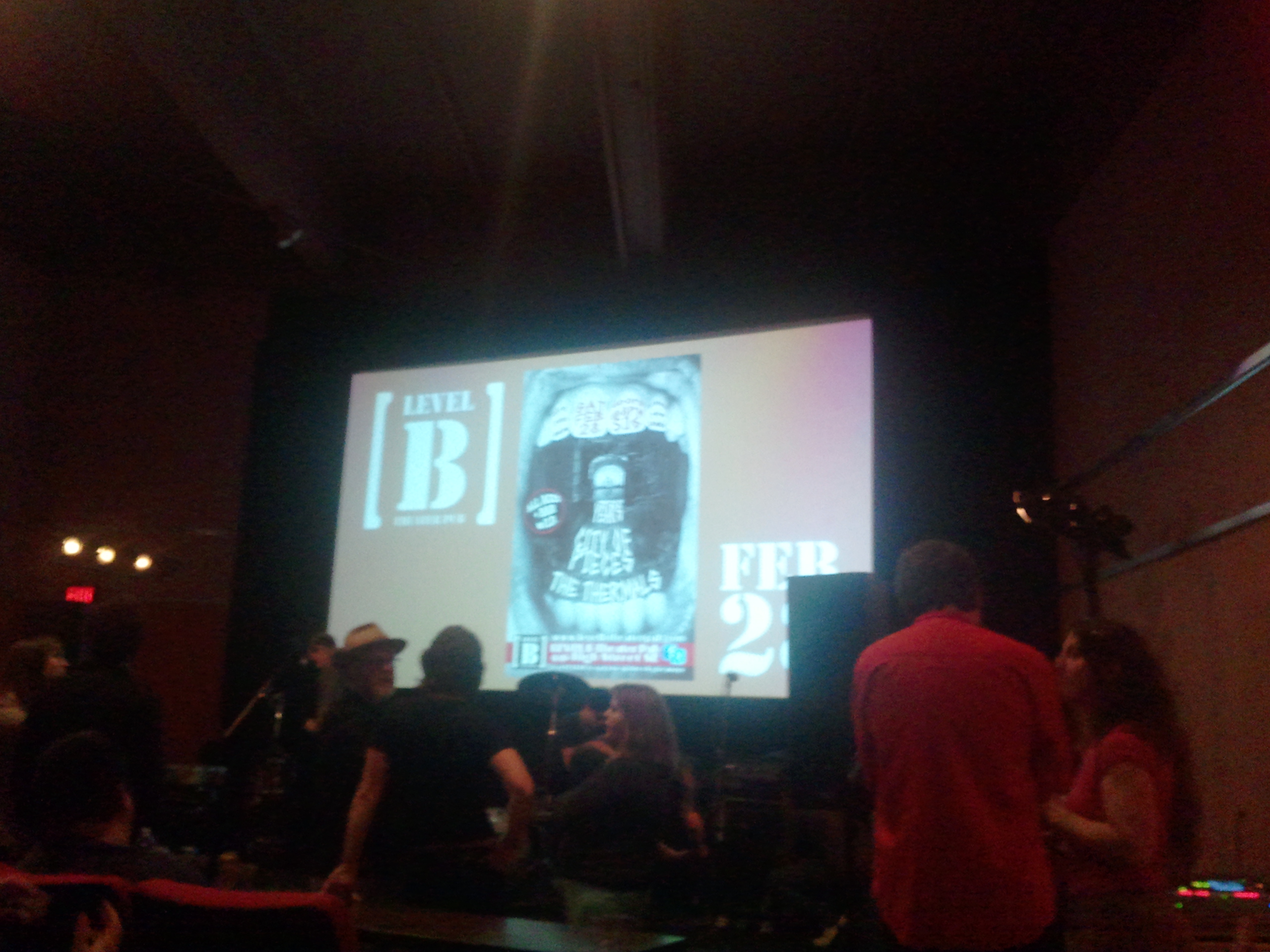
A view inside of the theater with the ad for the show

A view inside of the theater with the ad for the show

As for the openers, they represented both the old and the new of the Salem scene.  Years (the young folks) performed a set of catchy 90’s-era punk with what I assume is some heavy influence from Pavement, while City of Pieces (the old folks) taught the crowd some lessons on the classics, with a style that was reminiscent of The Cramps with their tinge of psychobilly.  Years could use some seasoning, not necessarily to brush up their chops but to work on their songcraft a bit, yet they probably have a bright future ahead of them.  However, City of Pieces was a blast, and I’m looking forward to seeing more of their sets around town, as their presence assures that it will be a fun night.

*Not only did we see The Thermals play Level B last year, but they were also part of the extensive Project Pabst lineup.

**The selection of cartoons included a rather racist episode made things uncomfortable for those paying attention (though the band was thankfully too busy to notice).

Over the Weekend (Mar. 2 Edition)

News, music videos, and other fun stuff to help kick off your March

It seems like there has been buzz about the new Kanye West album for months now, but the follow-up to Yeezus finally has a name: “So Help Me God”.  New material has been trickling out for some time now, and today the studio version of the club-friendly “All Day” was released, with an accompanying video to which we will link but not embed because of a certain amount of nudity that may not be welcome in all work establishments (Update: the video has been pulled).

Our favorite video of the week is Action Bronson’s “Actin Crazy”, which mashes up a ridiculous CGI video with a behind-the-scenes look at the making of said goofy video.

Alabama Shakes stopped by Saturday Night Live this weekend in preparation for the April 21 release of Sound & Color.  “Don’t Wanna Fight” was a nice little peppy funk number, but the standout performance was the electric “Gimme All Your Love”.

It wouldn’t be a Monday if we didn’t have random lists, so here’s SPIN ranking every single Oscar Winner for Best Original Song and here’s Loudwire’s list of the 10 Best Stone Temple Pilots songs, which includes just about every song you would hear from them on modern rock radio, with the welcome addition of “Down” from the long-neglected album No. 4 (though I would have hoped they could have found a spot for the closing ballad “Atlanta”).

Followers of The Thermals on Twitter have long known that singer/guitarist Hutch Harris is a funny guy, but they still may have been surprised by his recent forays into stand-up comedy.  Hutch talks to Splitsider about his longtime interest in the form and the difference in performing comedy versus on-stage as part of a band.  But don’t despair Thermals fans, Hutch hasn’t ditched his regular gig yet, and the band is working on a new album as we speak.

And finally, we regret that we weren’t able to post this video when it happened last week, but frankly it has taken this much time just to process what happened: Jimmy Kimmel had Warren G perform his classic “Regulate” with help from Kenny G.  I’m speechless.

Catching Up On The Week (Feb. 27 Edition)

Some #longreads as you contemplate what happened to February

Not a lot happened this week, but this Pitchfork exploration of the little-known connection between M.I.A. and 90’s punk rockers Elastica was an interesting piece and a highlight of the week.

The music press community has been buzzing these past few weeks about the release of legendary critic Robert Christgau’s memoir, on which Deadspin provides some commentary while Rolling Stone interviews the “Dean” himself.  Personally, I understand his importance to the field of music criticism, and appreciate the fact that he championed some worthy acts over the years, but I often found his writing itself as too clever by half.

Consequence of Sound interviews Wayne Coyne and the Flaming Lips frontman focuses their discussion on love.  I would assume that the site’s editor was disappointed that they ran this piece two weeks after Valentine’s Day.

The AV Club takes a look at Nas’s follow-up to his legendary Illmatic, which gave him his first taste of commercial success even if it didn’t measure up artistically to his debut, as well as providing its readers with a Primer on 80’s UK Synth-Pop for some reason.  One of these pieces is more essential than the other.

And finally, for those of you who are the sort of people who plan things, Consequence of Sound ranks the summer festivals so you can adjust your schedules accordingly.

This Is Not The Anniversary of the Release of Pearl Jam’s “Vs.”

For some reason, the Internet celebrated the FCC net neutrality classification decision with hours of chatter about a pack of escaped llamas.  With all this talk about llamas, my mind turned to Vs., my favorite Pearl Jam album, because of its memorable album cover.   Then there was a huge uproar on social media about the color of some random ugly dress, and my head began to hurt because of the light and my eyes and all the terrible arguments that confuse perception and reality and so on and so forth.  After all this hubbub, I then conducted some additional research and found out that the animal on the cover of Vs. is not a llama at all, like I had assumed after all these years, but is in fact a sheep.

My mind has been broken.  Llamas are sheep and gold is black.  It is nearly impossible to function.

So we’re going to take things easy today, because it’s just too difficult to write a response to this terrible article about how “live music kinda sucks” (and please don’t click on the link for now, but just know it exists) when the mind is broken.  We will instead delay our rebuttal for another time, in part because we will also the piece as a pivot to include a discussion concerning recent commentary on the purposes of live albums.  But that’s for the future.

Dammit, I just remembered time doesn’t exist.  Oh well.

Feats of Strength: British Sea Power

The profile of British Sea Power has diminished considerably in recent years, which makes the title of their debut unfortunately prescient.  While there are several things that I love about Open Season and Do You Like Rock Music?, there is still a certain quality about The Decline of British Sea Power that puts it a cut above and helps establish it as one of the great indie rock records of the last decade.  The band found the perfect mixture of idiosyncratic rockers, catchy anthems, and gorgeous ballads, and twelve years later I still find the record as fresh as it was the first time I listened to it.

There are several extraordinary moments worthy of discussion on Decline, from the bizarre “Apologies to Insect Life” to the epic guitar freak-out of “Lately” to the dazzling instrumental “Heavenly Waters” that closes the album.  But there is one particular aspect from the middle section of the album that we want to single out for closer inspection, when the band runs through a string of songs packed with hooks.  Even amid all those great tracks, the propulsive and energetic “Remember Me” stands out and gets stuck in your head for days, and the key is a subtle strategy employed by the drummer Wood.

The immediate element that grabs your attention is the jagged and raucous twin guitar attack from Yan and Noble, a trebly, noisy blast packed with bends that doesn’t bother to stop to catch its breath as it jumps from riff to riff.  Of course, even after multiple deep listens you aren’t going to shake off those prominent leads, but you can pick up on some of the other parts hidden underneath the surface, such as the brilliant drumwork.  Wood does an excellent job from start-to-finish on this song, expertly deploying fills and keeping a rock-solid beat amid all the surrounding chaos.  I can point to his ridiculous snare-rolls or deft cymbal-work, but the element that I love the most is a very simple trick he does to keep up the energy and provide some variety to keep the song from getting stale.  Listen carefully to the verse (around the :47 mark), and pay attention to how Wood shifts his pattern with each lyrical phrase.  The first line is a standard beat, but then it shifts to a double-time beat on the hi-hat for the next phrase; this alternating structure is repeated throughout the song.

It’s a very small detail, but it’s an excellent example of a drummer providing some extra creativity by deviating from the standard approach, yet not doing too much to overshadow the work of the rest of the band.  By switching between the two patterns, Wood provides an extra push-and-pull to the song and establishes an additional forward momentum, driving the song through the verse into the chorus.  There are several other excellent moments in the song, but this is something that I listen for every time I hear the song.

However, if that’s not satisfying enough for you, then take a few minutes to enjoy the tranquil beauty of “Heavenly Waters”.

Review: Ought – More Than Any Other Day

Rust Is Just Right is not a very large operation, so we may overlook some albums when they are first released.  However, when we eventually catch up and listen to some of these records, we are not going to let the fact that we are ten months behind stop us from writing a review.  The point of all this introductory nonsense is to explain why we are reviewing the debut album from Ought in February of 2015 even though it was released in April of 2014, but the only necessary reason should be that More Than Any Other Day is a fantastic rock record that electrifies the listener with both its furious energy and its thought-provoking experimentalism.

The quickest description that I could use to describe Ought’s sound is “Alec Ounsworth fronting a Fugazi-inspired punk band”, but as you should expect, relying on the reductionist rock-crit namedrop cliche does not paint a full picture.  Tim Beeler’s vocals do mostly recall Clap Your Hands Say Yeah, but that doesn’t cover the spectrum of emotions and contortions that his voice undergoes to match the twists and turns of the music.  For instance, Beeler’s use of dynamics in songs like “Clarity!” bring to mind the theatrics of the Violent Femmes, and that dramatic touch helps create a memorable, slow-burning epic.  He may not have the the most extensive vocal range, but his speak-sing style is effectively used in a song like “Around Again”, as when the band stops and Beeler asks “Why is it you can’t stare into the sun but you can stick your head into a bucket of water and breathe in deep?”

Musically speaking, Ought blurs the line between punk and post-punk, and in the process does an excellent job of making the lives of critics that much more difficult–in other words, it is not as easy to define the distinction as it is with, say, Viet Cong.  Ought often does engage in the full-fledged fury of a more traditional punk band, but they still allow room for experimental sonic elements that makes it hard to pin down to a single genre.  Consider the catchy and frenetic “The Weather Song”, which veers from a jittery verse into frenzied finish that is reminiscent of Wolf Parade (especially with the unusual presence of keyboards), as well as “Forgiveness”, whose use of a violin as a drone adds in a touch of the Velvet Underground to the band’s sound.  I am unsure what is more impressive: the fact that from song to song, it is almost impossible to pin down where Ought will go next, yet the band switches gears in a way that doesn’t give the listener whiplash, or the fact that despite the fact one can spot all these diverse influences rather easily, the band organically incorporates these elements into their sound so well that one cannot pin the “copycat” label on them.

Though only eight songs long, More Than Any Other Day is a dense but rewarding album that reveals itself on multiple listens.  Initially, the most striking element of “Today, More Than Any Other Day” is probably its dramatic tempo and stylistic shifts.  Then you may notice the odd lines of “I am excited to go grocery shopping.  And today, more than any other day, I am prepared to make the decision between 2% and whole milk” that is referenced in many reviews, but you go back and see that it’s not merely a non sequitur but in fact a riff on the previous line that “I am excited to feel the Milk of Human Kindness”, either an allusion to Macbeth or the Caribou album, and now you have to reconsider how all these elements fit together.  The good news is that the album is so great that it is worth the extra effort.

Over the Weekend (Feb. 23 Edition)

New music, new videos, and other fun stuff as you prepare for when the revolution comes

Holy shit guys, we’re actually going to get a new Blur record!  Damon Albarn has apparently found some time in between his three hundred musical projects to record an album with his old mates, as The Magic Whip will be released here in the States on April 28.  As an appetizer, here’s the bizarre lyric video for the weird new song “Go Out”.

Normally, we would have this new video occupy our lead spot–after all, it includes not only a song from one of the best albums of the year so far, but also features some of our favorite television characters as well.  However, it’s not everyday that Blur announces a new album, so the Bob’s Burgers-themed video for Sleater-Kinney’s “A New Wave” gets the second slot, but it should make you happy nonetheless.

NPR has a couple of new albums streaming on their site that are worth sharing: first, Swervedriver returns for their first record in nearly twenty years with I Wasn’t Born To Lose You, and then there’s Of Montreal offering up Aureate Gloom for your pleasure.

Father John Misty stopped by The Strombo Show, and during that appearance he covered the Leonard Cohen classic “Bird on the Wire”.  It’s a bit jarring at first to hear the song without Cohen’s trademark baritone, but Joshua Tillman still makes a fine version.

Death Cab For Cutie have shared another new track from Kintsugi, which will be out by the end of March, called “No Room in Frame”.

Vox takes a look at Eric Malmi’s attempt to determine the Best Rapper Alive by looking at the use of assonant rhyme.  As with most data-intensive looks at creative endeavors, take it with a grain of salt.

And finally, have some fun as the satirical website Clickhole asks the question “How Well Do You Know The Lyrics to Radiohead’s ‘Creep’?” with their ridiculous quiz.

Catching Up On The Week (Feb. 20 Edition)

Some #longreads as you finalize your Oscar predictions…

Fans of Joy Division are probably well-aware that the famous illustration that graced the cover of their landmark album Unknown Pleasures was a graphic of radio waves from a pulsar taken from an old encyclopedia.  However, they are probably not familiar with the origins of the graphic itself.  Scientific American takes a look at the fascinating backstory behind the creation of what would eventually become one of the most famous images in music.

Earlier this week we published our review of I Love You, Honeybear, the brilliant new album from Father John Misty, and for those of you are interested now more than ever about the exploits of the man known as Joshua Tillman, check out the profiles on him by Rolling Stone and Consequence of Sound.

Consequence of Sound also takes a look at the trio BADBADNOTGOOD and how they ended up working with the likes of Ghostface Killah, and while you read it you can take a listen to their album Sour Soul, which is now available for streaming on SoundCloud.  The site also catches up with Elvis Perkins and fills us in on what he’s been doing in the years since 2009’s Elvis Perkins in Dearland as he prepares to release I Aubade next week.  Elsewhere, Pitchfork has an extensive interview with Sufjan Stevens available for your perusal this weekend.

If there’s a band that knows their way around cheap beer, it’s Red Fang, and Portland’s favorite heavy metal band recently persevered through a challenge from Denver’s Westword to rate some of the cheapest beer they could find.  Be sure to use that as inspiration for this weekend.

Ratter provides a great explanation of the copyright lawsuit over “Blurred Lines” between Marvin Gaye’s estate and Pharrell/Robin Thicke that is still making its way through the courts, including discussing exactly what parts of a song are copyrightable and how that can potentially affect the music industry.  You can even hear the musical excerpts from each side’s submissions to the court.

And finally, before watching the Oscars this weekend, be sure to read this New Yorker profile on the career and legacy of Glen Campbell, whose haunting “I’m Not Gonna Miss You” is up for Best Song.  We’re pulling for him to take home the statue, but we think it may be a longshot.