Author: symeo

Sharon Van Etten, Live at the Doug Fir

There’s always something to do in Portland.  One night you can go see Cloud Nothings play at a rundown theater behind a bar, and the next night you can go see Sharon Van Etten play in the cozy basement of the Doug Fir.  In two nights you get to see a couple of the best albums of the year, all within a picturesque town experiencing its finest weather of the year.

(To the outsiders, we’ll keep up the myth of the omnipresent rain (so they won’t move here), but 1). it’s never that much, and it’s usually only part of the day and 2). the summer almost never sees rain, and it’s the perfect temperature.)

They took down the marquee before I could take a picture, so you get this.

They took down the marquee before I could take a picture, so you get this.

The Doug Fir is my favorite venue in Portland: you get all the warmth and energy of a small club, but the sound system is excellent and you can hear all the necessary sonic details in perfect balance.  I have yet to see even a mediocre show at the venue, and it’s been home to some of my favorites over the years, including The Walkmen, British Sea Power, Los Campesinos!, Japandroids, and The Besnard Lakes.  Considering the quality of the acts that they book, my one concern is that I hope that the bands get enough of the gate that it makes their time coming out to Portland worthwhile.  It feels almost selfish that I get to see such great bands play in such a compact club.

The night kicked off with a set from Jana Hunter, touring apart from her regular gig with Lower Dens.  She had a decent set, augmenting 80’s synth-heavy beats (similar to those from the Drive soundtrack) provided by her laptop with heavily processed guitars (think early Jesus and Mary Chain or the most recent Dum Dum Girls record).  It was a perfectly pleasant way to start the evening, with a cover of “Maneater” lifting up the crowd’s spirits in particular.

Though Van Etten’s new album is notably bleak in several places, that didn’t mean that the show was a dour affair.  Sharon was both a spark and a soothing presence on stage, and in between songs she kept the mood light.  There were several fun jokes with the audience, including a discussion of her favorite ice cream (it involved multiple levels of peanut butter).  In other words, she was a complete delight.

Sharon Van Etten, a total delight

Sharon Van Etten, a total delight

Sharon bounced around between several instruments, trading guitars for various keyboard instruments and alternating spots on stage with her backing band.  Each member of the backing band did a great job, most notably the piano player (and Portland native!) who did excellent work in harmonizing with Sharon’s uniquely beautiful voice.  The set was heavy on material from the new album, which is perfectly fine considering how outstanding it is, but it was probably Tramp standout “Serpents” that generated the largest response from the crowd.  The new material sounded even better live, with some of the processed parts sounding more organic in this particular setting.  The show’s climax was the same as the one on Are We There, the heartbreakingly depressing yet beautiful “Your Love Is Killing Me”, and Sharon and her band were able to wrench every bit of emotion possible from that gorgeous lament.

As I mentioned before, the evening wasn’t just one giant downer.  It helped with Sharon’s jokes between songs, like “here’s another total bummer song”, said in a playful manner, or when she debuted a new song, an outtake from Are We There called “I Always Fall Apart”*, she made sure to mention that it didn’t aaalways happen.  The night ended on a cheerful note, as the last song was the light-hearted “Every Time The Sun Comes Up”, punctuated by comical pantomimes from Sharon.  Though I wish we could have heard some of my old favorites like “Warsaw” or “Magic Chords”, Sharon did more than enough to entertain the crowd in advance of the holiday weekend, and helped solidify the greatness of her new album with her excellent show.  Also, she succeeded in making me totally want to hang out with her.

*Not sure if this was the exact song title, since my memory is a little faded from last week (and Google is of no help), but it was along those lines.

Over the Weekend (July 7 Edition)

Hope everyone had a fun holiday weekend, with all fingers and toes still intact.  On to the news and videos:

Big news last week as Death Grips broke up, just in time for me to miss seeing them on their tour with Soundgarden and Nine Inch Nails.  To tell you the truth, I wasn’t fully expecting the group to show up, considering their history, but it’s a bummer nonetheless.  The “break-up” makes sense, in either their own narrative of being an art project or an outsider’s perspective of being a pure troll-job.  At least we can say that a lot of rich people gave them money, and they repaid that debt by giving the public a lot of cool music for free.

Some might say that the biggest news was the leak that Pink Floyd is releasing a new album, but this is only significant for people who never listened to The Division Bell and don’t care that Roger Waters is not involved in the new project.  Still, if you’re looking for an excuse to turn out the lights and fire up Wish You Were Here, might as well make it this one.

Or you could listen to “Wish I Was Here”, a collaboration between Cat Power and Coldplay for the new Zach Braff film of the same name.  I don’t remember much of the movie “Garden State”, but if it got more people to listen to The Shins, I’m perfectly fine with its existence.  I still get chills listening to “New Slang”.

Continuing with another (un)expected collaboration, Rolling Stone has the latest video to result from the Miley Cyrus/Flaming Lips partnership, this time with special guest Moby.  Yes, drugs were involved.

Jack White is continuing to clear out his vault, and announced the release of a single from his band The Dead Weather, along with a live album from The White Stripes.  Pitchfork has the details if you’re interested.

If you’re in the mood for some reading, you could do better than read the AV Club’s Hatesong feature, which continues to be a waste of time for most everybody involved.  This past week saw a comedian complain about Rage Against the Machine’s “Bulls On Parade” because…he was in 8th grade and didn’t like his classmates that liked the song.  AV Club, you’re better than this.

If you need something to lift up your spirits after that, no worries: we finally have a new song from Death From Above 1979.  The track “Trainwreck 1979” made its debut on Zane Lowe’s program on BBC Radio 1, and you can catch it at about the 1 hour and 54 minute mark.  Be sure to set your cursor back a couple of minutes before that, as Zane explains the significance of You’re a Woman, I’m a Machine to many music fans, even if it never sold all that much.  It reminds me of “Sexy Results”, but a quicker and dirtier version of it.  In other words, it’s grimy, but still has a good dance beat.

[Edited to add:] The band has uploaded a lyric video for “Trainwreck 1979” and have also included information to pre-order the new album The Physical World on their Facebook page.

Still bored?  Check out some Best Albums So Far lists, courtesy of Relix and Stephen Thomas Erlewine.  Several the albums we’ve touted appear on both lists, so good news for us, but they should also provide the opportunity to discover other new artists as well.

And last but not least, Spoon continues to release new tracks from its upcoming release, They Want My Soul.  The band released “Do You”, plus Brit stopped by the BBC Radio 6 studio to do a quick acoustic show and interview.

Cloud Nothings, Live at the Hawthorne Theatre

It had been a long time since I’d seen Cloud Nothings live, back when I caught them on an Austin rooftop at SXSW in 2011.  Cloud Nothings morphed from a bedroom/pop-punk project of Dylan Baldi into a full-fledged band, first as a four-piece and now as a trio, with their albums Attack On Memory and Here and Nowhere Else grabbing the attention of both audiences and critics.  I was impressed with them back then, and their recent work enhanced their reputation even further in my mind, so I was eager to finally witness the band’s evolution on stage instead of just on record.

The night kicked off with The Wytches, a band that sometimes provided energy, and sometimes provided noise; melodies were strictly optional.  METZ in many ways followed the same pattern; the way I put it was that “METZ are really good at making a lot of noise at a quick tempo”.  It was a fiercely energetic punk rock, with music that alternated between dissonant chords or emphasizing a bended note for measures at a time, and vocals that were an indecipherable yell.  It reminded me a lot of Side 2 of Nevermind, and then I got a little depressed wondering if the band members were even alive when that album was released.  By the end of their set, they had won me over a bit, as I let the cacophony rain over me and thought “Sonic Youth really should’ve written some more hardcore songs”.

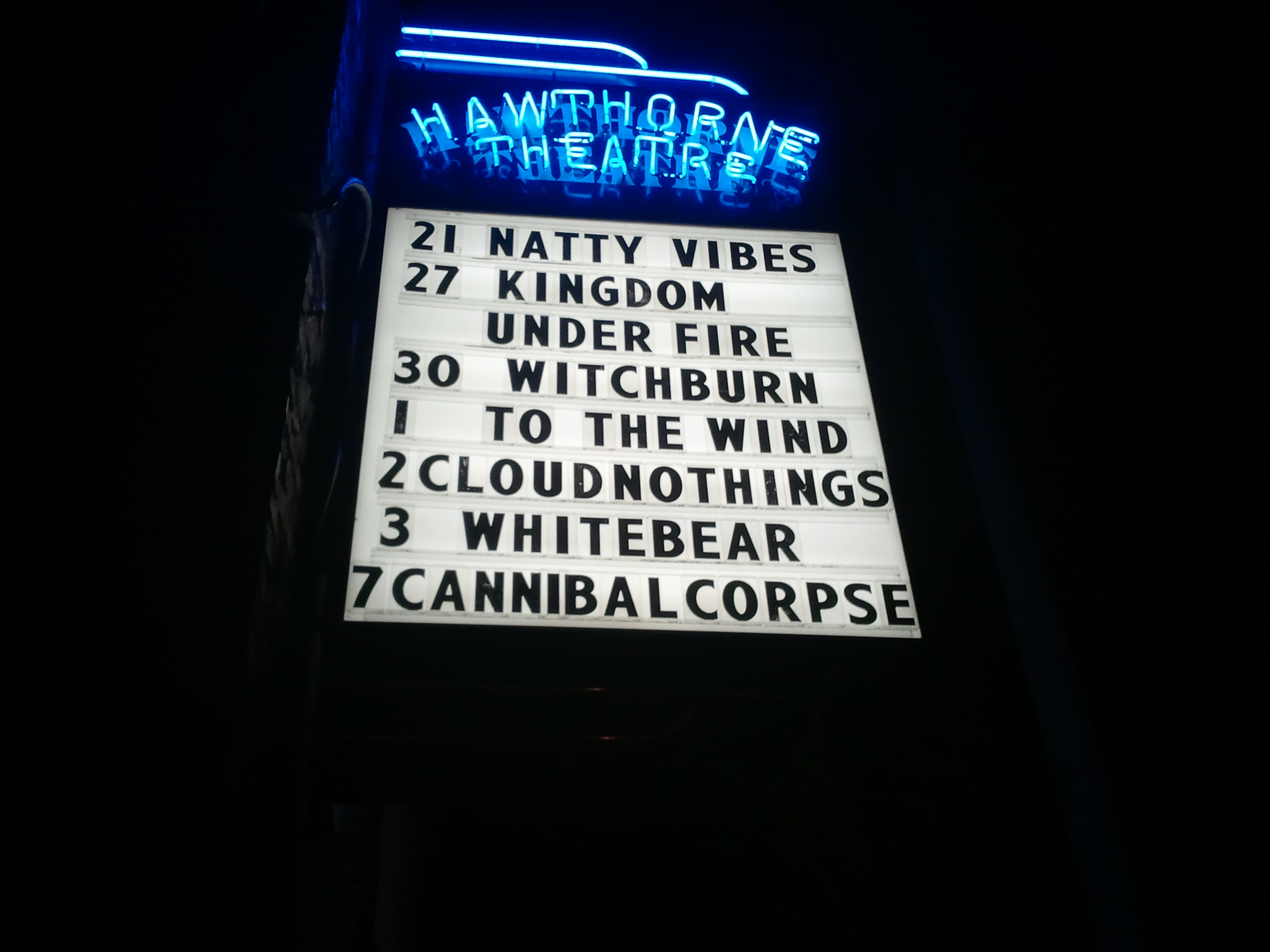
My phone can at least capture a pretty clear picture of the marquee

My phone can at least capture a pretty clear picture of the marquee

As we waited for the headliner to hit the stage, a quick look around the room gave me the impression that a significant portion of the crowd was even younger than the band members themselves.  I’m pretty sure I have some concert t-shirts that were older than many crowd members, and I’m still on the right side of 30 (though to be fair, we moved from the Adult Beverage section to the front in order to have a more proper experience of the show, so that easily skewed my perspective).  But you know, school’s out for the summer, so I’m perfectly fine with the Youth of America heading out to a punk rock show, especially for a band that’s influenced by the group that wrote an excellent album by that name (Portland’s very own The Wipers).

The more recent material from Cloud Nothings has been angrier and more cynical, but Dylan was a perfectly polite host, as he introduced the band to the crowd.  For the most part, the specific interaction with the audience was minimal, since there was business to attend.  The band tore through mostly newer stuff, rarely taking a breath or stopping to tune.  It certainly didn’t sound like the band was just kicking off a new leg of their tour after taking a short break, since the three guys were just about as tight as possible (when I informed my friend of this fact, he said he never would have guessed).

The lighting did me no favors.

The lighting did me no favors.

Each member turned in a great performance, with drummer Jayson Gerycz sounding as spectacular live as he does on record; the ridiculous acceleration marking the climax of “Psychic Trauma” being a particular highlight.  Dylan’s guitar-playing was also quite the sight, as his fingers performed some incredibly nimble gymnastics across the fretboard.  It’s clear that he uses a lot of interesting and unique chords to get that interplay between rhythm and lead, but to see it actually performed in action gave me a whole new appreciation for his composition skills.  Dylan also tore into a couple of fierce solos, with the one in “Stay Useless” energizing an already-amped crowd.

As could be expected, the sound mix wasn’t particularly good, with different parts burying each other.  The bass was especially brutal, often drenched in unintended feedback and overtones, the vocals were often muddy, and the guitar never really loud enough to hear all the necessary details.  The Hawthorne is not a particularly forgiving space, but the band still put on a great performance built on energy and crowd familiarity.  We didn’t need to hear every single note to know that we just heard a fantastic show.

The band has departed.

The band has departed.


Covered: “Just Like Heaven”

Covered is a feature where we examine the merits of various cover songs, debating whether or not they capture the spirit and intent of the original, if the cover adds anything new, and whether or not it perhaps surpasses the original.  If we fail on those counts, at the very least we may expose you to different versions of great songs you hadn’t heard before.

One of my all-time favorite covers is Dinosaur Jr.’s take on one of The Cure’s biggest hits, “Just Like Heaven”.  The Dino version somehow succeeds in being both faithful to the original and irreverent at the same time.  The video above helps make my point, as the band clearly has a bit of fun with the original version by mimicking many of its dance moves, but it’s done in a gently mocking manner instead of a heavy-handed insulting way.  The distinctive bass pickup/drumfill intro remains, but this time at a quicker tempo, followed by a shimmery acoustic guitar that’s a close match to the original.  It’s when the next wave of guitars enter that changes the mood, first with a heavily wah-wah’ed backing rhythm guitar, and then followed by a guitar that’s been whammy’ed within an inch of its life that takes on the memorable melody line, instead of the delicate twinkly style of the original.  It’s at this point that this sounds like a classic Dinosaur Jr. song, though with a more danceable beat.

J Mascis matches the vulnerability of Robert Smith’s vocals, and J’s distinctive whiny drawl actually helps bring out the emotion of the lyrics.  But it’s Lou Barlow’s shouted contribution of “You!” to the power chord-heavy chorus that really seals it, and it makes me crack up every time I hear the song.  It’s so jarring and unexpected that it changes the whole demeanor of the song, but once you know it’s there, you can’t wait for it to appear again.  J then twists the melody into one of his trademark blistering solos, further putting the band’s stamp on the song.  And just when you’re expecting the release from another chorus, the song abruptly cuts out.  For years, I thought I was the victim of a shitty version of the album, but I later found out that no, everyone had the same problem; the story is that the tape ran out while they were recording the song, but they liked the take so much they shipped it as is.  To this day, the band plays it the same way, abrupt ending and all.

For a long time, the Dinosaur Jr. version was the only one I knew; I had known it was a cover, but I never felt like seeking out the original since it was rare that I was in a mood to listen to The Cure.  So it may appear that my opinion is tainted, but no less of an authority than Robert Smith himself has proclaimed himself a fan of the cover, going so far as to say that it now influences how his band plays the song live.  I like the original, but I’ll agree with Mr. Smith on this one.

BONUS TRIVIA: In the Dinosaur Jr. video, the green puppet is wearing a “Deep Wound” t-shirt, which is the hardcore band that J and Lou were in before starting up Dinosaur Jr.

Review: Peter Matthew Bauer – Liberation!

We’ve professed our love for The Walkmen on Rust Is Just Right on several occasions, but even we’re surprised at how much we’re enjoying all the new albums that have been released in the wake of the band’s recent hiatus.  A couple of weeks ago, we reviewed the stellar solo debut of frontman Hamilton Leithauser, and now we’re doing the same for bassist/organist/guitarist/etc Peter Matthew Bauer.  We had never heard Bauer sing before, but we were at least familiar with his presence–his bouncing form was a trademark sight at any Walkmen show, and his instrumental parts were the key components to several of the band’s best songs.  There were high hopes in anticipation of Liberation!, but it was difficult to imagine what the final product would be.

There are still some elements of Bauer’s previous band to be found, most notably the distinctive trebly guitars and the basic but powerful drumbeats (the latter of which can probably be attributed to the presence of Walkmen co-member Matthew Barrick on percussion).  These touches don’t overwhelm the song, but fans of the band should be able to pick them out and appreciate them.  The shambolic solo guitar intro to “Irish Wake In Varanasi (For Big Pete Devlin)” recalls the great hit “The Rat” before switching gears into solid, driving rocker, and first single “Latin American Ficciones” seemingly could have evolved from a lost Walkmen track, an experiment where the band decided to switch vocal duties along with instrumental ones.

But Bauer mixes in a wide variety of unexpected influences into that basic template, including field recordings, latin touches, and most notably a stream of Eastern Indian instrumentation that runs throughout the album.  The integration of these musical influences also mirrors many of the lyrics and narrative themes of the album, as Bauer recounts his unique experiences and encounters stemming from a variety of religious backgrounds, including Hinduism, Christianity, and Scientology.  The album doesn’t look only to the past, however; after its delicate instrumental intro, “Philadelphia Raga” shifts into a slightly bouncy but breezy folk, echoing some of the recent work of contemporaries Real Estate and Kurt Vile.

The title Liberation! does seem to fit the album well, even without consulting the lyrics; there is a definite road-trip feel to the album, as if it were a soundtrack to an aimless but fruitful wandering across the country (and not a direct reference to releasing a solo album, considering the presence of Barrick and musical callbacks).  Bauer acquits himself just fine as a vocalist, carefully not exceeding his range, and makes use of his flat style to deliver his tales of the road in a convincing manner.  Though there are few moments that match the highlights of his previous band, Liberation! is still a nice surprise that’s worth repeated listens.

Over the Weekend (June 30 Edition)

Some videos and news as you begin your week thinking about how dumb Penalty Kicks are

Spoon played Jimmy Kimmel Live last week, with tracks from their upcoming album They Want My Soul.  We had previously heard “Rent I Pay”, but the band also debuted “Rainy Taxi” at the performance.  The first is a ragged, stilted rocker that Spoon has perfected over the years, but the second is a groovy, uptempo number that fits in some of the dissonant touches that the band does so well, and should be a live favorite.

Fans in Oslo were treated to a Pearl Jam rarity, as the band performed “Strangest Tribe” for the first time.  It’s a beautiful, somber song that can be found on the Lost Dogs compilation, and was originally released as one of the fanclub Christmas singles.  A hearty thanks to the fan that filmed this special occasion.

Speaking of Pearl Jam, Eddie Vedder recently received an invitation to join the Academy of Motion Picture Arts and Sciences (you know, the Oscars folks).  Maybe he’ll help clear up the mess that is the nominations process for the music categories.

Rolling Stone has Jack White’s entire Glastonbury set on its site, which included a quick cover of Metallica’s “Enter Sandman” (a specific choice that the article has details about), and also a link to a previous performance with some choice covers including a take on The Stooges’ “I Wanna Be Your Dog”.

And we didn’t get a chance to post this in our traditional Friday #longreads roundup, but here’s a link to an extended interview with Dennis Lyxzen, frontman of the legendary Refused and The (International) Noise Conspiracy, who is now working in a new band called INVSN.

Feats of Strength: The Olivia Tremor Control

Now that summer has officially arrived, I’ve been in the mood for some bright and happy music, driving me to root through my collection for something that could be considered along the lines of the “aural equivalent to sunshine”.  One of the first songs that comes to my mind that fits this exacting criteria is “Hideway” from The Olivia Tremor Control.  And with the upcoming release from the side project Circulatory System, now is the perfect time to explore their style in greater detail.  Like many of their Elephant 6 compatriots, The Olivia Tremor Control were experts mining all the possibilities of lo-fi production, proving that a limited recording budget shouldn’t limit a band’s ambition and scope.  However, the band was in a class of its own in creating a full symphonic sound from a bare-bones orchestra.

On the surface, “Hideway” is a really uplifting and pleasant song, filled with tons of catchy hooks and memorable melodies (for example, I find myself singing those delightful horn parts days later).  The band is really able to sell what in less delicate hands could be a corny message; “I know some kind of rain will fall, but it can’t rain everyday” would fit perfectly on a motivational poster, but the band is able to overcome any possible cynical response due to their sincere conviction that comes through in their singing.  Even the darker imagery in some of the other lines take on a more positive glow, due to the overall message of triumph over adversity.  So when I say “on the surface”, I’m not claiming there’s a subtle, sinister current lurking beneath in the subtext; instead, I’m referring to the many layers of the music itself.

It’s on this track that you can really feel the influence of The Beach Boys on the band’s sound, specifically the careful orchestration of songs like “Good Vibrations”.  On the first few listens, you pick up on the easy-going guitar, the perfectly accented horn lines, and the gorgeous vocal harmonies.  With additional listens though, you can find dozens of layers of instrumental tracks.  There are multiple guitar, keyboard, glockenspiel, horn, and percussion tracks filtering in and out, and the band makes perfect use of the stereo setup by placing specific lines in different speakers.  On one listen, you may notice that in the chorus, there’s a backing guitar line that plays a quickly-repeating-single-note figure that provides a slight push to the beat, in contrast to the easygoing verses before.  On another, you may notice that in the bridge there’s two separate keyboard parts, one running up and down an arpeggiated scale figure, and the other providing short staccato bursts.  Listen again, and you’ll notice wood percussion and bells that mirror melody lines from the vocals and horns.

Each listen brings out dozens of new details, but that alone isn’t what’s commendable about the music.  It’s the fact that at no point does the abundance of instruments and melodies feel overbearing in any way.  At its heart, there is still a great summer song that’s appreciable even on a superficial level, and diving deeper into the nooks and crannies of the music doesn’t overwhelm this basic fact.  Even when identifying specific trees, you never feel as if you’re losing sight of the forest.

The I had the privilege of seeing the band live during its short reunion tour, and it gave me a new-found appreciation of the collaborative nature of the group.  While the group is driven by its two leads Bill Doss and Will Hart, you could sense the joy of each other musician who would join in and play their small part, knowing that while it may seem minor from a distance, each part was a key component to the song.  This goes to the other subtle strength of the song, that the band was able to convey the same intricacy and detail that would be found in a 100 piece orchestra with just a few friends joining along on whatever instruments they found handy.  It’s this quality that made The Olivia Tremor Control one of the most significant bands of the 90’s, and how their music still seems fresh today.

The Folly of the Never-Ending Search of the Rip-Off

We recently saw the release of new albums from Jack White and The Black Keys (events which readers of this site should be very much well-aware), and while we were happy to hear new music from these great artists, that was not all that returned.  If you were to read up on any of the news surrounding these releases or the reviews themselves, you were bound to find the same tired joke/trope/criticism in every piece: these artists were merely “ripping off” old music.  Often this would be accompanied by the added attack that these were white men getting rich off of black music.  While there is an element of truth to this, it’s time to stop resorting to this same hackneyed cliche.

In the past, this was once a novel and significant complaint.  There were vast amounts of people that had overlooked or were  ignorant of the exploitation of artists throughout our history, and this form of criticism helped illuminate the struggle they endured.  It’s why Chuck D’s lyric that “Elvis was a hero to most, but he never meant shit to me” could strike a chord with so many people, both in the fierce resistance by some of an attack on their idol, but also by the support of other communities who could point to how they were left out in the process of cultural appropriation.

It’s taken for granted at this point by many that Elvis built his “revolutionary” rock’n’roll sound off the rhythm and blues music of contemporary black artists like Little Richard.  But this attitude that Elvis “stole” black music is an ultimately shallow analysis and illustrates a pointlessly reductive attitude.  It’s a charge made without context.  Elvis acknowledged the influence of black music and performers throughout his career, and made sure to point it out to others; his career shouldn’t be viewed in the same way as say, Pat Boone’s.

The problem with approaching music in only this way is that it completely reduces the role of the performer.  A song is made up of several components, from the chord changes to the rhythmic patterns to the lyrical content and so on.  While the strength of one part may dominate over the others, to rely solely on that part would make for boring and crappy music.  The fact that we have a whole feature on this site (Covered) where we analyze different performances of the same song helps emphasize this point.  Personal interpretation as well as individual technical skill are both vitally important elements and can significantly change the effectiveness of a song.

[This is where I would put up a video clip of the scene from Spinal Tap where the band spontaneously begins singing “Heartbreak Hotel” at Elvis’s grave, but you’ll have to make do with just the audio.]

The focus on deconstruction of the elements of a song to a simple common origin ignores the collaborative nature of music, and how new works of art are always indebted in some way to past works.  New music is built on the ideas of old music, often through slight tweaks or modifications.  A slight change may seem insignificant on paper, but the effects in reality are often significant–by changing the emphasis of the beat, you can switch a polka (hit the 1 and 3) into a rock song (hit the 2 and 4).  Therefore to identify a song as employing a traditional 12-bar blues structure and then calling it a day is ridiculous.  It invites the assumption that we have already found the One True Blues Song, and everything post Robert Johnson has been a waste of time.

You can play this game with just about any artist.  The Ramones play sped-up Beach Boys songs, Nirvana is a slicker version of the Pixies, Rachmaninoff puts the bombast of Beethoven and the lyrical romanticism of Chopin in a blender, and so on.   I’ve been guilty of this myself, namely when I complain that the EDM scene today is solely a rehash of the work Aphex Twin did over a decade ago, that it’s just “Windowlicker” with a heavy dose of “Come to Daddy”.  But why limit ourselves to music?  I mean, there’s no need for new video games when we already have “Pong”.  And for that matter, what are you doing on your computer, when you have a perfectly good television over there?  It doesn’t take much to show that the entire exercise is pointless.

None of this is to say that “rip-offs” don’t exist; artists still have to contribute something to the exercise.  But pointing out that elements of a song bear a resemblance to previously recorded music is not an end in and of itself.  Because Television used the double-hit ringing guitar in “Marquee Moon”, does that mean that Interpol can’t use a similar figure in “Obstacle 1”?  It should be obvious to any listener that the two bands achieve different results using the same concept, with each having their own merits.

This should be just as clear with Jack White and The Black Keys.  Yes, they are heavily indebted to old styles (namely the blues, but country and folk play roles as well) and they wear influences on their sleeves, but to deny the fact that each of them add significant personal twists on old ideas is idiotic.  They’re also ready and willing to point out their influences and to try and convince their audience to check them out–Jack White is quick to mention Son House, and The Black Keys released an EP of Junior Kimbrough covers.

The “rip-off” argument at this point is close to outliving its usefulness, and comes off now as lazy and a desperate attempt to impress others with the appearance of some music knowledge.  Hopefully we’ll see the end of it soon.