If we are to take Death From Above 1979’s claims at face value and believe that they are indeed machines, then fans should be glad to hear that they are at least constructed from materials incapable of rust. You would be hard-pressed to believe that it’s been a decade since You’re a Woman, I’m a Machine, because DFA1979’s long-awaited follow-up doesn’t miss a beat. The Physical World does everything you would ask following a landmark debut–it maintains the spirit and essence of what made the original so brilliant (perhaps with an edge or two smoothed over), while at the same time attempting new tricks that keep the new music sounding like a mere rehash of previous ideas. In other words, all previous devotees should be fully satisfied, and perhaps the band will pick up some new fans as well.
Death From Above 1979 proves that their formula of stripped-down rock reliant on bass and drums (but not drum and bass) still works, filling the album with plenty of riffs that are both fast and furious. “Right On, Frankenstein!” and “Gemini” would fit right in with some of the more blistering tracks from their debut, like “Little Girl” or “Romantic Rights”. “Gemini” has several catchy parts that will certainly stick in the minds of the listener (the pre-chorus of “she cries on her birthday” and the chorus of “24/7–still believes in heaven” will definitely be parts that the audience will be shouting along with at their concerts) and “Right On, Frankenstein!” features a terrific outro, with the band stopping on a dime before slipping into a furiously-picked rapid-fire 32nd-note bass riff that ends with a bang.
The band also stretches out a bit with great success, dipping into sludge-rock territory with the “Virgins” and getting damn near close to writing a ballad with “White Is Red”. The latter features an inventive bass part that utilizes a gorgeous unique tone that shows that simply because the band uses a limited set of instruments, it doesn’t mean that their sonic palette is in any way constricted. The lyrics are also some of their best work to date; DFA1979 always were able to come up with an incisive line or individual memorable lyrics, but the heartbreaking story of a spurned lover and an unplanned teenage pregnancy in “White Is Red” shows that the duo can craft a complete song and are capable of invoking previously unknown subtle emotions in the listener. It also ends up being the perfect setup to the lead single “Trainwreck 1979”, which sounds as terrific and energetic on the album as it does when it’s livening up rock radio’s otherwise generally moribund playlist. (It also may bear an interesting connection to the previous track, as the track begins with the details of the protagonist’s birth.)
The album ends with the epic title track, a song that shifts from a goofy 8-bit melody into a frenetic punk rocker before ending on a throwback 80’s metal coda, which fades seamlessly into a classical piano outro that mirrors the previous melody, processed through a filter that evokes the soundtrack of a classic horror film from the Silent Era. With the coda, Jesse Keeler comes as close to a bass “solo” as you’re likely to hear from the duo, and Sebastien Grainger shows off some of the drum tricks he’s picked up in the decade since their debut. Once you hear that, you gain a new appreciation for Grainger’s rhythmic support throughout the album, noticing how he’s not only driving the beat but also engaging intriguing melodic support as well by effortlessly shifting styles and patterns. But most importantly, the radical shift at the end shows fans that the band is capable of exploring even more styles, and that the band won’t be running out of ideas anytime soon.
You’re a Woman, I’m a Machine still is in my regular rotation ten years later, and at this point I’m willing to predict that The Physical World will follow the same path as well. It’s already been stuck in my car’s stereo for the past week, and the good news is that I’m not even beginning to get tired of the album. In other words, it’ll be definitely making an appearance on our Best Of list for 2014.
For the first time in Interpol’s career, we can honestly say that their newest album is better than their previous work. While we argued last week that Interpol’s “decline” was not nearly as sharp as some may contend, the band still had issues matching the success of their previous works. The band reached its nadir with Interpol, an album that while striving to push their music into new directions suffered from a clear lack of inspiration, with many songs seemingly the aural manifestation of creative gears spinning without any tangible result. After some time off, the band has regrouped and seemingly found its mojo once again, as for the first time since Antics Interpol seems to be having at least a bit of fun making music again.
The title El Pintor goes beyond being simply an example of clever wordplay by being an anagram of the band’s name and previous album, but also serves as a signal of the creative reshuffling that went on behind the scenes. Even dipping into Spanish was a nice touch, considering how the previous album ended with “The Undoing” and its verse in Spanish, providing an additional connective tissue with this creative reinvention. There were some interesting superficial touches (the cover art adds a bit of blue to the traditional red-and-black Interpol color scheme, the band published a lyric booklet for the first time with the album) that mirrored some of the internal structural changes the band underwent in recording the album. With Carlos D’s departure once Interpol was completed, the band decided that instead of searching for a new bassist that they’d power through as a three-piece, with Paul Banks laying down the bass in the studio (for the record, the band hired a touring bassist, so we won’t be seeing Paul trying to figure out how to play old songs on the bass and sing at the same time). Considering the importance of bass to the Interpol sound, fans were rightly concerned; the good news is that Banks proves himself a more than capable replacement on El Pintor. There aren’t any show-stopping riffs like in “Obstacle 1” or “The New”, but Banks often provides a great groove and a quality counterpoint to the melody in songs like “Anywhere” and “Tidal Wave”.
Traditionally, Interpol albums have begun with a stately, deliberate opener, and for the first 50 seconds, “All The Rage Back Home” seems to follow that pattern, before it pulls a left turn and abruptly shifts into a full-blown rocker. I initially expressed skepticism when the song was first released, mainly for a lead-guitar line that seemed out of place, but the song has grown on me since then and I’ve fallen under its spell and now eagerly anticipate the hell that will break loose when its performed live. Instead, I should have paid attention to more promising aspects of the song, like Sam Fogarino’s subtle touches, like his hits on the crown of the ride cymbal (noticeable around the 3 minute mark) or his work on the toms to help provide some added power to the final chorus. Fogarino has long been the secret weapon in Interpol’s arsenal, and for the first time in years the band has figured out how to take advantage of his gifts. Whereas the group had trouble with avoiding turning their start-stop rhythmic songs into slogs, Fogarino’s nifty hi-hat work on “My Blue Supreme” helps push the song forward and keep the listener’s attention, and his part in “Ancient Ways” is some of his liveliest playing in years.
There just seems to be a spark that runs through El Pintor, which helps give it a consistency that the band has lacked since Antics. The album may not have peaks as high as those on Our Love To Admire, but it doesn’t have any out-and-out duds either. El Pintor is a record that’s also worth exploring in a variety of settings–I’ve picked up several different nuances listening to the album on disc, on the computer, and through headphones, and in each instance the album as a whole has sounded excellent (which is reassuring, considering that the initial stream that I heard compressed the music so much that it was difficult to determine if dynamic contrast existed at all on the record). Some critics have claimed that El Pintor is an attempt to recapture Interpol’s earlier sound, but I would argue that it’s more of a reinterpretation of their more recent direction. There’s nothing that immediately recalls Turn on the Bright Lights or Antics directly, but this album seems to be a natural progression from those records than Our Love To Admire and Interpol were in hindsight. There is the movement towards incorporating more strings and keyboards (courtesy of former Secret Machines member Brandon Curtis) that marked their recent output, though their not at the forefront of their songs; Daniel Kessler’s guitar once again is prominently featured, but he’s armed with better riffs this time and a careful sense of restraint. This helps the songs breathe, and not make it seem like everything has to live or die based purely on the quality of Kessler’s guitar parts. Once again, just as in their best work, the unit is functioning more like a “band” once again with each member fulfilling their role.
The main takeaway for fans is that the band isn’t rehashing tired old ideas, and most importantly, El Pintor signals for the first time in years that there is still a bright future ahead for Interpol.
With the release of Interpol’s fifth album El Pintor yesterday, now is a great time to take a look back and examine the career of the band. Today we’ll analyze their brilliant debut, Turn on the Bright Lights, and tomorrow we’ll see how Interpol’s career developed in the wake of the success of that album.
Few albums have personally affected me as much as Interpol’s debut. When I first listened to the record back in high school, it helped introduce me to whole new worlds of music, providing the gateway to both modern indie bands and to classic post-punk bands from the past (though it would be many years before I truly comprehended what the term “post-punk” meant). It became one of those albums I would spin over and over again, be it as a disc pumping through my car stereo, an iTunes playlist played through dorm room speakers, or an iPod selection performed through my headphones. Over the years, there was one particular situation that would always inspire me to listen to Turn on the Bright Lights, and that was in my frequent airplane trips from coast-to-coast as I shuttled between college/law school and back home. It didn’t matter which was the destination; either way, the album allowed me to both confront and relax away the mixture of emotions that were a result of the trip.
So you should consider my claim that Turn on the Bright Lights is the greatest album released since the turn of the new century with this personal backstory in mind. Simply put, I believe that this album is an example of each individual member playing his part and fulfilling his role perfectly. Daniel Kessler’s beautiful and unique guitar style is the first thing that you notice; his use of single-note melody runs as well as a dynamic array of unusual two and three-note chords (as well as his crystalline tone) helped set Kessler’s guitarwork apart from his contemporaries, and showed how an alternative approach to the instrument can work (inspiring critics to deem his guitar lines as “angular”, a nonsensical description if-you-think-about-it that has nevertheless prevailed over the past decade in comparing guitarists influenced by Kessler, much like how “jangly” became ubiquitous with the rise of R.E.M.). The guitar doesn’t have to be omnipresent for it to still have an impact, and it can still have a massive effect even when it’s used to deploy bits of color to a song. Kessler is helped as well by Paul Banks’s wonderful work on second guitar, which doesn’t rely on playing mere stock chords or basic rhythms but instead provides a melodic counterpoint in weaving melodies around Kessler’s runs (often creating intriguing, rarely-heard chords) or complex rhythmic interplay that help propel the songs in new directions. Of course, you can’t talk about the genius of early Interpol without discussing Carlos D’s mesmerizing bass, which often provided key melodies to the songs and gave musicians everywhere a lesson in how to provide rhythmic support without relying on basic and repetitive patterns. But the real hero may be Sam Fogarino’s drums, and it may take several listens to realize the subtle tricky patterns that he employs without coming off like a showoff that are nevertheless integral to keeping the songs fresh, as well as his ability to provide just the right accents to punctuate all the key moments of the album.
In addition to their fantastic individual musicianship, there are two things that the band does very well that are revealed after multiple listens. The first is that Interpol does a brilliant job of subtly tweaking repeated phrases, both musical and lyrical, a technique that often provides the effect of casting both in a new light. It helps keep the listener on his or her toes by challenging expectations, and also provides an incentive to engage in repeated listens, so as to uncover new musical “tricks”. Interpol are also compositional experts, rarely relying on a basic verse-chorus-bridge formula; not only do they employ the tweaks mentioned before, but they often create dynamic bridges that lead to amazing outros, taking the song in unexpected and rewarding directions.
Before going any further, let’s just address the Joy Division comparisons for a second. The comparison between the two bands is valid, but to argue that Interpol is merely aping or ripping off Joy Division can only be the result of a superficial listening of the two. There are similarities, namely the prominence of the bass and the way that it often provides melodies (especially in the upper-register), the way that the guitar is often used to provide color and as a support instead of the point of emphasis, and the disaffected baritone vocals shared by Ian Curtis and Paul Banks. However, saying that the two are the same fails to take into account that Joy Division’s rhythmic approach was more straight-ahead and based on motorik styles (with Peter Hook’s bass in “Dead Souls” being a notable exception), while Interpol used “funkier” rhythms and switched styles more easily. As for the vocal comparisons, this fails to take into account how Paul would often explore the outer limits of his range, or attempt to convey various emotions more often than the flat, affectless style that was the trademark of Ian Curtis. The two bands are also unfairly tagged as “depressing” music, though this is due to some extent to the way that they present themselves. I think it’s fairer to say that both are serious about their craft, which comes out in their songs, and deliberate in their intentions; even if the themes may edge into darker territory, that is not the same thing as saying they’re both depressing. Interpol can often tread in the realm of the melancholic and gloomy, but after a few listens it’s easier to see both the hope and the humor in their lyrics and music. It’s not “mope-rock” to say the least. However, if you’re a reviewer still stuck on comparing the two bands, John Darnielle of the Mountain Goats once provided a helpful list of other things to which you can compare Interpol.
With these general points in mind, I’d like to provide some personal insights on a track-by-track basis. Hopefully they help inspire you to listen to the album and discover insights of your own.
The album begins with the delicate ballad “Untitled”, starting with a gorgeous, gauzy guitar playing a delicately descending figure. After repeating this pattern four times with a gradual crescendo, the drums kick in with a memorable cymbal pickup, followed by Carlos D’s powerful bass. This actually provides the dominant melody of the song, giving a prelude to Paul Banks’s vocal line. While the song essentially amounts to one line, with each repetition Banks adds a couple of words to the phrase that subtly changes the tenor of the lines, it never feels incomplete (as the title may suggest). After a gorgeous buildup featuring some guitar flourishes, the song ends with each instrument gradually dropping out. But the part that I always captivates me is the bass, which switches from the ambling, rolling figure to a deliberate and decisive conclusion. The effect of the quarter note bum-bum-buuuuuuum line is both ominous and chilling, especially as the third note lingers and you can hear the overtones rattling around your speakers.
“Obstacle 1” is the song that first made me fall in love with TOTBL, and it was unlike anything else I had heard before. Once again, the bass takes center stage in this song, as Carlos plays one of the most innovative bass parts ever recorded. He switches between delicate figures played on the upper register to switching between alternate rhythmic figures in the verse, to adding certain flourishes with his glissandos that slide up the neck before stopping without warning. Kessler’s guitar sounds like a distant alarm, echoing Television’s “Marquee Moon”, before interacting in a subtle interplay with Banks’s rhythm guitar. And then everything slides into place for that driving chorus, featuring the memorable line “as you go stabbing yourself in the neck.” The violence of the line is never really explain, but it somehow still makes sense. It should be noted that Paul makes a subtle switch between the two choruses, singing “It’s different now that I’m poor and aging, I’ll never see this face again” the first time, and replacing “face” with “place” the second time. In the context of the song, which is seemingly about the dissolution of a relationship, this switch shifts the context from the personal interaction between the partners to the setting.
This all sets up the brilliant bridge, featuring some of Sam’s most furious drumming as he shuffles around the entirety of his drumkit, providing the perfect foundation as Banks struggles with the reasons that the relationship has ended. Many critics like to make fun of the line “her stories are boring and stuff”, but this is merely an example how in many songs the narrator in many Interpol songs are either unreliable are unsympathetic; this line is an example of the narrator grasping at straws to end things, which is made clear with the very next line that “she’s always calling my bluff.” The mood then immediately shifts to one of mourning, as he laments the “weights” that she put in his heart, which is contradicted by the consistently ascending guitar part.
“NYC” is a devastatingly gorgeous ballad filled with memorable imagery; the line “the subway is a porno, the pavements they are a mess” is one of the most memorable of the decade, and really captures the grime in the city in more ways than one (it even takes on a whole new meaning when you think of the implication of the idea that the second phrase is a direct result of the first). For me, though, the opening lines are what stick with me: “I had seven faces, thought I knew which one to wear; I’m sick of spending these lonely nights training myself not to care.” It is the single most accurate depiction of depression I’ve ever heard, right down to the selection of “seven faces”, since each day of the week means a different role to play according to social norms.
But it’s not all doom-and-gloom, echoing a mistake that many detractors make when describing the band. Because the band takes that pain and decides to use that to propel themselves–first encouraged by the backing vocals “gotta be some more change in my life”, this builds into a personal call for action as Paul sings “it’s up to me now, turn on the bright lights” as Dan’s guitar elevates to the heavens with a majestic termolo-picked solo guitar line. But perhaps the song’s highest moment is when Sam’s drums emphasizes each quarter note before the last chorus of “New York cares”, as if you can reach through and feel the band sense each of those words.
The track “PDA” is how many people first heard the band, and in many ways this makes it easy to understand why all the music critics insisted on comparing the band to Joy Division in every single review. It’s one of the most straight-forward songs on the album, with a momentum built on its forward-leaning eighth-note drive, and is marked by Paul’s nearly affect-less singing, which makes those connections that critics drew to Ian Curtis pretty clear. One thing I enjoy hearing is Sam switching drum patterns from the hi-hat to the ride cymbal during each line in the verse, giving some lines extra clarity while others get a bit of cloudiness added to the mix. This song has some of Interpol’s most oblique lyrics (I never figured out what “sleep tight, grim ride, we have two hundred couches where you can sleep tonight” meant), though I do enjoy the lines “You’re so cute when you’re frustrated/you’re so cute when you’re sedated”, which can double as both sweet and alarming, depending on the context or your perspective. But it’s the breakdown into the outro which shows the band’s true musical genius, as one single guitar figure is countered with an alternate guitar figure, before the bass adds a third melodic line to an already complex mix. It’s absolutely sublime, and it’s a crime that the music video omitted this section.
When people want to mock Interpol and say that they’re a bunch of sad bastards, I like to point them to the song “Say Hello to the Angels” which has some lines with real, actual humor. Just think for a second what Paul is referring to when he says “I can’t control the part of me that swells up when you move into my airspace” (the line “1-2-3, do me” is a little less subtle). If you think that’s an inappropriate metaphor for a serious musician to use, then you clearly have never noticed the erection joke in Bob Dylan’s “I Shall Be Free”. Musically, I love the alternating moods of the song, from the frantic, driving beat that shifts into a bouncy shuffle, to the deliberate, almost-metal stomp at the end that’s augmented by those palm-muted, percussive guitar strokes.
“Hands Away” is in many ways similar to the opener “Untitled”, and is one of the clearer instances that helps support my theory that the second half acts as a mirror to the first half, with tracks 6-10 partnering up with 1-5. It’s not a perfect theory, but it’s worth thinking about once you’re listening to this half of the album. The song is practically a music theory exercise, with each section seemingly getting faster merely by adding a note to the rhythmic figure (going from quarter to eighth to triplets, etc.). The high point of the song is the gorgeous use of string synths at the climax, as it becomes too difficult to keep adding to the rhythmic figure as laid out before. It’s also worth noting how the vocals switch styles from the first half of the song to the second, from a delicate approach to a more distant and evocative wail at the end.
In my first listens of TOTBL, I had felt that “Obstacle 2” didn’t measure up to “Obstacle 1”, making the comparison in my head even though I had read that the band claimed that the two are unconnected despite the similar names. But over time I have come to love this song even more than its counterpart, even though I recognize the unique creative brilliance of the first one. “Obstacle 2” provides the perfect case to examine how Interpol uses those “subtle tweaks” with its various repetitions to subtly change both tone and meaning. In the pre-chorus, Paul sings “If you can fix me up, girl, we’ll go a long way” twice, but uses a different rhythm each time; the first has a bit of a bounce, reminiscent of someone skipping down the sidewalk, while the second one is deliberately straightforward and on the beat, as if to emphasize the importance of this declaration. This pre-chorus is also repeated twice, with Sam using a different drum fill each time; the first is simpler and emphasizing the downbeat, while the second stutters and staggers a bit. In a song filled with various references to drinking, both direct and indirect (“I stand by all this drinking if it helps me through these days”; “friends don’t waste wine when there’s words to sell”; “toast the snow that fell”), this helps indicate that perhaps the narrator is stumbling a bit as the alcohol begins to take hold. It also puts the final lines of “It took time, then I found you” in a whole new light, depending on how much you read into that interpretation–is it a declaration, or is it a lament?
“Stella was a diver and she was always down” almost works as a reverse of “NYC”–instead of building up, the song is slowly torn down, as seen by its extensive breakdown that concludes the song (forgive me, I’m trying all that I can to make my theory proposed in the write-up of “Hands Away” work). This song features my least-favorite Interpol lyric, but one I rarely see mentioned in those “bad lyric” roundups that critics love to employ when they bring up Interpol; I don’t care for the repetition in the line “the building fronts are just fronts”, especially since this pattern isn’t used elsewhere in the song, and it’s not even used to fit into a rhyme. I feel that “the building fronts are just that” would capture the same idea in a more poetic manner, as the listener could pause to realize the implication of the use of the word “front”. Speaking of lyrics, I’m pretty sure this song is referring to a woman engaging in the art of oral sex, giving a whole new meaning to the title and what specifically is the goal of the diving.
“Roland” is where you can really see where the “punk” in post-punk comes from, and the driving rocker is a great change of pace once “Stella” slowly disintegrated into the bottom of the sea. I love the riffs, especially the riffs reminiscent of spy movies, which I believe helps shed light on the otherwise cryptic lyrics. With this in mind, I believe that the song can be interpreted as a friend being interviewed about the unexpected violent crimes of an acquaintance, with the non sequiturs of the snow and the beard indicative of the narrator’s delicate mental state as he/she confronts the ugly reality of the person they thought they had known.
It took me years before I warmed up to “The New”, but now I believe that it is perhaps the best song on the entire album. It’s a multi-part epic that doesn’t feel burdened by those expectations; the six minutes fly by and though the fragile first half and the sinister second half differ greatly, one can find the connective tissue between the two parts. The song is an excellent showcase for all the talents of Carlos, beginning with his upper-octave melody that begins the song to his restrained support in the first bridge to his stuttering and funky maneuvers that help raise the anxiety of the listener during the song’s climax. It also includes yet another example of the “subtle tweak”, this time with the insertion of a single word that may or may not change the meaning of a line (depending on how you interpret double-negatives in music). First, Paul sings “I can’t pretend, I need to defend some part of me from you”, but on the next time through, he says “I can’t pretend I don’t need to defend some part of me from you”; once you realize that “don’t” can alter what Paul is trying to say, you then go back and realize that depending on the punctuation and emphasis, you can change the meaning of both lines once again. It’s a puzzle that potentially always remains unsolved.
I want to make a special note of the climax of “The New”, which shows once again highlights the strength of each member as musicians. I mentioned Carlos and his bass earlier, who makes excellent use of both the high and low end of his instrument (the latter of which whose sudden entrance near the end of the song helps give a foreboding warning), but I should also point out that the interplay between the two guitars is also mesmerizing. For the guitar solo, Daniel repeats a single note multiple times, creating a tension in the listener’s mind because he/she cannot predict what will happen next; Kessler then responds by actually detuning the string, relieving the tension by physically releasing tension in the string. Somehow the unconventional maneuver of detuning a guitar mid-song sounds more comforting to the ear, if only for a moment, than playing a normal note. After this section, Daniel and Paul play competing lines that both dance around the tonal center, spawning a different kind of tension by devising these unconventional two-note chords. This effort is all underscored by Sam’s efficient drumming, which both effortlessly shuffles between different patterns and provides excellent fills, most notably the big snare-roll fill for the final climax and the subtle crescendo emphasized hits that end the song.
The album concludes with the sublime “Leif Erikson”, an elegant midtempo number that carefully outlines the delicate relationship between opposing partners and worldviews. The guitar chords are often unconventional, using slight deviations from normal patterns to create feelings of unease, but the band carefully resolves the progression each time they’re played. The bridge features perhaps my favorite lyric of the album, which eloquently describes how clumsy the initial communications of love can be: “it’s like learning a new language…helps me catch up on my mime” is an excellent simile, evoking the memory in many people the difficulties of expressing one’s self in a foreign language and the various work-arounds we attempt in order to carry across our message. Once again, synths help provide some nice color, and in combination with the final little guitar solo helps the song end on a hopeful note.
That may have seen like a rather intensive analysis of the album, but it’s only a fraction of the total number of ideas that Turn on the Bright Lights has spurred in me. It’s that amazing of an album, and it’s the reason why I will forever be a fan of Interpol.
There were several new albums released last week that I had been waiting to grab for months, so it should come as no surprise that this week I’m recommending something from that lineup. However, in the days prior to last Tuesday, my preliminary research (listening to a whole bunch of old albums/reading the occasional interview) was focused on a different new release in anticipation of a potential future review, an album different than the one mentioned in the above title; considering the other band’s track record, it was a safe assumption that it would have been the “album of the week”. But it’s the newest release from Cymbals Eat Guitars that has pushed its way into heavy rotation in my music library, and it’s LOSE that is currently climbing up my ever-shifting list of top albums of the year.
LOSE stands out as a guitar-focused, indie rock album at a time when the approach seems almost anachronistic. Musically it often works as a throwback to a more refined version of emo from early in the last decade (especially in regards to the vocals, which can often be a bit abrasive when it comes to hitting certain notes), though I hesitate to use the term because of its negative connotations these days. Though the album’s lyrical inspiration was the loss of a close childhood friend during the early years of the band, it’s a mature response that never comes off as pouty or whiny, a characteristic that puts the group above many of the more famous emo acts.
LOSE kicks things off with the stellar “Jackson”, a contender for album opener of the year along with Lost In The Dream‘s “Under the Pressure” and Turn Blue‘s “The Weight of Love”. “Jackson” is a song that doesn’t telegraph its intentions from the outset, declaring to the listener that “this is going to be one of those epic songs, and you’ll know it from the second we start playing”*; instead, it begins gradually, adding layers of instruments and emotion over the course of its running time. The build is so natural that it comes as a complete surprise that you start air-drumming and singing along at the top of your longs 3/4 of the way through the song. By the end though, when reflecting on what you just heard, you can say “oh, I see how they got there.”
*Not that this is necessarily a bad thing, because I love several “epic” songs whose scope is obvious from the outset, but I think it’s more difficult to successfully accomplish the feat in this manner
The album keeps the momentum going with the next two tracks, “Warning” and “XR”. The former offers an intriguing variation of a traditional punk/emo motif, riding an uptempo riff with a slight tweak in the connecting notes between the chords that is jarring to hear on first listen, but makes sense in context. “XR” is a harmonica-driven blast of whip-fast earnest punk rock, that makes it seem like the band had been listening to a lot of The Monitor by Titus Andronicus, without actually ripping them off.
The other major highlight of the album is “Laramie”, a big sweeping ballad that pushes and pulls the listener with an abrupt back-and-forth start-stop rhythm, that then switches gears and shifts into a rowdy driving rocker halfway through. It’s not style-mixing for the sake of it, however; the combination feels organic in the band’s hands. LOSE ends with “2 Hip Soul”, which follows a similar template, but when it shifts it calls back to the opener “Jackson”, eventually devolving back into the solo piano that began that song, in effect making the album an infinite loop.
LOSE is an incredible accomplishment for Cymbals Eat Guitars, who in some sense lost their way a bit with Lenses Alien after their catchy debut Why There Are Mountains. However, when looking back it’s easy to see that Lenses Alien was a necessary step in their development, as the band developed their chops a bit more and experimented with different ideas, but simply failing to recall their knack for the memorable melodies that marked their debut. LOSE combines the best of their previous work, and even then the sum is greater than its parts.
There are few things that would convince our crew to venture into the depths of southern Washington, but it shouldn’t be a surprise that a concert co-headlined by two of the greatest bands of the 90’s would qualify in that select list. Yes, after months of talking about this unlikely partnership (check out everything we’ve written mentioning the tour by clicking on either of the band’s tags above), we here at Rust Is Just Right were finally able to witness the collaboration in person. Both groups had wowed us with memorable shows in 2013, but the question remained whether either band could impress us once again in 2014.
This is the best photograph I have to commemorate the show.
Based purely on the logistics of the different stage setups, it made sense for Soundgarden to come on first. However, once the introductory rumblings of Badmotorfinger‘s “Searching With My Good Eye Closed” began to snake its way throughout the amphitheater, it was clear that the band had no interest in treating their slot as if they were merely an opening act, and thankfully, the audience reciprocated by standing up and raucously cheering. This isn’t always the case–years ago, when Queens of the Stone Age and Nine Inch Nails toured together, I remember that the audience at the Rose Garden collectively decided to keep sitting through the entirety of QOTSA’s set, even though the band had clearly established itself post-Songs of the Deaf as one of the top bands in rock. It can be a frustrating experience trying to rock out while staying firmly planted in your seat.
Soundgarden was impeccably tight and in fine form, as the reunion has shown that they still have the capability to line up their incredibly complex musical parts with astonishing ease, while extensively touring once again has improved their ear for balancing the sound mix in an arena setting. To the crowd’s delight, the band focused on mainly their classic early material, with several cuts from both Superunknown and Badmotorfinger representing the majority of the set. Hearing deeper cuts like the one-two punch of “My Wave” and “Let Me Drown” made my night, but the crowd’s biggest response was actually for Down on the Upside‘s “Burden In My Hand” (a fine choice if you ask me). It’s a pleasure to see guitar-god Kim Thayil playing once again, and he effortlessly pulled off astonishingly sophisticated leads without breaking a sweat, and it was a blast to watch Ben Shepherd attack his bass in his own bizarre and unique way. Matt Chamberlain proved to be a fully capable replacement for the legendary Matt Cameron behind the kit, creating another interesting link between the history of Pearl Jam and Soundgarden. It takes real talent to line up the intricate drum part of “Rusty Cage” with the weaving guitar and basslines, but Chamberlain was able to pull it off. The biggest wild card at a Soundgarden show is usually Chris Cornell’s voice, and for the majority of the show it was on point. It takes some adjustment on the part of the audience to realize that it’s impossible to pull of the multi-tracking vocals of the albums, but once that’s accepted, you can just marvel at the ability of Cornell to maintain that ridiculous range at his age. Personally, I would think that it’d be easier if he settled on a lower register as he ages, but he’s still able to hit all those big screams and high notes.
Soundgarden begins rumbling…
Amazingly enough, we had yet another headliner to see. With last year’s Tension tour, Nine Inch Nails provided some of the most amazing visuals ever developed for a rock show, setting the bar extremely high for this show. The theme this time seemed to emphasize the minimalist element of Hesitation Marks and bring it to the live show. The show began with Trent singing “Copy of A” on a bare stage, with different musicians gradually joining with small keyboards and electronic percussion. Eventually both the light show and the musical setup became more complex, building layers on layers throughout the set. For this tour, Trent stuck with a roster of only three other musicians to play the multitude of parts that make up a Nine Inch Nails song, switching out instruments with each track in a remarkable display of versatility.
Since the impetus of this tour was mainly nostalgia-based, commemorating the twentieth anniversary of The Downward Spiral, and that album along with Pretty Hate Machine made up most of the set. Trent still mixed in a fair amount of material from the latest album, but unfortunately for us, not a single track from The Fragile despite our specific plea from last week; at least we did get “Gave Up” as a consolation. But the goal wasn’t to just provide a rehash of the hits–time and time again, the band reworked old favorites with inspired new arrangements (though I wish that at some point Trent would leave the outro to “Closer” alone, because I believe that it’s fairly close to sheer instrumental perfection).
You can see why I went with a photo of the ticket as the lead
With the extensive production that Trent and company brings for each tour, it’s difficult to recap all the specific details of the elaborate visual components of the show. One particularly memorable song was “Reptile”, whose lights used a solely green motif, and when mixed with the mechanical sound effects of the songs recalled the kind of scene you would expect if you found yourself about to enter an arena to face off against the Mortal Kombat character. Another highlight was “The Great Destroyer”, which synced up to distorted, fuzzed-out images of violence, war, and various politicians to great effect (while also subtly integrating various configurations of red, white, and blue lights). It also set itself apart in that the song was one of the few times where the light show ventured beyond the abstract images and lights and into actual graphic images.
As impressive as the visuals were (and it’s hard to overstate just how groundbreaking each Nine Inch Nails tour is in this regard), they never overshadowed the musical performance. I can say this even though I was disappointed to miss out on more than a few personal favorites (though considering the band’s extensive catalog, that’s to be expected). Trent was a constant display of barely pent-up rage and viciously attacked the microphone with each song, as if he was grappling with an unseen enemy when delivering his vocals. The other musicians effortlessly switched between samplers and instruments, showing their full capability of handling both the analog and the digital as well as matching the intensity of their ringleader.
As expected, exiting the amphitheater was a nightmare on all levels, and we enjoyed another early-90’s classic, Enter the Wu-Tang (36 Chambers) in nearly its entirety before even reaching the interstate. At least I-5 south was a breeze after that–here’s to small miracles.
Beck’s most recent album, Morning Phase, is a brilliant companion piece to the somber Sea Change, but his live show at Edgefield last week recalled a different era of his career–the rocking and free-wheeling days of Odelay. The attention of most of the public was on LA last weekend, but the best performance of the week took place about 800 miles north and a few days earlier. Beck and his backing band were energetic and fired up and delivered an absolute knockout of a show.
Beck kicks things off with a fiery “Devil’s Haircut”.
To be honest, this kind of a performance came as a complete surprise to me. I had seen Beck live once before, back during the Modern Guilt tour in 2008, and in many ways it was easily one of the most disappointing shows I’d ever seen. He and his touring band played well enough, so from an aural perspective it was fine, but Beck hardly moved at all the whole time, and didn’t seem engaged until late in the encore. Earlier this year, during the press tour in advance of the release of Morning Phase, Beck had mentioned that he had sustained a back injury and was in a lot of pain during that time, which helped explain the lackluster show. Still, I wondered if this was only a convenient excuse; given how switched-on Beck was on Thursday night, I’m inclined to believe him.
Beck wasted no time getting down to business by opening with a fuzzed-out rendition of “Devil’s Haircut” that had the crowd singing along to every lyric. “Black Tambourine” got a surprisingly welcome response from the audience, but it was their reception to “Loser” that inspired some deep thinking on my part. Consider for a moment how a tossed-off lark of a song like “Loser” is now recognized as a cultural touchstone; especially now that we’re in an era when culture and especially music is extremely fragmented, yet people of all stripes universally love this song. I want to be there for the day eighty years from now when anthropologists explain to a skeptical public that the highlight of the day for thousands of people was when they got to sing along in unison the lines “I’m a loser baby, so why don’t ya kill me?” Initially, the line was ironic; a decade later it was nostalgic; and twenty years later it’s practically warm and fuzzy.
Even the more sedate material was captivating.
Early on, Beck often made mention of a noxious odor that had settled down near the front of the stage, commenting at several pauses during the set about the unexplained smell. It was indeed unpleasant, but the band and the audience were able to ignore it soon enough, and the rest of the set went off without a hitch. Beck effortlessly incorporated the new songs from Morning Phase into the set without disrupting the momentum, though perhaps the trade-off was a near-absence songs from Sea Change, besides a gorgeous version of “Lost Cause”. It never felt like that Beck had to “slow things down” to get to the more delicate material, and songs like “Wave” and “Blue Moon” became even more powerful in their live versions. Still, the most memorable moments were when the band dipped into older material, like an extremely raucous version of “Novocane”, which morphed into a fierce solo-harmonica version of “One Foot In The Grave”, and a rowdy rendition of the oldie “Beercan”. I also enjoyed hearing a couple of songs from Modern Guilt, as the guys performed both the title track and “Chemtrails”; the latter was apparently a song in which Beck felt rusty, because he had the lyrics taped to a monitor and could be seen reading off some of the lines as he was performing, but it had no bearing on the performance, especially the roaring climax of the song.
As great as the set was, the encore blew it out of the water. After they closed with “E-Pro”, police caution tape was used to mark off the stage; bassist Justin Meldal-Johnson then returned and began whipping the crowd into a frenzy by asking if they felt like breaking some laws tonight. The band then launched into a highly entertaining performance of “Sexx Laws”, the police tape was cut, and the show continued. Beck kept the mood funky by calmly transitioning into fan-favorite “Debra”, spicing it up with some great ad-libs about Oregon and all the perks that his frequent flyer card apparently holds. During the final chorus, Beck changed up the lyrics and said he didn’t care about the sister (Debra), he just wanted to get with Jenny…and brought up opener Jenny Lewis to the stage, where they collaborated on an exceptionally amusing cover of Rod Stewart’s “Do Ya Think I’m Sexy”. Beck and friends and family then finished the night with an extended version of “Where It’s At”, filled with solos highlighting the different members of the band, before it morphed into a dance party on stage with a cover of “Billie Jean”. All throughout the show, you could see Beck’s children running around backstage, but for the last couple of songs they became a part of the performance as they danced around on stage with the rest of the band; the presence of Beck’s son added some hilarity to “Billie Jean”, as he mockingly felt rejected every time Beck sang “the kid is not my son.”
The only bad part was that we had another day to wait before it was the weekend; that, and the fact that once the show was over we noticed the smell again. Otherwise, it was pretty close to perfect (though it would be great to hear some stuff from Mutations at some point, but I digress).
Summer may be winding down, but luckily it’s not over quite yet; there are still a couple more weekends for you to enjoy some sunshine and relaxation before the horrors of autumn begin. However, you might be getting a little annoyed with listening to the same Summer Mix playlist on your iTunes–a perfectly understandable concern. To that end, it is worth checking out the self-titled debut of the sunny beach-pop band Alvvays.
(Ed. note: from what I’ve read about the band, despite the odd spelling, the name is still pronounced “Always”)
There have been several bands that have mined this vein of indie rock in recent years, most notably DIIV and Real Estate; the trademarked trebly guitars laced with reverb, the simplistic percussion, and the general laid-back vibe are all present on the album. Even though there are many strong similarities between these groups, the upbeat disposition of many of the songs as well as the unique vocals of Molly Rankin help distinguish the group from its peers. Whereas Real Estate would be perfect for spending the day relaxing by the ocean, Alvvays fits better as the soundtrack to help get you amped on the car ride to the beach.
The album begins with a 1-2 punch of “Adult Diversion” and “Archie, Marry Me”, and it’s easy to see why these two songs were the first singles. “Adult Diversion” is propelled by a bouncy arpeggiated guitar part and airy vocals, a combination where one can note the apt comparisons to DIIV, but the true engine is the driving bassline, which provides both momentum and a great counterpoint. “Archie, Marry Me” is a a great pop song with a big chorus, with a style that recalls the Dum Dum Girls and their attempts to capture that 60’s nostalgia haze. While it’s easy to get caught up in the big sweeping hooks, the best part of the song is actually the feedback-drenched lead guitar in the second verse that provides a necessary subtle edge to the gauzy production.
The album is not without its problems, as the momentum begins to sag around the middle with “The Agency Group” and “Dives”. The latter is actually a well-done ballad with enough unique touches that are promising for the future, but within the context of the album it just ends up being a drag. Alvvays is able to avoid falling off the rails with the energetic “Atop A Cake” and its extremely catchy chorus, which should have you singing “How can I lose control when you’re driving from the backseat” long after you’ve finished listening to the album. Other highlights include “Ones Who Love You”, a great slow number that gradually builds into a shocking climax of “You can’t feel your fucking face” before breaking back down once again, and the midtempo song “Party Police”, which is built around an intriguing minor-key guitar lick and finds Rankin hitting an unexpected high note like Dolores O’Riordan of The Cranberries or Sinéad O’Connor.
When Alvvays is hitting on all cylinders, it’s a fun ride; unfortunately, there are a few too many moments when it stalls. That said, it’s a solid debut that can easily find a place in any future Summer Mix, and the band displays enough talent that it’s worth watching what they do in the future.
Portland celebrated MusicFestNW this past weekend, and it looked a little different than it had in past years. Instead of a colder, wetter version of SXSW (with a city more equipped to handle the traffic), we got a Northwest version of the current incarnation of Lollapalooza and other similar festivals. We didn’t have to buy tickets to multiple venues and plan across a whole week, but instead had a two-day festival in a specific part of the gorgeous Waterfront Park, soaking in that last bit of summer before the inevitable gloomy fall.
We decided to skip the first day since there were no acts that seemed worthy of shelling out the extra money for another day of tickets (with all apologies to Run the Jewels, for whom it would probably be worth to pay a full-day’s admission to see on their own). I’m going to avoid the opportunity to talk smack about bands for whom I don’t particularly care, because we here at Rust Is Just Right try to set ourselves apart by not indulging in condescending snark and instead promote what we enjoy. But in private, let’s just say there were a lot of good burns that were shared.
Portland’s Waterfront Park, on a non-MusicFest day.
Our plan on Sunday was to catch the lineup starting from The Antlers until the end, but thanks to several accidents on I-5 our ETA was delayed by about an hour. Luckily, we still caught the last few songs of The Antlers’ set, a circumstance which mimicked my previous limited encounter with their live show when they only performed a short showcase at SXSW. One would think that their delicate and fragile songs would not be ideal for a live show, especially in a large festival setting, but once again I came away extremely impressed with their performance. We were caught wandering around the backside of the cordoned-off grounds for “I Don’t Want Love” (mistaking beliving that there would be entrances on the bridge side), but we were still able to hear the devastating power of the song even filtered through the backstage equipment.
The Antlers: “Music Band Northeast, glad to play Music Fest Northwest.”
Once we finally settled in to the proper area, we heard a couple of songs from their latest album Familiars. I haven’t yet internalized the nuances of those songs, but I can assure you that they come off very well in a live setting. Perhaps the biggest surprise was their last song, “Putting The Dog To Sleep”. It’s a great closer on Burst Apart, but given the specific nature of the song, it wouldn’t appear to be the most natural way to end a set. The song was as cathartic as expected, but the band added an additional musical twist: first they began the natural breakdown of the song, taking pains to stretch out the chord progression while keeping the resolution slightly out of reach, but then building the song back up with an extended instrumental section that dazzled the crowd.
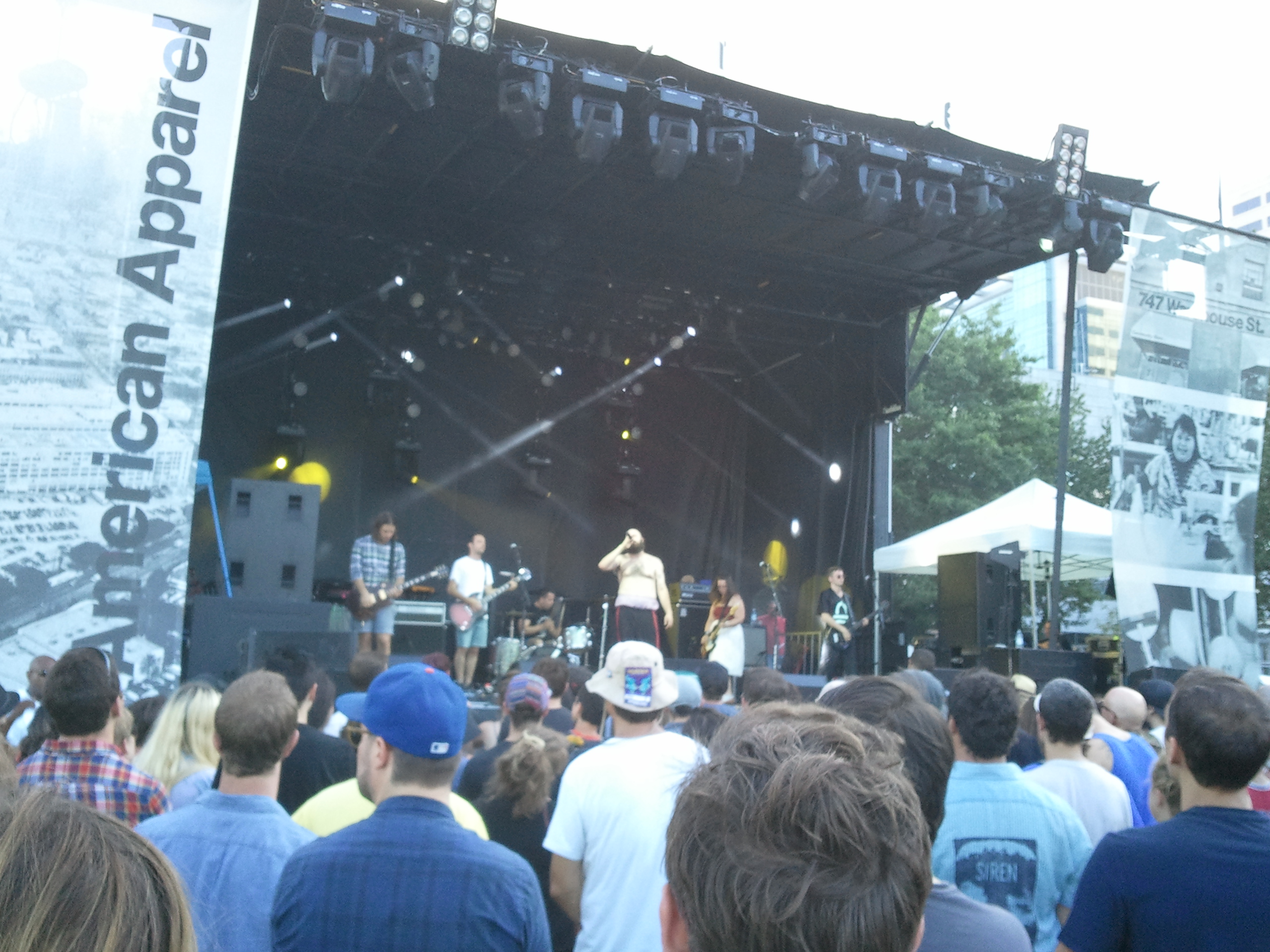
You know this was from early in the set because Damian Abraham’s shirt is still on.
We then made our way to the other end of the park, where Fucked Up was set to perform next–a transition that ranks among the most jarring ever scheduled at a music festival. Here is a great opportunity for praising the new setup of the festival, as this allowed minimal time wasted between different acts as they had the necessary amount of time to setup without holding the crowd hostage, and the distance between the two sets was both short enough for the walk to not be burdensome while long enough so that there was not any bleedthrough between the two stages. Someone deserves some extra kudos for that solid planning.
We’ve shown our love before with our glowing review of Glass Boys, but even we were taken aback at just how awesome Fucked Up’s set was at MusicFest. I’m willing to claim that their hour-long set alone was worth the price of admission for the full day’s lineup. There’s really nothing quite like seeing the giant hulking mass of positive energy that is Damian Abraham working his way through the crowd, giving hugs to folks passing by, climbing on top of the fence to sing out to the people on the river, and high-fiving a baby as the band ferociously kept up and played in lockstep. Seriously, Pink Eyes high-fived a baby–that immediately became an all-time top-five concert moment for me personally.
Pink Eyes, now sans shirt.
I believe most of the set was from Glass Boys and David Comes To Life, though I will admit that sometimes it can be difficult to tell certain songs apart. At least none of my personal favorites from The Chemistry of Common Life came up, though the rarity “I Hate Summer” made a welcome appearance, with a thoughtful introduction from Abraham on how one shouldn’t listen to personal attacks from others who are merely trying to shame people for no good reason. He also at other times mentioned the healthful benefits of weed and the terrible events occurring in Ferguson, MO, with each speech receiving thunderous applause. The band was tight, as I mentioned, but also could have benefited from an extra volume boost to help compete with Abraham’s sharp bellow, and also to help distinguish between the various components of their three-guitar attack. Unfortunately, it seemed that the raucous set eventually drove the crowd away, as it seemed after their initial welcome that many people grew tired of listening to an hour of hardcore, and eventually made their way back to the other end of the park. Then again, perhaps it was the heat finally getting to a few people, and the need to stock up on food. I hope it was the latter, because Fucked Up deserved a new wave of fans after that performance.
A glimpse of the color of tUnE-yArDs
We had previously seen tUnE-yArDs when they opened up for The National only a few months ago, and in between it seems the set morphed from less a capella and looped percussion to more synths and live percussion. That’s not to say that the music was any more conventional–there is still a dominant left-of-center sensibility. For those who are unfamiiliar, the music of tUnE-yArDs is filled with complicated rhythms and tribal influences with world music type lyrics. In other words, at many points through the set I thought I was living through a real-life Portlandia sketch. Despite this vague feeling of uneasiness, I still really enjoyed the tUnE-yArDs set, as did the hundreds of other people that packed the listening area.
I ate a lamb gyros.
We ate dinner during HAIM. Mine was delicious.
I save my worst photography for last.
Spoon closed out the festival with a fantastic headlining performance, with a setlist that went deep into their catalog. You may have noticed that we here at this site love the band quite a bit, and let’s just say that we loved every minute of their show. Britt Daniel, former Portland resident (who gave a shoutout to SE during “Black Like Me”), remarked that it had been a long time since their last show in the city, back when they performed at the Crystal Ballroom in 2009; as an attendee of that concert, I could only shout out “too long!”
Just to show that the festivities extended into the night.
In their live show, Spoon manages to perfectly balance between precision and spontaneity, as the band can maintain both a perfect verisimilitude of their albums and allow for individual players to freak out and revel in the moment. The band mixed in a healthy amount of their stellar new album They Want My Soul, and even some of the more experimental tracks like “Outlier” and “Inside Out” sounded perfectly at home within the set. The crowd roared when they heard old favorites like “Small Stakes” and “I Turn My Camera On”, but saved their most appreciative response for the hits from Ga Ga Ga Ga Ga like “Don’t You Evah” and “The Underdog”. Personally, I was glad to finally hear some of Transference live, including an extremely passionate performance of “Got Nuffin'”, and to witness at least one Girls Can Tell song, the sublime “Anything You Want”. The only odd part was that besides Britt there seemed to be several band members that wanted to get out of the show in a hurry–the band ended up doing two encores, which seemed to be partly the result of some poor time budgeting. It may have been the result of getting used to one-hour slots on various festivals and not properly adjusting to a headlining 90-minute slot, but from a distance I could see the look on some of the faces of the band members that they were hoping to cut things shot. Despite this, Spoon more than justified taking the top spot on the bill; I’m just hoping for a proper show at some point from these guys in the near future.
We’ll just get this out of the way early: They Want My Soul is a fantastic album, and is a worthy addition to the Spoon canon. Once again, the band pulls off the incredibly difficult trick of writing a record that is true to their song, without sounding as if they’re recycling the same old ideas. Each track that reminds the listener of an older Spoon song doesn’t come off as a retread but instead forges new territory, and then the other songs finds Spoon branching off into new and exciting territories while still maintaining their identity for articulate, incisive music.
Each Spoon album reveals itself over time to have certain musical themes–Girls Can Tell focused on quiet, somber reflections, Kill The Moonlight found an edge through its use of piano, Gimme Fiction pulled back with its use of guitar, Ga Ga Ga Ga Ga was straight pop music, and Transference deconstructed pop music. If I were to pinpoint a musical theme with They Want My Soul, it’d be something along the lines of seeking to revive one’s inner spirit. It seems self-evident if one looks at the album title itself, and the fact that for the first time in their career have a song and album share the same title seems to underline this. The song itself brings to mind a similar sentiment expressed in Wilco’s classic “Theologians”, but done this time with a bit more aggression and rebelliousness–not just in the lyrics, but in the attack of the guitars. There similar strains of this sentiment throughout, such as in the swagger of a song like “Rainy Taxi”, or in the defiance of “Inside Out”, with its aversion to “holy rollers”.
Spoon even is able to accomplish something that most rock bands at the turn of the century could only hope to pull off, and that’s to incorporate dance and electronic elements without coming off as gimmicky. “Outlier” is what Better Than Ezra was trying to accomplish with their album How Does Your Garden Grow?(and that’s coming from a rare fan of that album), in that the electronic percussion and dance beat seem to be an organic part of the song, and the processed guitars and keyboards actually enhance the song by providing both neat-sounding noises and actual melodies. “New York Kiss”, a collaboration with Semisonic’s former leader Dan Wilson (and the writer who helped Adele into a sensation, most notably with “Someone Like You”; a collaboration that’s hardly been mentioned in most reviews for the record) is an even deeper foray into dance territory, and is an irresistible pleasure to boot. My only issue is that I can’t think of the specific early-2000’s rock act that it reminds me of, but that in and of itself does not detract from the joy that naturally comes through when bouncing around to its beat.
Considering those two songs, it then becomes extremely irritating when you find critics complain that TWMS sounds like a typical Spoon record; go back and listen to those two songs, and then remind me again where Spoon delved into those styles previously. And these are people that are actually paid to write about music and presumably have ears. That said, when Spoon goes into their wheelhouse, they can still pack a punch. There’s their usual excellent cover, this time a version of Ann-Margret’s“I Just Don’t Understand”, where the band once again adopts that smokey and dark jazzy swing that they do so well, as well as their own brilliant original “Do You”. I’m glad that radio has switched over to this single instead of “The Rent I Pay” (a song where the previous criticism of repetition was more valid, but a song whose quality is strengthened when placed within the album as a whole than as a stand-alone track), since it’s hard to get enough of that deep groove and those ooh-ooh-ooh-oohs. Careful listens eventually reveal nifty little details, like the delicate layering of subtle background synth parts or the parabolic nature of the ooh-ooh parts, all while maintaining an infectious melody throughout.
That pretty much encapsulates the album as a whole as well–it’s been playing constantly in my car, on my stereo, and on my iPod since its release, and like all the Spoon albums before it, it’s unlikely to wear out its welcome anytime soon.
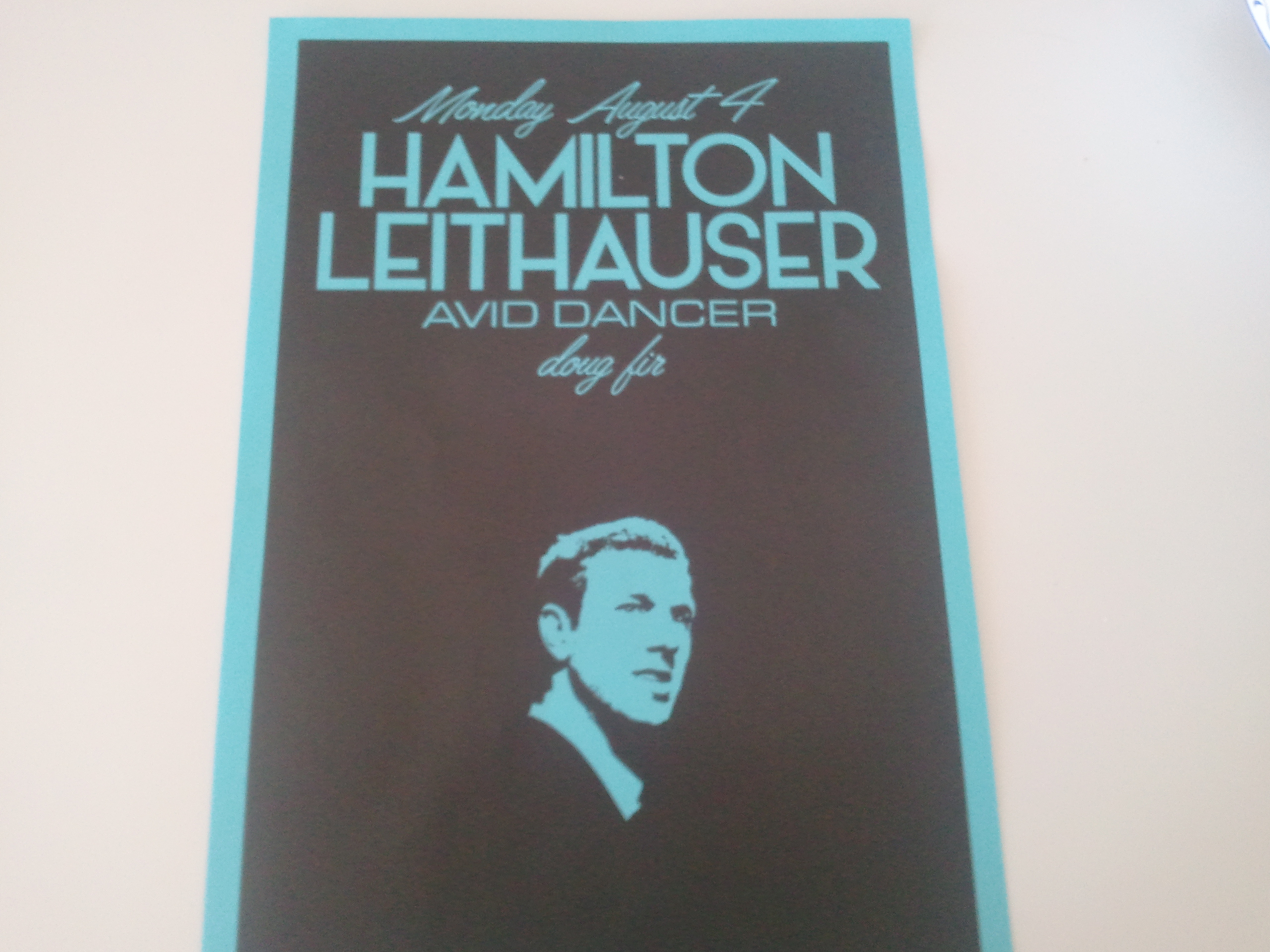
Before heading out on Monday night to the Doug Fir, I thought of a night about ten years ago when I saw The Walkmen perform at the same venue. To this day, it remains one of my favorite concert memories, as the band tore through a blistering set with such power that it felt like the lounge was ten times bigger than its actual size. Hamilton would also recall that night fondly, mentioning a couple of times during the set that he remembered having a great time ten years ago. It turns out we were both a little off in remembering the date (ten years ago I would not have been allowed into the venue–the show actually took place in the fall of 2007), but the performance Monday night was just as brilliant.
“In my younger and more vulnerable years…”
Hamilton proved once again that the Doug Fir is the best place to catch a show in all of Portland–it’s an intimate space where you can get up close and personal with the artist (there’s not a bad sightline anywhere), and the sound is always fantastic. There’s never an issue with the mix, and each musical part can be heard with complete clarity–a quality you wouldn’t expect from such a small venue. Though Hamilton employed a wide range of musicians and instruments on Black Hours, he kept it simple with his live setup–a quartet which featured fellow Walkmen bandmate Paul Maroon on guitar and xylophone, with a bassist and a spare drumset (reminiscent of the type of kit that Matt Barrick favored) filling out the support. Even with the modest setup, Hamilton and crew captured the sounds of the album and thrilled the crowd.
Hamilton enthralled the crowd from the beginning, kicking things off with the passionate “I Don’t Need Anyone”. He didn’t hold anything back, as he grabbed the microphone and leaned into the crowd to hit all the high notes with the loudest volume possible, testing the limits of the sound system. Leithauser seemed to be rejuvenated as a solo artist, eager to fight his way back up through the ranks and prove his talents once again; he had more energy than I had seen in years.
Hamilton had control of the crowd before he hit the first chorus.
Black Hours was already one of our favorite albums of the year, and it sounds just as great live, with Hamilton and the band bringing a thunderous energy to the music. The performance had the added bonus of allowing the audience to see how the different songs and their particular arrangements would capture distinct aspects of Hamilton’s personality. When Hamilton was just on vocals, it was a more lovelorn, bitter mood and it seemed as if he was baring his soul; when he picked up his acoustic guitar, like with the lead single “Alexandria”, the songs were more uplifting and he added a bit of swagger (with some stage moves that recalled a bit of Elvis, especially with some of the subtle hip thrusts); and finally, Hamilton with an electric guitar signified a more reflective spirit, with an air of contentment. The variation provided an excellent ebb and flow to the show, which differed from the normal straight run-through of the album. It also helped that Leithauser included a couple of the bonus tracks from the deluxe edition of the album–a passionate “I’ll Never Love Again” in particular convinced my friend that he needed to purchase the special edition vinyl as quickly as possible.
It was a fantastic performance, and we were talking about the shows for hours afterward. We had a little bit of fun at the end, as I took a photo for a fan with him and Hamilton, and I hope that he enjoyed the goofy face that Hamilton provided. It was a neat little detail that capped off one of the best shows of the year.









 Rust Is Just Right