Recs

Review: Real Estate – Atlas

Real Estate is in many ways as close as to what you get to a “known quantity” as you can get in indie rock.  They have a signature sound that is apparent from any track picked at random from their catalog–a laid-back, shimmery guitar rock, but don’t emphasize the “rock” so much, you don’t want to harsh everyone’s mellow.  This is not meant to be a dig on the band at all.  We should be thankful that they’ve managed to be so distinctive and original that a listener can tell instantly whether or not they like the band.  Instead, we should wonder how a band from Ridgewood, NJ is able to recreate the feeling of a lazy Southern California summer day so well.

One can then easily appreciate their sound overall, and their albums as a whole, but it normally takes an effort to distinguish between the individual songs themselves.  For example, when I first listened to their previous album Days, I enjoyed the overall vibe of the record: a perfect soundtrack for relaxing and either reflecting on the pleasant weather outside or maybe just creating an image in my head of what I wish the weather actually was.  But it took several listens before I could pick out the intricacies of the individual songs, even the singles.  The details eventually revealed themselves over several listens, such as the amiable bassline melody of “Younger Than Yesterday” or the slow deconstruction of “All The Same”.  The album was no longer just a congenial haze, but a collection of distinctly gorgeous songs.
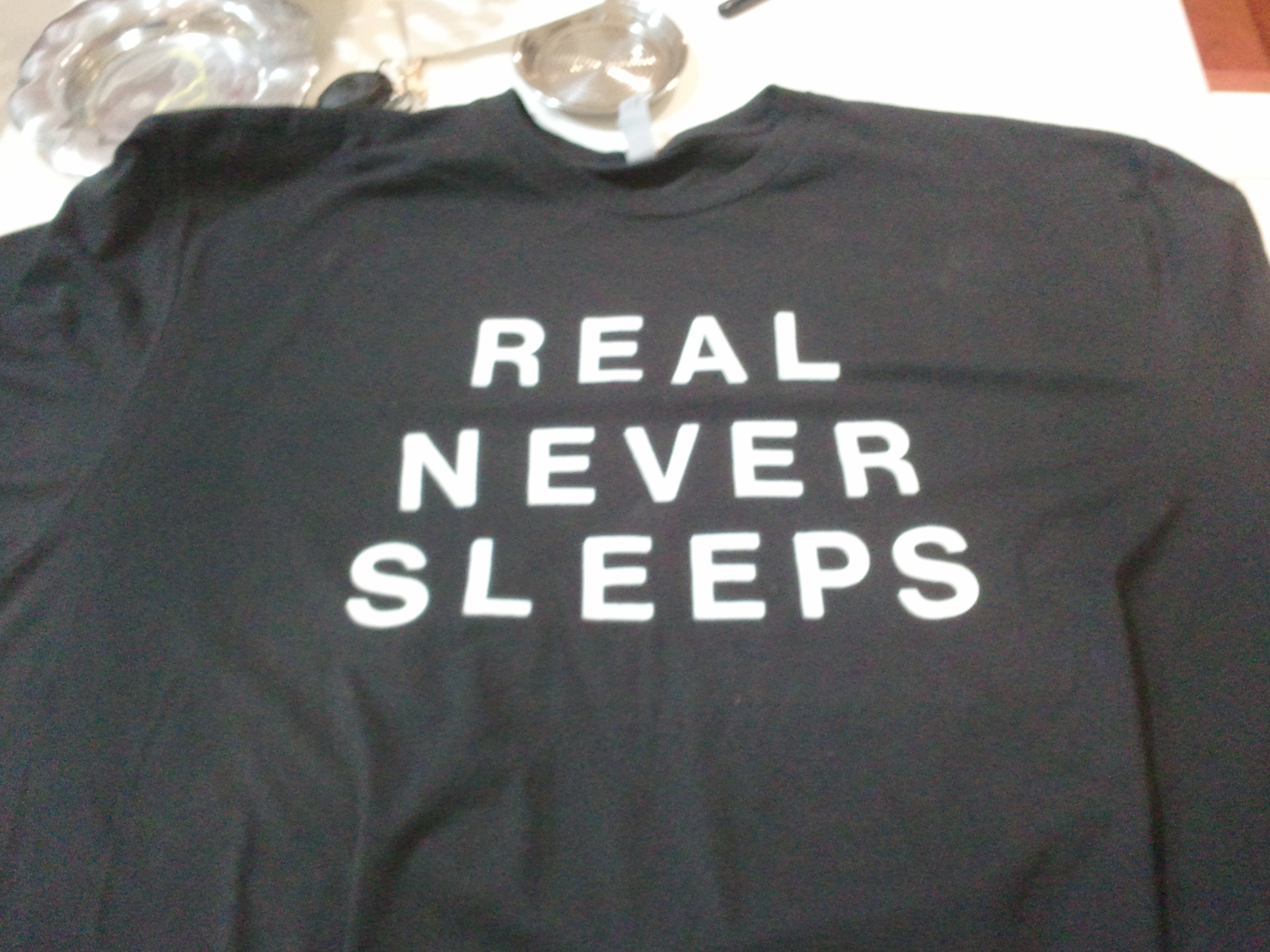
A well-made shirt.

A well-made shirt.

The new album Atlas follows a similar pattern.  It definitely has the same trademark Real Estate sound, which is by design (the band has stated that they’re not interested in radically transforming their style from record-to-record).  One therefore shouldn’t expect any real evolution within the confines of their style.  But there are refinements and new details that make the album worth exploring.  Hell, the band even came up with a really catchy single with “Talking Backwards”, which manages the neat trick of being a perfect encapsulation of the band that’s also presented in a hooky, toe-tapping manner that should capture the ear of any new listener.  Even though the lyrical subject of the need for communication is one that’s been covered many times before, the band still manages to be engaging; sometimes exchanging comfort for originality is a fair trade-off.  Real Estate does an equally good job with ballads as well, though the difference between the ballads and the “rockers” on a Real Estate album are about 10 beats per minute.  Real Estate knows their strengths, and plays to them well.

Feel the good vibrations.

Feel the good vibrations.

However, one gets the feeling that there were some missed opportunities on the album.  One of the highlights of the album is the song “The Bend”, a mid-tempo number that pleasantly chugs along, right up until the moment the tempo suddenly shifts at about four minutes in and the chugging nearly grinds to a halt.  It’s a dramatic moment, as the band stops on a dime, and it immediately grabs the listener’s attention and takes him or her out of their previous groove.  The deliberate beat also gives the lead guitar lines an additional emotional heft, as they wring out as much passion with each note as possible.  It’s a great moment, and since it occurs in the middle of the album, one expects perhaps that the record will shift directions.  The band instead goes right back into their wheelhouse and dives back into their standard jangly guitar rock, which is fine and what I expected when I bought the album, but it still leaves me wondering where else the band could have gone instead.

*There is one complaint that I have from the various reviews I’ve seen: comparing Real Estate to Television is pretty damn lazy.  Both bands have two guitarists and…that’s about where the similarities end.  If anyone wonders why Television is considered punk rock, a quick comparison to Real Estate should give him or her a clue.
Review: Solids – Blame Confusion

I’ve had a fascination with two-person bands for some time now, and I count many of them among my favorites.  It’s great to see bands like The White Stripes, Death From Above 1979, and The Black Keys attain success over the years and inspire others to start making music even if they can’t find a bass player (or in the case of DFA 1979, stick with the bass and abandon the guitar).  I’ve considered some theories as to why these two-person groups work so well.  One possibility is that it may be that it’s easier to reach consensus as to which musical direction to take with two people (though the lack of a third mediating party may be the reason why after the initial spark of incredible inventiveness these partnerships tend to fizzle out, Local H being a notable exception (though there was a lineup change at one point)).  Another might be that, as I’ve heard Jack White explain, that imposing certain limits allows creativity to flourish.  One can be paralyzed by infinite possibilities, so by setting boundaries you at least are able to realize your limits.  And once you know your limits, you can focus attention on challenging them.  It’s in those attempts to challenge that great music can result, as seen with bands like Japandroids and No Age.

I mention those two bands in particular, because they seem to be the most significant inspirations behind the debut album Blame Confusion from another two-man group, Solids.  Solids follow in the footsteps of their Canadian brethren Japandroids by focusing on energetic, driving rock songs with a guitar that seamlessly blends rhythm chords and inventive leads.  The haziness of the vocals and general attitude bring to mind No Age, though Solids don’t take any of their trademark left turn forays into ambient noise.  The result is a lot of distortion, a lot of riffs, and a lot of fun.

Solids definitely did a great job in choosing their influences, but the question remains if they add anything to the equation themselves.  I’ll give a group a listen if they remind me of some of my other favorite bands, but in order for me to keep listening to their album, they need to offer something up themselves, or else I’m going back to the tried-and-true.  Fortunately, Solids seems to have pulled off this task.  I find myself singing along to the great lead melodies, usually making up my own words because a lot of the vocals are pretty indecipherable.  I’ve read more than a few comparisons to Dinosaur Jr, which makes a certain amount of sense especially considering the guitar tones on the record, but you won’t find any of J. Mascis’s trademark solos on Blame Confusion.  That’s not to diminish the guitar playing on the record at all–there are ton of great riffs to be found.  The drums also do a great job of driving the beat when needed (like in “Traces”) or providing a rhythmic counterpoint to the caterwauling guitar.  And sometimes it helps when Solids throws in the traits of another band to the mix, like …And You Will Know Us By The Trail of Dead in “Cold Hands”.

Blame Confusion is a very good debut, and it’s easy to see that it would be a lot of fun to see Solids live.  I’ll definitely be looking forward to seeing what these guys do next, and hopefully we’ll see an artistic leap forward like the Japandroids did with Celebration Rock.

*Note: In a perfect bit of symmetry, famous two-man band Suicide came up on my iTunes as I was writing this review.  So this review comes courtesy of their 1977 performance live at CBGB’s.

Review: Beck – Morning Phase

We spent a long time analyzing Beck’s career recently here at RIJR, all in preparation for the release of his latest album.  And to put it simply, Morning Phase was worth all the fuss and effort.  It’s an absolutely gorgeous album that finds Beck creating some of the most beautiful music of his career.

In the weeks before its release (and in the initial reviews), a lot of comparisons were made to Beck’s previous album Sea Change, with some going as far as to call Morning Phase a sequel.  Initially, this seems to be a pretty fair comparison, at least from a superficial perspective.  Beck practically dares the comparison, with the opening acoustic strums of “Morning” being a near-copy of Sea Change‘s “The Golden Age” (this mirroring was a trick that Beck has pulled before with Guero and Odelay).  Even the opening lead melody from the keyboards seem to be a variation of the glockenspiel line from the earlier song.  But the differences between the two quickly become apparent, and are indicative of the albums as a whole.

In “The Golden Age”, after Beck’s initial lines of “Put your hands on the wheel/Let the Golden Age begin”, the mood quickly dampens, as the lyrics take a darker turn by depicting someone closer to the end of the rope rather than willing to take on a new challenge, giving those opening lines a dark irony.  The melancholic tone is summed up with the chorus of “These days I barely get by/I don’t even try”, an attitude that is reinforced by Beck’s weary vocal performance.  By contrast, Beck paints a more serene image in “Morning” with lines like “oceans of diamonds always shine, smooth out below”. leading into a triumphant chorus where he repeats the line “This morning”.  Here, the narrator actually sounds ready to push ahead even when confronting the past, asking “Won’t you show me the way it used to be?” and “Won’t you show me the way it could’ve been?”

Morning Phase then plays out not as a sequel to Sea Change, but more like opposite sides of the same coin; using a similar sonic palette of acoustic guitars, strings, and warm keyboards, Beck is not looking at the devastating end of a relationship but the potential fulfillment of marriage and fatherhood.  Does that mean that Morning Phase sounds like a post-Sky Blue Sky Wilco record, another in a long line of “dad-rock” records (a term that I generally despise, if you want to know)?  Not exactly, though there are certain moments on the album that echo the apprehension to this new phase in life like you would find on an album from The National, at least thematically.  You’ll find this in “Wave”, which builds upon the slowly-changing strings from the opening instrumental “Cycle”.  The use of Jim James-level reverb adds to the haunting nature of the song and complements the lyrics.  Lines like “If I surrender and I don’t fight this wave/No I won’t go under, I’ll only get carried away” take on an added poignancy as a result.  And the combination makes for a powerful performance, as seen from the clip from “Saturday Night Live” above.

These darker moments make up only a small part of the album, residing mainly in an introspective middle section.  The rest of the album is buoyant by comparison, shuffling through warm folk and slower country-tinged songs that evoke the album title itself.  There are no fun dance numbers or energetic rockers, but the album does end on an ebullient note with “Waking Life”, which culminates with a gorgeous guitar solo that cuts through and puts an exclamation point on the album.  The album as a whole is filled with brilliant sonic touches that for once will make your investment in high-end headphones  seem like a good investment and not just a foolhardy fashion statement.  And to think, this may not be the only Beck album we get to hear this year.

The Thermals, Live at Level B

Living in Oregon, we get the opportunity to see a lot of great acts.  We’re just big enough to attract the biggest headliners, but we’re also just weird enough to get a lot of up-and-coming groups as well.  It’s just that usually they come through Portland (and to a much lesser extent, Eugene).  It makes sense–there are a ton of venues and young people around, so it makes booking an easier bet.  On the other hand, we in Salem have old people and…the Armory.  For those of you who are unfamiliar with Salem, “The Armory” is not some cute name–that was its function.  You can imagine the kind of shows that get booked there.  I’ll just say that metal shows are the only ones are able to…take advantage of the acoustics.

So when I heard that one of the best punk bands around today (and a personal favorite) was coming down to Salem, I was more than a little excited.  Granted, The Thermals are from Portland themselves, so it’s not exactly like they’re venturing far from home, but let’s at least give Salem some credit, because it was not a one-off show but part of a tour.  And they were playing a venue that was not the Armory, but a spot that I hadn’t heard of before called “Level B”.  I’ve seen The Thermals plenty of times before (strangely enough, I saw them multiple times in New York before I got the chance to catch a hometown show), but never in my hometown.

Note: if you are unfamiliar with The Thermals or disagree with my assessment of their merits, you are free to stop reading and take a listen to their album The Body, The Blood, The Machine right now.  Then you can come back and finish this review.

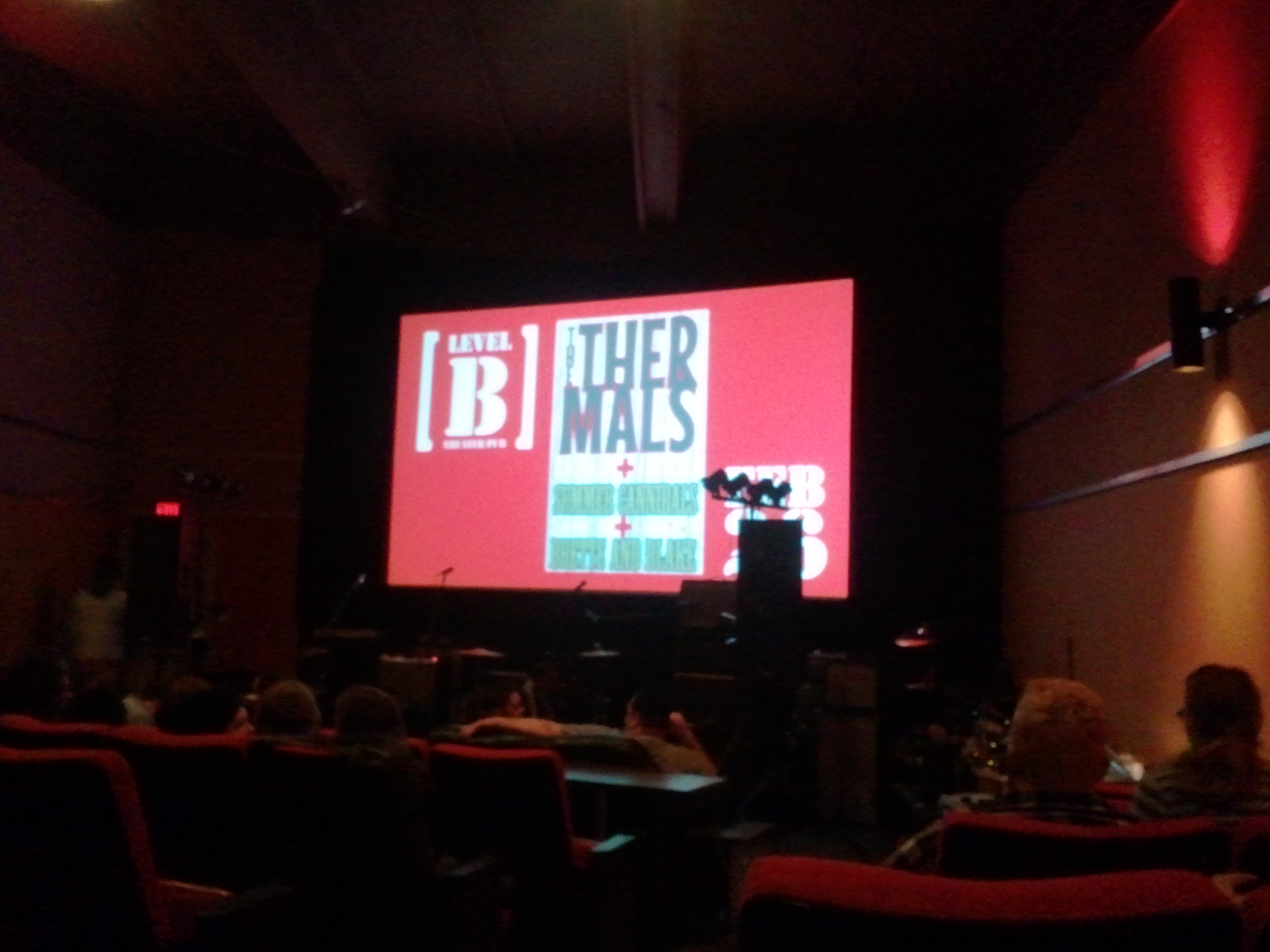
Level B preparing for the show

Level B preparing for the show

As it happens, Level B is the same spot where the old independent cinema in town was located, as can clearly be seen by the seats in the picture above.  (I want to assure readers unfamiliar with Salem that Salem Cinema is alive and well with a great new location with better facilities, so I still get the chance to watch plenty of great films).  I have high hopes for this venue in the future–it should be versatile enough to host different events, which means it’s more likely to stay afloat when it can’t get regular booking from non-local musical acts.  They also had an excellent sound system, and all three bands sounded great as a result.  And even the inconvenience of having those seats in place have a certain charm, giving the place a certain DIY-vibe of “we’ll play wherever they’ll allow us to play”.  Or that could just me spouting bullshit.  Either theory is valid.

I knew I was in for a good night (beyond the fact that I was seeing a live act that is consistently great) when two things happened: 1) I got a compliment on my Japandroids shirt (though it would have been nicer if it came from a lady, I’ll take what I can get), and 2) I heard somebody talking to the band before the show about how much he loved their album Fuckin A.  That’s an album that I love as well, and by some strange coincidence the band had not performed most of those songs live at the shows I’d been to previously.  It seemed like a good signal that we would get the chance to hear more of that album that night.

Aside: I never know how to act when I recognize band members in the audience.  It’s always an awkward dance of “should I say something and say, ‘YO I LOVE YOUR STUFF,’ or do I allow them to be normal people for a few minutes?”  I think I usually go for the worst option, where I’m pretty sure I end up staring at them far more than what is comfortable. 

When I heard the opening drumbeat of “Our Trip” early in the set, my hopes for some Fuckin A songs officially materialized.  The band then blistered through a high-energy set filled with tracks from their latest Desperate GroundFuckin A, and the now-classic The Body, The Blood, The Machine, sprinkling in favorites like “I Don’t Believe You” and “Now We Can See”.  The set seemed to mirror the attitude from Desperate Ground itself, which seemed to be constructed as a reaction to the more muted reception of Personal Life.  Personally, I am a big fan of Personal Life, which in many ways was an album that the band needed to make to shake up their formula and stretch their songwriting.  It’s an album filled with a lot of mid-tempo numbers that are great to listen to on the stereo, but can sometimes kill the flow of a set, so I have no problem if some of those songs don’t get played, no matter how great they are.

The super-fast and hard-charging songs of Desperate Ground make for a great live set, though it takes a lot of listens before you can appreciate the nuance of each song (which is just a fancy way of saying “it’s hard to remember which song is which, but you KNOW it comes from that album”).  It doesn’t help that those songs are missing some of the great guitar solos from Hutch that were a hallmark of their earlier work (not showy, but very melodic and building on the melodies within the song and brilliant with their subtlety), though Kathy’s bass often takes a lead role with some of the fills.  Knowing this, it made Hutch’s remark after diving into the crowd during “The Sunset” for the last half of the song that he “nailed the solo” all the more hilarious.

When all else fails, shoot in black and white.

When all else fails, shoot in black and white.

So yeah, it was a pretty fantastic show.  Any night where you get to hear excellent songs like “St. Rosa and the Swallows”, “A Stare Like Yours”, and “A Pillar of Salt” (a fan favorite that got legitimate airplay (at least in New Hampshire/Vermont) back when I worked in radio), it’s going to be a good night.  And the fact that I could plan my evening without budgeting a two-hour round-trip car ride made it even better.

Stray Facts and Observations

1. The drumbeat to “Our Trip” and “Here’s Your Future” are the exact same, meaning that those two albums start off the same.  Is it a coincidence that these might be their best two albums?  Probably.

2. The chord progression to “A Pillar of Salt” and “Returning to the Fold” are exactly the same, just at different tempo.  Since they are back-to-back on the album, you can bet this was intentional.  And it’s brilliant.

3. The Body, The Blood, The Machine is a concept album that doesn’t suck.  Give The Thermals kudos for pulling off the nearly-impossible.

4. There’s no reason why “I Don’t Believe You” shouldn’t have been playing on rock radio.  It’s a perfect pop-rock song.

5. There’s no reason why KNRK in Portland shouldn’t be playing The Thermals in their normal rotation.  They need to substitute one of the hundreds of times that they play The Lumineers or Muse with these local heroes instead for once.

6. The last time I was at the venue it was still Salem Cinema, and I went with my family to watch My Big Fat Greek Wedding.  Those who know me are free to laugh now.

Review: Band of Horses – Acoustic at the Ryman

If you really want to laugh some time at how seriously music critics take themselves, I recommend you take a look at the evolution of Pitchfork’s opinion of Band of Horses.  What was first breathless praise slowly but surely evolved into near utter contempt.  Even though it was the work of multiple reviewers, each had similarly high hopes derived from the band’s early work.  At a certain point, you have to ask, “Why was this case?”

Though it may seem like I’m attempting to bury Band of Horses, this actually is not the case.  I am just offering an argument for not having rapturous expectations in the first place.  I remember hearing “The Funeral” when it first came out, and my first instinct was to say “Hey, this is a pretty good Shins song.”  You would think that considering that they were label mates on Sub Pop that this would be among the first comparisons to be made, but instead I saw a lot written about My Morning Jacket (not really, but I can see some similarities at least from a vocal perspective between Ben Bridwell and Jim James) and Neil Young (no, not at all).  In fact, I had first tried to pay attention to Band of Horses because of the MMJ comparisons, and when I didn’t hear the similarities, I decided to ignore them, despite the heavy praise of the album.  It wasn’t until I saw BoH open up for Dinosaur Jr. that I decided to reconsider my stance, based both on the music and Bridwell’s beard, which was at the time at a level of Martsch-ian proportions.

I actually first became excited for the band when I heard the lead single for Cease to Begin, the seemingly upbeat “Is There A Ghost”.  And then when I saw that they had a song called “Detlef Schrempf”, they had all the hooks they needed for me.  If you reference one of my favorite third-banana NBA players from the 90’s (and a beloved Blazer in his short time here), you definitely have my attention.  It was at this point that I decided that I would start following this band and at least keep track when they released a new album.

Now I will agree with the critical consensus about the decline in relative quality over the course of BoH’s career.  Infinite Arms had a couple of catchy songs, but I never played it as much as Cease to Begin or Everything All The Time.  And Mirage Rock left such a minimal impression on me that I recently checked to make sure that I actually own the album.  The difference is, I don’t see the decline in the grandiose tragic terms as some of those other critics.  “Where’s the artistic growth?” they would ask; I respond, “Why did you expect any to begin with?”  There wasn’t anything necessarily uniquely great about the group from the beginning.  They merely developed an interesting sound, wrote a few good songs, and continue to do pretty much the same thing for each album.

This leads me to their latest release, Acoustic at the Ryman.  The review for this album in particular is even more hilarious considering the level of bile and invective.  It’s at this point you have to step back and ask, “What is a live acoustic album for?”  It pretty much just serves the purpose of providing a mix tape of previous albums, a pseudo-Greatest Hits collection for neophytes, with a slightly different take on these songs, something that serves the fans.  There’s no need to go into long digressions about the significance of the venue and analyzing the existential dilemma of a moderately successful indie rock group.  Accept it for what it is, and move on.

So, considering those parameters, is the album a success?  If you’ve never heard Band of Horses, pick the album up and you will get a good idea of their sound.  For fans of the band, sure, why not–the arrangements are different enough that they’re enjoyable to compare to what you know.  It’s not sacrilege to hear “The Funeral” with a piano.  Save the theatrics for someone else.

Review: Broken Bells – After the Disco

It’s been amusing to read reviews of the new Broken Bells album, namely the amount of focus that multiple critics place on the name of the record.  It brings to mind memories of middle schoolers putting together slap-dash book reports and riffing as much as they can on the title and back page in their oral presentations.  It makes me wish that I had some social media pull to start a trending hashtag of #CrappyBookReports.  I can understand how certain bands spend a lot of time and effort thinking that the album title really encapsulates what they were going for on the record, but you know, sometimes it’s just a convenient label (and just something taken from a particular song).

So, in other words, I’m not placing much stock in any grand statement in After the Disco.*  Instead, I’m content to enjoy it as a pleasant 45 minute record of mid-tempo rock.  The highs aren’t particularly high, and I wouldn’t say there’s a killer single hidden in the tracklisting somewhere, though “Holding On For Life” was enough of a hook to get me excited to actually buy the album.

One thing that the album does a great job is throwing enough curveballs that seemingly straight-ahead tracks usually in a place that you don’t expect.  It makes for a great listening experience, but hell to figure out which song exactly it was that you were digging.   Opener “Perfect World” starts with a great, motoring groove (almost a disco beat!), and then ends with a great half-time coda that brings the mood back down to Earth (maybe I should give critics more credit–they saw the album title AND listened to the first song).  That said, songs where the tempo picks up like “The Changing Lights” and “Medicine” stand out a bit, but they never fully lift off.  It’s most clear in the song “No Matter What You’re Told”–if there was just a little bit more urgency and just a couple more beats per minute (and a snare sound that was a bit more lively), this would be a great crowd-pleaser.  But the restraint is clearly by design, so it’s difficult to pin all the blame on stylistic choices like that one.

The biggest problem is with the concept of “Broken Bells” itself.  Both James Mercer and Danger Mouse have done excellent work on their own, but the combination of the two is puzzling at first glance, and there’s not really enough in their music to take away any potential doubts.  Mercer already has an authoritative voice in The Shins and is a suitable vehicle for most of his musical ambitions; Danger Mouse has produced great tracks, but he could probably need a stronger vocal presence than Mercer.  The music never really rises above its side-project nature; the whole is not greater than the sum of its parts.

But there is something to be said for just good music; bands don’t always need to justify themselves.  In that respect, I’m perfectly content on buying Broken Bells albums and will probably continue to do so in the future.

*For the record, I always thought that After the Disco would have been a perfect title for the Yeah Yeah Yeahs’ It’s Blitz!

How To Spend The Weekend When Snowed In

We usually don’t get much snow in the Pacific Northwest, and as a result we’re generally unprepared to deal with such unpleasantness.  This means outside of a couple of hours of shoveling the driveway and taking a quick trip to the grocery store (and then getting the car stuck in the snow before making it up the last hill to my house), it’s been a stay-indoors-the-whole-weekend kind of time here.

Someone didn't pay the fee to the Snow Miser

This will not get plowed for days.

At least I’m taking advantage of the opportunity to watch one of my many music DVDs, and what better time to watch the documentary of Sigur Rós’s tour of their homeland of Iceland.  The visuals of their countryside are stunning, and as one would expect with the majestic music of the band, so are the songs.  The band comes up with many novel arrangements of their songs, ranging from their stunning light shows in Reykjavik to acoustic performances in the middle of nowhere.  In addition, I also love seeing just how some of the most unreal sounds that the band makes on record are reproduced live.


I highly recommend buying it, but here’s at least the first disc.

Review: Dum Dum Girls – Too True

I first came across the Dum Dum Girls early last year, a few months after the release of their EP End of Daze.  I quickly was hooked on their hazy take on 60’s-era garage-pop and worked my way backwards through their catalog.  I enjoyed their bubblegum melodies and big hooks, and as a result, Only in Dreams had an extended residency in my car for a couple of months.  While it’s easy to pinpoint the limits to their style (simplistic drumbeats, 3-4 basic chords, etc.), it worked in small doses, and it didn’t hurt that the lyrics were alternately clever and heart-felt.  With songs as great as “Bedroom Eyes”, there’s no reason to spend much time nit-picking these slight concerns.

With their new album, the Dum Dum Girls decided it was time for a stylistic shift, ditching the 60’s as their prime influence and switching to a more 80’s-inspired sound.  From the outset, one hears the addition of synths and the use of heavily reverbed drums that give off that heavily-processed 80’s pop style.  The synths don’t dominate the sound, as might be expected, but are kept more in the background; guitars are still a dominant presence, either through slick lead lines or through arpeggiated strums that cut through the mix.

There is a question of what inspired this new direction–did Dee Dee spend a few late nights watching her Drive Blu-Ray?  Or was it simply a recognition of the limits of her previous style?  Last year I saw a couple of openers at different shows that either were influenced by the Dum Dum Girls directly, or they had found the original influences and decided that it was a viable option.  So it makes sense from both an artistic and commercial perspective to begin broadening horizons.

In the end, I’m not sure it entirely works.  There are some great moments on the album, but too often the staged artificiality of the music acts as a drawback, and cuts against taking any of the lyrics seriously.  However, there is something to be said to being able to craft a seemingly effortless pop song, which I think the Dum Dum Girls accomplished with “Are You Okay?”  Here, the light airy music with the sugary melody provide an effective dichotomy with the pleading lyrics.  This is the moment when you could say the new direction pays off.