Recs

Review: Run The Jewels – Run The Jewels 2

“Run the Jewels” is the answer, your question is “What’s Poppin’?”

Since the announcement in late October that they had leaked the much-anticipated sequel to their thrilling debut album, Run The Jewels has been the talk of the music world.  And it’s with good reason: Run The Jewels 2 is even better than the original collaboration between El-P and Killer Mike.  Their self-titled debut was among the best-reviewed albums of last year, and found a spot on most year-end lists, including our own.  The sequel does an even better job of mining and improving upon the best trends in hip-hop from the past twenty years, and finds the connection between the duo stronger than ever.

So while the quoted lyric above is certainly not the most acerbic or clever line on the record, the closing line of opener “Jeopardy” does sum up RTJ’s place in music right now.  If you need a better sampler of the album, you should listen to the banging “Oh My Darling Don’t Cry”, which will fully abuse your car stereo’s subwoofers with its pulsing bass.  The two MC’s trade verses fast and furious, picking up their speed and intensity with each round as the music grows more chaotic around them.  Another highlight is “Close Your Eyes (And Count to Fuck) which builds a bouncy, stuttering beat off a guest appearance from Zach de la Rocha, recalling the era when turntablism reigned.

Run The Jewels 2 is a treasure-trove of brilliant beats and production from El-P, switching up styles and moods on the fly that accommodates the desire for variety while never sacrificing flow.  Grimy, serious material like “Angel Duster” and “Blockbuster Night Part 1” fits in easily with more fun tracks like “All Due Respect”, which takes the fun elements of rap-rock without the negative connotations that term has taken in more recent years, thanks to some excellent drumming from Travis Barker.  It’s a lean and efficient album too, clocking in at less than forty minutes, so it never wears out its welcome–but it’s likely that you’ll be putting the whole thing on repeat.

Note: there seems to be a difference between the free download version and the physical copy you can buy, with the former including an extra verse from Gangsta Boo to provide the female counter to the duo’s claims on “Love Again (Akinyele Back)” that’s missing from the purchased disc.

The Black Keys, Live at the Moda Center

While most people were out spending their Friday night at various Halloween parties or at home greeting trick-or-treaters, we at Rust Is Just Right spent the evening trucking up to Portland to welcome back The Black Keys.  They had a high bar to pass, both from their own previous performances in the Rose City (they even made a DVD of a previous trip to the Crystal Ballroom) and for other legendary Halloween shows (we were witnesses to Pearl Jam’s amazing set to close out the Spectrum in Philadelphia for good).  “Brothers” Pat and Dan weren’t able to surpass those lofty expectations, but they certainly provided the soundtrack for an excellent night out.

The white light made taking photos a more pleasant experience

The white light made taking photos a more pleasant experience

At this point, The Black Keys are finely-tuned machine, with little room for flexibility or improvisation.  A quick look reveals a standard setlist these days, so for anyone thinking about catching the group on multiple dates should go ahead and probably make other plans.  When you’re at the level that the Black Keys have reached and you’ve constructed an elaborate tour, it’s not a bad strategy to consolidate and provide a more uniform experience, as it makes coordination from lights to sound to tech much easier.  Still, considering everything has been plotted in advance, it took a little bit too much time for the guitar tech to switch out Dan’s axe between songs–though this may be because I’ve been spoiled by the lighting-quick precision of the stage crew at a Pearl Jam show.  However, the guitar tech gets bonus points for providing the pedal steel guitar just for the solo in “Gotta Get Away” in such a smooth manner.

As for the music itself, it’s a new experience these days now that The Black Keys are no longer the Dan and Pat Show live; the touring group is now a cohesive four-piece, with the duo backed by some solid musicians with Oregon ties (Richard Swift and John Wood).  The arrangement frees up Dan quite a bit to emote even more with his singing and providing some support for extended soloing, but it does diminish the impact of Pat on the drums a bit.  There were some early moments where Pat shined and really brought the thunder from behind the kit, and he added a great touch by making the ending of “Fever” a four-on-the-floor feel with a constant kick-drum push, but his contributions tended to get lost more in the shuffle than they did at past shows.

And the curtain comes down, the lights go up

And the curtain comes down, the lights go up

There was no real acknowledgement of the holiday, though plenty of audience members and a significant portion of the crew indulged and dressed up in costume.  For the most part, we were content merely to hear Dan yell about how it was great to be back in Portland.  The band stuck with more recent material to make full use of all their members, leaning heavily on El Camino and reserving the material from Turn Blue for later in the set.  The big radio hits from Brothers got huge applause from the crowd, but there was a healthy contingent of fans that appreciated the dip into the back catalog, including the faithful who really dug in for “Leavin’ Trunk” from their debut, The Big Come Up.  The guys were tight, the sound mix was excellent, and all in all it was a very professional affair.

The highlight of the evening was the encore.  First, as the lights in the arena went out, cell phone lights began to come on and the effect bathed the stadium with a warm glow that was pretty magical.  Then the guys returned and delivered an epic version of Turn Blue opener “Weight of Love”, filled with several fantastic solos from Dan and an additional backing guitarist.  The night ended with “Little Black Submarines”, which is the perfect encapsulation of their career at this point, from the ballad-type intro to the hard-rock finale.

While the show didn’t top our personal list of Best Halloween Shows ever, at least we could take comfort in the fact that we didn’t need to take 5 hours to get back home, as was the case for Pearl Jam (public transport plus daylight savings will do that).  We can at least appreciate that Dan and Pat still put on a great show.

Essential Classics: Television – Marquee Moon

It is October, so that means it is time to analyze and celebrate one of the great Halloween albums of all-time: Television’s Marquee Moon.  Many of you are probably confused by that particular claim, but don’t worry, we’ll get back to it and explain ourselves in a bit.  There is no argument however that Marquee Moon is one of the greatest guitar-rock albums of all-time, but in addition to that distinction, it can also be argued that the album is capable of bending the rules of time and space itself.  How else could a band that was on the vanguard of the Punk movement have created the seminal Post-Punk masterpiece with their debut album?  It is a conundrum that should puzzle both music historians and physicists alike.

My first experience with the band Television was back in high school, during my initial forays into exploring the origins of punk rock.  I read several articles and books that discussed Television’s history and their influence on the New York punk scene as one of the original CBGB’s bands, and I quickly set out to track down copies of their first two records.  (Let us all take some time to acknowledge the fact that I approached punk rock in the nerdiest manner possible: research.)  There was one specific aspect of Television’s music which each piece emphasized that captured my attention, and that was the band’s masterful guitar-playing.  Being a budding guitarist myself, it was clear that it was vitally important for me to listen to these albums to help develop my own skills.  As a child of the 90’s though, I was completely unprepared to process Television’s approach to the guitar: a heavy emphasis on the treble strings (and no power chords), intricate but decidedly unflashy solos, and little-to-no distortion (at least of the kind with which I was familiar).  It all seemed so alien to me, and considering the portrait of the band that made up Marquee Moon‘s cover art, this may not have been a bad guess.

Most puzzling of all to my adolescent mind was how this pleasant if slightly bizarre album could be considered “punk” (it was a hopeless endeavor at that time to begin to comprehend what the hell “post-punk” could be, beyond the most literal definition, so that was not a pressing concern at the time).  But after several repeated listens and a gradual appreciation of the context in which the band flourished, I came to understand that even if there seemed to be little connection to The Ramones on the surface, they were both made up from the same basic DNA and were a reaction to the same movements in music.  The musical parts of “Friction” may have been much more complex than “Blitzkrieg Bop”, but one could easily see that both songs were stripped down to the barest elements in contrast to the bloat of prog or disco.

Television proved that “punk” didn’t have to mean “easy,” as each member of the group was an expert on his instrument.  The twin-guitar attack of Tom Verlaine and Richard Lloyd has been universally lauded, and rightly so, but their other two bandmates should be given their proper due as well.  Fred Smith crafted some amazingly beautiful bass lines, shifting between providing an impeccable rhythmic foundation and creating innovative counter-melodies, and Billy Ficca was a genius behind the kit, anchoring the songs with intricate rhythms and delicate textures, effortlessly shifting between different patterns and providing the perfect accents to each musical phrase.  As for Verlaine and Lloyd, it should be apparent how they inspired generations of guitar players, from the early post-punk of bands like Wire to contemporary indie rock bands like The Strokes.  They were a perfect tandem that fed off each other beautifully, alternating between unique chord choices and lyrical solos, interspersed with bits of brilliant one-off figures and licks.

The centerpiece of the album is the title track, an epic monster clocking in at over 10 minutes (Fun Fact: on the original vinyl edition, the song faded out before it hit ten minutes, but the CD version keeps the original recording intact and includes the full version, while still listing the vinyl running time of 9:58).  Its intro of dueling guitar riffs (Lloyd providing the double-stop alarm-type bit, Verlaine the countering quick swirl) is instantly memorable, but also merely a hint of what is in store.  The verses give way to an instrumental pre-chorus that shifts the song into something much more rhapsodic and cinematic with its winding guitar lines, followed by a chorus that gradually increases the tension with its ever-escalating chord changes.  Lloyd’s guitar solo after the second chorus is a master class in terms of both beauty and efficiency, with its mirroring of the melodic structure of the chorus accompanied by some gorgeous personal flourishes.  But it is the second, much longer solo by Verlaine and its accompanying full-band instrumental section that is the real show-stopper–the solo provides a brilliant example of how an improvised, meandering take can help ratchet up the tension, and the constantly-ascending full-band breakdown pushes the song to its limits.  Lloyd eventually joins in, and the two guitars overlap into similar winding lines, until the whole band suddenly becomes a single cohesive unit as they dramatically repeat in unison a series of sixteen eighth notes.  As the band makes its way up the scale, cracks begin to form in the union, as the drums begin to approach a frenzy and the bass peels off with some additional flourishes, gliding up and down the neck.  But together the band pushes the melody to the very top, culminating in a gorgeous explosion as the summit is reached, with little guitar twinkles helping add to the effect.

Even to the untrained ear, it is clear that from the music alone “Marquee Moon” is a special song, but now consider the instrumentals in conjunction with the intriguing and mysterious lyrics.  “I remember how the darkness doubled; I recall, lightning struck itself.  I was listening to the rain; I was hearing something else.”  The imagery of those first two lines captures a wonderful sense of dread, first with the description of an ever-enveloping darkness, followed by the contrast of the light cutting across the dark.  The lines also baffle the listener as well, as he/she contemplates the physical possibilities of how lightning can strike itself.  The next two lines help set up the listener for an uneasy scene, as things may not be what they seem: amid the rainstorm lurks an unknown…something.   It’s the perfect opening for a horror story!  The other verses support this interpretation, first with the meeting with the strange man down at the tracks, whose seemingly perceptive advice of don’t succumb to either the highs or lows of life taking on a darker edge when placed in context with the rest of the song, followed by the scene in the third verse of the Cadillac pulling from out of the graveyard, grabbing the narrator, driving back in, and throwing the narrator into the graveyard.  Spooky stuff.  After this scene is the long instrumental section, which can be interpreted as the narrator’s journey through the graveyard, with the culminating unison riff being the aural equivalent of the Big Reveal in a horror movie of the Monster or the Terror.  The song ends with a repeat of the first verse, which could indicate either that time has looped back on itself (much like how a “post-punk” classic can also be created at the beginning of the punk movement), or that underneath what seems like a restoration of what’s normal lurks a dark undercurrent.

Long story short, I am ready to declare that the narrator has become a zombie.

It is clear then that “Marquee Moon” is a perfect Halloween song, but what about the rest of the album?  The song is not only the centerpiece of the album in terms of track placement, but it also serves as a showcase to a lot of the musical ideas that are the connective tissue of the record.  The double-stop guitar figure is given a slight variation in the very next song, “Elevation”, for example, and “See No Evil” is the title of the opener, which makes the horror themes even more apparent!  It is also simply difficult to disconnect the song from the rest of the album, as each song flows beautifully into the next.  Television also provides wonderful bits of dark humor throughout Marquee Moon, perhaps best exemplified by the song “Venus”.  I was hoping that because of the lines “Then Richie, Richie said: ‘Hey man, let’s dress up like cops.  Think of what we could do!” the song would find a place somewhere in a movie that came out this summer, but that didn’t turn out to be the case.  Instead we will have to strike out on our own to consider the subtle beauty of the explanation that “I fell right into the arms of Venus de Milo” (a line that took far too many listens for me to realize the irony inherent in the claim), instead of having it soundtrack a scene of crazy hijinks.

Marquee Moon is simply an exquisite and dazzling album through and through, with each of its eight songs a classic in its own right.  Perhaps the greatest example of the beauty of the record is the underrated closer, “Torn Curtain”.  The ballad is filled lyrically with melodrama and over-the-top emotion, but is balanced by a delicate and nuanced restrained musical accompaniment, before the two components become intertwined with a triumphant final guitar solo that provides the perfect conclusion to the album.

But the album is more than just brilliant guitar compositions; as I mentioned before, there are plenty of fantastic bass lines and stunning drum parts throughout the entirety of Marquee Moon.  So listen to the album a few times to get a feel for the beauty and majesty of the guitar, spin it a few more times to pick up on the intricacies of the rhythm section, and then repeat it again a few more hundred times–because even though the album is nearly forty years old, it will never get old.

Review: Tweedy – Sukierae

Sukierae is quite the family affair, and while some may snicker and say that it represents the apotheosis of “dad rock”, it’s a pleasant but affecting listen.  Much of the debut album from “Tweedy” will remind fans of what they love about dad Jeff’s day job with Wilco, but the more personal nature of the material mirrors the stripped-down approach of the record and necessitates a separation from the main act.  It’s an intimate affair, but a welcome one.

Opener “Please Don’t Let Me Be Understood” recalls Telephono-era Spoon with its distorted repetitive riff, but that’s a bit of a misdirection, as Sukierae mainly consists of ballads or otherwise pleasant diversions.  The album is for the most part delicate and subdued, often just Jeff on vocals and guitar with son Spencer accompanying on drums, with the latter careful not to overwhelm the fragile nature of each song.  Acoustic guitar is the dominant sound, with electric guitar leads dancing in and out to provide emphasis and contrast as necessary, with the occasional sprinkle of piano providing hints of color.  Spencer’s drumming ventures occasionally into intriguing new territories for Jeff, as in the King of Limbs-like stuttering beat of “Diamond Light Pt. 1” (which ends with a bit that recalls an earlier period of Radiohead, specifically “The Gloaming”), but for the most part sticks to keeping it in the pocket and augmenting the music with subtle fills on a spare kit.  It’s all a bit “low key”, if you could excuse the pun (note: you are under no obligation to do so).

At seventy-one minutes long, some fans may wonder whether it was necessary for the album to be split into two discs, as Jeff insisted.  While the two discs themselves are not necessarily distinct from one another (though the second disc is a bit more subdued), but each disc does have its own shape; for instance, “I’ll Sing It” and “I’ll Never Know” each bring a sense of finality and work as closers.  One disc doesn’t stand out from the other, but splitting the album into two does benefit the listener by breaking it up into more manageable sizes.  Some may argue that there’s a 12-14 song, 50 minute album hidden in the two discs, but there are not any songs that are asking to be culled from the tracklist.  They may not all be standouts, but there are several quality songs and gorgeous moments spread throughout.

The New Pornographers, Live at the Crystal Ballroom

It’s always a treat to see The New Pornographers live, and with the full crew* available for Wednesday night’s show, Portland was in for a treat.  Their potent brand of fun power-pop is the kind of music that’s perfect for sharing with a crowd.  In theory.

The Crystal Ballroom took the band's name off the marquee as soon as possible.

The Crystal Ballroom took the band’s name off the marquee as soon as possible.

In theory, a feedback loop should develop wherein the band’s bright, sugary melodies inspires the crowd to respond with some noise and movement, which in turn invigorates the band to play with more energy, exciting the audience even more, and forever and ever amen.  However, last night’s crowd was possibly the deadest group I’ve ever seen at a show in this town, and stood in stark contrast to the music being played on stage.  There was perhaps no better illustration of this moment than when the band hits the chorus to the frenetic “War on the East Coast”, about three people jumped in the air ready to dance as soon as the crunch of the downbeat hit, only to find that they were alone in their enthusiasm (granted, I was one of those three).  And don’t blame it on poor set placement–the band saved their latest single for the second-to-last spot of the main set, so the crowd should’ve already been warmed up at that point.

While a bit deflating, the band didn’t seem to notice all that much, fulfilling their part of the bargain at least.  With both Neko Case and Dan Bejar along for this tour, the band had the full catalog at their disposal.  The band emphasized their recent album, Brill Bruisers, playing ten of the twelve tracks in their hour-and-a-half long set, but also made sure to perform the majority of Dan’s songs, ensuring that Bejar wouldn’t remain off-stage for too long (a fact that Carl Newman joked about early in the show).  Earlier this week, we expressed our opinion about the new album, and many of the same criticisms still apply even in a live setting; “Brill Bruisers” is a decent opener and “War on the East Coast” could really pop, but otherwise we were waiting for old favorites to pop up.  It’s clear that the band however loves the new material (the mere fact that they could rope in both Dan and Neko for this tour says to this, considering that’s not always the case), with Carl mentioning that “Spidyr” is his personal favorite.

The whole gang, though believe me that they're less blurry in real-life.

The whole gang, though believe me that they’re less blurry in real-life.

The old favorites made for some killer moments–the pop of “Use It” motivated the crowd to move around, while at the other end of the scale the delicate “Adventures in Solitude” moved the audience emotionally.  But it was in the two encores that the band truly shined, with the one-two combo of the rousing “The Laws Have Changed” leading into the epic “The Bleeding Heart Show” bringing down the house, with the band’s replacement for long-time drummer Kurt Dahle stepping up to the plate and nailing that brilliant part.  I haven’t been able to find out who it was behind the kit, but he went all-out (as evidenced by his sweat-drenched shirt)  and did an excellent job all night.  This was followed by a second encore of “Sing Me Spanish Techno” and “The Slow Descent Into Alcoholism” providing a perfect finale to the evening (I for one appreciated Carl taking the time to remember the chords to “Spanish Techno”).  Even if the crowd was half-dead for the most part, those songs shine through regardless.

Review: Aphex Twin – Syro

It was worth the wait.  It had been over a decade since we last had a proper Aphex Twin release, but Richard James has rewarded us with the challenging but beautiful Syro.  It’s not a revolutionary new work, but more of a distillation of the best parts of Drukqs with flashes of the brilliance of his 90’s output that put him at the vanguard of the electronic music movement.

The liner notes that inventively catalogs the use of every bit of musical equipment on SYRO

The liner notes that inventively catalogs the use of every bit of musical equipment on SYRO

Now, I’ll be the first to admit that I’m not a huge fan of electronica, and not particularly an expert of the genre (though I’m sure I upset at least a few people by using the catch-all term “electronica).  I haven’t been a regular purchaser of electronic music since the Big Beat era; any forays into the area are usually based on the insistent recommendations of friends (Darkside) or from research into musicians with a penchant for experimentation (Tim Hecker).  The rise of EDM in the past few years has only been a source of confusion and frustration, as the entire movement seems to be merely a repackaging of sounds and ideas that Richard James perfected back in the 90’s.  Mix in the abrasiveness and breakbeats of “Come to Daddy” with the acid-jazz grooviness and distorted finish of “Windowlicker”, and you have 95% of the formula that’s racking up the big bucks at these raves.  Just toss in a trick as old as music itself (“the drop” of the bass has always been a trick in a band’s arsenal), apply it in a haphazard fashion, ignore any semblance of rhythm or conception of songcraft in general, and you’ve got yourself EDM.

The album artwork is a list of all the expenses that went into the production of the record

The album artwork is a list of all the expenses that went into the production of the record

But Richard James sets himself apart from his successors, because it’s clear to even the lay individual that has a much better understanding of the fundamentals of music itself.  Even when he’s trafficking in beats that are lined-up with pinpoint precision based on computer formulas and arranged in odd meters, you can still feel a beat.  It may be odd, it may be unfamiliar, but it’s not arrhythmic–there’s a method to the madness.  James also has an excellent grasp of songwriting, providing careful shape to each song and the album as a whole.  The album draws you in with a subtle and trippy beginning, before pumping up the energy with a frenetic middle, before drawing back down and ending with a beautiful, Satie-inspired epilogue (meaning a delicate, spare piano with the barest hints of chord progression and melody, but still capable of evoking immense beauty).

The entire list of expenses, which can be read after unfolding the album cover.

The entire list of expenses, which can be read after unfolding the album cover.

Whether you’re listening to Syro as background music or with intense concentration through headphones, it’s clearly apparent that each sound was created and applied with the greatest of care and precision.  Fans will recall many similar tones from the Richard D. James Album, but he also tosses in several new variations as well, with each perfectly calibrated to elicit a particular emotion.  It’s difficult to go into more detail, not simply because it’s practically impossible to refer to specific tracks without employing a significant amount of cutting and pasting (James really emphasizes the pointlessness in some respects of distinguishing certain tracks by employing random letters and signifying particular “mixes” for each song, as if we have access to alternative mixes and they’re not just holed up on his hard drive somewhere, though noting the BPM for each track is a nice touch), but also because of the sheer amount of notes and styles in each particular track.  Hence, the resort to generalities.

It should be clear then this is an electronic album that casual fans will appreciate.  And since the more specialized press seems to be in agreement that his is a great record, I can take comfort in the fact that my inexperienced perspective has at least some solid footing.  It won’t be the Kind of Blue of the genre, but definitely a worthy addition to Aphex Twin’s illustrious discography.

Project Pabst 2014 Recap

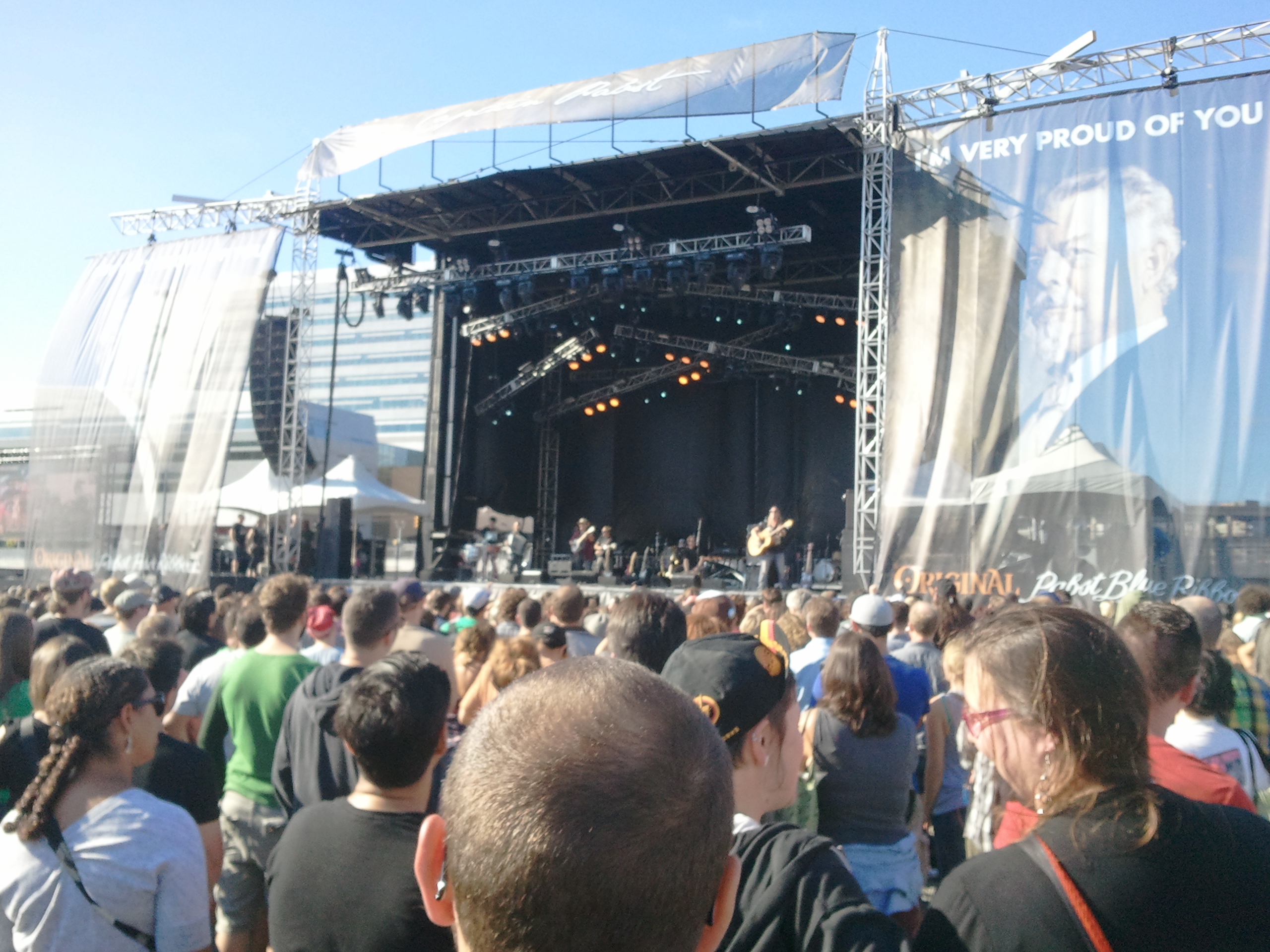
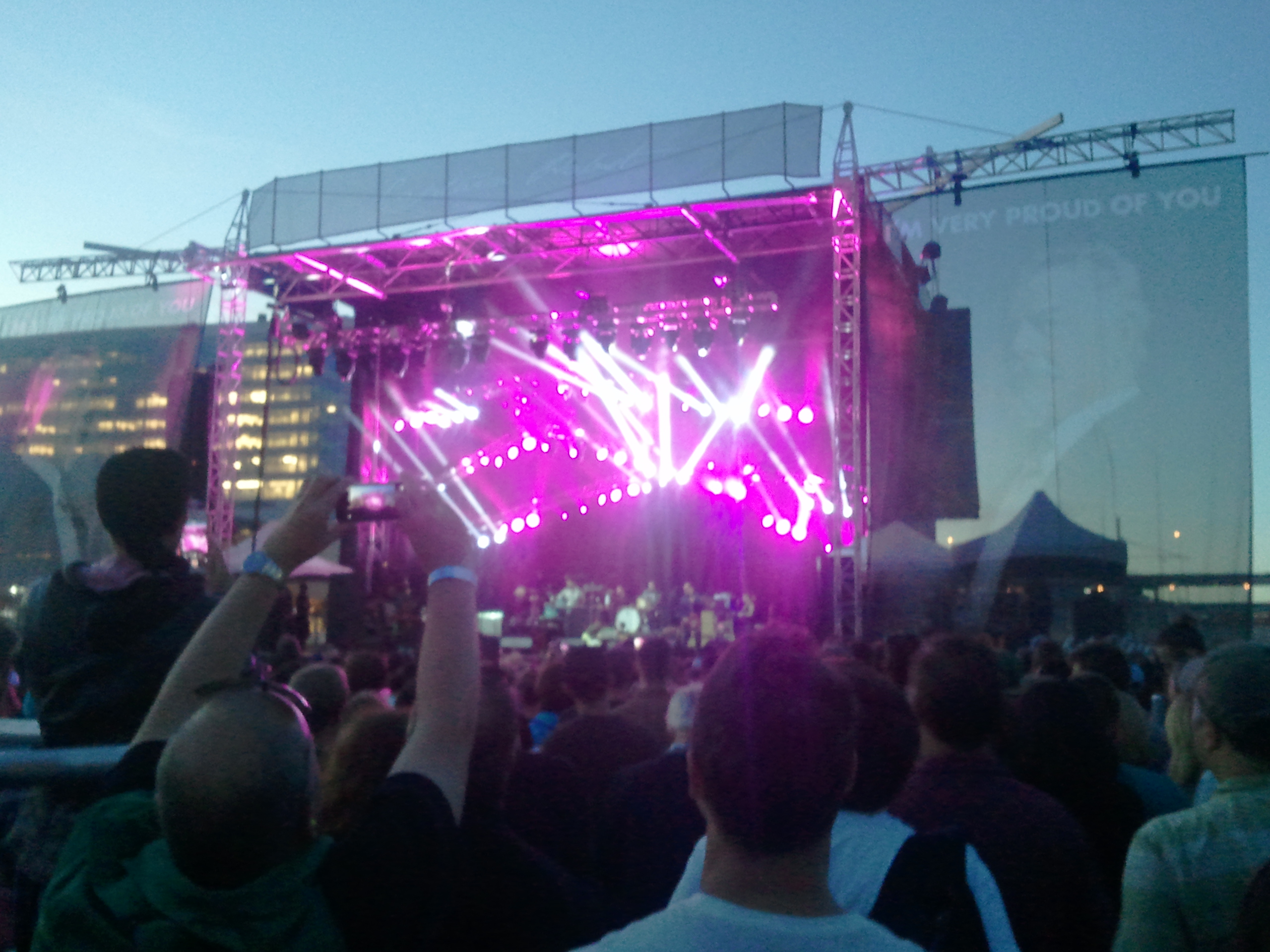
We gave recaps for a couple of the bonus shows that came courtesy of Project Pabst, and now it’s time to give some thoughts on the main event itself.  Overall, it was a pretty fantastic experience, feeding off the successful aspects of MusicFestNW with an even better lineup and nicer weather (the sun was shining just the same, but with none of that unpleasant August heat).    If this becomes an annual event, we’ll welcome it with open arms, but it’ll be hard to top this debut.
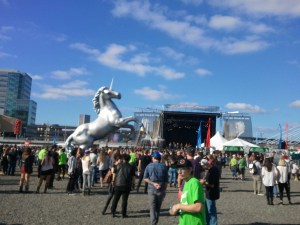
The mascot for Project Pabst and Scotland's national animal.

The mascot for Project Pabst and Scotland’s national animal.

I’ve lived for over 15 years in Oregon and have spent time in Portland on countless occasions, but this festival marked the first time I had poked around the South Waterfront.  It’s an area that the city has thrown a bunch of money at for redevelopment, but for some reason a few towers of condos haven’t spurred people to come down and spend money in that area.  And if you look closely at the gravel pit from the photo above, you can see why.  That said, parking was convenient enough (for ten dollars) and public transport ran smoothly, so clearly this spot should be able to handle an influx of hipsters as necessary.

Violent Femmes up on the stage.

Violent Femmes up on the stage.

Since I had to make the hour drive up each day, I skipped a couple of unfamiliar acts, but made sure to at least catch an old favorite, the Violent Femmes.  Though I came in half-way through and probably missed alternative radio staples like “Blister in the Sun” and “Add it Up”, I did get to enjoy “Gone Daddy Gone”, “Country Death Song”, and “Black Girls”.  The group showed why they would be a blast at festivals, engaging with the crowd with great jokes and keeping things fun and loose.  They may be basically a nostalgia act at this point, but no one should be complaining.

While the sun was pleasant for the audience, Red Fang would best be enjoyed in a grey thunderstorm.

While the sun was pleasant for the audience, Red Fang would best be enjoyed in a grey thunderstorm.

It’s always a blast to see these hometown heavy metal heroes, but Red Fang really brought it at this festival.  I’ve seen the band headline numerous shows around town, and for the first time the band had a proper mix, at an outdoor festival of all places.  Both guitars and vocals came in clearly and at the right volume, and it made it easier to enjoy crowd favorites like “Wires”, “Prehistoric Dog”, and “Blood Like Cream”.  It was the perfect soundtrack for driving around and committing some misdemeanors (and maybe a felony or two), but luckily no one actually took up that challenge.

Phosphorescent with some breezy jams

Phosphorescent with some breezy jams

I enjoyed Phosphorescent’s 2013 album Muchacho quite a bit, so I was eager to see Matthew Houck and his friends perform live.  He kicked things off with the best track off that album, “The Quotidian Beasts”, and it did not disappoint–the song builds off Chris Isaak’s “Wicked Game” chord progression to provide ample space for gorgeous and thrilling solos.  The mood was pretty chill for the most part, which was perfect for the afternoon, but the band was able to keep the momentum going even through some of the ballad-filled lulls.

I assure you, those ants are Tears for Fears

I assure you, those ants are Tears for Fears

We took a break during Rocket from the Crypt’s set, partly because I can never forgive the band for not being Rocket from the Tombs, and sampled some of the foodcarts and the free “PBRcade”.  Being originally from Louisiana, if someone is offering a Muffuletta sandwich you’re goddamn right I’m going to order one, and even if it wasn’t great, it’s better than most options.

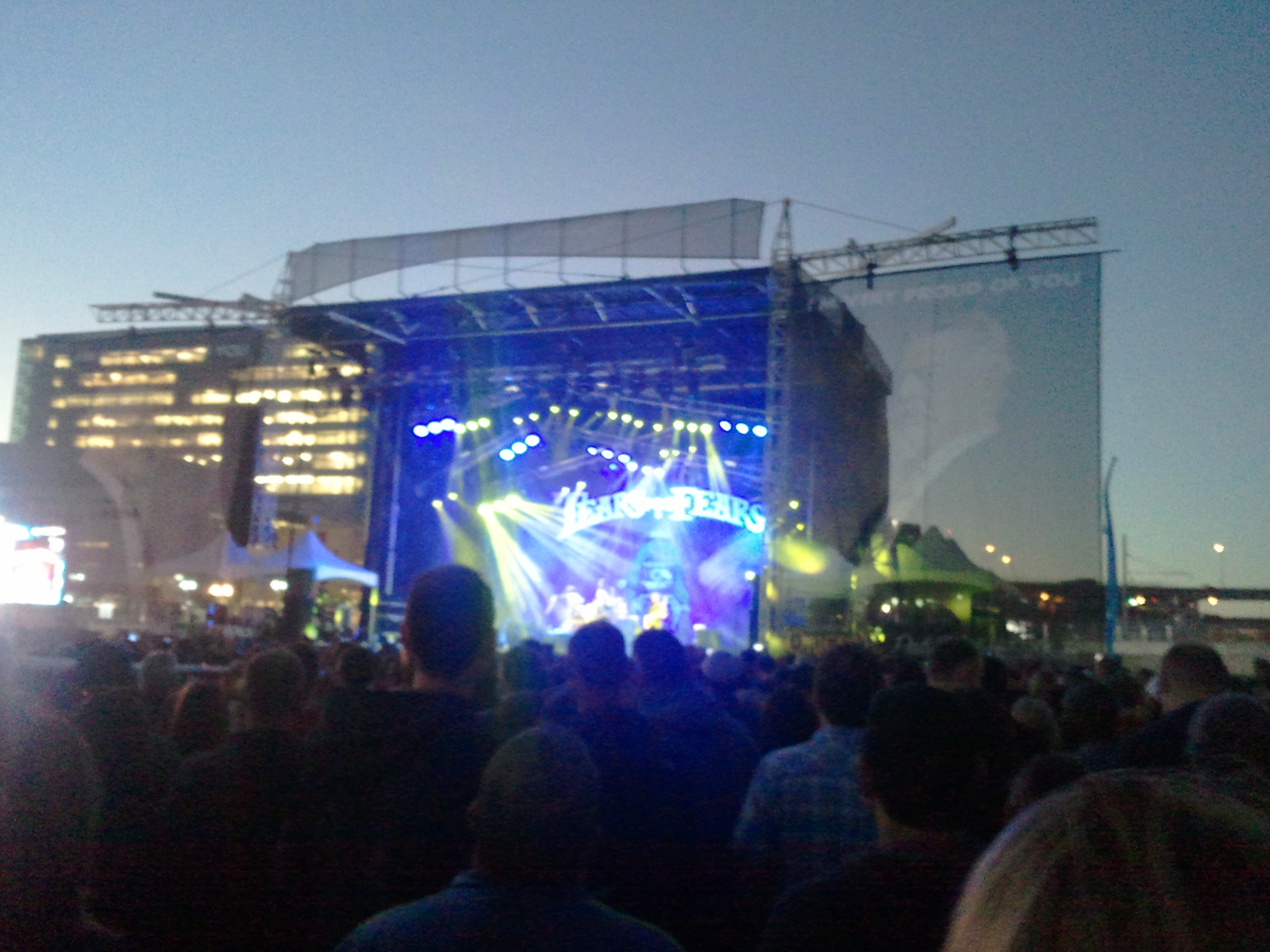
Tears for Fears were an unconventional headliner that made a lot of people scratch their heads (as they explained, they were a last-minute replacement for Kate Bush (yes, this was a joke)), but the crowd definitely seem to appreciate it.  The instrumentation was pretty spare, allowing a lot of space in the music, and probably could have benefited from some additional backup vocals.  They stunned the audience with an aching cover of Radiohead’s “Creep” (even if it failed to include the best part of the song as some would argue), then proceeded to capture the hearts of the hipsters in attendance with an Arcade Fire song.  I checked out at this point to get across town for Built to Spill, but as I exited they launched into “Everybody Wants to Rule the World”, so I hung out a bit right outside to hear one of the best songs of the 80’s live.

Speedy Ortiz keepin' the dream of the 90's alive

Speedy Ortiz keepin’ the dream of the 90’s alive

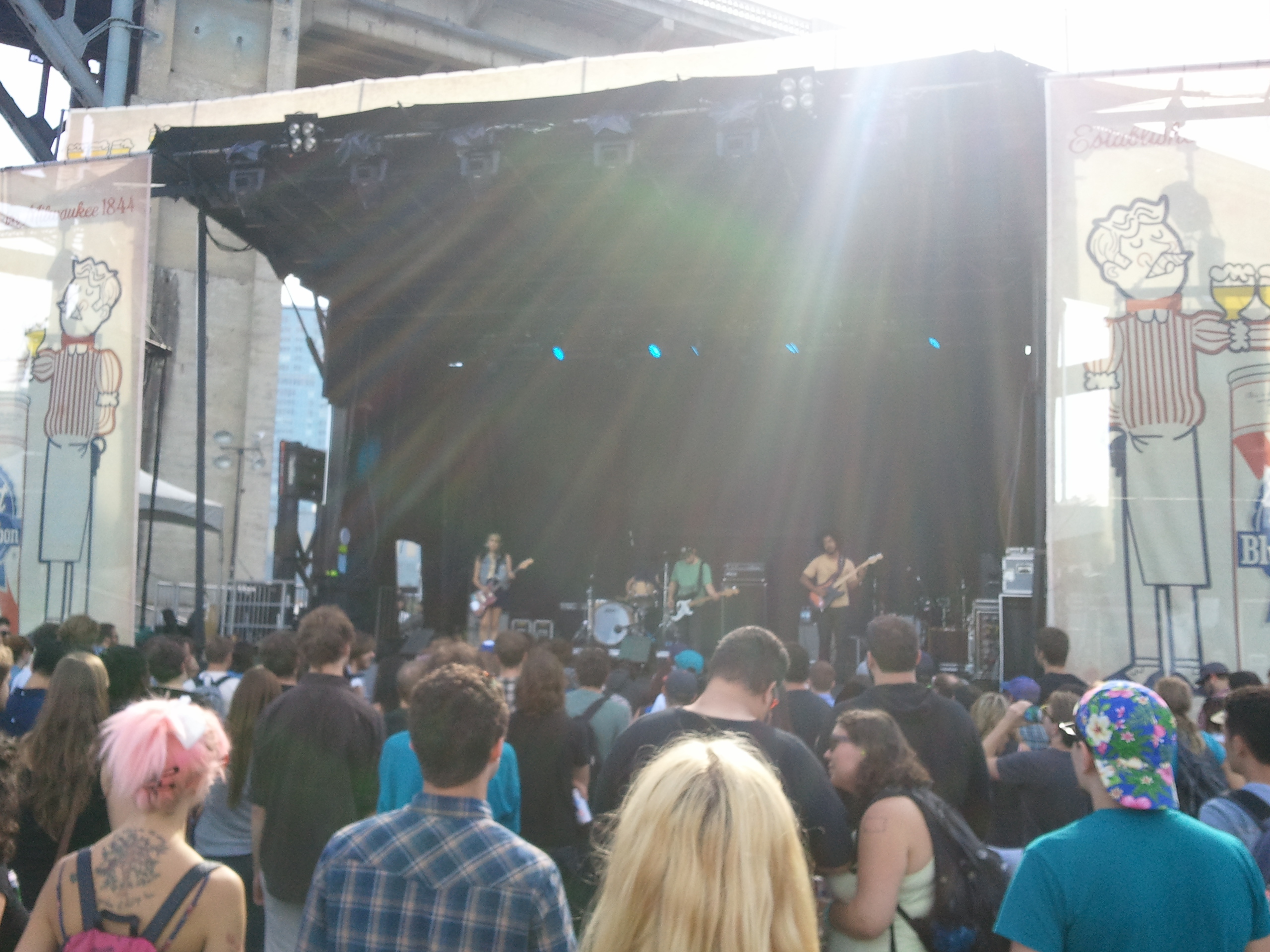
I was glad to catch the end of Speedy Ortiz’s set, since Major Arcana was one of my favorites from last year.  They draw from some of the best parts of Pavement and the early grunge era to write crunchy, meandering (in a good way) alt-rock, and while they could improve on their stage presence a bit, it was good to hear some noise.

The Thermals up on the main stage, and deservedly so.

The Thermals up on the main stage, and deservedly so.

The Thermals are the true hometown heroes, and they proved it with their blistering 45-minute set that tore up the main stage.  Granted, it was still early in the day and the crowd was a little sparse given their considerable effort, but the band played with a furious intensity that only let up when Hutch had to confront a bee on his microphone.  It’s always a treasure when the band throws in some tracks from Fuckin’ A in with the classics from The Body, The Blood, The Machine.

Shabazz Palaces rockin' the laptops and drums.

Shabazz Palaces rockin’ the laptops and drums.

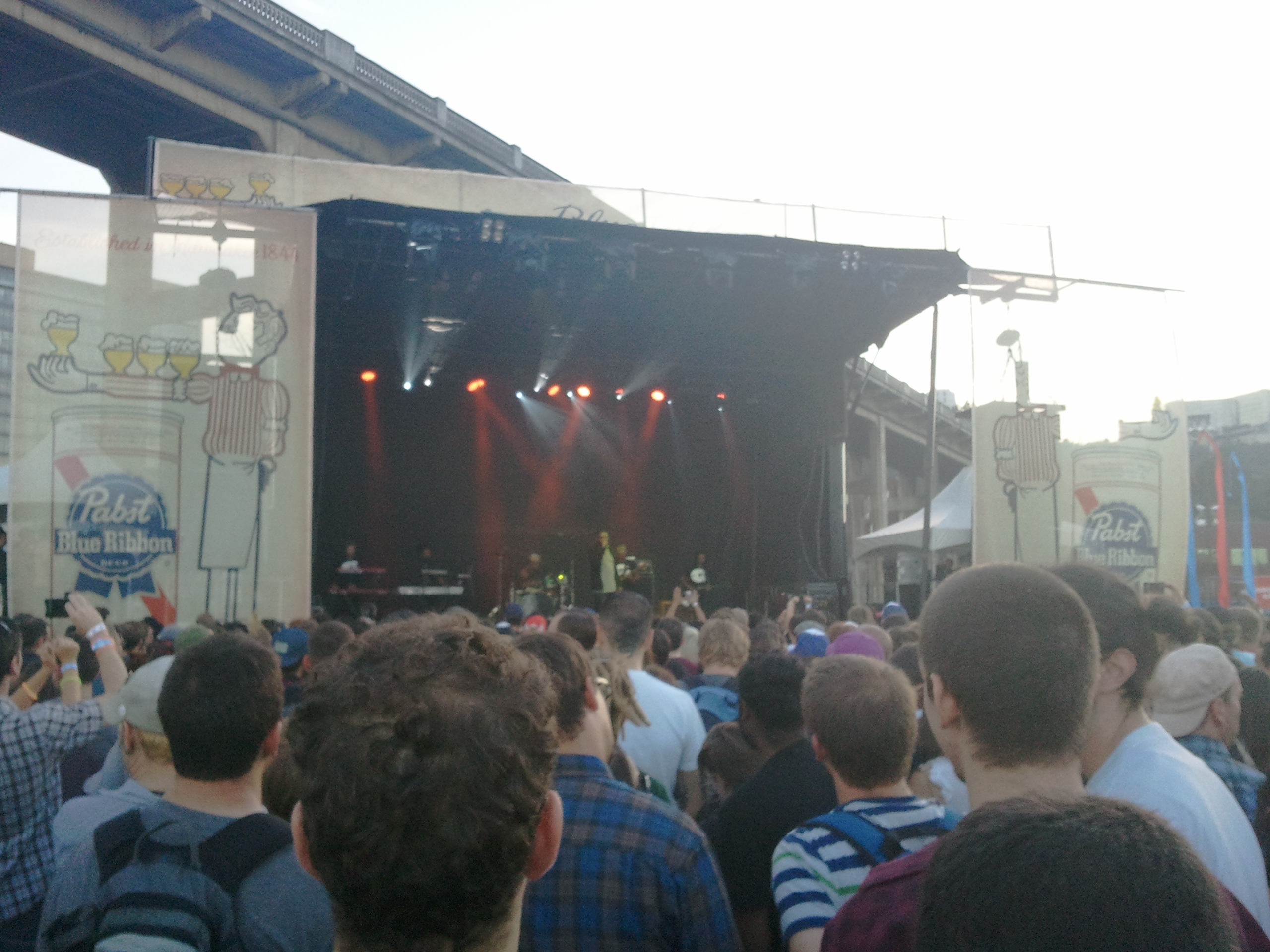
Shabazz Palaces were a change-up from the rock-heavy lineup, and while it was nice to have some hip-hop, the duo’s set was a bit monotonous.  Sure, it was groovy for a bit, but there wasn’t much shape to their set, and it was hard for the newcomer to really latch on to the music.

GZA taught Portland the finer points of astrophysics

GZA taught Portland the finer points of astrophysics

GZA thrilled the crowd with not only a performance of Liquid Swords but also by tossing in some Wu-Tang classics, with plenty in the crowd ready on-hand to provide some of the missing parts.  Liquid Swords can be a difficult album to get into, but with the help of an excellent backing funk band GZA was really able to get the songs to pop and come alive.
Modest Mouse putting an exclamation point on a great weekend.

Modest Mouse putting an exclamation point on a great weekend.

We had seen Modest Mouse a few months earlier as they started touring once again, and while that was a fine show, it was nothing compared to how tight the group was for this performance.  Holy shit, this may have been their best show yet, featuring such highlights as “Night on the Sun”, “Broke”, and “Doin’ the Cockroach”.  The group at this point has evolved so much over the years, transitioning from a power trio into what seems to be an 8-or-so piece in its current incarnation, with dual percussionists (as has been the norm since Good News) and multi-instrumentalists handling horns and strings.  With its revolving-door-like lineup, it can often appear to be some sort of musician welfare program, and I say that with the best of intentions.

On Sunday night, after a brief delay at the start (it was fitting that Modest Mouse was the only band unable to start on time the whole day), the band effortlessly ran through their extensive catalog with nary a hiccup, beginning with “Tiny Cities Made of Ashes”, which in a nice bit of symmetry was the final song of the encore from the time we saw them back in May.  The band easily moved throughout their extensive catalog, capturing both the big hits and the rare gems alike.  As mentioned above, the rare early single “Night on the Sun” was especially memorable, with Isaac putting his gruff delivery to good use and firing off some especially wicked solos.  Though Isaac was battling a cold, the audience wouldn’t have noticed if it wasn’t for his announcement, but it did lead to one of his many funny anecdotes during the show; at one point he claimed to be bad at the “in-between song banter”, but anyone who’s been to a Modest Mouse show knows that’s far from the case.

The encore ended with an especially stirring rendition of “The World At Large”, augmented by a coda which made excellent use of the full band with horns and strings helping deliver extra power to that gorgeous instrumental ending.  The finale of “The Good Times Are Killing Me” provided the perfect conclusion to a festival put on by a beer company, with audience engaging in a gregarious sing-along with the band as the lights flipped back on.

* * *

For the most part, the crowds at the festival were excellent, though I want to make special mention of the audience at this last performance.  I’ve been to hundreds of shows over the years, and I’d never encountered a larger group of pure assholes than the ones that were ostensibly there to be “entertained” by Modest Mouse.  If you’re heading out to grab beer while the band is performing a rarity like “Night on the Sun”, then maybe you should just ditch the show entirely and go get wasted out in Old Town; believe me, the pisswater available at the show was not worth the trouble.  It was infuriating to see people just try to force themselves through groups of people when there were clearer paths available that were also easy to spot.  At one point, a bro tried to barrel through, pushing into me but armed with an excuse that “hey man, let me through, I’m carrying wine, so I gotta be careful.”  If you’re concerned about the safety of your wine, then maybe you shouldn’t be attempting to bulldoze multiple people as they’re dancing along to “Doin’ the Cockroach”.  It was just an unrelenting stream of assholes constantly behaving in this manner, and it nearly ruined an otherwise perfect ending.  Considering that the rest of the festival went off without a hitch, perhaps in the future they should consider cutting off alcohol sales before the last act, similar to how they’ll cut sales late in a baseball or football game.  Other than that, it was a total success.
Built to Spill, Live at the Crystal Ballroom

In some ways, Built to Spill is an odd choice to be a part of a festival put on by a beer company.  A Built to Spill show is not intended for the casual music fan who’s out on the town looking for a fun night out with the music as mere background to other items on the agenda. The band’s focus is not on spectacle, but on recreating dense, complex works of Guitar As Art for a devoted and appreciative audience in as professional a manner as possible.  Even fans can find themselves lost as the group delves deep into an extensive catalog of originals and various covers.  In other words, there would be no shilling for corporate sponsors, or mentions of alcoholic beverages; Doug Martsch would punctuate a song with a simple “Thanks”.

Though technically a part of the Project Pabst festivities, it is best to think of Saturday night’s show as a stand-alone gig–the chance to see one of the great indie rock bands for over two decades in a locale that while not home, is close to it, for the low price of only $25.  As weekend entertainment options go, it was probably the best bang you could get for your buck, and that’s before taking into account the quality of the actual performance.  With a setlist that danced all around their extensive career and a lineup in which the new parts are now seemingly fully assimilated, the band ended up performing their finest show that I’ve seen in years.

Doug Martsch and co. remembering to carry the zero

Doug Martsch and co. remembering to carry the zero

It’s not a bad idea to start things off with one of the greatest album openers of all-time, and the band obliged with a furious rendition of You In Reverse‘s epic “Goin’ Against Your Mind” in all its solo-filled glory.  The band then dipped into the early years with two cuts from There’s Nothing Wrong With Love, “In the Morning” and “Stab”.  A riveting performance of “Liar” followed, complete with the trademark Doug Martsch head-swivel, as well as a rousing version of “Sidewalk” which got the crowd bouncing.

The middle of the set featured my first encounter with “They Got Away”, a reggae-inspired song that the band had released a few years back on a single that I didn’t even know existed; I had been anticipating new material as the group had been working on a follow-up to There Is No Enemy for some time, but instead I had to settle for a song that ended up being just “new-to-me”.  Speaking of that album, a personal highlight was the gorgeous ballad “Life’s a Dream”, whose climax really sizzled live.  I’m still hoping to catch a live performance of the devastating “Things Fall Apart”, though.

Built to Spill jamming with the opener's cover of "Psycho Killer"

Built to Spill jamming with the opener’s cover of “Psycho Killer”

The last time I caught Built to Spill it was at an intimate show at the Doug Fir where the group was incorporating a new drummer and bass player.  The guitarists were all predictably great, but the rhythm section was hesitant and looked rather bored; part of this could be attributed to a setlist that consisted of seemingly easier songs so as to gradually incorporate the new members.  However, there was no such caution with the material at Saturday’s show, and the two new guys sounded as if they had been a part of the group for years.

The show ended with slow-building classics “I Would Hurt A Fly” and “Time Trap”, and though we were warned the latter would be the last song of the evening, we were thrilled when it unexpectedly merged into old favorite “Car”.  It had been nearly a decade since I saw that song live, and goddamn did it feel good to hear it again.  That said, hopefully it won’t be another decade before I see it again.

Menomena, Live at the Wonder Ballroom

Most of the attention around Project Pabst was focused on the shows happening down on the South Waterfront of Portland on Saturday and Sunday, but the festivities actually began with a few select shows around town on Friday night.  Even though it would mean I would be making the trip up I-5 on three straight days, I jumped at the chance to see one of my local favorites play the Wonder Ballroom.  I’ve been a fan of the “experimental” indie rock of Menomena for years, ever since I caught them opening up for Modest Mouse about a decade ago (and in a nice bit of symmetry, Modest Mouse would be headlining the final night of Project Pabst), and have been consistently impressed with their albums and their live show, and Friday was no exception.

Fans who have followed the band over their career are well aware that the original trio has now become a duo, at least in the recording studio.  For the live show, Justin Harris and Danny Seim don’t do as much instrument-switching as they did in the past, with Danny finding a comfortable place behind the drumkit and Justin switching between bass and bari sax, with the occasional guitar thrown in, but sharing vocal duties.  To fill things out, they’re aided by various touring musicians, and for this tour they had help from a pair of them to cover additional keyboard and guitar lines, and with their help all bases were covered and the songs sounded fantastic.

Justin and Danny are setting up for the show.

Justin and Danny are setting up for the show.

The set was a mix of favorites from Friend and Foe on, though “Strongest Man In the World” from their debut I Am The Fun Blame Monster kicked off the show (aside: that title is an anagram for “The First Menomena Album”, a fitting coincidence since the last band we saw was Interpol who just released their own anagramed album, El Pintor).  The guys were loose, enjoying the hometown atmosphere and having fun with the title sponsor–Justin was hoping that anytime he said “Pabst Blue Ribbon” he could get a “cool hundy”, though he would settle for $33.33 for saying any part of the name, while Danny changed up the lyric in “Five Little Rooms” on the fly to “at half-Pabst again”.  Speaking of Danny, over the past decade he has become one of the greatest drummers in indie rock, and it’s always a marvel to watch him capture all the tricky rhythms that comes from a result of their unique songwriting process while also maintaining perfect time.  He alone is worth the price of admission.

I’m sure I wasn’t the only one hoping to hear a glimpse of a follow-up to the fantastic Moms, but there were no new songs on the agenda last night.  Instead, the audience had to be pleased to watch highlights like “Muscle’n Flo” and “TAOS” nailed with pinpoint precision.  The crowd was captivated as Justin alternated between different instruments and weaving in loops with his feet all the while.  Personally, I always enjoy it when a band utilizes a bari sax, and with Menomena, it’s an integral part of their sound and not a mere gimmick (though I have to say, those bros behind me who kept yelling “TUUUBA” every time they saw the bari sax, you’re exactly as clever as you think you are).

Justin and Danny exploding in light

Justin and Danny exploding in light

The night ended with a fantastic encore, with the epic rocker “The Pelican” thrilling the crowd, followed unexpectedly by the subdued track “Rotten Hell”.  However, the guys tweaked the song a bit from its recording version, with the changes providing the finale with enough of a kick to properly send the crowd off into the night with the right amount of energy to keep raging for the rest of the weekend.  It was as perfect a kickoff for a festival that Portland could ask for.

Interpol, Live at the Crystal Ballroom

Interpol hit the Crystal Ballroom last night feeling a bit rejuvenated.  Their latest album, El Pintor, was released last week to the best reviews that the band had received in a while (including our own rave, published on Tuesday), and they seemed eager to build on that momentum.  As the band geared up for a full-fledged fall tour in support of the album, a lot of the press from the early shows emphasized the prevalence of the band’s early material in their sets.  While many of the highlights of their beloved first two albums were performed last night, Interpol didn’t shy away from performing new material, sprinkling the set with several cuts from El Pintor.

Black and White helps hide some of the flaws of my photography

Black and White helps hide some of the flaws of my photography

Whereas before it often seemed that the band struggled to maintain an effortless cool in their performance–I have a distinct memory of their last Crystal Ballroom performance, which came during the Antics tour, where Paul would smoke and rest his still-burning cigarette on his guitar’s headstock while he played–last night the band was focused and intent on nailing their performance.  Daniel Kessler has always been a sparkplug and in his own little world with his various nifty dance-steps (though the Crystal’s stage put a damper on some of that footwork), but last night Sam Fogarino was locked in with a blistering performance, displaying a great ability to shake off the crowd’s enthusiastic-but-off-beat clapping.  Most significantly, Paul Banks was in a cheerful mood and seemed especially engaged, and it came through with one of the best performances of his that I’ve seen.

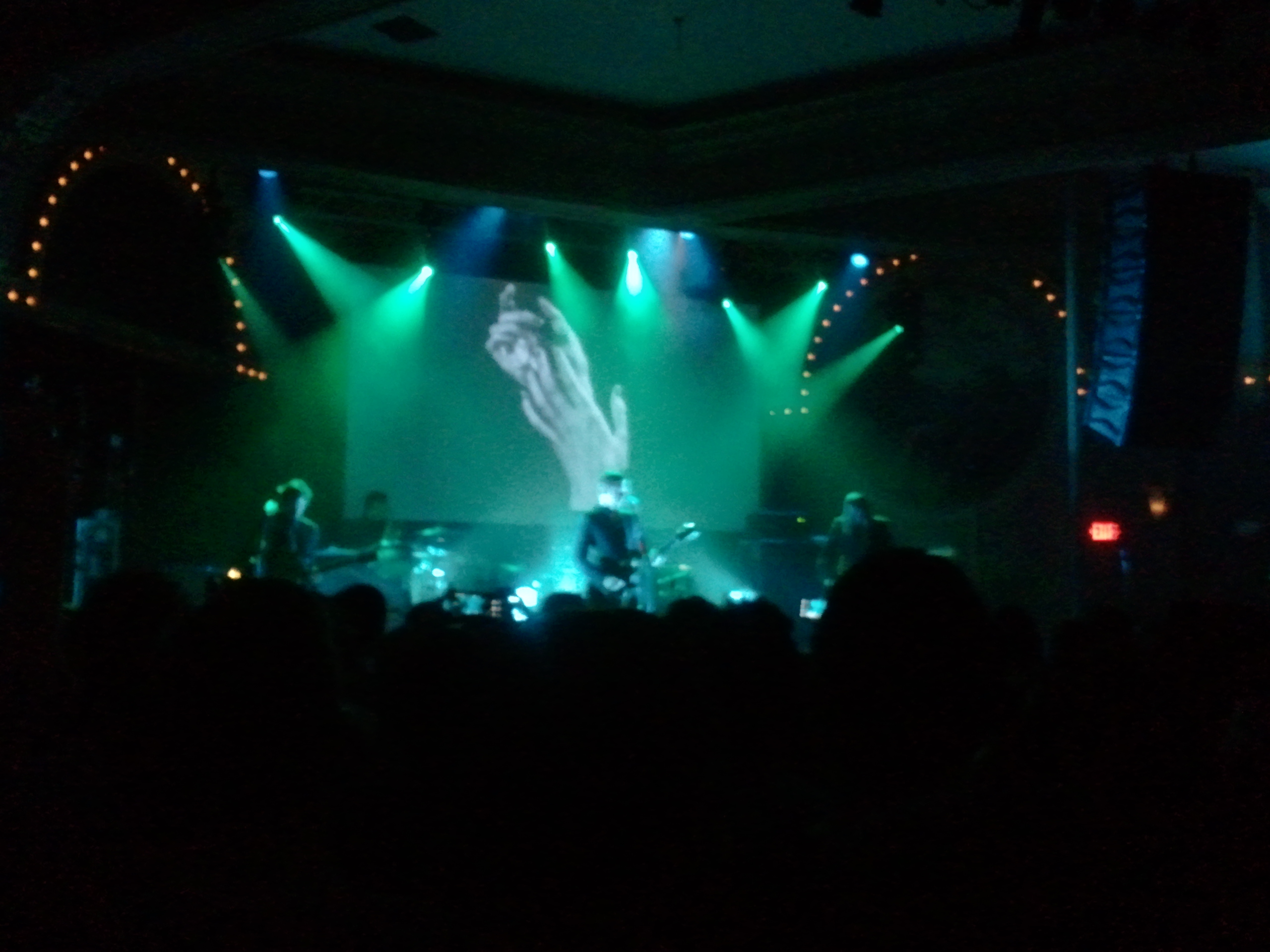
A glimpse of the stage show

A glimpse of the stage show

The stage show was fairly simple, alternating between green- and red-focused light setups and a simple backdrop, alternately displaying the hands of the El Pintor cover with the occasional abstract visualization.  The focuse was on the songs, and though the curse of the poor acoustics of the Crystal reared its head once again (Sam’s hi-hat and other auxiliary percussion were poorly mic’d, the keyboards were always buried, and Paul’s guitar spent most of the night turned down too low), it was still a riveting set.  After opening with “My Blue Supreme” from the new album, Interpol revved the crowd up with the one-two Antics combo “Evil” and “C’Mere”, with the latter surprisingly getting the bigger roar from the Portland crowd.  From then on it was an even mix between new material and early stuff, with the crowd going nuts for Turn on the Bright Lights‘s “Say Hello to the Angels”.  Our Love to Admire and Interpol only got one track apiece, with “The Lighthouse” being the surprise pick for the former and “Lights” leading off the encore for the latter.  It seems clear that the band is distancing itself from those albums (with Dan and Sam remarking how they barely remember how to play the songs from OLTA in a recent interview), but the band is not heading to the nostalgia circuit any time soon.  The new material was met with a rapturous response for the most part, an amazing feat considering the album was released just last week.

Interpol in a familiar red setting

Interpol in a familiar red setting

The future is bright once again for Interpol, and hopefully the band continues to make the most of its “comeback”.