Recs

Review: Earl Sweatshirt – I Don’t Like Shit, I Don’t Go Outside

Despite the huge buzz and heavy praise that has surrounded him through his brief career so far, it has taken me some time to appreciate the artistry of Earl Sweatshirt, outside of his appearance providing the hook for Frank Ocean’s “Super Rich Kids”.  However, when the news came that he was releasing an album entitled I Don’t Like Shit, I Don’t Go Outside, I knew I would have to be tracking down a copy; the last time the mere mention of an album title had me scrambling like this, Atmosphere had just released When Life Gives You Lemons, You Paint That Shit Gold, and that became one of my favorite hip-hop albums of that year.  Much like Atmosphere’s record, I Don’t Like Shit is a deeply introspective and reflective album, though it is a much darker musical journey that is distinguished by its grim and spare production.

Earl’s often extremely laid-back flow can make a codeine user appear as hopped-up as a meth addict, but on many tracks the deliberateness of his delivery helps emphasize his lyrics.  The album begins on a bright and playful note with the intro “Huey”, but this mood is quickly replaced by a more ominous tone that haunts the rest of the record.  Earl creates drum tracks that are heavily processed to emphasize unnatural tones, and the eerie synths and other industrial touches recall early Wu-Tang solo records.

Considering the often bleak subject matter, Earl wisely restricts the running time on I Don’t Like Shit, wrapping up the album in a concise fashion in slightly less than half an hour.  Lyrics deal with death, anxiety, depression, and the emptiness of fame in a frank and honest manner, but the album avoids merely dwelling in misery.  Though it is dark, I Don’t Like Shit is never oppressive, which makes it easier to digest over repeated listens.

Earl’s ability to maintain a strict standard in his editing is something that his fellow Odd Future mate, Tyler, the Creator, needs to learn.  His latest, Cherry Bomb, starts off promising enough, with its nods to N.E.R.D.’s catalog that are fun and engaging, but the album slides off the rails by the end.  It is certainly an improvement over the practically unlistenable Wolf, but Tyler still has trouble harnessing some of the potential seen on Goblin.  Tyler has shown some great talent with his production over the years, and I often prefer his particular delivery when he raps, but he continually falls into the same traps over and over again.  Experimentation can be exciting, but not every idea needs to be heard, and shock tactics result in diminishing returns.

Review: Blur – The Magic Whip

Over on this side of the Atlantic, news of a long-awaited Blur reunion album has been greeted with a collective shrug.  It is a reaction that is indicative of the band’s general reception in the US, but not befitting of the group’s sustained greatness over the course of their career.  Most American listeners remember Blur more-or-less as a one-hit wonder (“oh yeah, those guys that did the ‘Woo-hoo!’ song!“), which is a shame because that particular attempt to taking the piss out of grunge is hardly indicative of the band’s diverse body of work.

Blur’s albums have been eclectic and sprawling affairs, with the band shifting effortlessly between different genres over the course of the record, and The Magic Whip follows that template as well.  Unlike the band’s previous work though, there are no big singles to be found on the new record; it is unlikely that a crowd favorite like “Tender” or “Beetlebum” or “To the End” will emerge from this set of songs.  Fans should not be discouraged however–though Blur does not reach the peaks that they have in the past, overall this is perhaps the band’s strongest group of songs since their self-titled release, and it improves with every listen.

It is rather remarkable how little The Magic Whip resembles the typical comeback album.  The effort compares favorably to the recent Dinosaur Jr. reunion, as Blur sounds like they never broke up in the first place; listening to The Magic Whip in conjunction with the rest of the band’s discography, the novice listener would have no idea that there was a sixteen-year gap between the new album and the previous full-lineup incarnation.  There are no attempts to cash in on any modern trends, nor are there any painful attempts to recapture the glory of their youth; perhaps this is the payoff for all that restlessness and genre-shifting from their previous albums earlier in their career.  Blur never really had a typical sound, so they are free to experiment however they would like.

Contrary to what one may expect, there is only a moderate influence that can be detected from Damon Albarn’s myriad side-projects since the band’s last album; there is a bit of dub that recalls The Good, The Bad & The Queen, a bit of the melancholy that marked his recent solo album Everyday Robots, but little that is reminiscent of Gorillaz.  Instead, it is a much more cohesive affair than what would have been predicted, especially considering the background behind the recording of the album (it was put together during the downtime of a cancelled music festival over the course of a few short days).  In general, The Magic Whip is a laid-back affair, and some of the album’s best moments are when the band takes it down a notch and stretches out a bit, such as in the drifting “Mirrorball” or the appropriately-named “I Thought I Was A Spaceman”.  Of course, Blur is never content to just stick around mining the same groove, so there are a fair number of uptempo numbers, most notably the cheery “Ong Ong”.  It is an effervescent song that is placed perfectly near the end of the album, serving as an excellent capstone to the record, and will have you singing along with its refrain of “I wanna be with you” long after the whole thing is over.

Review: Alabama Shakes – Sound & Color

April has been an extremely busy month for new releases, with highly-anticipated albums by several noteworthy artists hitting the stores each week.  Several of these records have lived up to the hype, but the latest album from Alabama Shakes surpassed my wildest expectations to top them all.  Sound & Color sees the band expanding beyond their well-worn retro style, as they explore a wide variety of genres and captivate the listener with their passion and precision.

There is a reason why Alabama Shakes experienced massive success with the release of “Hold On”: the brilliant single was the perfect showcase for Brittany Howard’s powerhouse voice, and it was effectively supported by the band’s ability to reproduce old audience-pleasing blues-rock staples perfectly.  There is also a reason why despite the fact Boys & Girls was certified Gold off the strength of “Hold On”, the rest of the album failed to leave much of a mark.  While it was a perfectly pleasant record, Boys & Girls ended up being a somewhat forgettable album; each song failed to distinguish itself from one another and without a hook as memorable found on “Hold On”, everything eventually bled together.

The same cannot be said for Sound & Color, as Alabama Shakes digs deep into their record collection and delivers songs that filter in 70’s soul, funk, and even garage-rock influences into their blues-based style.*  The album never comes off as a series of dalliances with experimentalism though, and Alabama Shakes never sound like mere tourists,  since the band is able to find a common thread through each of these genres and infuses each song with their own distinct personality.  Each song allows the band to demonstrate their considerable musical chops, but the tracks are so well-composed that none of them sound like a technical exercise; Every guitar riff, organ flourish, and drum fill fit the song perfectly.  To top it off, not only is Howard’s dynamic voice as commanding as ever, she also displays a deft sense of control in fitting it within the style of each song.

Sound & Color fades a bit down the stretch, but the impact of the first three-quarters of the album more than makes up for it.  It is heartening to see Alabama Shakes improve upon the success of their debut by exploring different creative urges, and in the process they created a record that easily outshines their previous work.

*The easiest comparison I can make is to the new musical directions that the Black Keys took once they started collaborating with Danger Mouse, especially on Brothers and Turn Blue.  Though since this is only the second album from Alabama Shakes, the shift will probably be less jarring to the band’s fans.

Review: Speedy Ortiz – Foil Deer

After breaking through with their impressive debut, expectations were high for Speedy Ortiz’s follow-up to Major Arcana.  Fans of the group’s version of knotty, guitar-based mid-90’s indie rock will be glad to hear that Foil Deer fits perfectly alongside their previous work.  Though at times it is difficult to determine how it distinguishes itself from its predecessors, Foil Deer is still a showcase for the band’s greatest strengths: intricate guitar noodles delivered with a satisfying crunch, punctuated by powerful percussive outbursts.

The easiest musical comparison that critics rely on to describe Speedy Ortiz’s style is Pavement, but that is somewhat misleading, since Pavement’s catalog was more diverse than what most people remember; there is nothing on Foil Deer that recalls “Conduit For Sale” or “Range Life”, for example.  Instead, Speedy Ortiz for the most part is content to explore only one part of Pavement’s aesthetic (though not the same aspect in which Parquet Courts makes their living, for the record), namely the seemingly-aimless guitar melodies, prevalence of dissonant chords, and off-kilter rhythm section.  Vocally, Pavement and Speedy Ortiz share a similar approach, but with one key difference: though the two groups will never be heralded for the technical skills of their singers, Sadie Dupuis offers a more direct approach with her singing, unlike Stephen Malkmus, who more often than not hints at a song’s melody with his vocals.  In both cases the vocals are only a secondary concern.

Songs like the quotable “Raising the Skate” (numerous publications have cited the line “I’m not bossy, I’m the boss” as the exemplar of the album’s lyrical themes) shows the band adding the punch that the band displayed with the Real Hair EP released last year to their trademark sound, and “Swell Content” shows that the band can pack their sound into a tight, catchy, and concise package. However, the highlights of the album though are when Speedy Ortiz shifts away from their comfort zone, like when the band experiments with electronics on the groovy “Puffer” or dials the attack back a bit with the almost-ballad “Mister Difficult”, whose chorus may have the best hook on the album.  These tracks help stave off the potential for monotony and help elevate the second half of the album.

Foil Deer takes some time for the listener to unpack, as it takes multiple spins for particular details to emerge.  The good news is that with repeated listens, songs that initially seem like merely pleasant background music eventually reveal their depth, as it becomes easier to spot countermelodies and other sonic embellishments.  Speedy Ortiz may not have experimented much with the formula they developed for Major Arcana, but if the band keeps delivering solid results like Foil Deer their fans are unlikely to complain.

Review: Waxahatchee – Ivy Tripp

Every week, I grow more and more convinced that the 90’s will never die.  Even if the music of the era will never dominate the airwaves like it did in its heyday, personally I feel it’s a good thing that there will forever be an undercurrent that will think getting a couple of friends together to bang out something with a few simple guitar chords with a few clever lyrics over the top is a great idea.  Though this gives the listener a basic idea of the DIY aesthetic of the album, it is but an oversimplification of what makes Waxahatchee’s new album Ivy Tripp such an engaging listen.

Waxahatchee first captured the attention of critics and listeners with Cerulean Salt, a charming lo-fi take on folk with a bit of a punk attitude that functioned more or less as a Katie Crutchfield solo album.  With Ivy Tripp, Crutchfield keeps the lo-fi spirit alive, but for the first time Waxahatchee feels more like the effort of a full-fledged group.  The band maintains a loose, low-stakes feel with much of the music, with the slightly off-time bass and off-kilter drums on “<“ providing a perfect example, or the breezy, easygoing ballad “Summer of Love”, a simple acoustic ode to a companion whose identity is revealed with a barking cameo at the end.

There are other moments where the group snaps into focus, like the mid-90’s indie rock throwback “Under a Rock”, with its bass countermelodies and drum fills lining up perfectly with the song’s big hooks.  Waxahatchee also shines when it steps out of their comfort zone and explores unfamiliar territory, as in the slow groove of “Air” or the spare “Breathless”, with its simple, distorted synth melody accented by the occasional feedback-tinged guitar divebomb.  Ivy Tripp effectively switches between these styles, keeping the listener’s attention throughout without ever sounding the least bit disjointed.


Ivy Tripp is an excellent step forward for Waxahatchee, as it reminds listeners of the highlights of Cerulean Salt while pushing forward into new musical directions.  This time around, Waxahatchee maintains their DIY spirit, but wraps that feeling up in a package filled with big hooks that encourages repeated listens.  Ivy Tripp may evoke nostalgic sentiments from a couple of decades ago, but Waxahatchee puts their own unique stamp on it that the album never sounds like a 90’s jukebox of indie rock’s greatest hits.

Review: Sufjan Stevens – Carrie & Lowell

After the experimentalism and bombast of The Age of Adz, Sufjan Stevens has returned with the stripped-down, heartbreakingly beautiful Carrie & Lowell, a nakedly intimate album that is possibly his greatest work yet.  Stevens attempts to come to terms with the myriad emotions resulting from the death of his birth mother (the “Carrie” in the title), with whom he had an unusual relationship; present-day stabs at attempting to comprehend their relationship are intertwined with memories of childhood summer visits to Oregon, often accompanied by only a delicately finger-picked guitar and Stevens’s soft cooing voice.  It is easy to get wrapped up in the emotional turmoil of the lyrical content, but despite the often dark subject matter, the record never succumbs to the potential to overwhelm the listener, because Stevens preserves a delicate balance through his carefully constructed arrangements and beautiful melodies.

For the most part, the easiest reference points to Carrie & Lowell are to early-Elliott Smith/late-Nick Drake records, a fair comparison because of the shared connection of hushed vocals and acoustic guitars.  However, the high points of the album are when Stevens channels other influences.  One can hear shades of The Antlers in the album’s finale “Blue Bucket of Gold” and especially in “Fourth of July”, with its soundscapes providing an elegiac ambiance and its simple keyboard chords delivered in a brisk eighth-note rhythm; the shift in musical style also complements the shift in the narrative, as “Fourth of July” details the events of his mother’s death in painstaking detail.  The song builds to an agonizing climax, with the dramatic haunting line “we’re all gonna die” lingering in the air as the music drops out.

“The Only Thing” follows, switching back to the soft treble tones of a finger-picked guitar but maintaining the same devastating narrative; if it was backed by heavily distorted lead guitar, it would be a perfect siren song for a Victory Records band, especially with lyrics like “Should I tear my eyes out now before I see too much?  Should I tear my arms out now?  I want to feel your touch.”  The difference is that Stevens delivers these nakedly personal lines with such a deft touch that it only invokes empathy in the listener, and avoids the possibility of falling into self-caricature.  This adroitness extends to other brilliant sonic details, such as the end of “John My Beloved”–as Stevens ends the song with the line “in a manner of speaking, I’m dead”, the tape keeps rolling for a few moments, and one can hear a short breath before the tape is cut, creating an extremely powerful moment.

While Stevens abandoned the “Fifty States” project, the subtitle for Carrie & Lowell could easily be “Oregon”, as references to state landmarks and historical events are peppered throughout the album.  Hearing mentions of The Dalles, Spencer’s Butte, and the Tillamook burn, among others, helps ground the album to a specific time and place, as well as provide a personal touch to the universal emotions explored throughout the record (and as an Oregonian, it definitely keeps my attention as a listener as I keep trying to spot the different references with each listen).  The album is an often harrowing listen, but Carrie & Lowell is never a slog; with the aid of his gorgeous and elegant musical arrangements, Stevens is able to probe difficult questions about love and relationships without leaving the listener in a depressed and miserable state.  It may be Sufjan’s best work to date, and possibly the most beautiful album you will hear this year.

Best of the Rest: Other Highlights from 2014

Even with our expanded Best-Of list courtesy of The Process, there were still a ton of great albums released last year that were worthy of recognition.  Since we here at Rust Is Just Right are big believers in spreading all good music, we’re going to put a spotlight on some other great records that you may have overlooked from the past year.

Atmosphere – Southsiders.  At this point in their career, you know what you’re going to get with Atmosphere, and for occasional fans that’s perfect.  Slug still comes up with great one-liners, and Ant provides an intriguing, grimy production to back him up.

Biblical – Monsoon Season.  This selection is proof that good things can happen when you show up to see the opening act.  We first caught them when they were touring with Death From Above 1979, and we instantly fell for their version of heavy metal that takes the sensibility of Queens of the Stone Age and Mastodon and expands it out to include several rocking solos.  A prog version of Red Fang?  We’re there.

clipping. – CLPPNG.  These guys do a great job of pushing the boundaries of modern rap, though their experimentalism can get the best of them on occasion.  There are several instances on CLPPNG that the abrasiveness becomes oppressive, but then there are plenty of other times where everything coalesces and it just hits.  Throughout the record, MC Daveed Diggs showcased some of the best technique of the past year, displaying an impressive ear for rhythm and deploying some incisive rhymes, with “Story 2” serving as the most prominent example.

Flying Lotus – You’re Dead!.  This mixture of electronica, jazz, hip-hop, and R&B flows effortlessly from one track to the next and always keeps your attention.  Kendrick Lamar’s appearance on “Never Catch Me” is the highlight, but there is a lot of fun to be had throughout the album.

King Tuff – Black Moon Spell.  A unique mix of glam rock and lo-fi indie, the best moments of this album are some of the most fun rock’n’roll released last year.

Mastodon – Once More ‘Round the Sun.  Mastodon continues to evolve and refine their sound, reining in some of their tendencies towards excess with more concise songs but still adventurous enough to seek out some crazy riffs and solos.  In this way, Once More serves as an efficient composite of their previous albums, but also features some of their catchiest riffs yet.

The Roots – …And then you shoot your cousin.  The Roots are so consistently excellent that they are practically the Spoon of hip-hop.  Their latest concept album was overlooked and underrated, and though it suffers from a diminished presence from Black Thought, the record still works even if it leans on more traditional R&B than rap.

Slow Bird – Chrysalis.  They show a good ear for slow builds and pretty melodies, and  one can hear the foundation for future success.

Tweedy – Sukierae.  Who would have thought that Jeff Tweedy and his son Spencer would make a good team?  This side project has enough of the charm of his main gig in Wilco, while also offering enough of an alternative that makes it a worthwhile effort.

Walter Martin – We’re All Young Together.  This is the third solo album from a former member of The Walkmen released last year, but since the intended audience was for children there were much lower stakes involved.  However, this is one of those “kids albums” that is just as pleasant for adults, with its effortless easy-going charm.  If you play this for the kids, chances are they will grow up with good taste in music.

Also Worthy of Praise

Broken Bells – After the Disco; Clap Your Hands Say Yeah – Only Run; D’Angelo and the Vanguard – Black Messiah; Deerhoof – La Isla Bonita; Eels – The Cautionary Tales of Mark Oliver Everett; Foo Fighters – Sonic Highways; Parquet Courts – Content Nausea; Sun Kil Moon – Benji; Temples – Sun Structures; tUnE-yArDs – Nikki Nack.

All Albums That Were Considered

Here is a list of the albums that we listened to last year, in full.  Most of these were quite good and worthy of repeated listens, but they just could not crack the previous lists.  The good news is there were no absolute stinkers this year, though some were weaker efforts from bands that had excelled in the past.

…And You Will Know Us By The Trail Of Dead – IX; Band of Horses – Acoustic at the Ryman; The Brian Jonestown Massacre – Revelation; Circulatory System – Mosaics Within Mosaics; Cold War Kids – Hold My Home; Coldplay – Ghost Stories; Crosses – Crosses; Damon Albarn – Everyday Robots; Dum Dum Girls – Too True; Ghostface Killah – 36 Seasons; J Mascis – Tied To A Star; Jack White – Lazaretto; Karen O – Crush Songs; Kasabian – 48:13; Kevin Drew – Darlings; The New Pornographers – Brill Bruisers; Philip Selway – Weatherhouse; Pixies – Indie Cindy; Thee Silver Mt. Zion – Fuck Off We Get Free We Pour Light On Everything; Thurston Moore – The Best Day; Tokyo Police Club – Forcefield; We Are Scientists – TV en Francais; Wye Oak – Shriek.

Review: Godspeed You! Black Emperor – Asunder, Sweet and Other Distress

Writing a review for a Godspeed You! Black Emperor album can be an exercise in futility.  If you have time to kill and want to have some fun, be sure to peruse some of the awkward attempts to describe to the untrained ear what one should expect to hear on a GY!BE album.  It is a challenging task to convey into words the kind of music that Godspeed creates, as their songs buck traditional styles and structures; complicating matters is the nearly-wordless nature of their work, which leaves most reviewers out to sea without the benefit of the potential life preserver of lyrics to help guide a review.  An added difficulty for reviewers is the problem of distinguishing the band’s current work from its previous output, since Godspeed more or less relies on the same tools for each of their albums.   The result is that many reviewers find themselves out of their element, often using technical musical terms incorrectly and employing flowery language in an overwrought manner in an attempt to impart on the listener their emotional response to the album, but reveal very little about the actual music.

The point is not to disparage the attempts of others, but to point out the particular predicament that arises when attempting to review a Godspeed album.  The best way to avoid these pitfalls is to keep the analysis simple, and to cite easy-to-grasp concrete examples.  Asunder, Sweet and Other Distress is Godspeed You! Black Emperor’s most accessible album, with its shorter length and more easily identifiable melodies, which makes it the perfect entry point for anyone interested in the band.  After repeated listens, it may also be my favorite.

For the most part, one can consider the track listing on Asunder as a mere suggestion–four tracks are listed, but the album is constructed as more of a three movement suite.  The middle pair of songs (“Lambs’ Breath” and “Asunder, Sweet”) can collapse into one, as a few minutes of respite to allow the listener a chance to breathe between the two epic bookends; both play around with different kinds of distorted feedback, with the first acting as a gradual extended breakdown of the opener and the second as a slow build that serves as an intro to the closer.  Even that characterization may be imposing too much of a structure on the album, since the songs were initially conceived as a single piece that was appropriately named “Behemoth”.

The highlights of Asunder are its two epics, the opener “Peasantry or ‘Light Inside of Light!'” and the closer “Piss Crowns Are Trebled”, and both show Godspeed at their most triumphant.  In an unusual maneuver for the band, “Peasantry” immediately asserts itself with a bombastic beat and a monstrous, lumbering guitar riff.  Over the course of ten minutes, this riff gradually inverts itself into a more expressive Middle Eastern motif, but without any of the intensity subsiding.  The drums play an indispensable role on the album, more so than on any previous Godspeed record in the past.  On “Peasantry” they are a vigorous, robust force that pierces through with precise accents, while on “Piss Crowns” they show off an impressive array of subtle rhythmic tricks (listen to the oddly placed hits and ghost notes at the beginning of the track) and dazzle with expertly placed fills.

Asunder shows Godspeed at their most conventional, but it is also shows them at their most impressive.  Try not to get caught up in the emotional buildup of “Piss Crowns”, as the band unleashes possibly their most triumphant riff in their history, and marvel at how they play around with a relatively simple melody in different ways that augments both its symphonic and rock aspects.  It makes for an engrossing album that begs for heavy rotation (and the loudest speakers that you can find).

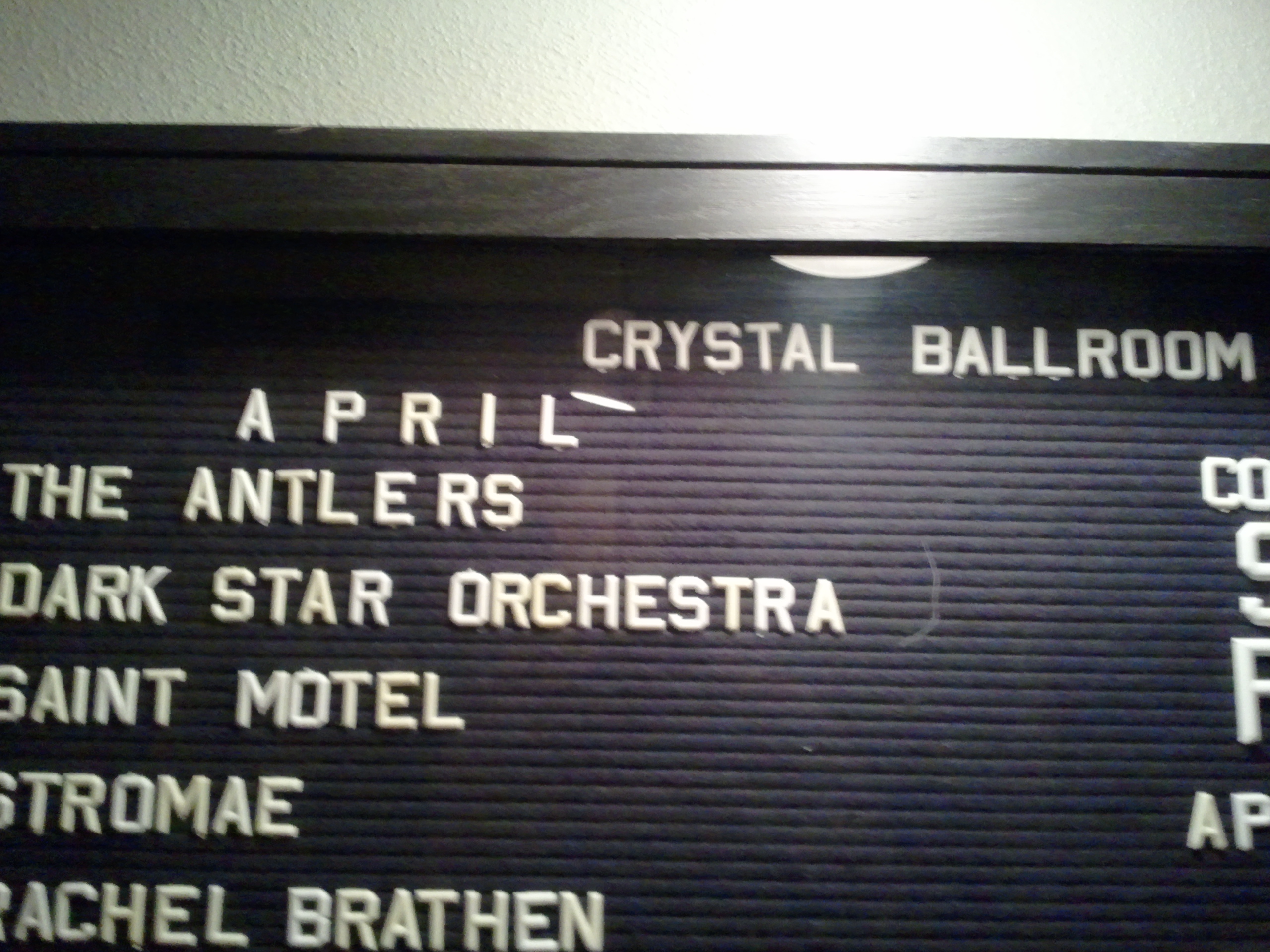
The Antlers, Live at the Crystal Ballroom

You might not expect it, but The Antlers can really bring the thunder live.  The band may be famous for its delicately gorgeous ballads, but they certainly know how to build to a climax and drop the hammer, and it makes for an excellent show.  I was excited to see the band headline the Crystal Ballroom last night, since I was finally getting to see them play a full set–previously, I had only seen them play a quick SXSW showcase event and half of a shortened set at MusicFestNW, and each time they had left me wanting more.  It turns out that even ninety-plus minutes is not enough either.

Up close and personal with The Antlers

Up close and personal with The Antlers

The crowd was disappointingly sparse, though those who did show up were often enthusiastic in their response.  Previously the band had played the Doug Fir, and the jump up to the cavernous Crystal Ballroom may have been a bit overzealous; if they booked the show at the Wonder Ballroom, it would have been much closer to a sellout.  The good news is that the acoustics and sound system of the Crystal, which often frustrate and stymie even the most experienced acts, proved to be a good fit for the band’s haunting chords and gorgeous melodies.  Occasionally Peter’s guitar would find itself buried in the mix or a trumpet would pop a bit too much, but these were very minor concerns.

The band overall played brilliantly, with Darby and Tim mesmerizing the crowd with their ability to simultaneously play keys and horn parts, and Michael Lerner serving up some bombast with his work behind the kit.  The drums are often overshadowed on the album by the other instrumental parts, but they help the songs take on a whole new dimension live, giving real weight to the low end and providing unexpected rhythmic kicks–for example, in their stunning performance of “I Don’t Want Love” from their previous album Burst Apart, Lerner would add an extra beat on the kick drum leading into the chorus that helped drive the anticipation for its big release, and helped create some great tension by utilizing a snare pattern that danced around the expected beat with the final chorus.  Peter also showed signs that he is an underrated guitarist with some sneaky displays of his chops, ranging from a couple of excellent and tasteful guitar solos to a one-handed pull-off chord technique that helped spark even more intensity from their performance of “Putting the Dog to Sleep”.

The Antlers up on the big board.

The Antlers up on the big board.

The band took an intriguing approach to their setlist, primarily running through their latest album Familiars front-to-back, with older songs filtered in on occasion.  There were murmurs in the crowd for older material, namely from their classic album Hospice, but they still showed their appreciation for the newer material.  As the night went on, the band gradually loosened up in their interactions with the crowd, including a memorable exchange where Peter acknowledged the “holiday” and pulled an April Fool’s Day prank by signalling that they were about to play a new song, before quickly correcting the record.  What made this simple joke even better was Darby’s confession soon after that he had panicked a bit, wondering what it could possibly be that they were playing since they had not written any new material yet, as well as Peter’s suggestion that the audience come up with better stories of the “prank” the band had pulled.

Though The Antlers never played “Two” or “Bear” as some members of the crowd requested, the show did feature intense performances of “Kettering” and the heart-wrenching “Epilogue”, and the arrangements of the newer songs also infused them with an extra vitality.  Perhaps word of mouth will lead to a better turnout the next time the band plays Portland.

I didn’t get a chance to see the first band, but the second openers Shaprece was pleasantly delightful.  She had a wonderful voice, and the use of a cello helped add an extra dimension to the glitch-pop R&B that other artists like fka Twigs are popularizing.

Review: Kendrick Lamar – To Pimp a Butterfly

Kendrick Lamar instantly launched himself into the ranks of the elite MCs with the release of his stellar album good kid, m.A.A.d. city, where he weaved with exceptional skill a complex narrative of a young man’s struggle to escape from all the various negative influences trying to entrap him.  good kid managed to avoid the primary problem that plagues most concept albums, as it never felt weighed down by the potential constraints of its central narrative; it was an album filled with hit singles (“Backseat Freestyle”, “Swimming Pools (Drank)”, and “Bitch, Don’t Kill My Vibe” are just three of the record’s modern classics) that could be enjoyed on their own, but gained an additional weight when placed in context with the underlying story.   Kendrick’s technical skills as both a rapper and a writer ensured that there would be heavy anticipation for its follow-up, and for months fans and critics were on the edge of their seats with each revelation.

To be sure, To Pimp A Butterfly meets and possibly exceeds all these expectations.  It is more ambitious than its predecessor, moving from documenting a personal struggle to a more universal one, as Kendrick analyzes the trials and tribulations that face black people in America today.  The result is a denser, less accessible album than good kid, but represents a true artistic statement.  It might best be explained by using the old music critic cliche of the analogous connection to a completely unrelated artist: if good kid, m.A.A.d. city is Kendrick’s The Bends, then To Pimp a Butterfly represents his OK Computer.

The music on Butterfly is a heady and thrilling mix of numerous jazz, funk, and R&B influences, veering from one style to the next and capturing a gamut of emotions and moods.  Though Flying Lotus is only credited as a producer for one song, it seems as if the experience of their previous collaboration rubbed off on Kendrick, with the free mix of jazz and electronic elements dominating a significant portion of the record.  As the album progresses, the music shifts from a smoother, freer feel to a more deliberate beat, and provides an excellent counter to Kendrick’s growing anger. Spoken word passages also play a significant role, with Kendrick periodically adding lines to a poem that begins each time with “I remember you was conflicted”, and it creates an interesting effect of breaking the album into sections while also providing a connective tissue with narrative thrust.

Butterfly is an album that takes a lot of effort to unpack, but the effort is worth it; though it runs close to eighty minutes, it never feels like a chore to listen.  There are not a wealth of singles like good kid, with most of the tracks sounding better in context; “i” works as a single, but it sounds even better as a culmination of the album’s themes and as a response to “u”.  As a result, in the future I can see most people (including myself) throwing on the other album more often, but the times we do listen to Butterfly will still be appreciated.  After all, this is an album that ends with Kendrick “interviewing” Tupac, and it makes perfect sense that the legend finally has a true successor.