Review

Review: Hamilton Leithauser – Black Hours

In a week filled with great new releases, it’s Hamilton Leithauser’s Black Hours that outshines them all.  The debut album from the former frontman of The Walkmen masters the tricky conundrum that plagues every artist that goes solo: satisfying old fans while justifying the decision to go solo.  Hamilton indulges enough touches and signifiers that recall the unique sound of The Walkmen, while experimenting with new ideas and leaving enough of his own personal imprint that makes Black Hours a work distinct enough from his previous output.

Hamilton’s voice is one of the most recognizable in indie rock, and the full range of his rough-around-the-edges style is showcased throughout Black Hours.  He switches effortlessly between an exuberant bark (“Alexandra”), to a joyful serenade (“11 O’clock Friday Night”), to a delicate croon (“St. Mary’s County”), and that’s within the space of three songs.  The performance on Black Hours is reminiscent of the more recent Walkmen albums, where Hamilton learned to use the right amount of restraint with his voice, and not let its power get out of control.  That said, he can still let it out when he needs to, as he does on the exhilarating “Alexandra”.

Listeners should be able to pick out specific instrumental touches throughout Black Hours that evoke the trademark work of The Walkmen.  Most notably, there is the clean, trebly guitar that appears in songs like “I Don’t Need Anyone” and “Bless Your Heart”, so it should be no surprise that it’s former bandmate Paul Maroon that helps out with guitar, strings, piano, and organ on eight of the ten tracks.  There are other small callbacks that should grab the attention of Walkmen fans, most notably a chorus form “11 O’clock Friday Night” of “You and me and everybody else” that seems designed to specifically evoke one of their best-received albums.

Even with all these details that hearken back to his previous band, Hamilton does enough to separate Black Hours from his previous work.  “5 Am” is a spare, haunting ballad that would fit nicely in Leonard Cohen’s back catalog, and “The Silent Orchestra” continues with that retro-ish feel with the use of a playful backing orchestra, a style befitting that of a classic Dean Martin or Sinatra record.  There’s the goofy marimba from “11 O’Clock Friday Night”, which sets the tone with a melody that rips off the old “Updated Score” sound from ESPN’s BottomLine ticker, and is soon matched by a prominent bass and embellished by the guitar.  The careful use of strings throughout the album add a new dimension to many of the songs, but most effectively on “Self-Pity”.  In the end, Hamilton doesn’t fully escape the identity of his old band; album closer “The Smallest Splinter” would fit perfectly within the tracklist for Heaven, and the careful, midtempo ballad is one of the highlights of the album.  But that’s okay–when you were a member of one of the best indie rock bands of the past decade, no one should complain that the new music sounds a little bit like the old stuff.

Review: Sharon Van Etten – Are We There

I remember first hearing of Sharon Van Etten back when her previous album Tramp was released.  In reading the press materials for the record, the mentions of The National and The Antlers immediately grabbed my attention–Aaron Dessner of the former produced the album, and she provided the haunting vocals on the latter’s “Thirteen” from Hospice.  Add in the fact that she had a habit on stopping by the AV Club for their “Undercover” series, and I was sold.  I picked up Tramp and was entranced by her unique voice, a sweet yet vulnerable timbre equipped with a slight countryish tinge.  Songs like “Warsaw” and “Magic Chords” would stick in my head for days, but for many “Serpents” was the song that got people’s attention (it helped that it was used for a promotion for “The Walking Dead”, but hey, who am I to knock where people first hear great music?)

Are We There turns out to be an excellent showcase for the musical growth of Van Etten.  Before, most songs would reveal themselves at the beginning and consist of mainly basic elements; you would hear the verse and the chorus, usually using the same instruments, and have a good idea for how the rest of the song goes.  On Are We There, Van Etten instead opts for the “slow-reveal” approach, gradually building songs from the ground-up, slowly adding layers and building to thrilling climaxes.  Often these climaxes are mirrored by a cathartic release as Van Etten shares especially painful and confessional lyrics.  The ending of “Your Love Is Killing Me” is an unforgettable example, as she expands on the chorus to reveal that “You love me as you torture me; you tell me that you like it” as the band swells around her.

Van Etten also branches out with different instrumentation, moving beyond more traditional folk/rock standards.  Piano and guitar is still present, but are augmented by careful touches of strings and horns (as in the sublime “Tarifa”) or the occasional use of a drum machine or other programming (“Our Love” bears more than a passing resemblance to a Beach House song with the minimalist programming and soft female vocal).  The single “Taking Chances” makes use of the latter, building on a programmed drum beat with mellow keyboard, with the guitar saved for accented hits during the chorus.

Still, the selling point remains Van Etten’s uniquely beautiful voice and her personal songwriting.  The album is often dark, though there are moments of black humor that provide a bit of levity, as seen in the album closer “Every Time The Sun Comes Up”, where she stretches lines like “People say I’m a one-hit wonder, but what happens when I have two?  I washed your dishes then I shit in your bathroom” out to great effect.  Even so, the saddest and bitterest songs leave the greatest impression, with the effects of “Your Love Is Killing Me”, “I Know”, and “You Know Me Well” lasting long after the album is over.  Are We There doesn’t have the same evenhanded flow as Tramp, but the peaks are often higher.

And you have to appreciate an artist that provides a list of “Recommended Listening”, and includes the likes of The War On Drugs, Suicide, Spiritualized, Kurt Vile, and The Men, among several others.  Thanks Sharon, now I have additional homework to do.

Missing the Point & Other Disasters

Normally, I’m not the kind of person to go out of my way to trash other people’s reviews.*  No matter how authoritative the tone, in the end, the review is merely the opinion of one writer.  Arguments can be made about the effectiveness about certain tactics or styles, but there is little point in quibbling when there is no single determinate answer to be found.

That said, there are certainly some dumb ways to approach writing a review.  Take the AV Club’s review of Turn Blue for example.  In a three paragraph review of a Black Keys album, the first third is entirely devoted to their lyrics.  To anyone that has ever spent time listening to the band, this is a patently ridiculous approach to reviewing the group (if you look at the review we ran yesterday, you’ll notice that we gave the lyrics only a passing mention).  That of course is not to say that lyrics are unimportant; it’s just that for a blues-rock group like The Black Keys, lyrics are usually an afterthought and are written in more as placeholders than anything (as mentioned in this interview with NPR).  Sure, those that are new to the group may not expect this to be the case, but the writer is reviewing the work of an established band with roots in a genre that doesn’t place an emphasis on the words.  This isn’t true of the blues only; when people listen to a techno or heavy metal song, they tend to not focus on the lyrics (though for the latter this apparently isn’t always the case).  Over a career that spans eight albums, I can hardly think of any significant lyrical turns of phrases or bon mots from the group, outside of a few catchy (and generally meaningless) choruses designed just to get the crowd singing along.

This book may have been used as research in one of the reviews

This book may have been used as research in one of the reviews

Not only are the lyrics unnecessarily emphasized in the review, but they are viewed through a lens that makes no sense in context.  The writer applies half-assed feminist theory in his critique, stating that the band portrays “a view of women that…is glaringly reductive” and that “women are mere caricatures, often painted as temptresses in desperate need of the guidance and fulfillment that can be provided by a man.”  The fact that the band hails from a tradition of the blues is tossed aside, instead of being cited as the primary reason why this would be the case.  One can make it a goal to point out the stereotypes of past generations or go against the perceived boundaries of certain genres, but when it’s clear from the outset that there is no interest in doing so, it doesn’t seem smart to knock a band for failing to engage in that particular fight, especially if one has trouble citing noteworthy examples.  Since in general The Black Keys are not particularly interested in their lyrics (and neither are their fans), it makes little sense to deride them for not bucking against the history of the genre.

This would be bad enough, but from an errant statement it becomes clear that the writer did not do the necessary research before writing this review.  In picking apart the song “It’s Up To You Now”, the author writes “he can’t help but feel exploited by a woman who’s left him,” and then uses that as his conclusion of the band’s foray into typical stereotypes.  Of course, there may be a particular reason why this sentiment may have been present–Dan Auerbach recently went through a divorce, and the tone of the album reflects that difficult ordeal.**  It’s one thing for a reviewer to not know this vital piece of information for an up-and-coming band, but considering that The Black Keys have been the biggest rock band in the country for the past few years (and were well-established in the indie community which is the AV Club’s audience well before then), it’s inexcusable to not know that information.

The other problem with this approach is the utterly reductive notion that if a woman is portrayed in any sort of antagonistic manner in a song, it is a symptom of a serious malady like sexism.  The Pitchfork review runs with this premise and makes the argument explicitly, stating “[l]yrically, the Black Keys’ casual chauvinism has gone from ‘Girl, you look so good’ to ‘Woman, you done me wrong[.]'”  This kind of assertion is troubling on some levels, and utterly ridiculous on others.  First, the idea that noticing the attractiveness of a potential partner is a concept that is inherently chauvinistic shows a total lack of regard for both context and human nature (yes, leering and catcalling is bad, but not all examples of noting attractiveness are inherently evil–without it, it’s difficult to imagine how most relationships would ever start); and second, that if when discussing a relationship one cannot attempt to assess blame on another party without coming off as a misogynist, then we are truly fucked.  Let’s brush aside the fact that this attitude is more paternalistic than anything, that denying the other party any agency and indulging in only the most protectionist of assumptions is a bad approach to any situation.  It’s utterly remarkable that the reviewer has attempted to brush aside the subject matter of 90% of music of the last half century in only a few words; if you take away the joy of falling in love and the despair in falling out of it, you’re not left with much to discuss, and we already had Rage Against The Machine cover politics and The Decemberists cover 19th century literature.***  Also, it ignores the various lyrics where Dan assigns blame to himself, but who cares, it doesn’t fit the narrative.

The entire approach reeks of someone attempting to pass off a superficial understanding of critical theory, as if they learned the vocabulary but failed to pay attention when the class discussion switched to their proper application.  It’s one thing to view cultural trends and their impact, but it’s quite another to expect everyone to suddenly align with the same worldview and create a product that conforms to it.  Merely invoking a general trope is not enough to warrant such condemnation; make your argument when you can cite something concrete and of substance instead of a lazy generality.

Again, this isn’t to say that lyrics are unimportant–it’s just that the people interested in reading a review of The Black Keys generally do not care.

*This isn’t true at all–I’ve been known to trash reviews to my friends on several occasions.  I just don’t write articles about them.

**It’s possible to interpret this as a possible contradiction to my main argument, that in fact the lyrics do matter.  However, I think this information is more important to understand the general tone of the lyrics (and the music as well), and that the individual lines themselves hardly matter at all.

***This wasn’t even my biggest problem with the Pitchfork review.  There were several issues I had with the discussion of the music itself–the clear problem that the reviewer had with Danger Mouse as a producer (a bias that is good to admit to, but then you wonder why if someone comes in with a negative attitude at the start why they are assigned the review), the idea that covering the Beatles is somehow a sign of artistic bankruptcy (and implicitly that nobody innovative ever covered the Beatles), but most of all that the keyboard in “Fever” is…”farty”.  I expressed serious concerns for the reviewers health (and for his ears as well) if he thought that kind of tone was “farty”.  At least Mr. Fitzmaurice had the good humor to favorite that tweet.

Review: The Black Keys – Turn Blue

It’s a bit odd that for a band that got its start and first achieved fame as a blues band, that it wasn’t until their eighth album that anyone would call an album by The Black Keys “sad”.  Part of that is the nature of the blues: even when you’re writing about how life has done you wrong, the goal is to keep it from letting you stay down for too long.

Turn Blue isn’t a typical “sad” album however.   There is no overwhelming aura of depression or melancholy; it’s marked more by a sense of restraint and internal contemplation, especially compared to their most recent work (most notably the built-for-arena-touring El Camino and their crossover breakthrough Brothers).  Instead of outsized swagger and riffs, the album relies on intimate grooves and swirling psychedelic touches.  It’s definitely of a piece of their post-Magic Potion work (i.e., it’s not the down-and-dirty two-man grimey blues of their early work), but it’s examining a different aspect of that style.

The album kicks off with the fantastic “Weight of Love”, a slow-burner that begs for repeated listens–a desire that I’ve indulged in several times already.  A ballad that takes its time to gradually build over six minutes before carefully fading away, it serves as a great mission statement for the album.  The song signals the return to prominence of guitar to The Black Keys’ sound, with three separate, gorgeous solos from Dan Auerbach, culminating in a thrilling double-tracked ripper at the climax.  While the solos are definitely worthy of being singled out for praise, the song works so well because of the efforts of all the musicians involved.  The breakdowns to the bare grooves of the verses lead into gorgeous swells of the chorus and climax as instruments are added to the mix, and Patrick Carney’s fills in the solo mark some of his finest work to date.

[There originally was a YouTube clip of the song included in this post, but it has since been taken down.  We will attempt to post a replacement when one becomes available.]

The album maintains a mysterious, somewhat ethereal mood throughout, with 60’s/70’s soul replacing the blues and classic rock as the primary influence this time around.  It’s noticeable even on the tracks meant to get the crowd moving, like on the lead single “Fever”.  The keyboard melody is catchy, but there is a slight air of disturbed menace that gives the whole song a delirious quality, especially considering the lyrics.  Though it has escaped attention from most people, the ending should be given some special praise, as it does a great job of inverting the melody to build up the mild paranoia evoked in the song before falling apart at the end.

The blues influences haven’t completely disappeared, however.  “It’s Up To You Now” relies on a similar groove to The Stooges’ “1969” (with the addition of typical eighth-note drum hits from Carney to accent the end of each phrase), and the halftime breakdown features an especially sleazy guitar solo.  The ingratiatingly fun closer “Gotta Get Away” is the closest the band gets to big dumb classic rock, and it serves as an excellent epilogue to the seriousness preceding it.  Considering how easily it puts a smile on your face, it wouldn’t be a surprise if it ended up being a single down the line.

Danger Mouse contributes a lot of his signature touches to the album, but his production doesn’t overwhelm the group.  Some of his trademarks do show up, like the muted staccato bass, the subtle organ flourishes, and the spaghetti western-influenced strings (the last of which is most clearly heard in “Year in Review” and “10 Lovers”).  But the band has incorporated a lot of these aspects into their sound already at this point, and they never push Dan’s guitar and vocals away from the spotlight.  It’s clear that since Danger Mouse’s initial contributions to Attack & Release that the group has evolved into a different entity; at the time, it was a necessary injection of new blood, as the original formula had begun to deliver diminished returns (though I believe that Magic Potion doesn’t deserve the poor reputation that it seems to have received).  Though the sound of present-day Black Keys differs in many ways from the Rubber Factory and thickfreakness days, one can still feel the basic DNA of their sound still present in the music, that it’s simply exploring different sonic territory through their own unique lens.

Franz Ferdinand, Live at the Roseland

We need to have a serious discussion: Franz Ferdinand is an incredibly underrated live band.

I have never been particularly passionate about Franz Ferdinand, instead merely content to listen to their albums every so often, with a periodic defense of their post-debut output.  However, after seeing them at the Wonder Ballroom back in 2012, I had to reassess my position, and I became more insistent about their talent due to their unbelievably fun live show.  Saturday night’s stellar performance at the Roseland was able to fully confirm their greatness.

RIJR continues to provide the finest random concert photography

RIJR continues to provide the finest random concert photography

The show started off with a bang, as Franz opened up with the explosive single “Bullet” from the recent Right Thoughts, Right Words, Right Action (sharing the number 8 spot in our ranking of last year’s albums, for the record).  The band kept the momentum up with the fan-favorite “Michael”, a delightful twist on the usual sexual dynamics of the traditional pop love song.  A raucous version of “The Fallen” followed, with Alex Kapranos stretching out some of the lines and throwing in a little flair with his guitar playing, and “No You Girls” signaled that the party had officially arrived.  Throughout their set, it was clear that the band had perfected the mix of caddishness from their early days to the more libertine seediness of their recent work, all done with a grin and a catchy dance beat.

The band was able to effortlessly shift through their four albums, though the band made sure to showcase most of Right Thoughts.  A combined version of Tonight‘s “Can’t Stop Feeling” and “Auf Achse” was a perfect example of this, with the latter nestled perfectly in the middle of the former.  It took a few moments to realize that the band had transitioned between songs as they played, and I was surprised because I never heard the parallels between the two songs before.

Throughout the night, the band effortlessly engaged with the audience, dancing along when appropriate or goading participation from the crowd.  The audience was eager to clap along, and in a manner unusual for Portland audiences, actually kept the beat (most of the time).  Kapranos in particular was a delight, with his goofy dancing and his playful come ons.   When the band played “This Fire”, the crowd eagerly joined in on the chorus and shouted along, until Kapranos was able to bring the volume of the chants down to a minimum, before of course exploding in the end (though I should note that if it was a hip-hop show, if the crowd chanted “We’re gonna burn this city!”, the Portland police would have shut down the whole show before the end of the song).  The band concluded their set with and extended full-band drum solo in “Outsiders”, as each member grabbed sticks to play along on the drumset–a trick that they pulled off at the Wonder Ballroom before, but I’m glad to see that it’s now an established part of their set.

The only issue was that at some points the band’s tempo was out-of-step with the audience, with the band more willing to slow it down a bit and grind while the crowd was eager to explode.  Such tension could easily be felt with songs like “Take Me Out”, where the crowd wanted to lose their minds but the band wanted to rein things in to the proper deliberate stomp of the original.  But that’s really a nitpick, and it shows discipline on the band’s part for adhering to tighter rhythmic control.  However, it was pleasantly surprising that the show ended up selling out, considering I was able to purchase tickets earlier in the week with ease, and too bad for those who were unfortunate enough to miss out, because they missed an amazing show.  If word continues to spread, I may need to make sure I make my purchase well in advance.

The War On Drugs, Live at the Wonder Ballroom

Regular readers of this site know how much we love the latest album from The War On Drugs, the absolutely superb Lost In The Dream.  It’s one thing for an album to sound great on record, but it is of course no guarantee that the songs will translate live very well.  Considering how much effort the band expended in constructing each song in the studio, there is always the risk that it may be impossible to replicate in a live setting.  The band was very conscious of this possibility (as the linked article shows), and spent weeks figuring out ways to ease the transition.  I can report that it’s clear from Sunday night’s show that the band has nailed the challenge.

It's intentional, and not my crappy photography

Hazy photo matches hazy music

The band gave the audience a clue from the get-go about how committed they were to being faithful to the album by reproducing the mechanical clicking whirr that marks the start of “Under the Pressure”.  After that quick intro, the band launched into the hard-charging opener, and the live energy made a great song even better.  I had predicted that “Baby Missiles” would be a likely show closer, so it threw me when they played it so early in the set, right after the opener.  It took a couple of verses before the sound engineer got the buoyant keyboard part at the right level in the mix, but the crowd didn’t mind this minor problem as they bounced around to the beat.

Songs from Slave Ambient blended in seamlessly with the new material, which was heavily featured throughout the set (the entirety of Lost In The Dream but the instrumental “The Haunting Idle” was played).  Frontman Adam Granduciel also was a fun and engaging presence throughout, and kept it light with the audience even when minor difficulties like a busted string after a particularly raucous solo from “An Ocean In Between The Waves” dulled some of the momentum.  He endeared himself to the crowd by giving a shout-out to The Doug Fir and by informing us that he wishes that everyday was Saturday, except when he was younger the wish was for Thursday, because that was when Seinfeld was on (he then explained he now prefers Saturday again because Seinfeld is on every day (AS IT SHOULD BE)).

The band was in top form, improving on even some of their best songs.  “Eyes To The Wind”, a fantastic mid-tempo folk-rocker, had an added coda that had the entire group locked in a groove as Adam piled on some gorgeous solos above the mix.  “Burning” really rips on the record, but with the added energy of the crowd they’re able to kick it up another notch.

I attempt computer tricks to overcome my crappy photography

Jim James joins the band on stage

As we posted in our roundup yesterday, the band had a special guest for their encore, as Jim James joined the band on a cover of John Lennon’s “Mind Games”.  There had been a couple of hints that we would witness something special, but I’ll admit that when I first saw a roadie that looked like the frontman of The Decemberists setting up an extra microphone, my first thought was “Did Colin Meloy gain some weight and grow a beard?”  I think pseudo-Colin would have been a decent choice, but Jim James was definitely an upgrade.  After the raucous cover, the band finished their encore with some of the more downbeat numbers, a perfect end as Sunday night gradually turned into another Monday morning.

Review: The Men – Tomorrow’s Hits

Some bands take their time between albums and spend countless hours on crafting each sonic detail.  They think deeply about how each song fits within the general themes of the album.  Perhaps they also ponder how their latest release will fit within their oeuvre overall, and what kind of comment they could possibly be making on their genre or their industry as a whole.  Then there’s The Men, who see that it’s a new year once again, so that means it’s time to put out another album.

The underground punk roots of The Men still shine through in their sound as well as their prolific pace, and they have managed to keep that spirit alive even as their sound has evolved.  The days of the pure noise and cacophony of Leave Home are closer to becoming a distant memory, but The Men still believe in no-bullshit rock, even when they’re clearly bullshitting you (as seen in the lyrics to the opener “Dark Waltz” (which isn’t even a waltz): “My mom gave me this guitar in 1974, and it’s true”–a timeline that paints the band as being about a decade older than reality).  Over the course of the album, the band continues to play whatever strikes their interest, whether it be some Americana-influenced 80’s boogie, complete with backing horns (“Another Night”) or a winsome country-tinged ballad (“Settle Me Down”–a song that will probably make it the second year in a row that The Men will have released my favorite country song).  The standout track is “Different Days”, which manages the neat trick of morphing the keyboard line of “Walk of Life” into the hook of a blistering punk blast.

Everything about Tomorrow’s Hits gives the listener the feeling that they’re hearing a bar band playing a rundown of the  Most Played Songs of that dive’s particular jukebox, from the title itself to the neon light cover art.  The Men even look to their own recent material for inspiration, re-working the riff of “Half Angel Half Light” from last year’s New Moon into “Going Down”, exchanging the lo-fi swing of the former for more hard-charging straight-ahead rock.  Some older fans of the band will complain that they’ve softened or mellowed out since the Leave Home era, but as someone who was first introduced to The Men with the stellar Open Your Heart, I have no problem with the shifts in style within and between albums.  It’s not an issue that they’ve traded in Dinosaur Jr. and Sonic Youth influences for Crazy Horse and Tom Petty, because no matter what it’s still clear that the band is having fun.

There’s a looseness and a joy to the music, even when they’re pushing the tempo or stepping back for some reflection.  It’s just a whole lot of…fun.  And while the title Tomorrow’s Hits is at most wishful thinking and most likely meant to be ironic and tongue-in-cheek, I would be glad if its prediction held true and I was getting a nice blast of “Pearly Gates” as I flip on my radio and hit the highway.

That said, what I find most amusing about The Men is the way that they’ve become the focus of a bunch of ridiculous thinkpieces for more than a few rock critics.  These listen to an album of straightforward rock, and then look at a no-nonsense band, and then think that they need to ask “What does it all mean?”  This is a band that has no social media presence (Facebook, Twitter, etc.), doesn’t print out a lyric sheet, have a name that’s practically useless to Google, and plays whatever style fits their mood at the moment–all this points to a group that really doesn’t give a fuck about “their place in the industry”.  You read reviews like this and you just have to wonder who the author is trying to impress with this pseudo-intellectual nonsense.  Just grab a beer and have some fun as the band decides to have some fun.

Tool, Live at Matthew Knight Arena

In my review of Nothing’s debut album, I commented on the fact that metal was an often stagnant genre, a style that would find bands content to cover the same ground over and over again in hope that the law of diminishing returns somehow didn’t apply to them.  One band that resisted this trap for years was Tool.  Their albums for years showed a band willing to explore the outer edges of heavy music, with each album possessing distinct characteristics.  Tool would evolve with each release, from the dirty, sludgy darkness of Undertow to the more reflective and spiraling Lateralus, pushing themselves musically and incorporating more and more elements of progressive rock along the way.  It wasn’t until 10,000 Days that Tool sounded as if they were repeating themselves.

It was with that last release that that it seemed Tool had begun spinning its wheels, with the best moments sounding like variations of riffs we heard before from Lateralus and the worst parts simply failing to make an impact (the problem with most of the second half of the album in a nutshell).  The feeling that the band was treading water combined with the increasing time between new albums leads to a problem that befalls other similar bands–the danger of becoming a nostalgia act.  The audience is no longer looking forward to new, exciting (and especially in the case of metal, “dangerous”) ideas, but have come to the show to bask in the comfort of remembering their favorites from a previous era.  With their last release dating back all the way to 2006, when I was still working in radio and years before attending law school, and no new music having been announced, “nostalgia” was strictly my approach: it was time to revisit some of my high school metalhead(-ish) days.

High School Memory: Wearing my T-Shirt from this show, and having people ask "Who's 'And King Crimson?'"

Reliving the Glory Days

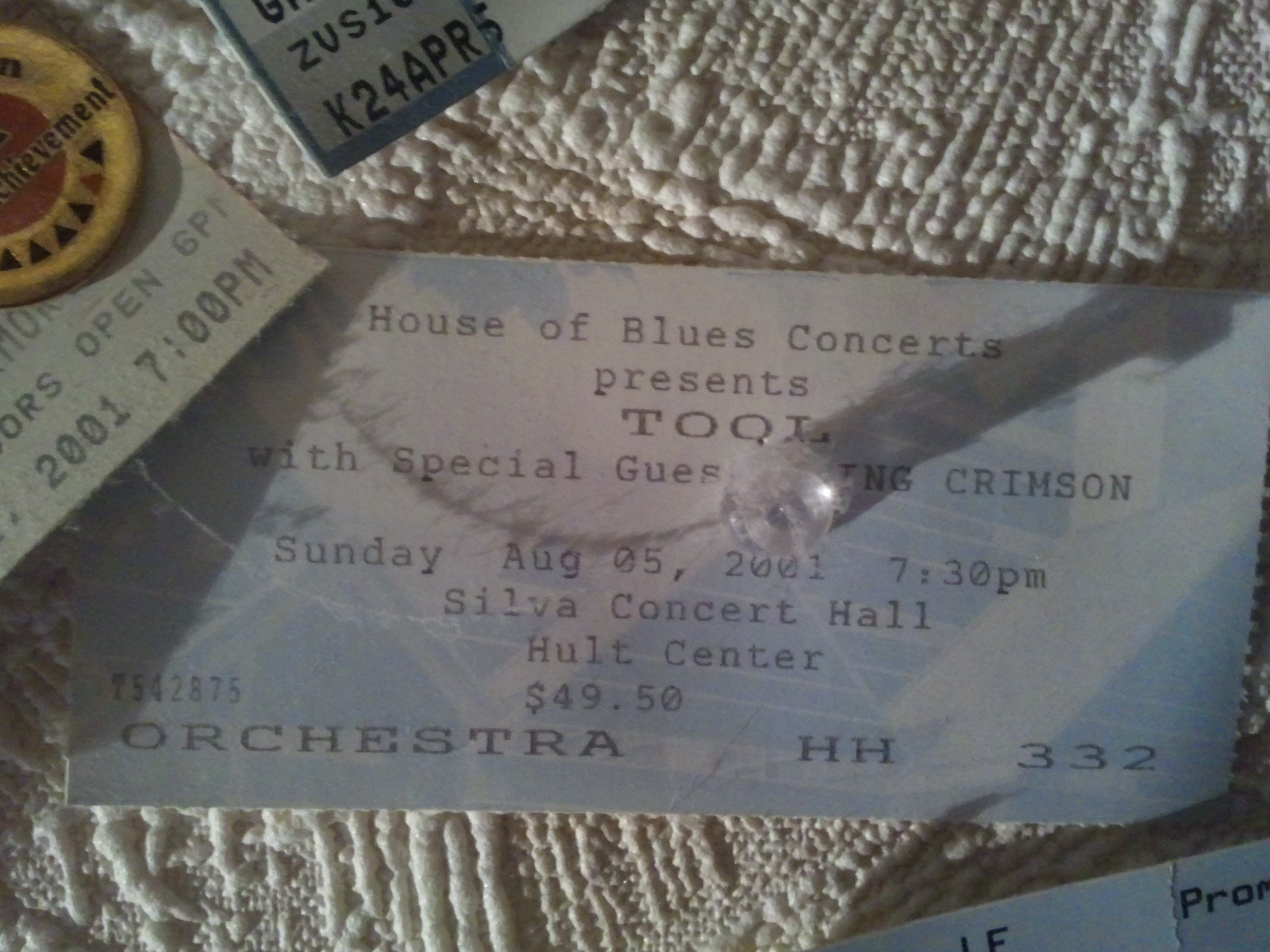
Adding to the general air of nostalgia that I personally felt was the fact that I had not seen Tool live since their show in Eugene back in 2001–a time before I even had a drivers license, which means that yes my mom indeed made the trip down and then had to figure out something to do on a midweek evening in Eugene on the fly.  That show was a particularly mind-blowing experience, and not only because it was my first exposure to King Crimson (and that presented me with the opportunity to purchase this bad-ass t-shirt).  I had arrived at the show an intrigued skeptic and left a full-fledged fan–at least by the standards of normal fans (spend any time in certain areas of the internet, and you are bound to find a Tool SuperFan, the kind that spends hours constructing YouTube videos breaking down the supposed allusions in Maynard’s lyrics and the symbology present in album artwork (and those are the more pleasant examples)).

We arrived in between the opener and the main event, partly due to an epic Blazers comeback (that fell short), and partly due to the ridiculous parking setup at the arena.  After some shuffling around, we made our way down to the arena floor, where we found our seats–yes, this was a heavy metal show, but Tool was not going to allow us to get disorderly in any way.  There were several people in official blue polo shirts that would make sure that chaos would be restrained, at least on the audience’s side, and please no photos or videos thank you.  Having previously seen them at the Hult Center, which is home to the finer arts groups of Eugene, I remarked to my compatriots that it was not unexpected for us to have seats, and besides we were there to witness a full-fledged “experience”.
The one photograph I risked taking

The one photograph I risked taking

Tool began the show in a fury, opening up with the rager “Hooker With A Penis” from Ænima, as the man in camo would have predicted if he was in attendance (I personally would not trust a person in a camo shirt in many situations, but the intricacies of the Tool setlist would mark one of the few exceptions).  The band was all business, with minimal stage banter with the audience beyond a few brief words of thanks and a mention of the city’s name (though Maynard’s quip this time lacked the touch of the last appearance, where he acted as the party responsible for introducing the band to the city and vice-versa: “Tool, Eugene.  Eugene, Tool.”).  There was no encore, but a brief intermission midway through the set that was partnered with a countdown clock, giving you the exact knowledge of the targeted time to return with an overpriced beer.  (Unfortunately, the intermission was not accompanied by their own song, “Intermission”.)

Each member was set in his traditional position: Adam and Justin up front and out to the sides, and Maynard and Danny in the back but centered.  The setup of the band and their respective demeanor exemplified the interesting dynamic within the band.  Maynard is a powerful frontman on record, with a charismatic and distinctive voice that stands out even in collaborations with other bands and lyrics that inspire careful study and feverish devotion in fans.  However, Maynard’s stage placement de-emphasizes the position of the singer within the band, and puts him on an equal footing with everyone else.  And Maynard’s performance and movements when singing also differ from the traditional frontman–he positions himself sideways to the audience, and always seems to act as if he is in combat with an unseen enemy, actions which often enhance his own lyrics.

Maynard is but one example of how Tool upends the traditional band structure within itself–the guitar generally does the work of keeping everyone grounded with the more basic rhythms, the bass provides a significant amount of the melody, and the drums are where most of the fireworks happen.  I pondered whether or not to do a Feats of Strength post highlighting how this dynamic works, using the breakdown/solo of 46 & 2 as the example.  If you listen closely, the guitar and bass go in and out of sync, alternating parts where they play in different time signatures.  In those parts, the bass gets the melody while the guitar palm mutes the accent hits.  And then Danny comes in with an amazing drum solo, syncopating his parts with amazing precision but also using his gigantic drum kit to actually create a melody that lines up with the guitar and bass perfectly.  There’s a good reason that this song is a fan favorite, and we of course went nuts when the band played it–and believe me, all eyes in the audience were on Danny as he nailed that solo.

It’s that precision coupled with the complexity of the music which draws a lot of people in, but the moment that I remember most from the previous concert was the time where the crack was most apparent.  It was one of the first performances of the Lateralus tour, and so the band was still getting a handle on how to play the songs live, including “Schism”.  For the bridge/solo, they had Maynard pick up a guitar to handle the melody, but his inexperience was clear and he flubbed a couple of the notes.  It was that little moment which made the band more human and less of a machine, and it actually made the rest of the set more impressive.  There was no such moment this time, as Maynard played his part on a keyboard this time and was much more comfortable.

With no new songs to play, the question then was how much of the experience felt like a nostalgia act.  The setlist hit some of the expected highlights, but the band also often did a great job in disguising a lot of what was coming up with interesting new intros and interstitial music.  And combined with an even more elaborate video setup, with huge television screens playing some of their trademark bizarre art (at one point during “Lateralus”, the image could only be describe as a view from the back of a spiraling train of guys providing manual pleasure to each other), it made for a pretty memorable experience.  At this point though, the time has passed for me to be a zealous follower, but I can still say that I’m intrigued by what is coming up next.
Review: Band of Horses – Acoustic at the Ryman

If you really want to laugh some time at how seriously music critics take themselves, I recommend you take a look at the evolution of Pitchfork’s opinion of Band of Horses.  What was first breathless praise slowly but surely evolved into near utter contempt.  Even though it was the work of multiple reviewers, each had similarly high hopes derived from the band’s early work.  At a certain point, you have to ask, “Why was this case?”

Though it may seem like I’m attempting to bury Band of Horses, this actually is not the case.  I am just offering an argument for not having rapturous expectations in the first place.  I remember hearing “The Funeral” when it first came out, and my first instinct was to say “Hey, this is a pretty good Shins song.”  You would think that considering that they were label mates on Sub Pop that this would be among the first comparisons to be made, but instead I saw a lot written about My Morning Jacket (not really, but I can see some similarities at least from a vocal perspective between Ben Bridwell and Jim James) and Neil Young (no, not at all).  In fact, I had first tried to pay attention to Band of Horses because of the MMJ comparisons, and when I didn’t hear the similarities, I decided to ignore them, despite the heavy praise of the album.  It wasn’t until I saw BoH open up for Dinosaur Jr. that I decided to reconsider my stance, based both on the music and Bridwell’s beard, which was at the time at a level of Martsch-ian proportions.

I actually first became excited for the band when I heard the lead single for Cease to Begin, the seemingly upbeat “Is There A Ghost”.  And then when I saw that they had a song called “Detlef Schrempf”, they had all the hooks they needed for me.  If you reference one of my favorite third-banana NBA players from the 90’s (and a beloved Blazer in his short time here), you definitely have my attention.  It was at this point that I decided that I would start following this band and at least keep track when they released a new album.

Now I will agree with the critical consensus about the decline in relative quality over the course of BoH’s career.  Infinite Arms had a couple of catchy songs, but I never played it as much as Cease to Begin or Everything All The Time.  And Mirage Rock left such a minimal impression on me that I recently checked to make sure that I actually own the album.  The difference is, I don’t see the decline in the grandiose tragic terms as some of those other critics.  “Where’s the artistic growth?” they would ask; I respond, “Why did you expect any to begin with?”  There wasn’t anything necessarily uniquely great about the group from the beginning.  They merely developed an interesting sound, wrote a few good songs, and continue to do pretty much the same thing for each album.

This leads me to their latest release, Acoustic at the Ryman.  The review for this album in particular is even more hilarious considering the level of bile and invective.  It’s at this point you have to step back and ask, “What is a live acoustic album for?”  It pretty much just serves the purpose of providing a mix tape of previous albums, a pseudo-Greatest Hits collection for neophytes, with a slightly different take on these songs, something that serves the fans.  There’s no need to go into long digressions about the significance of the venue and analyzing the existential dilemma of a moderately successful indie rock group.  Accept it for what it is, and move on.

So, considering those parameters, is the album a success?  If you’ve never heard Band of Horses, pick the album up and you will get a good idea of their sound.  For fans of the band, sure, why not–the arrangements are different enough that they’re enjoyable to compare to what you know.  It’s not sacrilege to hear “The Funeral” with a piano.  Save the theatrics for someone else.