Author: symeo

Essential Classics: Foo Fighters – The Colour and the Shape

With the release of their eighth studio album Sonic Highways this week, Rust Is Just Right is celebrating with a week devoted to the Foo Fighters.  Today we take a close look at their most beloved album, The Colour and the Shape.

Last week, one of my friends suggested to me that despite its initial popularity, The Colour and the Shape is “criminally under-appreciated today.”  After spending some time contemplating the proposition, I wrote that I agreed with his assessment, while expanding on his point and making some minor modifications.  I think most people would agree that it’s a very good album, but I also believe that a majority of those fans wouldn’t even begin to consider TCATS a “classic” or one of the best albums of the 90’s.

I would contend that there are a few reasons that The Colour and the Shape is not held up in the same regard as other classic albums of the era.  First, the fact that the Foo Fighters are not only a still-functioning band, but have continued to be one of the most successful rock bands of the past two decades, works against them in this case.  This prevents an appropriate distance from the album from being formed, so that we as an audience can stand back and reflect on its merits.  The Foos have churned out a fairly consistent product over time, with good-to-very-good albums released every few years; there hasn’t been a need for fans to ask “hey, when are these guys going to get back to the formula of The Colour and the Shape” or for critics to say with each review “THIS is their best album since TCATS!” as they do with every Pearl Jam release since No Code.  Fans today aren’t rediscovering the bands early work that they missed the first time around like they would with Pavement or the Pixies, as they just get caught up in the normal album cycle; the anticipation that builds up when a band may potentially reunite doesn’t create the same fervor for their early work as a normal album progression does.

And with Dave Grohl’s status as the Unofficial Mascot of Rock, even when the band takes time between album releases, their frontman is never far from the public’s consciousness.  He’s the modern guy that musicians from all eras and genres call up, from living legends to standouts from the underground,* so we’re always hearing about him teaming up with this guy on this record or performing with those guys on that show.  And in an era where there are fewer and fewer rock stars, he’s a consistent source for quotes and interviews–if Gene Simmons says something stupid about the state of rock, you’re damn sure Grohl will have a rebuttal.

This leads into a secondary issue that leads to people underrating The Colour and the Shape, and that it is a mainstream rock record.  It’s not an underground classic waiting to be discovered (most everyone has heard the Big Singles from this album; at the very least “Everlong” was definitely featured at every single one of your middle school dances), so it doesn’t evoke a need in its fans to proclaim its greatness.  Nor is it an album that will blow your mind with its experimental take on different genres or change your attitude as to what actually constitutes “music”, so there is no need to argue with detractors that “They just don’t get it, man.”  I highly doubt that musicians would point to it as a highly influential record, beyond stating that they may have been really big fans; if there’s one takeaway to be had from TCATS, it would probably be that you can have songs with big hooks without being dumb, so maybe it was an inspiration for some in that regard.  But there’s nothing exciting in being a person that cites The Colour and the Shape as a classic, especially as mainstream rock is caught between two competing trends in critical thought–that there is merit to pop music, as long as it isn’t rock, and that the best rock music is the stuff isn’t popular.**  By sticking up for TCATS, you’re begging people to say, “Congratulations, you’re praising a record that went double-platinum and enjoy hearing when it comes on the radio.  Have a cookie.”

Fine, I’ll take that cookie.

The Colour and the Shape is a brilliant guitar album, first and foremost: it’s packed with memorable riffs and great hooks, and guitars dominate the songs from beginning to end, whether they are electric or acoustic.  Fans immediately remember that huge descending riff from “Monkey Wrench”, the delicate strums of “Everlong”, and that killer melody from “My Hero” when reminiscing about the album.  Even the deeper cuts are defined by their guitars, from the arena-rock-ready lines “Hey, Johnny Park!” to the sugary-sweet melody of “Up In Arms”.  But while these parts are so catchy that they sound easy, there’s a greater layer of complexity to these guitar parts than your standard garage-rock/bar-band fare.  The Foos often use unique chords or uncommon voicings, altering your expectations just enough that you can’t predict a progression the first time you hear it but done in a manner that’s not so jarring that it affects your attention.

There is another area which shows the technical expertise of the record when you dig in a little deeper.  The Colour and the Shape is a Drop-D album that doesn’t succumb to the laziness that is often inherent in the technique.  Usually, down-tuning the bottom string invites guitarists to simply crank out a riff and then let the tuning give it a superficial depth, since they can easily turn a single-line melody into a chord by simply pressing one finger over multiple strings (though guitarists deserve credit if they use this convenience to write more intricate riffs than they would otherwise–then Drop-D is used appropriately).  Instead, the band uses that tuning to create bigger-sounding chords, using the entire width of the neck and allowing for more individual voices to be heard and more complex melodic lines within a chord progression, and also to create unique chords in and of themselves, as in “Everlong”.  The progression itself is not particularly complex, but by using the Drop-D it creates a more unusual and novel chord for each step of the phrase.  That means when your roommate picks it out on his acoustic that it is not nearly as impressive as Grohl writing the progression in the first place, but good on roomie for trying to impress the audience with a great song.

The album is known to the masses for its big singles, and rightfully so.  “Monkey Wrench” was a furious introduction as the lead single, and you can instantly connect with the anger and passion of the band’s performance, especially that all-shouted third verse.  “My Hero” with its thunderous and epic intro was the perfect soundtrack to movie climaxes and sporting events, and its simple message of praising the ordinary heroes among us is one we can all recognize.  And of course, there’s the monumental “Everlong”, which remains one of the totemic songs of the past twenty years.  Even stripped down to its barest elements, just a hushed voice and a delicate guitar, one can feel the power of all the emotions associated that come with the experiences of first love, from the anticipation to the anxiety and everything in between (if the acoustic version has one flaw, is that it cuts out the fantastic bridge from the original electric version, but it’s a forgivable omission).  I’m sure someone in the past decade has paired it with My Morning Jacket’s “Touch Me I’m Going To Scream Pt. 2” on a mixtape, and if they haven’t, I want to alert you that you’re missing a golden opportunity.

(I would also like to take a moment to praise the Michel Gondry-directed video, which in addition to being excellent and unforgettable, also is one of the few music videos that extends the song instead of cutting it short, making one wish that the band actually add an extra chorus to the end.)

But the true strength of the album is in its deeper cuts, the songs between the tentpoles that defined the album.  As mentioned above, there’s “Hey, Johnny Park!” with its huge riffs and its gleeful willingness to toss in all sorts of goofy rock tricks, like slides up and down the neck and amusing manipulations (the effect used for the bridge being the most easily identifiable example), and “Up In Arms” with its catchy melody and the way that it inverts the seriousness of its intro by cranking up the volume and repeating everything in double-time.  Then there are other fun tracks throughout that stay fresh after all these years, like the pounding “Wind Up” and “Enough Space” or the gentle bounce of “See You” or the delicate ballad “Walking After You”.  But the true standout that all fans of the album would point to is “February Stars”, a song that should immediately rectify any prior misgivings that one may have had about the term “power ballad”.  It earns its huge final chorus, and the band makes sure not to waste any of it by piling on layers and layers of guitars playing big, thick chords.

It’s not perfect, and I have a few minor quibbles–I’d end “Doll” on the sustained chord instead of resolving it, so as to build tension and use it as a true intro to “Monkey Wrench”, and I’d slide “February Stars” behind “Walking After You”, to provide a more natural trilogy with “Everlong”, creating a better flow between each of the songs as well.  But these trivial issues aside, it’s an otherwise unimpeachable record.  It’s at its base a simple rock record, just a few guys on guitars, bass, drums, and vocals, but it never feels limited by those potential constraints.  And while it may be known for many of its quiet and sweet moments, there is still an edge to the album, and the Foos are never afraid to let loose and crank the distortion up.  In that context, The Colour and the Shape shouldn’t be dismissed as a mere mainstream rock record, but should be praised as a quintessential example of the form.  It’s not merely a good record, but an all-time great album.

*Just consider that Dave Grohl performed in a band with John Paul Jones (Them Crooked Vultures) AND with Paul McCartney, as well as .  He’s the musical equivalent of Kevin Bacon–you’ll connect him with anyone from the past fifty years in less than six steps.

**That’s not to say that we here don’t tend to prefer less-mainstream fare, but instead that just because it’s obscure it doesn’t mean it’s good, and just because it’s popular, it doesn’t mean it’s bad.

I Saw Them Live! Memories From a Foo Fighters Show

With the release of their eighth studio album Sonic Highways this week, Rust Is Just Right is celebrating with a week devoted to the Foo Fighters.  Today, we reminisce about a favorite concert memory from a Foo Fighters show.

I’ve seen the Foo Fighters live a couple of times over the years, and each time they put on a great show.  I have to give a lot of credit to a band that’s willing to make a stop in Salem instead of skipping over it just to play Portland, even if it means that they have to perform in the footlocker known as the Armory.  That show in particular will always have a special place in my memory as it was the day after my friends and I graduated from high school, and we had one last party together before breaking off for the summer and going our separate ways to different colleges.

But it’s a different concert that’s the focus of our new feature, one the Foos played a couple of years later up in Portland.  Before the show, I had read an interview that Dave Grohl did for Rolling Stone magazine, and he had mentioned that one of the things that he was most appreciative of after ten years of touring with the Foo Fighters was the fact that people in the crowd had stopped throwing Mentos at the band.  If you are unaware of the reason why this was a common occurrence, then you need to take two minutes and watch the video for “Big Me”, helpfully embedded above.  It is well worth your time.  Of course, being the young knuckleheads that we were, my friends and I decided to take this as a challenge, and made sure to purchase rolls of Mentos before the show.  Was it to prove that we were true fans, dating back to the earliest days of the group, or was it just because we were assholes?  The truth, as always, lay somewhere in between.

Our initial plan was to of course wait to see if on the off chance the band decided to play “Big Me”, then we would unleash hell and launch our supply of Mentos at the band.  As the set went on, we were pleased to enjoy a number of the Foos’ greatest hits as well as their hilarious stage banter, but we soon began to get antsy about releasing our payload.  The band was reaching the end of its set, and the three of us reached a consensus that we would start tossing Mentos if the band played anything off their debut album.  The problem was that at this point there were far too many songs off their subsequent releases that required their attention, so there was no guarantee that we would have our opportunity.  The Foos reached their encore, and we weren’t sure how much longer the show would go on, so we decided to start our assault during “Breakout”.

I began tossing individual Mentos as soon as the song started, as did one of my other friends.  Unfortunately, we were just a bit too far away from the stage (we did not have any interest in engaging in any sorts of mosh-pit behavior, so we kept our distance), and our volleys were not reaching the stage.  Nonetheless, we kept picking our spots and tossing candies when an opening developed.  However, one of our friends kept waiting for an opportunity before deciding to strike.  Now, I should tell you that this friend will soon be referred to as “Dr.” due to his eventual completion of his Ph.D. in Physics, so he had a better plan of attack than us.  While my friend and I were encountering the problem of wind resistance as tossed individual candies at the band, our friend quickly solved the problem by refusing to toss individual candies, but instead giving a heave of the entire stick of Mentos at once.

My friend, despite possessing only a small percentage of the average arm strength of an adult male, managed to hit Dave Grohl in the shoulder with his stick of Mentos.

Dave of course was surprised at being hit by the unknown object, and mouthed the words “What the fuck?” as he looked around the stage to see what had struck him.  It took him a second, but he identified the object, and gave a quick chuckle as he continued playing the guitar.  He then reached down, picked up the stick of Mentos and…proceeded to use it as a slide during the bridge of “Breakout”.

It was an unbelievable combination of coincidences, but our juvenile escapades resulted in a truly unforgettable concert moment.  The rest of the audience probably had no idea exactly what it was that Dave Grohl had in his hand that he was using to run up and down the neck of his guitar, but the three of us certainly did.  It could not have gone better if we had planned it.

The Foo Fighters then finished the set with “Monkey Wrench” and it was awesome.

Over the Weekend (Nov. 10 Edition)

New music, videos, and other fun as we prepare for “Foo Fighters Week”…

The Foo Fighters are released their eighth studio album today, Sonic Highways, and we’ll be running features on the band all week long.  To help get you into the spirit, SPIN has provided a ranking of all 147 Foo Fighters songs, including covers and soundtrack selections.  As with all lists, this one has its fair share of faults, including a weird affinity for the band’s weakest effort (Echoes, Silence, Patience, & Grace), dismissal of some of their best recent work in Wasting Light, and an unfortunate-but-expected disdain for tracks from One By One, and ranks “Hey, Johnny Park!” at least thirty spots too low.  On the other hand, it does provide the proper reverence for deep cuts like “A320” and “February Stars”, so we’ll take the good with the bad.  And though we have most of these Foo Fighters singles, including several obscure ones, this list did inform us of the existence of this performance with Serj Tankian of the Dead Kennedys’ classic, “Holiday In Cambodia”.

Aphex Twin recently sat down for an extensive interview with Dan Noyze, and not only that, provided a number of outtakes and and fragments made during the making of Syro.

Hutch Harris from local favorites The Thermals sat down with Late Night Action recently, and talked about subjects including the band’s early recording methods as well as the band’s personal involvement with their merchandise.  It’s always fun to listen to Hutch, so watch when you can.

Here’s an excellent list of “Songs You’ll Never Hear on a Sufjan Stevens Album”.

We’ve mentioned Interpol guitarist Daniel Kessler’s upcoming side-project before, but now we have a bit more info about Big Noble.  They’ve also provided a video of one of their songs, which is a nice combination of Kessler’s crystalline guitar with intriguing soundscapes.

Mark Ronson is going to be the musical guest on SNL in a couple of weeks, and to get an idea of where he’s at, he recently released one of the songs he wrote with Tame Imapala’s Kevin Parker, and the result is something that sounds a bit like MGMT.

We’re looking forward to the second album from Father John Misty, since Fear Fun was such an excellent debut; plus we need an additional enticement to go see Josh Tillman’s stage show once again.  I Love You, Honeybear will be released next February, but last week FJM performed on Letterman the new track “Bored In The USA”, and it was fantastic.

Cults performed in Austin, and Pitchfork was there.  That should be enough to get you to click the link.

And because we’ve spent the entire weekend pondering the philosophical conundrum that comes with “too many cooks”, we’ll ride that out the rest of the week and post the video here.

Catching Up On The Week (Nov. 7 Edition)

Some #longreads for your weekend after watching a bunch of college football…

Stereogum has an interview with Travis Morrison of The Dismemberment Plan as they release a reissue of their album Change.  It’s a wide-ranging interview, and if nothing else, it’s a great reminder that you should probably listen to more of the D-Plan.

With the highly-anticipated release of their new album Sonic Highways next week, Dave Grohl and the Foo Fighters are in high demand.  Of all the possible pieces and interviews you could read this weekend, Alex Petridis’s piece in The Guardian is your best choice, providing the proper context of the man and his band.

The AV Club has a piece discussing the evolution of film soundtracks since the 70’s, and while touchstone 90’s soundtracks like the one from Singles get only a brief mention, it’s still an interesting dissection of film and music trends over the years, if nothing else.

R.E.M.’s Mike Mills is preparing for another live production of Big Star’s Third/Sister Lovers, and he talks to local Athens, Georgia magazine Flagpole about his love of Big Star, baseball, and dislike of streaming services, among other items.

Finally, if you’re in the mood for a project this weekend, might I suggest you take a dive into Captain Beefheart’s fascinating and bewildering discography, with the AV Club’s Primer on the enigmatic musician as your guide?  It may seem a daunting task at first, but this well-written blueprint does an acceptable job of describing the evolution of Van Vliet’s muse, even if I think they malign the “Tragic Band” era a bit too much.

Slowdive, Live at the Crystal Ballroom

Rust Is Just Right and Slowdive have a bit of a shared history, as our first story was an article discussing their surprise reunion earlier this year.  At the time, we were unsure whether the reunification was a one-off deal, but luckily the band would not only launch a tour, but they would stop by our corner of the world here in Oregon.  Considering we were too young to catch them during their initial heyday, we jumped at the opportunity to see the shoegaze legends live.  As they proved Wednesday night, The Jesus And Mary Chain may have created the genre and My Bloody Valentine created its masterpiece, it was Slowdive that perfected the craft.

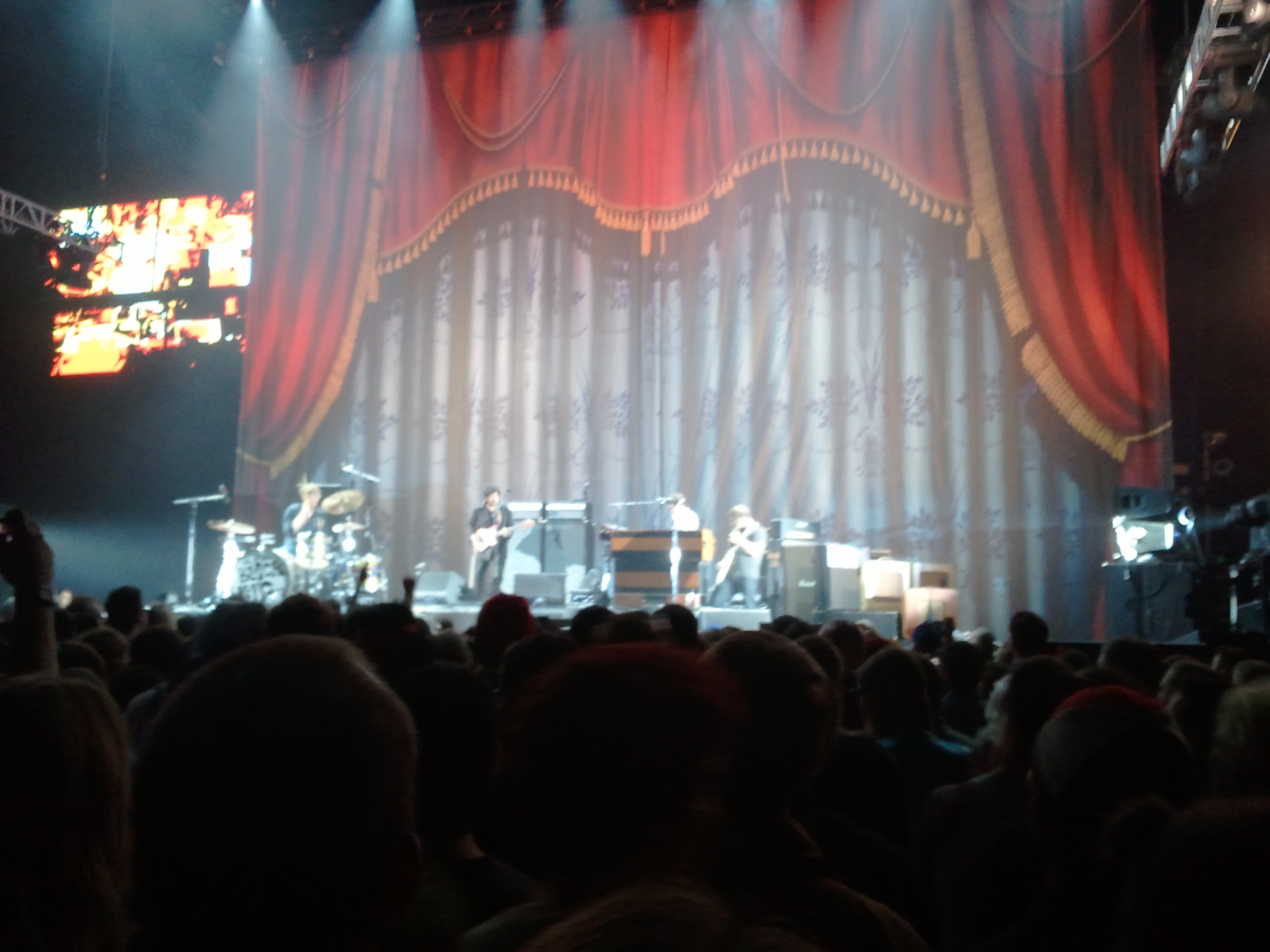
Slowdive up in lights.

Slowdive up in lights.

Just seeing the headliners would have been enough of a treat, but we were blessed with the additional bonus of Low opening up the show.  Low is definitely a band worthy of its own headlining tour (though they may not be playing in venues as large as the Crystal), but when given an invitation from icons like Slowdive, you take that gig in a heartbeat.  As such, we tried to get in as close to the start of the show as possible, and despite a slight delay at the Will Call office due to some confusion with the customers in front of us, we were able to arrive as their first song faded and “Plastic Cup” began.  This started a run of songs from their overlooked recent album The Invisible Way that the crowd ate up, leading me to suspect that there may have been more than a few people who bought tickets to the show on the strength of the opener alone.  Low stuck with some of their heavier, more bombastic material, like “Monkey” and the sublime “Dinosaur Act”, which elicited cheers from the crowd as soon as the first hints of its melody drifted through the venue.  The band finished up a tight set to thunderous applause, leaving the crowd wanting more, even though we were eagerly anticipating the headliners.

The interstitial music coming over the PA featured some inspired choices like The Shins’ “Caring Is Creepy” and Mazzy Star’s “Fade Into You”, which kept the audience in a suitably relaxed mood before the main act arrived.  But even though we were prepared for an evening of gorgeous, dreamy music, that didn’t stop us from providing a rapturous welcome to Slowdive as they walked onto the stage.  The band kicked the show off with some of their earliest songs, from the Slowdive EP, with the guitars swirling and Rachel Goswell’s and Neil Halstead’s vocals floating in and above the haze in a gorgeous, dreamlike state.  Though those components are the hallmarks of the Slowdive aesthetic, in the live setting you get a full appreciation for Simon Scott’s drums, which not only provided a necessary tether to the ethereal songs, but also provided some brilliant beats in and of themselves.  His contributions tend to go unnoticed on record, but they formed an integral part of the performance.

A glimpse of the psychedelic set

A glimpse of the psychedelic set

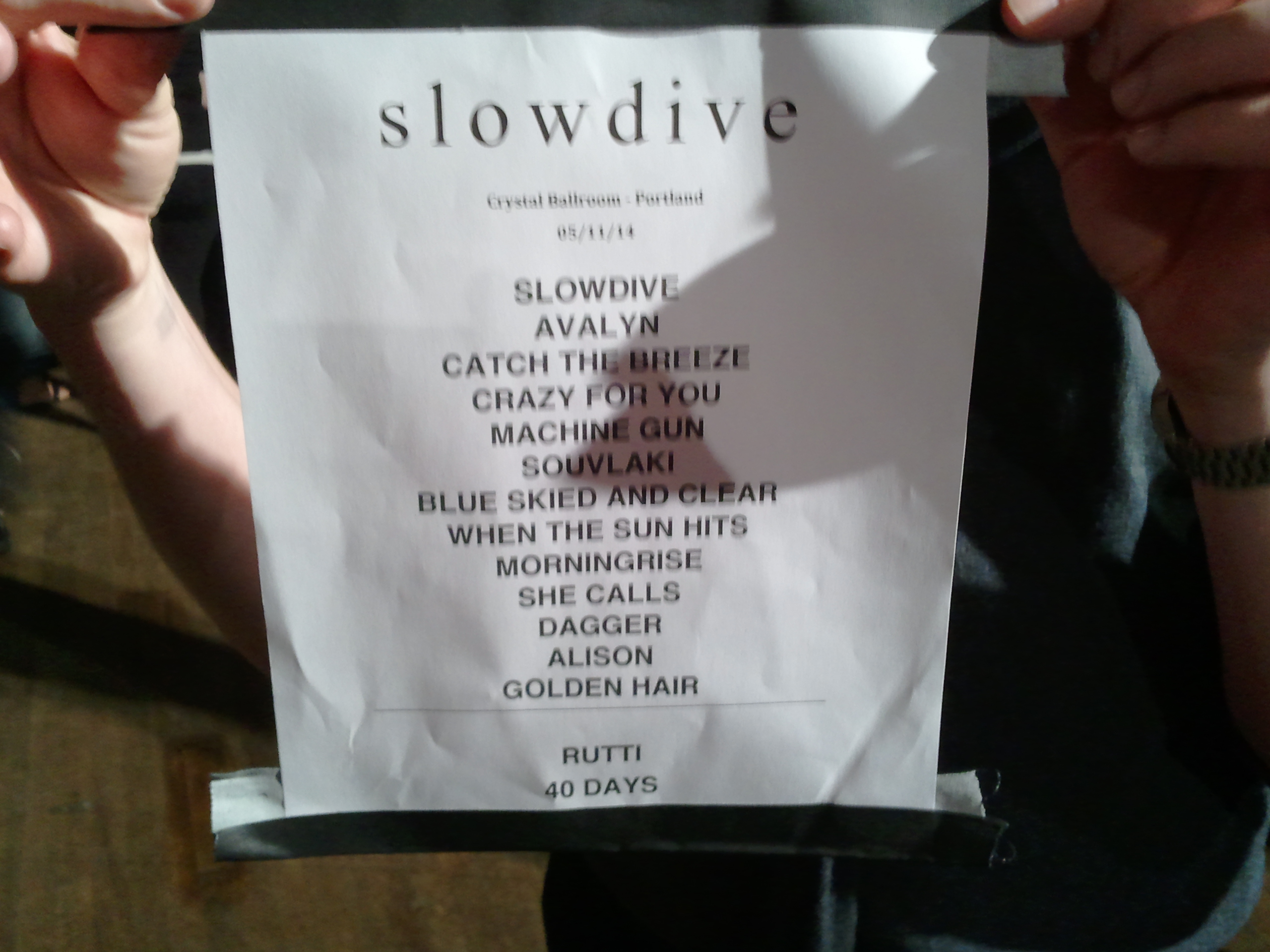
The early results were pleasing, but the band hit another level with “Catch the Breeze” from Just For A Day, with an exhilarating climax propelled by Scott’s thunderous drums enhanced by a delirious strobe effect, in perhaps the most effective use of the trick I’ve ever seen.  It was this moment that confirmed that as wonderful as their albums are, it’s no comparison to Slowdive’s live show.  Highlights included favorites from their classic Souvlaki like “Machine Gun” and “Alison”, which strangely enough were the only songs introduced by the band even though they rank as among the most recognizable.  With all the pure noise generated from the several guitars over the course of most of the set, it made the delicate and sublime “Dagger” stand out even more, as all the reverbs, delays, wahs, filters, and phasers were stripped away for the mournful ballad, backed by a light setup that focused on various bulbs that enhanced the somber overtones of the song.  Considering the respectful silence that greeted the song, I may have been a bit too excited in unleashing a “whoo” as soon as I heard its opening chords, but dammit I was happy to hear one of my favorite songs played live for the first time.

Setlist from an amazing show.

Setlist from an amazing show.

It was an amazing experience from beginning-to-end, and hopefully it inspires the group to continue–whether it be with new music, re-releasing out-of-print albums, remastering their old material (while we’re generally not in favor of the “loudness wars”, the Slowdive back-catalog would benefit greatly from a volume-boost), or just launching more tours.  Because as I said after the show, Slowdive live was even more beautiful than I imagined.

Review: Run The Jewels – Run The Jewels 2

“Run the Jewels” is the answer, your question is “What’s Poppin’?”

Since the announcement in late October that they had leaked the much-anticipated sequel to their thrilling debut album, Run The Jewels has been the talk of the music world.  And it’s with good reason: Run The Jewels 2 is even better than the original collaboration between El-P and Killer Mike.  Their self-titled debut was among the best-reviewed albums of last year, and found a spot on most year-end lists, including our own.  The sequel does an even better job of mining and improving upon the best trends in hip-hop from the past twenty years, and finds the connection between the duo stronger than ever.

So while the quoted lyric above is certainly not the most acerbic or clever line on the record, the closing line of opener “Jeopardy” does sum up RTJ’s place in music right now.  If you need a better sampler of the album, you should listen to the banging “Oh My Darling Don’t Cry”, which will fully abuse your car stereo’s subwoofers with its pulsing bass.  The two MC’s trade verses fast and furious, picking up their speed and intensity with each round as the music grows more chaotic around them.  Another highlight is “Close Your Eyes (And Count to Fuck) which builds a bouncy, stuttering beat off a guest appearance from Zach de la Rocha, recalling the era when turntablism reigned.

Run The Jewels 2 is a treasure-trove of brilliant beats and production from El-P, switching up styles and moods on the fly that accommodates the desire for variety while never sacrificing flow.  Grimy, serious material like “Angel Duster” and “Blockbuster Night Part 1” fits in easily with more fun tracks like “All Due Respect”, which takes the fun elements of rap-rock without the negative connotations that term has taken in more recent years, thanks to some excellent drumming from Travis Barker.  It’s a lean and efficient album too, clocking in at less than forty minutes, so it never wears out its welcome–but it’s likely that you’ll be putting the whole thing on repeat.

Note: there seems to be a difference between the free download version and the physical copy you can buy, with the former including an extra verse from Gangsta Boo to provide the female counter to the duo’s claims on “Love Again (Akinyele Back)” that’s missing from the purchased disc.

The Black Keys, Live at the Moda Center

While most people were out spending their Friday night at various Halloween parties or at home greeting trick-or-treaters, we at Rust Is Just Right spent the evening trucking up to Portland to welcome back The Black Keys.  They had a high bar to pass, both from their own previous performances in the Rose City (they even made a DVD of a previous trip to the Crystal Ballroom) and for other legendary Halloween shows (we were witnesses to Pearl Jam’s amazing set to close out the Spectrum in Philadelphia for good).  “Brothers” Pat and Dan weren’t able to surpass those lofty expectations, but they certainly provided the soundtrack for an excellent night out.

The white light made taking photos a more pleasant experience

The white light made taking photos a more pleasant experience

At this point, The Black Keys are finely-tuned machine, with little room for flexibility or improvisation.  A quick look reveals a standard setlist these days, so for anyone thinking about catching the group on multiple dates should go ahead and probably make other plans.  When you’re at the level that the Black Keys have reached and you’ve constructed an elaborate tour, it’s not a bad strategy to consolidate and provide a more uniform experience, as it makes coordination from lights to sound to tech much easier.  Still, considering everything has been plotted in advance, it took a little bit too much time for the guitar tech to switch out Dan’s axe between songs–though this may be because I’ve been spoiled by the lighting-quick precision of the stage crew at a Pearl Jam show.  However, the guitar tech gets bonus points for providing the pedal steel guitar just for the solo in “Gotta Get Away” in such a smooth manner.

As for the music itself, it’s a new experience these days now that The Black Keys are no longer the Dan and Pat Show live; the touring group is now a cohesive four-piece, with the duo backed by some solid musicians with Oregon ties (Richard Swift and John Wood).  The arrangement frees up Dan quite a bit to emote even more with his singing and providing some support for extended soloing, but it does diminish the impact of Pat on the drums a bit.  There were some early moments where Pat shined and really brought the thunder from behind the kit, and he added a great touch by making the ending of “Fever” a four-on-the-floor feel with a constant kick-drum push, but his contributions tended to get lost more in the shuffle than they did at past shows.

And the curtain comes down, the lights go up

And the curtain comes down, the lights go up

There was no real acknowledgement of the holiday, though plenty of audience members and a significant portion of the crew indulged and dressed up in costume.  For the most part, we were content merely to hear Dan yell about how it was great to be back in Portland.  The band stuck with more recent material to make full use of all their members, leaning heavily on El Camino and reserving the material from Turn Blue for later in the set.  The big radio hits from Brothers got huge applause from the crowd, but there was a healthy contingent of fans that appreciated the dip into the back catalog, including the faithful who really dug in for “Leavin’ Trunk” from their debut, The Big Come Up.  The guys were tight, the sound mix was excellent, and all in all it was a very professional affair.

The highlight of the evening was the encore.  First, as the lights in the arena went out, cell phone lights began to come on and the effect bathed the stadium with a warm glow that was pretty magical.  Then the guys returned and delivered an epic version of Turn Blue opener “Weight of Love”, filled with several fantastic solos from Dan and an additional backing guitarist.  The night ended with “Little Black Submarines”, which is the perfect encapsulation of their career at this point, from the ballad-type intro to the hard-rock finale.

While the show didn’t top our personal list of Best Halloween Shows ever, at least we could take comfort in the fact that we didn’t need to take 5 hours to get back home, as was the case for Pearl Jam (public transport plus daylight savings will do that).  We can at least appreciate that Dan and Pat still put on a great show.

Over the Weekend (Nov. 3 Edition)

News and new videos as you adjust to the terrifying new era of reverting back from daylight savings…

The Decemberists have announced that they will release a new album early next year, entitled What a Terrible World, What a Beautiful World.  And so we don’t come away with only this announcement, the band also provided us with a new song, “Make You Better”, complete with a “visualizer” video.

Prince performed on Saturday Night Live this past weekend, eschewing the normal two song/~four minute blocks for one eight-minute mega-jam.  It was a memorable performance, and not just for Prince’s third-eye sunglasses or his backing 3rdEyeGirl group.  At the very least, we learned that Prince has spent some time listening to Pantera.

Cymbals Eat Guitars recently uploaded the music video for “Warning”, off their excellent new album LOSE, featuring a very young band (Crosshair) playing the part of CEG.  If you never got the chance to pick up their stellar debut Why There Are Mountains, wait another week for the reissue.

Spoon helped end The Daily Show’s run in Austin in style, playing multiple tracks off their latest excellent album, They Want My Soul.  We would embed the videos here, but Comedy Central uses a screwy system, so either go to The Daily Show website or find all three performances on Pitchfork, since they did the legwork to get the correct plug-in.

Nirvana fans may be intrigued by the recent discovery of a “sound collage” that Kurt Cobain created, illustrating more of a connection with a band like The Olivia Tremor Control than one would have suspected.  Note: this sounds nothing like Nirvana, but have fun with it anyway.  Update: An interview with Cobain’s girlfriend at the time, Tracy Marander, sheds some light on the recording, including that there are two versions of “Montage of Heck” and that Nirvana diehards had known of this for years, and in fact a copy had been circulating for some time.

Wilco had some fun on The Tonight Show last week, though not all the footage was aired during the show.  Check out this acoustic version of the classic Yankee Hotel Foxtrot track “I’m the Man That Loves You”.

And finally, to wrap up our coverage of bands that played on late night last week, there’s The Flaming Lips in full costume performing “With A Little Help From My Friends” (with their “fwends”), and Run The Jewels blasting “Early” with a Halloween-appropriate performance on Letterman.

Catching Up On The Week (Oct. 31 Edition)

Some #longreads as you deal with the candy hangover this weekend…

The recent release of The Best Day is allowing Thurston Moore to talk to a range of news outlets over the past couple of weeks.  This week, there are interviews with SPIN and Esquire to check out.

Pitchfork has an in-depth cover story on Run The Jewels, and considering they just released one of the best albums of the year, you should probably give it a look.  And just in time for the holiday, elsewhere on the site they have Jason Heller talking to Peter Berbegal about the connection between the “occult” and rock and roll.

David Lovering, the drummer for the Pixies, talks to Diffuser about touring for the new album, and also touches upon his work as a magician.

Wayne Coyne has been making the rounds discussing With A Little Help From My Fwends, the tribute album to Sgt. Pepper’s that The Flaming Lips and various colleagues put together, including this interview with Newsweek where he discusses favorite and least-favorite Beatles tracks.

If you read any takedown on how brotastic bastardizations are ruining country music, it should be this review of a recent Jason Aldean/Florida-Georgia Line concert.

FADER talks to female music producers about the lack of gender diversity among producers, and asks them what can be done to fix the issue.

And finally, The Black Keys are arriving in town tonight, so we’ll link to an interview that Patrick Carney did with The Oregonian.  We’re looking forward to a great show, and we’ll be back with a review next week.

You’re Not As Cool/Smart/Edgy As You Think, Sir

A couple of weeks ago we linked to a commentary published by the New York Times entitled “Streaming Music Has Left Me Adrift.”  The opening paragraph gives hints of a potentially much better piece, one that highlights the connection between musical product and consumer in a much more eloquent fashion.  There was an opportunity to explore how the creation of a physical production of music can help inspire an emotional attachment in the listener, especially when one considers the effort that went into procuring the damn thing in the first place.  Instead, we ended up with the online equivalent of the stereotypical prick who works at a record store yelling at the world at large to get off his lawn.

There is some merit to the complaint that ease of access to an entire universe of music has cheapened our connection with it.  As the author alludes to, it definitely took effort to attempt to seek out music that wasn’t already played everywhere, whether it be to take the time to research through magazines and the like, or simply purchasing albums with the hopes that you got lucky that it was worth the inflated sticker price.  This is an entirely different world from today, where you can instantly search for a band based on a mere mention of their name and then fire up a sample immediately afterward to get an idea of their sound.  If you make a mistake, no problem, all you lost was a couple of minutes of your time; if you’re lucky and find something worthwhile, hey, purchasing the album is only a click away (or selecting it for your Spotify/Pandora/whatever streaming station).  You’ve lost all the risks and have a similar reward, but in the process you don’t experience the disappointment of the lows, but also miss out on the joy of going through all the effort to find a new favorite band.

The article doesn’t spend much time on this conceit, but instead goes in a different direction to discuss the split between alternative/indie and the mainstream.  Again, there are ways in which this could provide an illuminating discussion.  One could explore the different machinations that explain the dissemination of different musical trends, or simply come up with a way to eloquently describe the merits of underground music.  Instead of these potentially worthwhile exercises, the author chose to simply complain that it’s not as easy to impress people with his knowledge of esoteric artists.

The key problem with the entire piece is that the writer reveals that he is forever stuck in high school, trying to position himself as some elite outsider who calls out the masses about his superior taste in music.  The problem now is instead that we cannot properly acknowledge this guy’s pure fucking awesomeness for taking all this time to curate a knowledge of obscure musical acts.  It is now this man’s awful burden that there are now thousands of people that can share in his “love” of particular bands, and woe is him that he can’t immediately judge someone based on the fact that he or she owns the same CD as the author does.

At the heart of the matter is the belief that the author is that music is a dividing force, instead of a unifying one.  He selects new music based on its ability to separate himself from the ignorant masses, and if the mainstream catches on, it signifies a defect.  Instead of being glad that there are potentially more people than ever that can become fans of great music, this fucker is pissed off he has to share.  What a douche.

Also, if you’re going to make your big point by quoting LCD Soundsystem, then you should make sure you fully understand the irony inherent in their song “Losing My Edge.”  Hint: you didn’t get it.