Last Thursday saw the return of one of the most significant and unique voices in indie rock, as Modest Mouse kicked off a new tour with a two-night homestand at Portland’s Crystal Ballroom. It was a personal return for me as well, since I hadn’t seen the band perform at the Crystal since they did a four-night run back in 2004, right as “Float On” broke the band into the mainstream and out of college radio late-night playlists. Fans across the nation were eager to know if we would finally hear some of the new material from their oft-delayed follow-up to their 2009 EP No One’s First and You’re Next (or to go back even further, to their last album, 2007’s We Were Dead Before the Ship Even Sank). To quickly answer the question, no we didn’t hear any new music per se, though a few songs were new to me (“Sugar Boats”, “Shit in Your Cut”, and “Lampshades on Fire” have not been released yet, though they had been a part of a few scattered live performances recently).
A handy concert calendar
People have had varying experiences with Modest Mouse concerts, and I’ve read a few reviews where people were disappointed with their live set. After seeing them five times over 10 years at a variety of venues, I’m ready to say that it’s more likely than not that you’ll see a stellar show if you’re a true fan of the band. Things may have been different back in the early days where you weren’t certain what kind of state Isaac would show up in, but even the performance where he came off as a bit drunk had its charms, as I remember a particularly funny conversation that he had with an audience member on why they had trouble playing “Dramamine” (something along the lines of “it’s our first song from our first record, it’s hard to remember how to play it, it’s been a while!”). Every other performance has been outstanding, through all the different compositions of the band, with a set list that varies quite a bit from show-to-show. Chances are you’ll hear at least one deep cut from an early album at a show, which should be enough enticement for fans–it’s not a strict “greatest hits” playlist, in other words.
The night began with a slow start, as the crowd became restless when the band took its time before hitting the stage. It didn’t help that it was apparently many people’s first experience at a rock show, as you would hear random cheers when a roadie would come up to check an instrument or when a song from the system PA would end (here’s my quick reminder: the show hasn’t started until they turn off the house lights–just settle in until then). And initially, it seemed that the band was having to deal with first-show issues as instruments and mixing seemed to be an issue (though the latter is definitely a continual problem with shows at the Crystal). But by the time they got to “Ocean Breathes Salty” with the second song, all was forgiven as the crowd sang along with all the words.
We were treated to a career-spanning setlist, so fans from all eras of the band should have been pleased. Personal highlights included the rarity “Baby Blue Sedan” and the trio from the brilliant The Moon & Antarctica, especially a rambunctious version of “Tiny Cities Made of Ashes” that along with a raucous “Doin’ the Cockroach” formed a hell of a one-two punch to close the show. While the inclusion of “The World at Large” was to almost-be-expected (but not guaranteed, especially considering that “Float On” was absent from both nights’ setlists), it still was a moving experience, as a deeper inspection of lyrics over the years has revealed to me a beautifully melancholic perspective that I find has taken on increasing personal relevance with each passing day. (Though, unlike the performance in the link, Isaac played his usual guitar, possibly due to the fact that if they kept up the same instrumental setup over the years, they’d have to increase their keyboard budget significantly).
Over the course of the show, Isaac gradually loosened up and engaged with the crowd, possibly due to the fact that the venue had trapped in most of the heat on an unseasonably warm 90 degree day in May. We were treated to two great random stories, one referring to cat food and the other to his spectacularly short stint as an actor. For the first, Isaac told us how when walking past the venue earlier in the afternoon, he noticed a strange smell, later determining it to be cat food; he then remarked how that smell reminded him of visits to his grandmother’s house, but then he remembered that his grandmother had no cats (abrupt end of the story on purpose and warned about beforehand). The other was related directly to the chants coming from the back of the crowd* that he remarked “Chanting is hard to hear”, getting the crowd to chant that as a counter. He then told us about his work as an extra on The Pelican Brief, where he and his girlfriend were part of a group of protesters that were picketing whatever they wanted and shouting, just as B-Roll footage; the kicker was that it was such a pain in the ass that his girlfriend at the time didn’t bother to show up the next day, but he did and signed her in as well, meaning that he got both his $50 for the day and hers as well (as he said, it was clear that he needed the extra money more than she did).
Overall, the band sounded great, with the current lineup well-prepared to tackle the diverse instrumentation that is required of the Modest Mouse catalog. Hopefully over the course of the tour we’ll hear some more news about a potential new album, but meanwhile if you’re still on the fence to attend one of their shows, take my word for it and go.
*The chants were for a former band member, and when Isaac realized this, his answer was “Maybe…I don’t know…we’ll see.”
I would say that with most shows that I go to that I have an encyclopedic knowledge (or something approximating that standard) of the band I’m about to see. I expect to know the title of each song that I hear instantaneously, and probably a few facts about it as well. However, that is not always the case.
Exiting the show
I’ve been listening to Mastodon ever since I heard that they were releasing a concept album about Moby Dick. I decided that right then and there, that I needed to purchase this record because 1). The band’s name was Mastodon; 2). They wrote an album called Leviathan; and 3). It was a concept album about Moby Dick. It really does not get more metal than that. And to think, ten years later, it’s probably only the third-most ridiculous thing they’ve done.
I’ve enjoyed listening to Leviathan over the years, and have dutifully bought each subsequent release, but I can’t say that I truly understand their music. In many ways, listening to Mastodon has mirrored my attempts to read Gravity’s Rainbow–the individual sentences make sense (the riffs), and I get the idea of the general story (the album as a whole), but fuck me if I know what’s happening from paragraph-to-paragraph (the songs). So, generally my impressions of Mastodon go from “that’s a sick riff/drumfill” to “that was a really intense experience”. It would be pure luck if I could identify a song as it were playing, for the most part.
I’m pretty sure the lighting indicates this was a “Leviathan” track
Therefore, I’m not the best source for Mastodon fans who want to hear about the band as they kicked off their most recent tour in Portland, in anticipation of the release of their upcoming album Once More ‘Round the Sun. I can tell you these things for certain: the band was incredibly tight, with Brent Hinds’s solos and Brann Dailor’s drumming being specific standouts, and it was incredibly loud. The vocals were buried deep in the mix for each vocalist, but I’d argue they were probably not the most important part of each song. The set was a pretty even mix of material from each album, and featured a couple of new tracks as well: “High Road”, which I immediately recognized (especially with Brann’s Ozzy-ish vocals in the chorus), and “Chimes at Midnight”, which I did not.
The main takeaway I’d say is that Mastodon fans should be excited to once again see them on tour, and novices shouldn’t be afraid to witness a spectacle of amazing musicianship. In other words, I was glad to get my metal on once again, even if it was on a Tuesday night.
We need to have a serious discussion: Franz Ferdinand is an incredibly underrated live band.
I have never been particularly passionate about Franz Ferdinand, instead merely content to listen to their albums every so often, with a periodic defense of their post-debut output. However, after seeing them at the Wonder Ballroom back in 2012, I had to reassess my position, and I became more insistent about their talent due to their unbelievably fun live show. Saturday night’s stellar performance at the Roseland was able to fully confirm their greatness.
RIJR continues to provide the finest random concert photography
The show started off with a bang, as Franz opened up with the explosive single “Bullet” from the recent Right Thoughts, Right Words, Right Action (sharing the number 8 spot in our ranking of last year’s albums, for the record). The band kept the momentum up with the fan-favorite “Michael”, a delightful twist on the usual sexual dynamics of the traditional pop love song. A raucous version of “The Fallen” followed, with Alex Kapranos stretching out some of the lines and throwing in a little flair with his guitar playing, and “No You Girls” signaled that the party had officially arrived. Throughout their set, it was clear that the band had perfected the mix of caddishness from their early days to the more libertine seediness of their recent work, all done with a grin and a catchy dance beat.
The band was able to effortlessly shift through their four albums, though the band made sure to showcase most of Right Thoughts. A combined version of Tonight‘s “Can’t Stop Feeling” and “Auf Achse” was a perfect example of this, with the latter nestled perfectly in the middle of the former. It took a few moments to realize that the band had transitioned between songs as they played, and I was surprised because I never heard the parallels between the two songs before.
Throughout the night, the band effortlessly engaged with the audience, dancing along when appropriate or goading participation from the crowd. The audience was eager to clap along, and in a manner unusual for Portland audiences, actually kept the beat (most of the time). Kapranos in particular was a delight, with his goofy dancing and his playful come ons. When the band played “This Fire”, the crowd eagerly joined in on the chorus and shouted along, until Kapranos was able to bring the volume of the chants down to a minimum, before of course exploding in the end (though I should note that if it was a hip-hop show, if the crowd chanted “We’re gonna burn this city!”, the Portland police would have shut down the whole show before the end of the song). The band concluded their set with and extended full-band drum solo in “Outsiders”, as each member grabbed sticks to play along on the drumset–a trick that they pulled off at the Wonder Ballroom before, but I’m glad to see that it’s now an established part of their set.
The only issue was that at some points the band’s tempo was out-of-step with the audience, with the band more willing to slow it down a bit and grind while the crowd was eager to explode. Such tension could easily be felt with songs like “Take Me Out”, where the crowd wanted to lose their minds but the band wanted to rein things in to the proper deliberate stomp of the original. But that’s really a nitpick, and it shows discipline on the band’s part for adhering to tighter rhythmic control. However, it was pleasantly surprising that the show ended up selling out, considering I was able to purchase tickets earlier in the week with ease, and too bad for those who were unfortunate enough to miss out, because they missed an amazing show. If word continues to spread, I may need to make sure I make my purchase well in advance.
There’s really no better way to cap a Record Store Day (or just a beautiful spring weekend in general) than to go to a tiny club and see a great young band just rip through a set. We got that exact opportunity last weekend when we caught RIJR favorites The Men do a blistering one hour show at one of Portland’s great gems, Dante’s. And our enjoyment was certainly not only due to our kind waitress, though she certainly helped.
Well, not tonight. But the sign was correct when taken.
The night began with an anti-comedy duo that when Tim & Eric are ever properly brought up on charges for the terror they’ve inflicted on audiences will be presented as Exhibits (E) and (F). Needless to say, at our first sight of a dilapidated ventriloquist’s dummy we were all of a sudden no longer perplexed as to why tables were still set up but instead grateful. Grateful for the seating as well as the opportunity to procure various alcoholic beverages to make the “show” more “enjoyable” (for the record, since this is Portland, the beverages were IPAs and bourbons because we don’t believe in bullshit). The next act, Nasalrod, featured a frontman that was simultaneously late-period David Lee Roth (thinning hair and a gut) and early-period David Lee Roth (doing flying leg-kicks and stage-diving). I remember nothing specific about the music, except that it was loud, not-melodic, and full of energy, which was perfect for the setting. Gun Outfit provided a nice change of pace, with actual songs, and now I am reminded that I should probably look up more of their stuff because they were quite good.
We had caught The Men before at the very same venue during MusicFest NW last fall, but with a new record out we were anxious to hear how different their set would be. Whereas last time New Moon featured heavily and allowed the band to stretch a bit, including an extended-version of “I Saw Her Face” that opened the show, Saturday night was a take-no-prisoners run that went through the majority of Tomorrow’s Hits. For all the fans that bemoaned how the band had changed their sound to be, for lack of a better word, more “polished”, this performance was a stark rebuttal from the band. The Men upped the tempo, cranked up the amplifiers, and blasted through raucous versions of “Going Down”, “Pearly Gates”, and even the shuffling “The Dark Waltz”. And for those wondering how the band would replicate some of the cool horn parts, a couple of guitar pedals were apparently all that were necessary to recreate the fun stomp of “Another Night”.
The curtains really add the right touch.
Sure, the mix was a little off, with the vocals buried way below all the guitars and keyboards; if you were unfamiliar with the new material, the set would have seemed to just run together. Fortunately, it seemed that the crowd knew their stuff and sang along anyway. And yes, it was loud as fuck, but at a show like this, that’s a feature and not a bug; we were informed by our waitress Brittney that at soundcheck it was the first time they had to tell a band to turn it down a little bit, and perhaps they didn’t fully understand the request. It was a good thing we had worked out a system before the band took the stage so our drink orders were still heard.
Despite the crowd’s pleas for an encore, the band did not return, which makes the one that we received back in the fall a seemingly more unique experience, and the band’s surprise at our demand seem even more genuine. Everyone still left buzzed and in good spirits, and I was glad to shake guitarist Nick Chiericozzi ‘s hand and congratulate him on a great show (once he finished downing his shot of tequila). Let’s hope that this trend of quick return trips back to Portland continues.
It’s become increasingly clear that if you’re going to see a band perform, it’s best to do it in Portland. Sure, we always have enthusiastic crowds and a ton of great venues, but that’s been the case for years. What I’m talking about is that special moment that sends you straight to your cell phone to put everyone on blast that “Holy shit, you won’t believe what happened at the **** show!” Just in the past few months, we’ve seen a Sleater-Kinney “reunion” at a Pearl Jam show, Jim James showing up to do a John Lennon cover with The War On Drugs, and now a surprise reconciliation at Tuesday’s Queens of the Stone Age concert.
I didn’t realize most of the new material was in standard tuning
Queens kicked things off with a bang, perhaps buoyed by the announcement earlier in the day of their number 2 ranking in RIJR’s Album of the Year rankings, with the raucous “Feel Good Hit of the Summer”. Few bands would then follow up their opener with their biggest hit, but QOTSA knew that the sold-out crowd didn’t come just to hear the songs they heard from the radio. That’s what we call confidence, my friends. After that, “Avon” brought a huge cheer from the fans who remember QOTSA’s self-titled debut with fondness.
The band then went on a run of material from their scintillating new album, …Like Clockwork. By the end of the night, 80% of the album would be covered, and considering the excellence of the material, nobody minded missing out on a couple of old favorites. The lead single “My God Is The Sun” serves as an excellent bridge between classic Queens desert-rock and the rest of the new album, with its catchy riffs and rolling drums interspersed with a groovy shaker rhythm. However, it was what’s in my opinion …Like Clockwork‘s cornerstone “I Appear Missing” that was the highlight of the new material, with its intoxicating and hypnotic Gothic groove that you allow to drag you forward, even though you know it’s probably not a good idea. The band did a brilliant job of extending the ending, as if caught in a trap with ever-escalating tension, matching the image of a man falling forever and ever from the sky. As the band brought the volume down, the crowd watched the video screen and there was a moment that you thought perhaps the character would live to see a happy ending, but then the band snapped back with full force and that was the end for Our Hero. It was but one of many examples of how QOTSA was able to improve on already-fantastic new material.
As the band neared the end of their main set, Josh Home dedicated Rated R‘s “Better Living Through Chemistry” to “his brother from a fucked-up mother”, former bandmate Nick Oliveri. Nick played bass with the opening band, Moistboyz (who also featured another QOTSA collaborator in Mickey Melchiondo (aka Dean Ween)), and it was good to see further confirmation that he and Josh had patched things up. The song itself was a perfect distillation of the greatness of Queens, and was one of the most mind-blowing performances that I could remember; in many ways, it was an inversion of many standard rock tropes, with epic breakdowns and solos. Queens capped off the first part of the evening with the excellent “Go With the Flow”, leaving the crowd breathless but wanting more.
An amazing show even from these ridiculous seats.
The band returned for their encore with the haunting “The Vampyre of Time and Memory”, featuring Josh behind the piano. As the roadies wheeled away the extra piano, a familiar guitar riff came on, and the crowd went apeshit as they heard the opening to “You Think I Ain’t Worth A Dollar, But I Feel Like A Millionaire.” Josh then brought Nick out on stage and handed him a mic, and Portland then witnessed Nick perform with Queens of the Stone Age for the first time in ten years as the crowd lost their shit a second time. “Gimme toro, gimme some more!!!” The band ended the evening with the live favorite “A Song For The Dead”, officially making it worth the wait since the band’s last stop in Portland several years ago. And considering Josh’s lively interactions with the crowd and the several bits of praise he had for Portland (“You got yourselves a cool town…fuck it, you’re the best.”), hopefully we’ll be seeing him again soon.
Neutral Milk Hotel’s reputation was built on the strength of its magnum opus In the Aeroplane Over the Sea. What is it about this album that it has inspired rabid devotees ready to proselytize about its brilliance at the drop of a hat? In this next part, we will closely examine the particular genius of Aeroplane and why it is worthy of such deference.
It is difficult to enjoy In the Aeroplane Over the Sea on the first listen; to borrow a term from economics, appreciation has “a high barrier to entry”. The bizarrely-stocked orchestra of cheap instruments, the ramshackle production combined with lo-fi recording touches, and Jeff Mangum’s raw and unique voice (some kind people may call it “untrained” to be charitable) all become qualities that you come to love, but it takes some time before this occurs. It can be tough to overcome those initial impressions, and that’s how you end up with reactions like this Rolling Stone review (I don’t know if there’s a more “Rolling Stone” review than this, which when not engaged in strained allusions (Tusk and the MacArthur awards committee both get a mention) manages to do everything it can to show that the reviewer missed the point entirely (“burying the hard gem of songcraft under layers of bizarreness”; “most of the music is scant and drab, with flat-footed rhythms and chord changes strictly out of the beginner’s folk songbook”), all capped with a generic three-star rating).
The chord changes that the Rolling Stone reviewer derides are actually one of the quiet strengths of the album. Most of the songs only rely on three or four basic chords, all of which should be familiar to the average listener’s ear. The effect is that it grounds the songs into something that is immediately identifiable to the listener, and allows one to appreciate the more peculiar touches without allowing one’s attention to completely drift away. The title track is a perfect example of this: it’s built on a common progression, G – E minor – C – D, or as I like to call it the “Last Kiss” progression (the I, vi (relative minor), IV, V chords for those inclined), over which Mangum sings a sweet and pleasant melody, and gradually more and more instruments are layered to provide distinctive accents, like the various horns and especially the eerie singing saw. Mangum never changes the chords but in the bridge he makes a slight adjustment in their order, beginning each phrase with the E minor chord instead, which changes the tone of the entire section to something darker. These little touches help bring out certain lines in the lyrics; a perfect example is how the singing saw helps embellish the line “how the notes all bend and reach above the trees”, providing an aural representation of the image depicted in the lyrics.
The brilliant “Holland, 1945” is another excellent example. It’s even simpler than “Aeroplane” in that it uses only three chords: C, G, and D, the most basic chords in all contemporary music. In fact, most of the time it switches only between C and G, with the D thrown in occasionally to provide the bridge between those two endpoints. The simple structure also allows the song to retain the same amount of power when it’s just Mangum and his guitar. That said, there are few things that equal the magnificence of this song when it’s the full band playing–the fuzz bass that gives the low end that buzzed edge, those horn lines which provide glimpses of triumph, and that excellent driving percussion that is always on the threat of falling apart but blisters through nonetheless. Just listen to those crisp snare rolls and how they push the song into the next line, or those kick drum hits that accent the walking bassline in the coda.
It’s almost amazing that I’ve spent this many words analyzing the album with only passing references to the lyrics, because the story behind the words is often what is most familiar to those with even a passing knowledge of the band (“Oh, they’re the guys with the ‘Anne Frank’ album, right?”). The discussion of the mythology of Aeroplane is certainly a factor that draws in many fans, and Mangum’s lyrics definitely invite further scrutiny. Much of the album was indeed inspired by Anne Frank’s The Diary of a Young Girl, and she is referenced in many songs throughout the album (the bulk of her appearances is in the middle of the album, with “In the Aeroplane Over the Sea”, “Holland, 1945”, “Oh, Comely” and “Ghost” as significant examples). However, it needs to be seen through the eyes of Mangum’s intense reaction to her ordeal and not just a recounting of her story. Mangum uses several other characters on the album, as he weaves scenes of an impoverished modern family with fantastical characters and the ghost of Anne Frank, all as attempts to process all the terrible things that happen and how we are often powerless to stop them. Individual lines alternate between sweet, childish simplicity and bizarre horror, all processed through a particular straightforward innocence.
It is an extremely affecting and compelling work underscored by Mangum’s raw and impassioned vocal performance. What initially comes off as harsh at worst and amateurish at best becomes warm and comforting after repeated listens. You can feel each and every sentiment that Mangum goes through as he journeys through the emotional roller coaster of an album; the album veers from the affectionate “The Earth looks better from a star that’s right above from where you are” to the stark “I know they buried her body with others, her sister and mother and 500 families…I wish I could save her in some sort of time machine” to the redemptive “And when her spirit left her body, how it split the sun; I know that she will live forever, all goes on and on and on.” It’s the reason why one of the most powerful experiences in my life was when I listened to this album and then visited the Anne Frank House in Amsterdam.
However, it’s not just the brilliance of the album itself that has inspired such fanatical devotion, but the mystery surrounding it. While it’s easy to pick up on the general story behind the songs, the often cryptic lyrics filled with fantastic and grotesque imagery have inspired wild theories and intense discussion. And fans were left to argue their meaning among themselves, because Jeff Mangum rarely spoke about the album and conducted very few interviews once it was released. Actually, I may be understating Mangum’s reluctance a little bit, as his silence led to stories of him becoming a recluse in the face of the overwhelming reaction to the album, so much so that Slate published an article in 2008 that dubbed Mangum “The Salinger of Indie Rock”. The continued silence of Mangum over the years fed a cycle that increased the hysteria behind the album, and as nature abhors a vacuum, people rushed in to fill the gaps and speculate on the meaning of what seemed to be the last musical release of an eccentric genius. With nothing to compare it to, the stature of the album was destined to grow, a pattern we’ve seen before (My Bloody Valentine’s Loveless is an excellent example of this phenomenon).
*******
Which was why it was such a surprise when Jeff Mangum eventually began his return to the spotlight a couple of years ago with a scattering of solo appearances, and why segments of the internet exploded in euphoria. Finally, we would be able to hear from the man himself!
A triumphant return.
In the years leading up to his return, fans had to make do with scattered bootlegs and a tantalizing glimpse of the early form of Aeroplane-era songs with Live at Jittery Joe’s, a recording of Jeff performing solo before friends and an otherwise indifferent audience in a tiny club in Athens, Georgia between On Avery Island and Aeroplane. It was remarkable to hear Mangum interact with the audience and give brief explanations and insights into his songs, and the casual nature of the set helped undercut some of the self-serious reverence that some fans had developed over the years. This was music made by an actual human, not some ethereal muse or other mystical creature.
Jittery Joe’s also provided a clue as to how some of those early return shows would sound like, as Mangum seemed weary of returning the band as a whole. Instead, he gradually introduced other band members in various performances and only for certain songs, generally performing by himself just with a couple of acoustic guitars. I had the great fortune of seeing Mangum on these early tours twice, and it was a concert experience that few could possibly match. It was amazing to watch a crowd that over years and years had connected on a deep emotional level with an artist that they had no idea they would ever have the chance to see, finally confronted with the opportunity to witness the source of their passion in person. It was a mixture of joy and adoration, and took on the tone of an almost-religious revival. I can say with some authority that the only person that could get a bunch of young Portland hipsters to yell “I love you, Jesus Christ” would be Jeff Mangum.
But still, there was something missing from these performances. Jeff and his guitar may have been the backbone of each of these songs, but we had come to adore all the extra flourishes over the years–the thrashing drums, the buzzed bass, the kitchen-sink orchestra, et al. So we were welcome to the new experience of seeing “Neutral Milk Hotel” as a whole perform these songs that we had come to know by heart.
Fellow Elephant 6 comrades The Minders and Elf Power were the opening bands, and they did a good job of keeping the energy of the crowd up. We got an unexpected highlight when Elf Power covered the Olivia Tremor Control’s “Jumping Fences” in memory of Bill Doss, who had tragically died two years ago. It was a reverent take of a brilliant song whose greatness was somewhat unappreciated by most of the crowd, who apparently had not delved into the oeuvre of the other band in the collective that often matched the brilliance of Neutral Milk Hotel. One of the greatest concert experiences I ever had was seeing the Olivia Tremor Control perform a raucous set in a tiny Portland bar during Music Fest Northwest with a bunch of their friends from Elephant 6, and I wished that the other people in the crowd had been there so they could have been as excited as I was for this cover.
After Elf Power, the audience grew impatient as the moment that many had spent at least a decade to see was growing closer, but soon their fears were allayed as a lone bearded figure climbed up onto the stage. Jeff opened the show with a stirring solo version of “Two-Headed Boy”, buoyed by a raucous crowd singing along. And in a manner that perfectly matched the performance on the album, the rest of the band gradually made their way in a procession to the stage as they played the instrumental segue “The Fool”, and we could finally say that we had lived to see the return of Neutral Milk Hotel. When the band launched into “Holland, 1945”, I could barely contain myself, and I shouted the lyrics along with the band as they played my favorite song of all-time. It was an unbelievable moment, made better by the fact that you could see the joy of the band as well.
In those earlier Jeff solo shows, there was always a delicate tension between performer and audience, as the crowd was careful not to disturb a potentially emotionally fragile performer. There was a strange dichotomy at work, as there was a connection between Jeff and the crowd because of the music, but also a distance between the two, as the crowd didn’t want to cross any imaginary line. With this in the back of my head, I was therefore interested to see how Mangum would react with the rest of his band during the show. Instead of being withdrawn and remote, Jeff seemed most joyous when he was playing along with his band. He was still somewhat on an island off to the far right of the stage, and the nature of the songs meant that often it was him by himself facing the crowd, but the sense was not of “Jeff Mangum & Some Guys” but more of a cohesive unit called “Neutral Milk Hotel”.
The band had a varied set, shifting between songs from throughout their career. There were of course several songs from Aeroplane, but they also hit highlights from their debut like “Gardenhead-Leave Me Alone” and “Song Against Sex”, as well as tossing in rarities like the early single “Everything Is” as well as “Ferris Wheel on Fire”. The band saved the best for last, as they ended the show with an encore of the ending trio of songs from Aeroplane. There’s “Ghost”, which manages to create this unbelievable tension as instruments pile on top of each other while the upbeat is hammered incessantly, while at the same time there is some relief because we have the potential relief of Anna’s ghost being free to escape. Then there is the instrumental segue “Untitled”, which has the aura of a carnival celebration and where the band let loose, led by unusual instruments like the zanzithophone, which handles the main melody. One of the indelible memories I will have of the show will be of Jeff jumping around with his acoustic guitar as this joyous circus performed along with him. “Two-Headed Boy Pt. 2” then closes out this set, as we revisit characters from throughout the story as gradually everything fades away, and we’re left with Jeff alone with his guitar. However, he doesn’t leave as he does at the end of the album; instead, Jeff has one more sing-along for the audience, and the crowd joins in on the fan-favorite “Engine” to close out the show. It was the perfect ending to a memorable show, and we exited into the night to the sounds of “Pink Moon” filtering through the Crystal Ballroom sound system. That’s about as good as a Sunday night gets.
I remember a recent conversation where an acquaintance asked a question along the lines of “How did Neutral Milk Hotel become so popular?” For the vast majority of the American public, this would seem to be a preposterous question, especially for a group that has yet to sell even a gold record; furthermore, I’d imagine that most of these people would be clueless as to how those three words could possibly fit together.* However, depending on the community, this bewilderment is understandable. Within the right group of people, Neutral Milk Hotel, and especially their masterpiece In the Aeroplane Over the Sea, have taken on an almost hagiographic glow, and both now exist as shorthand for raw, cathartic genius and simple, pure brilliance.** Not bad for a few guys from a small town in Louisiana.
One of the signs that you know you’re in my office.
I’m going to twist the original question a little bit, and rephrase it as “How did Neutral Milk Hotel reach this level of acclaim (with the corollary ‘Is it deserved?’ answered with a quick and resounding ‘Yes.’)?” Looking back to their origins, there would be few clues as to how these guys would become the most influential voices in the independent music scene of the last two decades. As the story has been recounted before, it dates back to the early days of childhood friendship in Ruston, Louisiana, the home of Louisiana Tech. It began with the sons of a couple of professors bonding over their love of strange and exotic music, and together they navigated following their cultural ambitions with the realities of small town life. Sharing records eventually led to experimentation and making recordings themselves, and it was from those humble beginnings that the Elephant 6 collective was born.
Those childhood friends were Robert Schneider, Bill Doss, William Cullen Hart, and Jeff Mangum, and their bands and their subsequent offshoots would create some of the greatest music of the 90’s. The Apples in Stereo, The Olivia Tremor Control, and Neutral Milk Hotel all trace their origins to those days in Ruston, and they in turn would inspire and work with several other bands like Beulah, Elf Power, and of Montreal that would shape the sound of independent music from the mid-90’s to today. But while I feel this history lesson is beginning to drag us away from the question at hand, it does provide the proper context to understand Neutral Milk Hotel. It was within that setting that a culture of sharing and experimentation developed, where bands and genres blended as necessary, all in the name of making beautiful and heartfelt music. It was from these humble beginnings where you can also hear the origins of the Elephant 6 aesthetic. The sincere belief that merely lacking the trappings of an expensive studio is not a good enough excuse to prevent musicians from emulating the psychedelic sounds of the Beach Boys and the Beatles, when all you need is a bedroom, a tape recorder, and a bunch of friends to help you.
The story of Elephant 6 is significant, but the particular importance of Neutral Milk Hotel still needs to be explored. One can find momentary glimpses of future genius in their debut album, On Avery Island: songs like “Gardenhead”, “Song Against Sex”, and “Naomi” are great examples of the warped take on folk music that would be the hallmark of the band’s sound. In a way it captured the old-time spirit of folk music, which wasn’t the sixties stereotype of the singer/guitarist in a cafe, but friends gathered together playing whatever instruments were handy. This atmosphere was enhanced by the lo-fi recording techniques and production, which emphasized the do-it-yourself spirit of the group. And on top of all this were Jeff Mangum’s cryptic and often bizarre lyrics, which draw your attention and invite endless speculation. However, there was little that would prepare fans to the great leap forward that would come next from the band.
Next door to the Anne Frank House.
I still remember my first introduction to the band, back during my freshman year of college. I was looking at the away messages that my friends would post on AOL Instant Messenger, and one of them had posted a few lyrics from the song “In the Aeroplane Over the Sea” and had listed the name “Neutral Milk Hotel” underneath. I found the words particularly moving, which led to further research to learn more about these guys. After reading a few reviews filled with lavish praise, I immediately used the intra-college network to download the album, since we had long passed the halcyon days of Napster (quick aside that attempts to justify my actions: this was before the days of YouTube and other streaming possibilities; the nearest record store was two towns over and I lacked a car; and I have a strong habit of purchasing what I like after the test preview download as soon as I can).
Those unmistakable first acoustic guitar strums of “The King of Carrot Flowers, Pt. 1” soon were filtering out through my computer speakers, and I was subtly intrigued. It was a catchy little progression, with a playfulness that was reminiscent of old nursery rhymes. And then that distinctive and idiosyncratic voice came in, and I was momentarily taken aback. At this point, I had limited experience with such an unconventional vocal style, where emotion and passion took priority over a pleasing tone or technical accuracy. So I was put back on my heels a little bit at this point, and I was still listening to the first song at this point. There’s a slow transition into “The King of Carrot Flowers, Pts. 2 & 3” as a sustained organ chord bridges the two songs, followed by a staccato banjo arpeggio, and then…
“I-I-I LOVE YOU JEEE-SUS CHRIIIIIIIIIST! JEEESUS CHRIST I LOOOOO-O-VE YOOOOOOOOU!”
At that moment, my first thought is “what the hell have I just gotten myself into?” And when I played the album for the first time for each of my friends, that was the exact point where they would produce an identical reaction. I have expressed a similar philosophy as Hank Hill when it comes to Christian Rock, and so this moment was quite jarring: the combination of the raw emotion and the nakedness of the proclamation itself were a bit much to take on first listen. But then that triumphant trumpet kicks in, the drums begin to ramp up, and then the song morphs into the most punk rock folk song I had ever heard in my life. My initial concerns were slowly fading away.
It was then that the title track came on, and my conversion was soon complete. It’s a gorgeous ballad, filled with gorgeous unique touches, like the eerily beautiful singing saw that wavers in and out throughout the song. Yet it was the lyrics that had slowly captured my attention, language filled with gorgeous imagery and a sentiment of sweetly innocent longing, an emotion that Mangum’s voice wonderfully captured. And by the time I heard the last verse, I had reached an epiphany.
“What a beautiful face, I have found in this place that is circling all around the sun; and when we meet on a cloud, I’ll be laughing out loud, I’ll be laughing with everyone I see. Can’t believe how strange it is to be anything at all.”
That last line continues to stick with me to this day; I have never heard a more perfect summation of the absurdity and majesty of existence, and the mere acknowledgement of this fact proves the sentiment in and of itself. It’s in moments like that instant connection with that particular lyric that reveal how a band can inspire such intense devotion.
*******
To be continued in Pts. 2 & 3
* The best explanation that I remember reading of the band name was that “milk hotels” were a specific lodging that I believe sprang up during the time of the Gold Rush, and they were not stocked with alcohol. “Neutral” didn’t describe the non-leanings of the hotel, but rather was the name of a town. My search skills are failing at the moment, but I will edit this when I find more information.
** It can also exist as shorthand for people trying to make a quick joke about hipsters or as a comment on seemingly pretentious and inscrutable music, but fuck those guys.
Note: The book from the 33 1/3 series on In the Aeroplane Over the Sea written by Kim Cooper was an invaluable resource in helping to flesh out some of the backstory of the Elephant 6 Collective, and I highly recommend picking up a copy if you want more information.
Regular readers of this site know how much we love the latest album from The War On Drugs, the absolutely superb Lost In The Dream. It’s one thing for an album to sound great on record, but it is of course no guarantee that the songs will translate live very well. Considering how much effort the band expended in constructing each song in the studio, there is always the risk that it may be impossible to replicate in a live setting. The band was very conscious of this possibility (as the linked article shows), and spent weeks figuring out ways to ease the transition. I can report that it’s clear from Sunday night’s show that the band has nailed the challenge.
Hazy photo matches hazy music
The band gave the audience a clue from the get-go about how committed they were to being faithful to the album by reproducing the mechanical clicking whirr that marks the start of “Under the Pressure”. After that quick intro, the band launched into the hard-charging opener, and the live energy made a great song even better. I had predicted that “Baby Missiles” would be a likely show closer, so it threw me when they played it so early in the set, right after the opener. It took a couple of verses before the sound engineer got the buoyant keyboard part at the right level in the mix, but the crowd didn’t mind this minor problem as they bounced around to the beat.
Songs from Slave Ambient blended in seamlessly with the new material, which was heavily featured throughout the set (the entirety of Lost In The Dream but the instrumental “The Haunting Idle” was played). Frontman Adam Granduciel also was a fun and engaging presence throughout, and kept it light with the audience even when minor difficulties like a busted string after a particularly raucous solo from “An Ocean In Between The Waves” dulled some of the momentum. He endeared himself to the crowd by giving a shout-out to The Doug Fir and by informing us that he wishes that everyday was Saturday, except when he was younger the wish was for Thursday, because that was when Seinfeld was on (he then explained he now prefers Saturday again because Seinfeld is on every day (AS IT SHOULD BE)).
The band was in top form, improving on even some of their best songs. “Eyes To The Wind”, a fantastic mid-tempo folk-rocker, had an added coda that had the entire group locked in a groove as Adam piled on some gorgeous solos above the mix. “Burning” really rips on the record, but with the added energy of the crowd they’re able to kick it up another notch.
Jim James joins the band on stage
As we posted in our roundup yesterday, the band had a special guest for their encore, as Jim James joined the band on a cover of John Lennon’s “Mind Games”. There had been a couple of hints that we would witness something special, but I’ll admit that when I first saw a roadie that looked like the frontman of The Decemberists setting up an extra microphone, my first thought was “Did Colin Meloy gain some weight and grow a beard?” I think pseudo-Colin would have been a decent choice, but Jim James was definitely an upgrade. After the raucous cover, the band finished their encore with some of the more downbeat numbers, a perfect end as Sunday night gradually turned into another Monday morning.
In my review of Nothing’s debut album, I commented on the fact that metal was an often stagnant genre, a style that would find bands content to cover the same ground over and over again in hope that the law of diminishing returns somehow didn’t apply to them. One band that resisted this trap for years was Tool. Their albums for years showed a band willing to explore the outer edges of heavy music, with each album possessing distinct characteristics. Tool would evolve with each release, from the dirty, sludgy darkness of Undertow to the more reflective and spiraling Lateralus, pushing themselves musically and incorporating more and more elements of progressive rock along the way. It wasn’t until 10,000 Days that Tool sounded as if they were repeating themselves.
It was with that last release that that it seemed Tool had begun spinning its wheels, with the best moments sounding like variations of riffs we heard before from Lateralus and the worst parts simply failing to make an impact (the problem with most of the second half of the album in a nutshell). The feeling that the band was treading water combined with the increasing time between new albums leads to a problem that befalls other similar bands–the danger of becoming a nostalgia act. The audience is no longer looking forward to new, exciting (and especially in the case of metal, “dangerous”) ideas, but have come to the show to bask in the comfort of remembering their favorites from a previous era. With their last release dating back all the way to 2006, when I was still working in radio and years before attending law school, and no new music having been announced, “nostalgia” was strictly my approach: it was time to revisit some of my high school metalhead(-ish) days.
Reliving the Glory Days
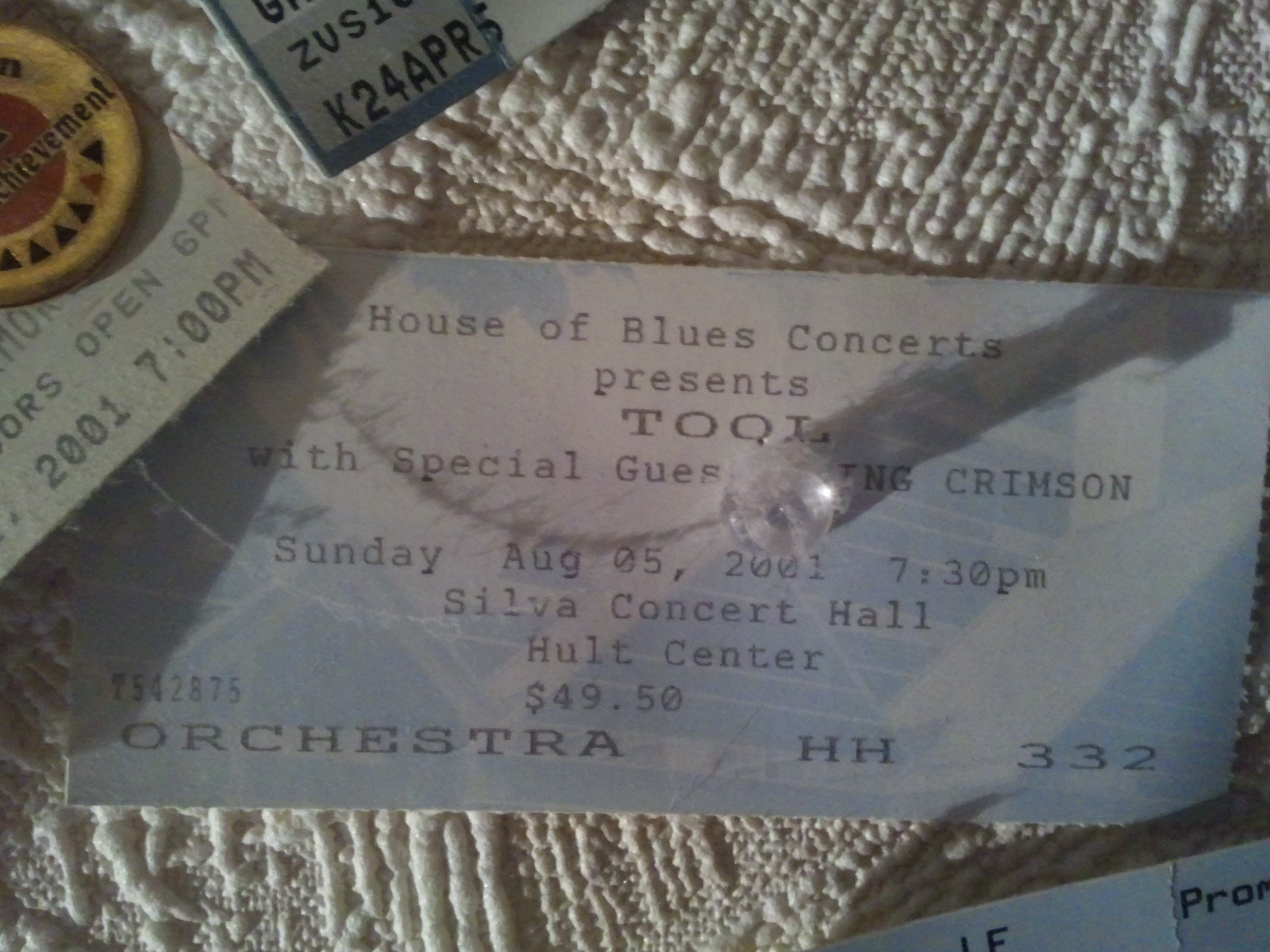
Adding to the general air of nostalgia that I personally felt was the fact that I had not seen Tool live since their show in Eugene back in 2001–a time before I even had a drivers license, which means that yes my mom indeed made the trip down and then had to figure out something to do on a midweek evening in Eugene on the fly. That show was a particularly mind-blowing experience, and not only because it was my first exposure to King Crimson (and that presented me with the opportunity to purchase this bad-ass t-shirt). I had arrived at the show an intrigued skeptic and left a full-fledged fan–at least by the standards of normal fans (spend any time in certain areas of the internet, and you are bound to find a Tool SuperFan, the kind that spends hours constructing YouTube videos breaking down the supposed allusions in Maynard’s lyrics and the symbology present in album artwork (and those are the more pleasant examples)).
We arrived in between the opener and the main event, partly due to an epic Blazers comeback (that fell short), and partly due to the ridiculous parking setup at the arena. After some shuffling around, we made our way down to the arena floor, where we found our seats–yes, this was a heavy metal show, but Tool was not going to allow us to get disorderly in any way. There were several people in official blue polo shirts that would make sure that chaos would be restrained, at least on the audience’s side, and please no photos or videos thank you. Having previously seen them at the Hult Center, which is home to the finer arts groups of Eugene, I remarked to my compatriots that it was not unexpected for us to have seats, and besides we were there to witness a full-fledged “experience”.
The one photograph I risked taking
Tool began the show in a fury, opening up with the rager “Hooker With A Penis” from Ænima, as the man in camo would have predicted if he was in attendance (I personally would not trust a person in a camo shirt in many situations, but the intricacies of the Tool setlist would mark one of the few exceptions). The band was all business, with minimal stage banter with the audience beyond a few brief words of thanks and a mention of the city’s name (though Maynard’s quip this time lacked the touch of the last appearance, where he acted as the party responsible for introducing the band to the city and vice-versa: “Tool, Eugene. Eugene, Tool.”). There was no encore, but a brief intermission midway through the set that was partnered with a countdown clock, giving you the exact knowledge of the targeted time to return with an overpriced beer. (Unfortunately, the intermission was not accompanied by their own song, “Intermission”.)
Each member was set in his traditional position: Adam and Justin up front and out to the sides, and Maynard and Danny in the back but centered. The setup of the band and their respective demeanor exemplified the interesting dynamic within the band. Maynard is a powerful frontman on record, with a charismatic and distinctive voice that stands out even in collaborations with other bands and lyrics that inspire careful study and feverish devotion in fans. However, Maynard’s stage placement de-emphasizes the position of the singer within the band, and puts him on an equal footing with everyone else. And Maynard’s performance and movements when singing also differ from the traditional frontman–he positions himself sideways to the audience, and always seems to act as if he is in combat with an unseen enemy, actions which often enhance his own lyrics.
Maynard is but one example of how Tool upends the traditional band structure within itself–the guitar generally does the work of keeping everyone grounded with the more basic rhythms, the bass provides a significant amount of the melody, and the drums are where most of the fireworks happen. I pondered whether or not to do a Feats of Strength post highlighting how this dynamic works, using the breakdown/solo of 46 & 2 as the example. If you listen closely, the guitar and bass go in and out of sync, alternating parts where they play in different time signatures. In those parts, the bass gets the melody while the guitar palm mutes the accent hits. And then Danny comes in with an amazing drum solo, syncopating his parts with amazing precision but also using his gigantic drum kit to actually create a melody that lines up with the guitar and bass perfectly. There’s a good reason that this song is a fan favorite, and we of course went nuts when the band played it–and believe me, all eyes in the audience were on Danny as he nailed that solo.
It’s that precision coupled with the complexity of the music which draws a lot of people in, but the moment that I remember most from the previous concert was the time where the crack was most apparent. It was one of the first performances of the Lateralus tour, and so the band was still getting a handle on how to play the songs live, including “Schism”. For the bridge/solo, they had Maynard pick up a guitar to handle the melody, but his inexperience was clear and he flubbed a couple of the notes. It was that little moment which made the band more human and less of a machine, and it actually made the rest of the set more impressive. There was no such moment this time, as Maynard played his part on a keyboard this time and was much more comfortable.
With no new songs to play, the question then was how much of the experience felt like a nostalgia act. The setlist hit some of the expected highlights, but the band also often did a great job in disguising a lot of what was coming up with interesting new intros and interstitial music. And combined with an even more elaborate video setup, with huge television screens playing some of their trademark bizarre art (at one point during “Lateralus”, the image could only be describe as a view from the back of a spiraling train of guys providing manual pleasure to each other), it made for a pretty memorable experience. At this point though, the time has passed for me to be a zealous follower, but I can still say that I’m intrigued by what is coming up next.
Living in Oregon, we get the opportunity to see a lot of great acts. We’re just big enough to attract the biggest headliners, but we’re also just weird enough to get a lot of up-and-coming groups as well. It’s just that usually they come through Portland (and to a much lesser extent, Eugene). It makes sense–there are a ton of venues and young people around, so it makes booking an easier bet. On the other hand, we in Salem have old people and…the Armory. For those of you who are unfamiliar with Salem, “The Armory” is not some cute name–that was its function. You can imagine the kind of shows that get booked there. I’ll just say that metal shows are the only ones are able to…take advantage of the acoustics.
So when I heard that one of the best punk bands around today (and a personal favorite) was coming down to Salem, I was more than a little excited. Granted, The Thermals are from Portland themselves, so it’s not exactly like they’re venturing far from home, but let’s at least give Salem some credit, because it was not a one-off show but part of a tour. And they were playing a venue that was not the Armory, but a spot that I hadn’t heard of before called “Level B”. I’ve seen The Thermals plenty of times before (strangely enough, I saw them multiple times in New York before I got the chance to catch a hometown show), but never in my hometown.
Note: if you are unfamiliar with The Thermals or disagree with my assessment of their merits, you are free to stop reading and take a listen to their album The Body, The Blood, The Machineright now. Then you can come back and finish this review.
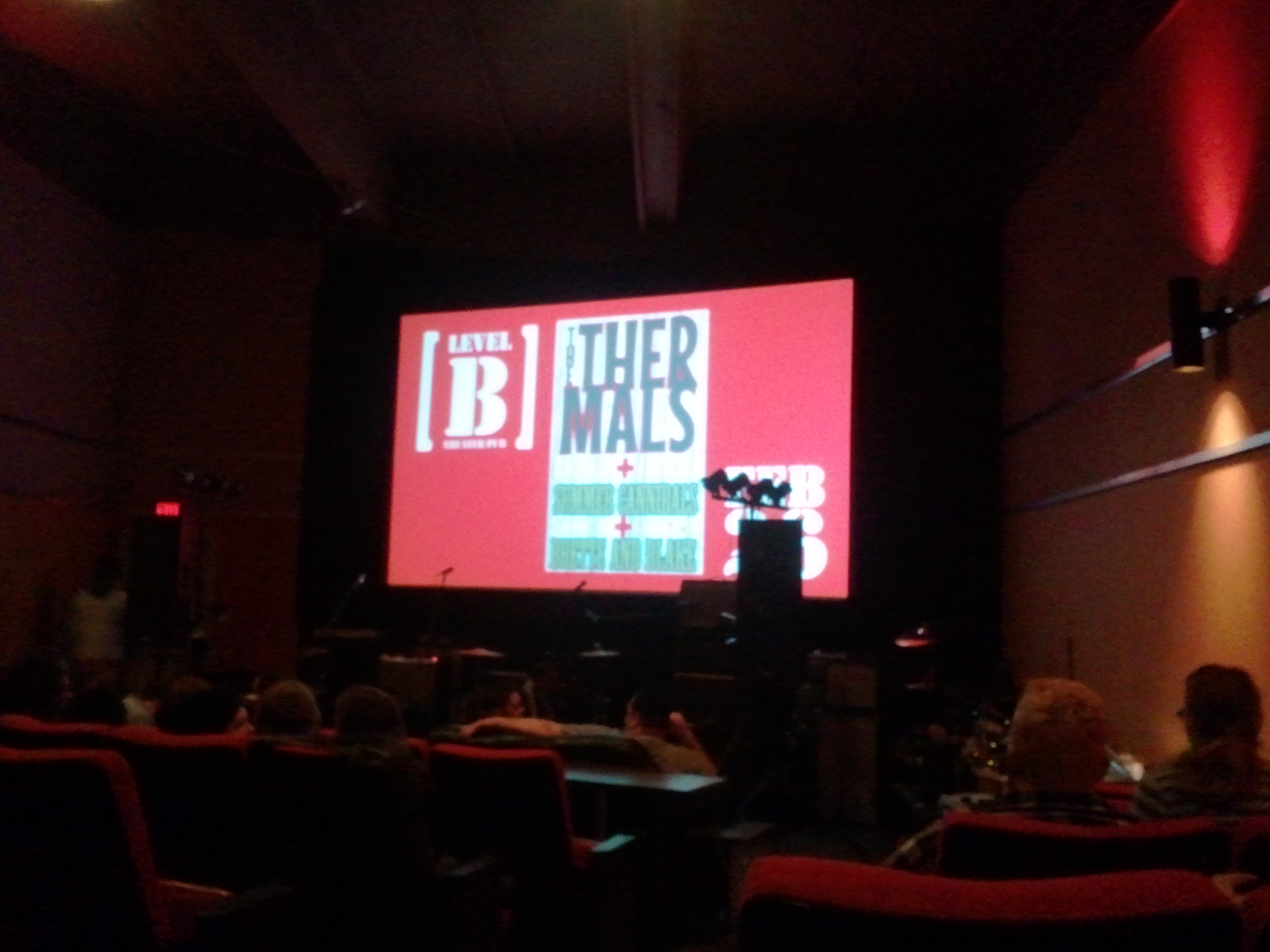
Level B preparing for the show
As it happens, Level B is the same spot where the old independent cinema in town was located, as can clearly be seen by the seats in the picture above. (I want to assure readers unfamiliar with Salem that Salem Cinema is alive and well with a great new location with better facilities, so I still get the chance to watch plenty of great films). I have high hopes for this venue in the future–it should be versatile enough to host different events, which means it’s more likely to stay afloat when it can’t get regular booking from non-local musical acts. They also had an excellent sound system, and all three bands sounded great as a result. And even the inconvenience of having those seats in place have a certain charm, giving the place a certain DIY-vibe of “we’ll play wherever they’ll allow us to play”. Or that could just me spouting bullshit. Either theory is valid.
I knew I was in for a good night (beyond the fact that I was seeing a live act that is consistently great) when two things happened: 1) I got a compliment on my Japandroids shirt (though it would have been nicer if it came from a lady, I’ll take what I can get), and 2) I heard somebody talking to the band before the show about how much he loved their album Fuckin A. That’s an album that I love as well, and by some strange coincidence the band had not performed most of those songs live at the shows I’d been to previously. It seemed like a good signal that we would get the chance to hear more of that album that night.
Aside: I never know how to act when I recognize band members in the audience. It’s always an awkward dance of “should I say something and say, ‘YO I LOVE YOUR STUFF,’ or do I allow them to be normal people for a few minutes?” I think I usually go for the worst option, where I’m pretty sure I end up staring at them far more than what is comfortable.
When I heard the opening drumbeat of “Our Trip” early in the set, my hopes for some Fuckin A songs officially materialized. The band then blistered through a high-energy set filled with tracks from their latest Desperate Ground, Fuckin A, and the now-classic The Body, The Blood, The Machine, sprinkling in favorites like “I Don’t Believe You” and “Now We Can See”. The set seemed to mirror the attitude from Desperate Ground itself, which seemed to be constructed as a reaction to the more muted reception of Personal Life. Personally, I am a big fan of Personal Life, which in many ways was an album that the band needed to make to shake up their formula and stretch their songwriting. It’s an album filled with a lot of mid-tempo numbers that are great to listen to on the stereo, but can sometimes kill the flow of a set, so I have no problem if some of those songs don’t get played, no matter how great they are.
The super-fast and hard-charging songs of Desperate Ground make for a great live set, though it takes a lot of listens before you can appreciate the nuance of each song (which is just a fancy way of saying “it’s hard to remember which song is which, but you KNOW it comes from that album”). It doesn’t help that those songs are missing some of the great guitar solos from Hutch that were a hallmark of their earlier work (not showy, but very melodic and building on the melodies within the song and brilliant with their subtlety), though Kathy’s bass often takes a lead role with some of the fills. Knowing this, it made Hutch’s remark after diving into the crowd during “The Sunset” for the last half of the song that he “nailed the solo” all the more hilarious.
When all else fails, shoot in black and white.
So yeah, it was a pretty fantastic show. Any night where you get to hear excellent songs like “St. Rosa and the Swallows”, “A Stare Like Yours”, and “A Pillar of Salt” (a fan favorite that got legitimate airplay (at least in New Hampshire/Vermont) back when I worked in radio), it’s going to be a good night. And the fact that I could plan my evening without budgeting a two-hour round-trip car ride made it even better.
Stray Facts and Observations
1. The drumbeat to “Our Trip” and “Here’s Your Future” are the exact same, meaning that those two albums start off the same. Is it a coincidence that these might be their best two albums? Probably.
2. The chord progression to “A Pillar of Salt” and “Returning to the Fold” are exactly the same, just at different tempo. Since they are back-to-back on the album, you can bet this was intentional. And it’s brilliant.
3. The Body, The Blood, The Machine is a concept album that doesn’t suck. Give The Thermals kudos for pulling off the nearly-impossible.
4. There’s no reason why “I Don’t Believe You” shouldn’t have been playing on rock radio. It’s a perfect pop-rock song.
5. There’s no reason why KNRK in Portland shouldn’t be playing The Thermals in their normal rotation. They need to substitute one of the hundreds of times that they play The Lumineers or Muse with these local heroes instead for once.
6. The last time I was at the venue it was still Salem Cinema, and I went with my family to watch My Big Fat Greek Wedding. Those who know me are free to laugh now.










 Rust Is Just Right