Even with our expanded Best-Of list courtesy of The Process, there were still a ton of great albums released last year that were worthy of recognition. Since we here at Rust Is Just Right are big believers in spreading all good music, we’re going to put a spotlight on some other great records that you may have overlooked from the past year.
EELS – Wonderful, Glorious. It had begun to seem as if Eels were stuck in a rut, with a trio of dour albums (Hombre Lobo, End Times, Tomorrow Morning) that were difficult for even a superfan like me to listen to on an regular basis. But E switched up the formula a bit and even sounds “happy” with this album. And the live show for the tour for this album was quite great as well, a kind of variety-show getup with everyone dressed in monochrome tracksuits and sporting the same facial hair.
No Age – An Object. No Age have always been a band that’s difficult to appreciate on first listen, but even fans of their abrasive sound (whether it be riotous punk rock or feedback-drenched ambient) weren’t sure how to respond to An Object. In many ways it was built more like an art project than just “the next album from No Age”, and surprisingly it often worked.
Phosphorescent – Muchacho. This country-tinged indie folk album is a real treat to listen to on a relaxing, sunny day, but would still be worth it if it only included the reworking of “Wicked Game” that we didn’t know we needed in 2013 with “The Quotidian Beasts”.
Red Fang – Whales and Leeches. I always love hearing my favorite hometown metal band, so it was surprising that they didn’t manage to make it onto the official list. Such is the mysterious ways of The Process. It seems that touring with Mastodon rubbed off on them a bit, as one could definitely hear their influence on the album (my initial comparison was “Mastodon on amphetamines”, and I think that it still fits). And good news, Red Fang is still making great music videos.
David Bowie – The Next Day. Can we just pause a minute and recognize how awesome it is that it’s 2014 and David Bowie can just surprise the world with a damn good album 45 years into his career? The album isn’t perfect, but there are some songs that would fit comfortably aside the old classics on a Greatest Hits.
Los Campesinos! – No Blues. I keep telling everyone to go to one of their shows because it’ll probably be the most fun you’ll have all year, and I’ll continue to do so. No Blues sees the band continuing with the mature sound from Hello, Sadness but with a slightly more positive outlook.
Janelle Monáe – The ElectricLady. It’s hard to keep track of the narrative about robots and revolution, but the music is fantastic. Seeing her perform with OutKast was one of the highlights of Coachella.
The Knife – Shaking the Habitual. I hadn’t understood the love that some people had for this band until I heard this album. It’s bizarre, but I like it.
Death Grips – Government Plates. Who knew we hadn’t heard the last from Death Grips? My favorite part is that when I downloaded the album, it was automatically tagged as “Rock & Roll”. If you are unfamiliar with their music, well…
Also Worthy of Praise
Speedy Ortiz – Major Arcana; Waxahatchee – Cerulean Salt; Ghostface Killah – Twelve Reasons to Die; Moonface – Julia With Blue Jeans On; Tim Hecker – Virgins; Neko Case – The Worse Things Get, the Harder I Fight, the Harder I Fight, the More I Love You; Washed Out – Paracosm.
All Albums That Were Considered
Here’s a list of the albums that I listened to last year, in full. Most of these were quite good and worthy of repeated listens, but they just couldn’t crack the previous lists. And I’m not going to do something like say the new albums from The Strokes or Black Rebel Motorcycle Club were complete garbage, because that wouldn’t be nice.
Boards of Canada – Tomorrow’s Harvest; Daft Punk – Random Access Memories; Kurt Vile – Wakin On A Pretty Daze; The Strokes – Comedown Machine; Surfer Blood – Pythons; Atoms for Peace – Amok; Ducktails – The Flower Lane;Black Rebel Motorcycle Club – Specter at the Feast; British Sea Power – Machineries of Joy; The Dismemberment Plan – Uncanney Valley; M.I.A. – Matangi; Palms – Palms; Phoenix – Bankrupt!; Cold War Kids – Dear Miss Lonelyhearts; Deerhunter – Monomania; Jake Bugg – Shangri-La; Jim James – Regions of Light and Sound of God; MGMT – MGMT; Mudhoney – Vanishing Point; Yo la Tengo – Fade; Beach Fossils – Clash the Truth; Fitz & The Tantrums – More Than Just a Dream; Alice in Chains – The Devil Put Dinosaurs Here; The Appleseed Cast – Illumination Ritual; Chelsea Light Moving – Chelsea Light Moving; Darkside – Psychic; The Dear Hunter – Migrant; Dr. Dog – B-Room; How to Destroy Angels – Welcome Oblivion; Kavinsky – OutRun; Major Lazer – Free the Universe; Of Montreal – Lousy With Sylvianbriar; Oneohtrix Point Never – R Plus Seven; Ra Ra Riot – Beta Love; Talib Kweli – Prisoner of Conscious; Tyler, the Creator – Wolf; Typhoon – White Lighter; Baths – Obsidian.
Today is April 15, and while the rest of the nation celebrates Tax Day, we here at Rust Is Just Right choose this occasion to release our Best Albums of the Year list. To be technical, this is our first such list since the site was launched only a few months ago, but this is a practice that I’ve personally done for a few years now. There are a few of reasons for this: 1) It allows some of the albums that are released at the end of the calendar year to get some recognition, since they usually get swallowed up in the attention of the flurry of year-end lists; 2) I get the chance to analyze other lists to pick up on albums that somehow escaped my attention during the course of the year; and 3) It provides a handy consumer guide for people to focus where to spend their tax refund.
The process that is used to determine this list is highly rigorous and hardly scientific. That said, it is in the process of being patented and trademarked, so I can say that it’s not simply a look at my iTunes playcount for the year. Actually, that is what it is exactly, but I’ll choose to believe in your good faith that you won’t steal The Process. On to the list!
Note: Though the list is a Top 10, there are more albums than slots, because I don’t like breaking ties for the same play count. If you’re really intent on focusing on only 10, I guess take the 10 highest performing albums from the list, but you really shouldn’t limit yourself like that if you can help it.
We already have a surprise courtesy of The Process, as I didn’t think that Mosquito would perform so well. The first single “Sacrilege” had me really excited for the album, but there was no other song that really matched its heights. It was a bit of a letdown after the great It’s Blitz!, so my response to it may be harsher than it should be. The Terror on the other hand was a new high point for The Flaming Lips; with the band involved in so many projects and gimmicks, there were legitimate fears that the creative well may have been running a bit dry, but the Lips responded with an album that showed that even after 30 years the band still has new directions to explore. Long known for their happy outlook on life, the band channeled inner turmoil (Steve Drozd’s relapse, Wayne Coyne’s separation from his partner) and created a dark, disturbing album that often plays like an hour-long version of the horrifying “Frankie Teardrop”, incorporating new elements like krautrock influences and drum machines. The only reason it’s not higher on the list is you really need to prepare yourself to handle the despair that is prevalent throughout the album (though there are moments of pure beauty). With Th!!!er, !!! may have won Album Name of the Year, but they also back it up with some of the best songs of their career. I’m a sucker for their dance-punk style, and I highly recommend seeing these guys live. It’s fun to see a bunch of people who normally don’t dance groove to songs like “One Girl/One Boy”.
9). (7 plays) Foals – Holy Fire; The Joy Formidable – Wolf’s Law; Low – The Invisible Way; Nine Inch Nails – Hesitation Marks; Parquet Courts – Light Up Gold; Pearl Jam – Lightning Bolt; Run the Jewels – Run the Jewels.
Normally, I would say that Pearl Jam exists outside the scope of “lists”, but one cannot argue with The Process. I haven’t delved deep into my love of the band since starting this site, so for those of you unfamiliar with my passion for the band, I’ll try to sum it up like this: I’ve been to hundreds of shows over the years, and when people ask me for my all-time greatest concerts, I tell them there’s a Pearl Jam list and a non-Pearl Jam list.
As for the others, I’ll offer a few quick thoughts. Foals have been underrated for a while now, and by my calculations “My Number” should have been as big a summer hit as “Get Lucky”. The Joy Formidable put on one of the best shows I saw last year, and I’m a big fan of how the sweetness of the vocals contrast with the heaviness of the music, but all done in a very melodic way. There wasn’t a big hit like “Whirring” on this album, but “This Ladder Is Ours” should have been. Nine Inch Nails returned with a very good comeback album–I loved the incorporation of more minimalist ideas, which made it an exceedingly interesting dance record. And it’s amazing that Low once again produced an amazing album, and I hardly saw any mention of it on the year-end lists. Invisible Way saw the band returning to the more delicate sounds pre-Drums and Guns, but it was definitely not a simple rehash.
Light Up Gold is a perfect example of reason number two up above, as I heard nothing about this album before I saw it on a few year-end lists. This catchy and too-smart-for-probably-its-own-good soon became a go-to in my car stereo. You have to love a band that makes the point that “Socrates died in the fucking gutter.”
As for Run The Jewels, I’ll say this: it’s hard to believe that one of the best albums of the year was given away for free earlier this year. And it received a small fraction of the attention of Magna Carta Holy Grail.
8). (8 plays) Franz Ferdinand – Right Thoughts, Right Words, Right Action; Kanye West – Yeezus; The Thermals – Desperate Ground.
I was glad to see Franz Ferdinand return from hiatus alive and kicking. After some experimentation with Tonight, the band decided to go back to their old sound and play to their own strengths–a lot of good, hook-filled rock songs (for the record, I was a fan of Tonight, but hey, I understand the calculus). The Thermals made a similar return to their roots: after the reflective Personal Life, the band decided to keep the songs short and the tempos fast, with the furious Desperate Ground.
I’m sure Yeezus was the most analyzed album of the year, so my opinion shouldn’t add much to the conversation. I think Lou Reed did an excellent job in explaining its genius, so you should probably take his word for it. I will say that one of the things I enjoy most about Kanye records is that it always seems like we’re listening in on a therapy session, because he seems free to let his thoughts roam unfiltered. I also love a person that embraces the dichotomy of the sacred and the profane; who else would follow a great line “close your eyes and let the word paint a thousand pictures” with “one good girl is worth a thousand bitches”? The man knows exactly what he’s doing: “After all these long-ass verses, I’m tired, you’re tired. Jesus wept.“
7). (9 plays) The Men – New Moon; Sigur Rós – Kveikur; Vampire Weekend – Modern Vampires of the City; Volcano Choir – Repave; Yuck – Glow & Behold.
We had an extensive piece already on Yuck, so we won’t rehash it here. Volcano Choir is proof that Justin Vernon knows what he’s doing and that he doesn’t need the “Bon Iver” name to make great music. The Men will continue to put great, solid rock albums from now until eternity it seems like; throwing in some classic rock and Americana touches like they did on New Moon just helps expand their sound.
Vampire Weekend got a lot of credit for their show of maturity on their third album, and a lot of it is deserved–Modern Vampires is an excellent rumination on love and faith. That said, it wasn’t as great a leap as some critics made it out to be; I thought that Contra showed that the band was creative enough to find a way to connect their niche sound with other genres and still remain true to their identity. So while this is a very good album, it’s not quite the “Album of the Year”.
I’m much more surprised about the latest album from Sigur Rós. I found Valtari to be a real low point, an album that often struggled to find any semblance of creativity or inspiration, and it just seemed like an ambient mess. So when the band released Kveikur so quickly after Valtari, I was pretty skeptical. But holy shit, this sounds like a band reborn. It’s a much more aggressive album, an adjective that is rarely associated with the band, and bears some (dare I say?) metal influences.
5). (11 plays) Arctic Monkeys – AM; The Besnard Lakes – Until in Excess, Imperceptible UFO.
The instant I heard “Do I Wanna Know?”, I knew I would love this album; I just didn’t know that it would turn out to revive their career here in the States. It’s a huge improvement over the good-but-unmemorable Suck It And See and the completely forgettable Humbug, and it wins my coveted award of “Night Driver of the Year”.
I’ve been a longtime fan of The Besnard Lakes, a band far more deserving of some of the plaudits that another Canadian band whose absence you may notice from this list. If there were actual justice in this world, they’d be headlining arenas, but I’m glad I get to see them perform spellbinding sets in tiny venues like the Doug Fir. I initially was not impressed with the new album, mainly because I had been hoping that they could use some of the huge hooks from Roaring Night and hopefully catapult into the mainstream; but once I accepted the album for what it was, I was able to appreciate the subtle melodies and beautiful atmosphere.
4). (12 plays) Deafheaven – Sunbather; My Bloody Valentine – m b v.
My Bloody Valentine shocked the world when they announced that they were immediately releasing their long-awaited follow-up to Loveless. Servers were in a constant state of crashing as music buffs around the world rushed to download the album, but eventually we all got our copy. Was it worth the over two-decade wait? If you based it on trash like “Nothing Is”, then you would say no, but then you hear the gorgeous “Only Tomorrow” with its monumental guitar solo, and all is forgiven, because you are reminded that while there are thousands of bands that were inspired by them, there is truly only one My Bloody Valentine.
Sunbather might be the most surprising album on my list, because while there is a lot of heavy metal that I do enjoy, it’s usually not of the black metal variety. However, Deafheaven uses the banshee wail-type vocals to their advantage, as they blend in with the walls of guitar. If I had my preference, it wouldn’t be the style I choose, if only because it becomes hard to distinguish what are actually some pretty decent lyrics (an exchange like “‘I’m dying.’ ‘Is it blissful?’ ‘It’s like a dream.’ ‘I want to dream.'” read great on the page, but impossible to pick out when sung). That said, the actual music is pretty goddamn brilliant. I’m going to explore them in a future Feats of Strength, but I’ll say that the last half of “The Pecan Tree” was probably the best music I heard all year, but to understand its full brilliance you need to hear the 55 minutes of brutality that came before it.
3. (16 plays) Wavves – Afraid of Heights.
Wavves received the best press and sales of their career with King of the Beach, and to follow it up they release an album filled with cynicism and paranoia and plain old depression. But they made it fun as hell. I have to give a lot of respect who released a single that got actual radio airplay whose chorus is “Holding a gun to my head, so send me an angel; or bury me deeply instead, with demons to lean on”. And they played it on Letterman.
2. (17 plays) Queens of the Stone Age – ...LikeClockwork.
This one of the best albums of QOTSA’s career, and that’s saying something since they’ve released several classic albums already. It’s a brilliant mix of their desert rock with gothic horror. It’s hard for me to think of much more to say than that, because I’m still bitter thinking how not one person on the AV Club staff gave this album a single vote.
1. (20 plays) The National – Trouble Will Find Me.
In the end, the list was topped off by what I would have predicted at the beginning of the year, but when I first listened to Trouble Will Find Me this was not a foregone conclusion. But like other albums from The National before it, what initially sounded like a shapeless bore gradually revealed its subtle strength and beauty. Melodies become more apparent, and dynamics become more evident; often it’s not drastic loud-soft contrast, but a gradual intensity that builds throughout in a song. Each listen brings about a new favorite; first it was “Sea of Love”, then it was “Pink Rabbits” followed by “Don’t Swallow the Cap”. Lately, it’s been “Graceless”, a powerful look at attempts to shake the melancholy stemming from a past relationship, filled with great lines like “God loves everybody–don’t remind me” and “all of my thoughts of you: bullets through rotten fruit.” After a few listens, you notice things like the shift halfway between “graceless” and “grace” that occurs in the lyrics, and the gradual buildup of intensity in Matt Berninger’s voice as he powers through the song. It’s perfect that an album that rewards multiple listens takes the top spot.
Neutral Milk Hotel’s reputation was built on the strength of its magnum opus In the Aeroplane Over the Sea. What is it about this album that it has inspired rabid devotees ready to proselytize about its brilliance at the drop of a hat? In this next part, we will closely examine the particular genius of Aeroplane and why it is worthy of such deference.
It is difficult to enjoy In the Aeroplane Over the Sea on the first listen; to borrow a term from economics, appreciation has “a high barrier to entry”. The bizarrely-stocked orchestra of cheap instruments, the ramshackle production combined with lo-fi recording touches, and Jeff Mangum’s raw and unique voice (some kind people may call it “untrained” to be charitable) all become qualities that you come to love, but it takes some time before this occurs. It can be tough to overcome those initial impressions, and that’s how you end up with reactions like this Rolling Stone review (I don’t know if there’s a more “Rolling Stone” review than this, which when not engaged in strained allusions (Tusk and the MacArthur awards committee both get a mention) manages to do everything it can to show that the reviewer missed the point entirely (“burying the hard gem of songcraft under layers of bizarreness”; “most of the music is scant and drab, with flat-footed rhythms and chord changes strictly out of the beginner’s folk songbook”), all capped with a generic three-star rating).
The chord changes that the Rolling Stone reviewer derides are actually one of the quiet strengths of the album. Most of the songs only rely on three or four basic chords, all of which should be familiar to the average listener’s ear. The effect is that it grounds the songs into something that is immediately identifiable to the listener, and allows one to appreciate the more peculiar touches without allowing one’s attention to completely drift away. The title track is a perfect example of this: it’s built on a common progression, G – E minor – C – D, or as I like to call it the “Last Kiss” progression (the I, vi (relative minor), IV, V chords for those inclined), over which Mangum sings a sweet and pleasant melody, and gradually more and more instruments are layered to provide distinctive accents, like the various horns and especially the eerie singing saw. Mangum never changes the chords but in the bridge he makes a slight adjustment in their order, beginning each phrase with the E minor chord instead, which changes the tone of the entire section to something darker. These little touches help bring out certain lines in the lyrics; a perfect example is how the singing saw helps embellish the line “how the notes all bend and reach above the trees”, providing an aural representation of the image depicted in the lyrics.
The brilliant “Holland, 1945” is another excellent example. It’s even simpler than “Aeroplane” in that it uses only three chords: C, G, and D, the most basic chords in all contemporary music. In fact, most of the time it switches only between C and G, with the D thrown in occasionally to provide the bridge between those two endpoints. The simple structure also allows the song to retain the same amount of power when it’s just Mangum and his guitar. That said, there are few things that equal the magnificence of this song when it’s the full band playing–the fuzz bass that gives the low end that buzzed edge, those horn lines which provide glimpses of triumph, and that excellent driving percussion that is always on the threat of falling apart but blisters through nonetheless. Just listen to those crisp snare rolls and how they push the song into the next line, or those kick drum hits that accent the walking bassline in the coda.
It’s almost amazing that I’ve spent this many words analyzing the album with only passing references to the lyrics, because the story behind the words is often what is most familiar to those with even a passing knowledge of the band (“Oh, they’re the guys with the ‘Anne Frank’ album, right?”). The discussion of the mythology of Aeroplane is certainly a factor that draws in many fans, and Mangum’s lyrics definitely invite further scrutiny. Much of the album was indeed inspired by Anne Frank’s The Diary of a Young Girl, and she is referenced in many songs throughout the album (the bulk of her appearances is in the middle of the album, with “In the Aeroplane Over the Sea”, “Holland, 1945”, “Oh, Comely” and “Ghost” as significant examples). However, it needs to be seen through the eyes of Mangum’s intense reaction to her ordeal and not just a recounting of her story. Mangum uses several other characters on the album, as he weaves scenes of an impoverished modern family with fantastical characters and the ghost of Anne Frank, all as attempts to process all the terrible things that happen and how we are often powerless to stop them. Individual lines alternate between sweet, childish simplicity and bizarre horror, all processed through a particular straightforward innocence.
It is an extremely affecting and compelling work underscored by Mangum’s raw and impassioned vocal performance. What initially comes off as harsh at worst and amateurish at best becomes warm and comforting after repeated listens. You can feel each and every sentiment that Mangum goes through as he journeys through the emotional roller coaster of an album; the album veers from the affectionate “The Earth looks better from a star that’s right above from where you are” to the stark “I know they buried her body with others, her sister and mother and 500 families…I wish I could save her in some sort of time machine” to the redemptive “And when her spirit left her body, how it split the sun; I know that she will live forever, all goes on and on and on.” It’s the reason why one of the most powerful experiences in my life was when I listened to this album and then visited the Anne Frank House in Amsterdam.
However, it’s not just the brilliance of the album itself that has inspired such fanatical devotion, but the mystery surrounding it. While it’s easy to pick up on the general story behind the songs, the often cryptic lyrics filled with fantastic and grotesque imagery have inspired wild theories and intense discussion. And fans were left to argue their meaning among themselves, because Jeff Mangum rarely spoke about the album and conducted very few interviews once it was released. Actually, I may be understating Mangum’s reluctance a little bit, as his silence led to stories of him becoming a recluse in the face of the overwhelming reaction to the album, so much so that Slate published an article in 2008 that dubbed Mangum “The Salinger of Indie Rock”. The continued silence of Mangum over the years fed a cycle that increased the hysteria behind the album, and as nature abhors a vacuum, people rushed in to fill the gaps and speculate on the meaning of what seemed to be the last musical release of an eccentric genius. With nothing to compare it to, the stature of the album was destined to grow, a pattern we’ve seen before (My Bloody Valentine’s Loveless is an excellent example of this phenomenon).
*******
Which was why it was such a surprise when Jeff Mangum eventually began his return to the spotlight a couple of years ago with a scattering of solo appearances, and why segments of the internet exploded in euphoria. Finally, we would be able to hear from the man himself!
A triumphant return.
In the years leading up to his return, fans had to make do with scattered bootlegs and a tantalizing glimpse of the early form of Aeroplane-era songs with Live at Jittery Joe’s, a recording of Jeff performing solo before friends and an otherwise indifferent audience in a tiny club in Athens, Georgia between On Avery Island and Aeroplane. It was remarkable to hear Mangum interact with the audience and give brief explanations and insights into his songs, and the casual nature of the set helped undercut some of the self-serious reverence that some fans had developed over the years. This was music made by an actual human, not some ethereal muse or other mystical creature.
Jittery Joe’s also provided a clue as to how some of those early return shows would sound like, as Mangum seemed weary of returning the band as a whole. Instead, he gradually introduced other band members in various performances and only for certain songs, generally performing by himself just with a couple of acoustic guitars. I had the great fortune of seeing Mangum on these early tours twice, and it was a concert experience that few could possibly match. It was amazing to watch a crowd that over years and years had connected on a deep emotional level with an artist that they had no idea they would ever have the chance to see, finally confronted with the opportunity to witness the source of their passion in person. It was a mixture of joy and adoration, and took on the tone of an almost-religious revival. I can say with some authority that the only person that could get a bunch of young Portland hipsters to yell “I love you, Jesus Christ” would be Jeff Mangum.
But still, there was something missing from these performances. Jeff and his guitar may have been the backbone of each of these songs, but we had come to adore all the extra flourishes over the years–the thrashing drums, the buzzed bass, the kitchen-sink orchestra, et al. So we were welcome to the new experience of seeing “Neutral Milk Hotel” as a whole perform these songs that we had come to know by heart.
Fellow Elephant 6 comrades The Minders and Elf Power were the opening bands, and they did a good job of keeping the energy of the crowd up. We got an unexpected highlight when Elf Power covered the Olivia Tremor Control’s “Jumping Fences” in memory of Bill Doss, who had tragically died two years ago. It was a reverent take of a brilliant song whose greatness was somewhat unappreciated by most of the crowd, who apparently had not delved into the oeuvre of the other band in the collective that often matched the brilliance of Neutral Milk Hotel. One of the greatest concert experiences I ever had was seeing the Olivia Tremor Control perform a raucous set in a tiny Portland bar during Music Fest Northwest with a bunch of their friends from Elephant 6, and I wished that the other people in the crowd had been there so they could have been as excited as I was for this cover.
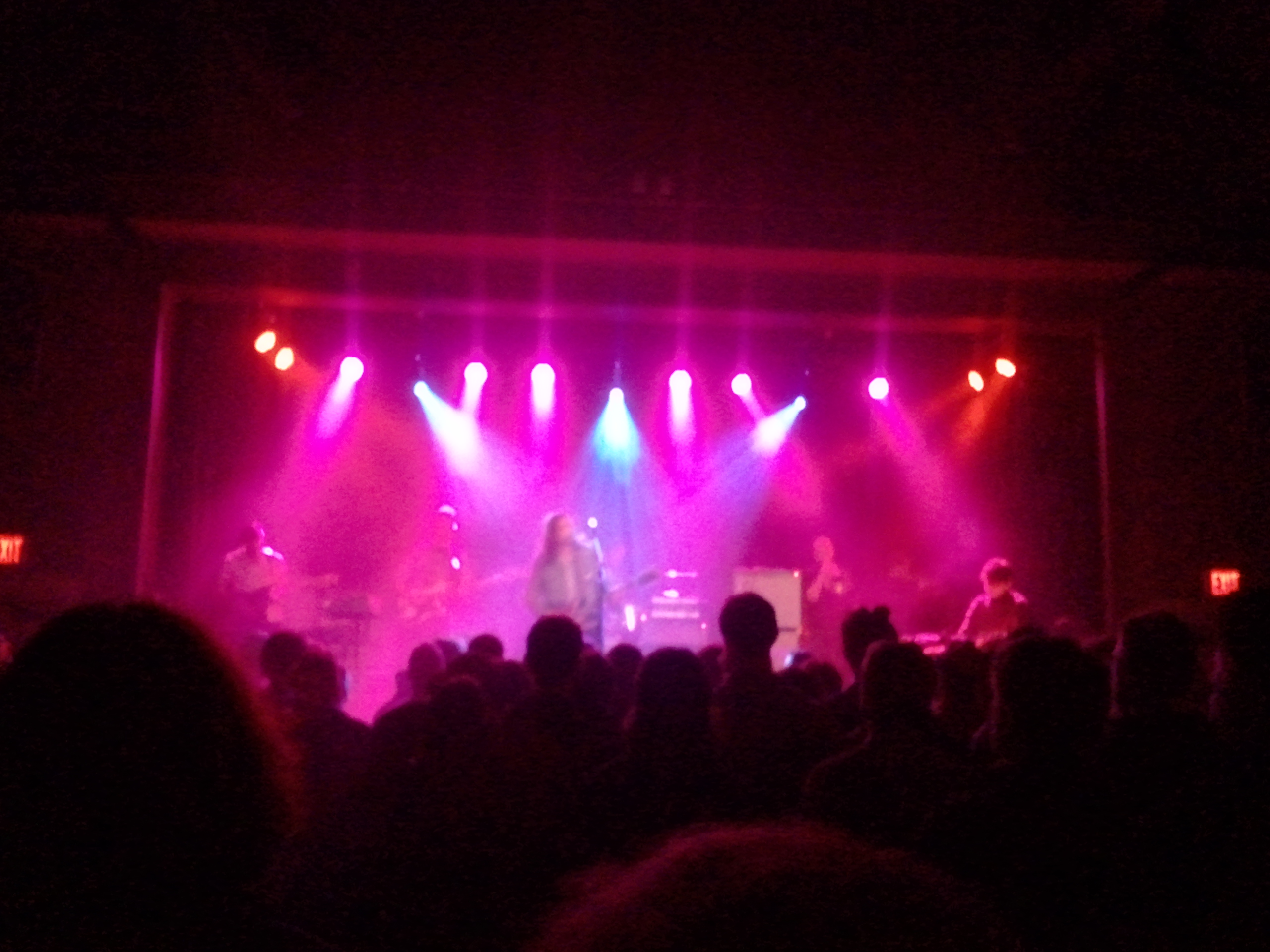
After Elf Power, the audience grew impatient as the moment that many had spent at least a decade to see was growing closer, but soon their fears were allayed as a lone bearded figure climbed up onto the stage. Jeff opened the show with a stirring solo version of “Two-Headed Boy”, buoyed by a raucous crowd singing along. And in a manner that perfectly matched the performance on the album, the rest of the band gradually made their way in a procession to the stage as they played the instrumental segue “The Fool”, and we could finally say that we had lived to see the return of Neutral Milk Hotel. When the band launched into “Holland, 1945”, I could barely contain myself, and I shouted the lyrics along with the band as they played my favorite song of all-time. It was an unbelievable moment, made better by the fact that you could see the joy of the band as well.
In those earlier Jeff solo shows, there was always a delicate tension between performer and audience, as the crowd was careful not to disturb a potentially emotionally fragile performer. There was a strange dichotomy at work, as there was a connection between Jeff and the crowd because of the music, but also a distance between the two, as the crowd didn’t want to cross any imaginary line. With this in the back of my head, I was therefore interested to see how Mangum would react with the rest of his band during the show. Instead of being withdrawn and remote, Jeff seemed most joyous when he was playing along with his band. He was still somewhat on an island off to the far right of the stage, and the nature of the songs meant that often it was him by himself facing the crowd, but the sense was not of “Jeff Mangum & Some Guys” but more of a cohesive unit called “Neutral Milk Hotel”.
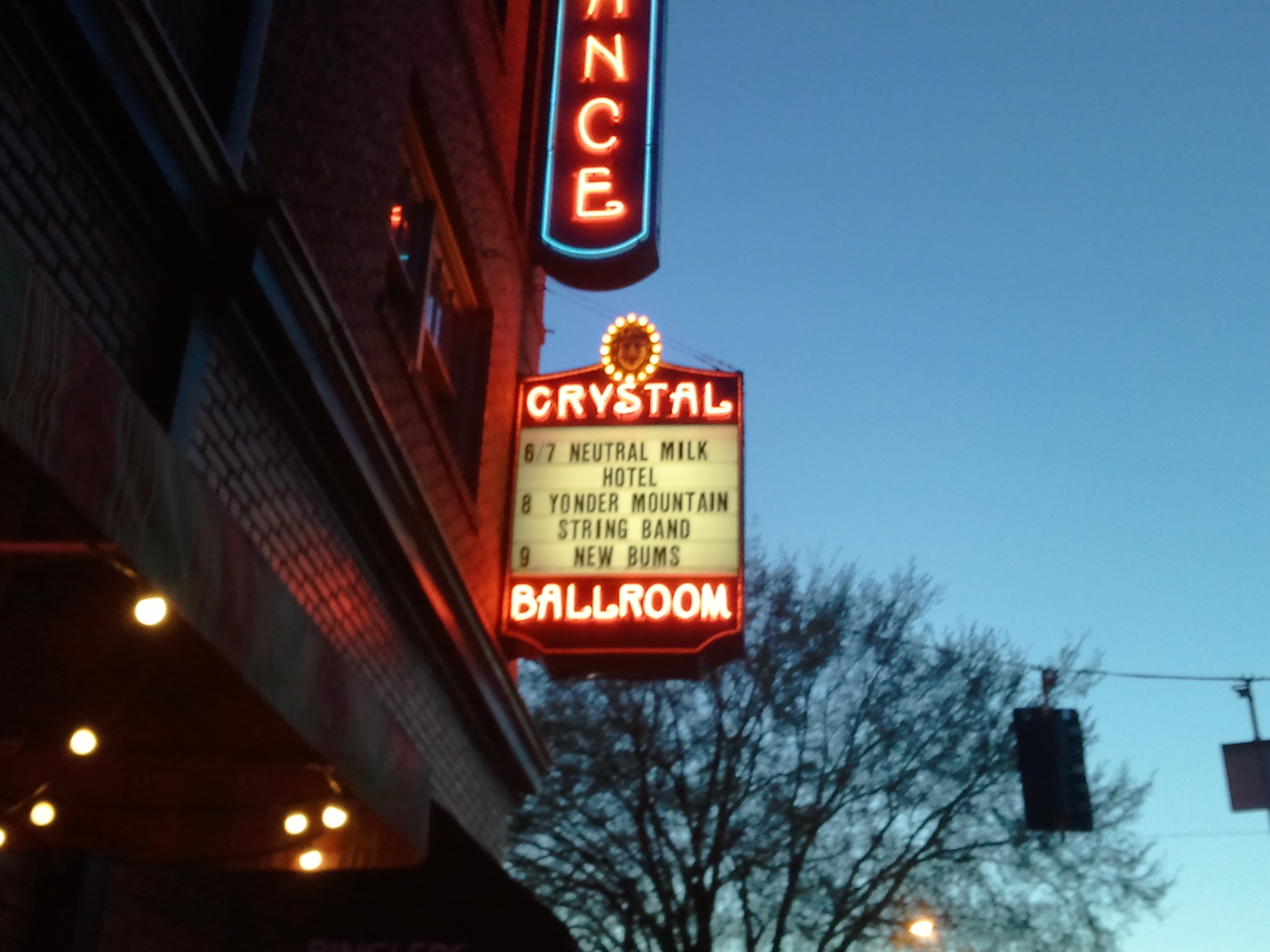
The band had a varied set, shifting between songs from throughout their career. There were of course several songs from Aeroplane, but they also hit highlights from their debut like “Gardenhead-Leave Me Alone” and “Song Against Sex”, as well as tossing in rarities like the early single “Everything Is” as well as “Ferris Wheel on Fire”. The band saved the best for last, as they ended the show with an encore of the ending trio of songs from Aeroplane. There’s “Ghost”, which manages to create this unbelievable tension as instruments pile on top of each other while the upbeat is hammered incessantly, while at the same time there is some relief because we have the potential relief of Anna’s ghost being free to escape. Then there is the instrumental segue “Untitled”, which has the aura of a carnival celebration and where the band let loose, led by unusual instruments like the zanzithophone, which handles the main melody. One of the indelible memories I will have of the show will be of Jeff jumping around with his acoustic guitar as this joyous circus performed along with him. “Two-Headed Boy Pt. 2” then closes out this set, as we revisit characters from throughout the story as gradually everything fades away, and we’re left with Jeff alone with his guitar. However, he doesn’t leave as he does at the end of the album; instead, Jeff has one more sing-along for the audience, and the crowd joins in on the fan-favorite “Engine” to close out the show. It was the perfect ending to a memorable show, and we exited into the night to the sounds of “Pink Moon” filtering through the Crystal Ballroom sound system. That’s about as good as a Sunday night gets.
I remember a recent conversation where an acquaintance asked a question along the lines of “How did Neutral Milk Hotel become so popular?” For the vast majority of the American public, this would seem to be a preposterous question, especially for a group that has yet to sell even a gold record; furthermore, I’d imagine that most of these people would be clueless as to how those three words could possibly fit together.* However, depending on the community, this bewilderment is understandable. Within the right group of people, Neutral Milk Hotel, and especially their masterpiece In the Aeroplane Over the Sea, have taken on an almost hagiographic glow, and both now exist as shorthand for raw, cathartic genius and simple, pure brilliance.** Not bad for a few guys from a small town in Louisiana.
One of the signs that you know you’re in my office.
I’m going to twist the original question a little bit, and rephrase it as “How did Neutral Milk Hotel reach this level of acclaim (with the corollary ‘Is it deserved?’ answered with a quick and resounding ‘Yes.’)?” Looking back to their origins, there would be few clues as to how these guys would become the most influential voices in the independent music scene of the last two decades. As the story has been recounted before, it dates back to the early days of childhood friendship in Ruston, Louisiana, the home of Louisiana Tech. It began with the sons of a couple of professors bonding over their love of strange and exotic music, and together they navigated following their cultural ambitions with the realities of small town life. Sharing records eventually led to experimentation and making recordings themselves, and it was from those humble beginnings that the Elephant 6 collective was born.
Those childhood friends were Robert Schneider, Bill Doss, William Cullen Hart, and Jeff Mangum, and their bands and their subsequent offshoots would create some of the greatest music of the 90’s. The Apples in Stereo, The Olivia Tremor Control, and Neutral Milk Hotel all trace their origins to those days in Ruston, and they in turn would inspire and work with several other bands like Beulah, Elf Power, and of Montreal that would shape the sound of independent music from the mid-90’s to today. But while I feel this history lesson is beginning to drag us away from the question at hand, it does provide the proper context to understand Neutral Milk Hotel. It was within that setting that a culture of sharing and experimentation developed, where bands and genres blended as necessary, all in the name of making beautiful and heartfelt music. It was from these humble beginnings where you can also hear the origins of the Elephant 6 aesthetic. The sincere belief that merely lacking the trappings of an expensive studio is not a good enough excuse to prevent musicians from emulating the psychedelic sounds of the Beach Boys and the Beatles, when all you need is a bedroom, a tape recorder, and a bunch of friends to help you.
The story of Elephant 6 is significant, but the particular importance of Neutral Milk Hotel still needs to be explored. One can find momentary glimpses of future genius in their debut album, On Avery Island: songs like “Gardenhead”, “Song Against Sex”, and “Naomi” are great examples of the warped take on folk music that would be the hallmark of the band’s sound. In a way it captured the old-time spirit of folk music, which wasn’t the sixties stereotype of the singer/guitarist in a cafe, but friends gathered together playing whatever instruments were handy. This atmosphere was enhanced by the lo-fi recording techniques and production, which emphasized the do-it-yourself spirit of the group. And on top of all this were Jeff Mangum’s cryptic and often bizarre lyrics, which draw your attention and invite endless speculation. However, there was little that would prepare fans to the great leap forward that would come next from the band.
Next door to the Anne Frank House.
I still remember my first introduction to the band, back during my freshman year of college. I was looking at the away messages that my friends would post on AOL Instant Messenger, and one of them had posted a few lyrics from the song “In the Aeroplane Over the Sea” and had listed the name “Neutral Milk Hotel” underneath. I found the words particularly moving, which led to further research to learn more about these guys. After reading a few reviews filled with lavish praise, I immediately used the intra-college network to download the album, since we had long passed the halcyon days of Napster (quick aside that attempts to justify my actions: this was before the days of YouTube and other streaming possibilities; the nearest record store was two towns over and I lacked a car; and I have a strong habit of purchasing what I like after the test preview download as soon as I can).
Those unmistakable first acoustic guitar strums of “The King of Carrot Flowers, Pt. 1” soon were filtering out through my computer speakers, and I was subtly intrigued. It was a catchy little progression, with a playfulness that was reminiscent of old nursery rhymes. And then that distinctive and idiosyncratic voice came in, and I was momentarily taken aback. At this point, I had limited experience with such an unconventional vocal style, where emotion and passion took priority over a pleasing tone or technical accuracy. So I was put back on my heels a little bit at this point, and I was still listening to the first song at this point. There’s a slow transition into “The King of Carrot Flowers, Pts. 2 & 3” as a sustained organ chord bridges the two songs, followed by a staccato banjo arpeggio, and then…
“I-I-I LOVE YOU JEEE-SUS CHRIIIIIIIIIST! JEEESUS CHRIST I LOOOOO-O-VE YOOOOOOOOU!”
At that moment, my first thought is “what the hell have I just gotten myself into?” And when I played the album for the first time for each of my friends, that was the exact point where they would produce an identical reaction. I have expressed a similar philosophy as Hank Hill when it comes to Christian Rock, and so this moment was quite jarring: the combination of the raw emotion and the nakedness of the proclamation itself were a bit much to take on first listen. But then that triumphant trumpet kicks in, the drums begin to ramp up, and then the song morphs into the most punk rock folk song I had ever heard in my life. My initial concerns were slowly fading away.
It was then that the title track came on, and my conversion was soon complete. It’s a gorgeous ballad, filled with gorgeous unique touches, like the eerily beautiful singing saw that wavers in and out throughout the song. Yet it was the lyrics that had slowly captured my attention, language filled with gorgeous imagery and a sentiment of sweetly innocent longing, an emotion that Mangum’s voice wonderfully captured. And by the time I heard the last verse, I had reached an epiphany.
“What a beautiful face, I have found in this place that is circling all around the sun; and when we meet on a cloud, I’ll be laughing out loud, I’ll be laughing with everyone I see. Can’t believe how strange it is to be anything at all.”
That last line continues to stick with me to this day; I have never heard a more perfect summation of the absurdity and majesty of existence, and the mere acknowledgement of this fact proves the sentiment in and of itself. It’s in moments like that instant connection with that particular lyric that reveal how a band can inspire such intense devotion.
*******
To be continued in Pts. 2 & 3
* The best explanation that I remember reading of the band name was that “milk hotels” were a specific lodging that I believe sprang up during the time of the Gold Rush, and they were not stocked with alcohol. “Neutral” didn’t describe the non-leanings of the hotel, but rather was the name of a town. My search skills are failing at the moment, but I will edit this when I find more information.
** It can also exist as shorthand for people trying to make a quick joke about hipsters or as a comment on seemingly pretentious and inscrutable music, but fuck those guys.
Note: The book from the 33 1/3 series on In the Aeroplane Over the Sea written by Kim Cooper was an invaluable resource in helping to flesh out some of the backstory of the Elephant 6 Collective, and I highly recommend picking up a copy if you want more information.
It’s been a real fun ride watching the continued evolution of Cloud Nothings over the past few years. I started keeping my eye on the band back when it was still a weekend project of Dylan Baldi, having fortuitously downloaded the initial bedroom recordings of Turning Onon a whim. Baldi’s strengths had been his great melodic sensibilities and a knack for strong hooks, so few would have expected the direction that he took with the Steve Albini-produced Attack on Memory, which added a healthy dose of grit and bitterness to the mix. Attack on Memory was an often great album that was a significant step forward for the band, even after taking some of its unevenness into consideration. The question was then what direction the band would take next.
Here and Nowhere Else sees Cloud Nothings increasing the aggression and upping the angst even more, and the result is a voracious blast of pure intensity that doesn’t let up over the course of its half-hour runtime. However, some of the ambition found on Attack on Memory, which can partially be explained by Baldi pulling double duty and handling both rhythm and lead guitar parts. The songs don’t have the same obvious surface complexity as those on Attack on Memory, though that’s not necessarily true from a structural songwriting standpoint, as several tracks venture into unexpected directions. The real strength of the album is that it’s clear that the band has become an even more cohesive unit during the intervening years of touring. There are several nice melodic basslines that snake their way throughout the album and Jayson Gercyz’s drumming is a real standout from front to back, as he is able to change tempos at the drop of a hat as well as match the mood with subtle dynamic touches. Listen in “Psychic Trauma” to how seamlessly Gercyz switches from a steady groove to a raucous attack, culminating in an absolutely ferocious final climax.
There is no equivalent to the Wipers’-influenced “Wasted Days” on Here and Nowhere Else, but “Pattern Walks” comes close. It’s a nice touch that the chorus benefits from the purposefully lo-fi mix that can have the listener mistaking the title for “padded walls”, giving an extra edge to the song. It devolves into a glorious mess, with swirls of keyboards, but it lacks the intricate guitar lines, the groovy solo section, and the perfect shout-along of “I thought I would be more than this” from “Wasted Days”. The album does end on a high note with the excellent “I’m Not Part of Me”, which proves the perfect bridge of the early bedroom days of the band and the new aggro-punk leanings of the current incarnation.
Regular readers of this site know how much we love the latest album from The War On Drugs, the absolutely superb Lost In The Dream. It’s one thing for an album to sound great on record, but it is of course no guarantee that the songs will translate live very well. Considering how much effort the band expended in constructing each song in the studio, there is always the risk that it may be impossible to replicate in a live setting. The band was very conscious of this possibility (as the linked article shows), and spent weeks figuring out ways to ease the transition. I can report that it’s clear from Sunday night’s show that the band has nailed the challenge.
Hazy photo matches hazy music
The band gave the audience a clue from the get-go about how committed they were to being faithful to the album by reproducing the mechanical clicking whirr that marks the start of “Under the Pressure”. After that quick intro, the band launched into the hard-charging opener, and the live energy made a great song even better. I had predicted that “Baby Missiles” would be a likely show closer, so it threw me when they played it so early in the set, right after the opener. It took a couple of verses before the sound engineer got the buoyant keyboard part at the right level in the mix, but the crowd didn’t mind this minor problem as they bounced around to the beat.
Songs from Slave Ambient blended in seamlessly with the new material, which was heavily featured throughout the set (the entirety of Lost In The Dream but the instrumental “The Haunting Idle” was played). Frontman Adam Granduciel also was a fun and engaging presence throughout, and kept it light with the audience even when minor difficulties like a busted string after a particularly raucous solo from “An Ocean In Between The Waves” dulled some of the momentum. He endeared himself to the crowd by giving a shout-out to The Doug Fir and by informing us that he wishes that everyday was Saturday, except when he was younger the wish was for Thursday, because that was when Seinfeld was on (he then explained he now prefers Saturday again because Seinfeld is on every day (AS IT SHOULD BE)).
The band was in top form, improving on even some of their best songs. “Eyes To The Wind”, a fantastic mid-tempo folk-rocker, had an added coda that had the entire group locked in a groove as Adam piled on some gorgeous solos above the mix. “Burning” really rips on the record, but with the added energy of the crowd they’re able to kick it up another notch.
Jim James joins the band on stage
As we posted in our roundup yesterday, the band had a special guest for their encore, as Jim James joined the band on a cover of John Lennon’s “Mind Games”. There had been a couple of hints that we would witness something special, but I’ll admit that when I first saw a roadie that looked like the frontman of The Decemberists setting up an extra microphone, my first thought was “Did Colin Meloy gain some weight and grow a beard?” I think pseudo-Colin would have been a decent choice, but Jim James was definitely an upgrade. After the raucous cover, the band finished their encore with some of the more downbeat numbers, a perfect end as Sunday night gradually turned into another Monday morning.
There were high expectations for the latest album from The War on Drugs as they followed up their breakthrough Slave Ambient, a fixture of many 2011 year-end lists. It’s safe to say that not only has the band met the challenge with Lost In The Dream, but they’ve exceeded even the most ambitious projections. The band has further honed their distinct style of 80’s Americana pitched through the hazy lens of shoegaze, finding even more common ground between what had seemed to be two unconnected genres. The combination helps make Lost In The Dream simultaneously one of the most comforting and thrilling releases of the year.
The exciting lead single “Red Eyes” gave us a clue as to the direction of the album, with the punch of an upbeat rocker that is reminiscent of Slave Ambient highlight “Baby Missiles”. Instead of keeping the intensity at 11 for the duration of the song though, the song slowly builds and builds, gradually adding layers and volume; the performance is captured so well that the listener can feel it down to each and every snare hit. On Slave Ambient, “Baby Missiles” served as the climax for the whole album–the band shuffled between shimmery ambient melodies and reverb-soaked folk before coalescing into the big kick of that single. The War On Drugs took the template of the album and applied it to each song on Lost In The Dream, giving the album a forward propulsion even amid the natural emotional ebb and flow. This skill allows the band to indulge in longer songs without ever losing momentum. Opener “Under the Pressure” is a perfect example of this, which even though it runs nearly nine minutes long, it keeps the listener’s attention the whole time.
With their previous work, The War On Drugs were eager to explore dreamier soundscapes, which while pleasant, gave some of their work an unfocused aspect that allowed the listener’s attention to drift before a more fully-formed song would appear from the haze. With Lost In The Dream, the band has moved into a much more song-based approach (save the instrumental interlude “The Haunting Idle”). One may attribute this shift perhaps to the absence of Kurt Vile; one can almost sense a split in the identity since that album, as Vile has continued to mine that vein in his subsequent solo work. It’s not a drastic difference–the trademark style of The War On Drugs is definitely still evident. There is still a heavy dose of reverb-soaked guitars and vocals, with synth lines that thicken up folk-tinged rock songs that don’t rework old Springsteen and Tom Petty, but captures their spirit. One can even hear the influence of Bob Seger, right down to the title, in “Eyes to the Wind”.
Throughout the course of the album, the band displays an incredible knack of building complex songs and evoking strong emotions from simple elements. Most songs are built on the basic rock beat with an emphasis on the 2 and 4 by the snare, with only slight deviations from that formula (for example, the added delay/reverb effect added to the kick and snare on “Disappearing”). It seems that the band took Homer’s advice of “Why have burger when you can have steak?” to heart, since they know that the beat gets the job done–it forever moves the song forward, pushing the listener’s anticipation into the next phrase. They manage to keep this repetition from getting stale mostly through the use of dynamics, enhancing the natural push of the rhythm and allowing the song to build organically. “An Ocean In Between The Waves” is a perfect example of this, and one can imagine how the crowd will eat it up when they hear it live.
It’s amazing how organic the album sounds, as if it was done by a band recording live, when it was actually mainly a solo record. Stereogum has an excellent behind the scenes look at the making of the album, which is definitely worth reading. There was an incredible amount of effort that went into the making of Lost In The Dream, and it paid off with what is surely one of the best albums of the year.
Some bands take their time between albums and spend countless hours on crafting each sonic detail. They think deeply about how each song fits within the general themes of the album. Perhaps they also ponder how their latest release will fit within their oeuvre overall, and what kind of comment they could possibly be making on their genre or their industry as a whole. Then there’s The Men, who see that it’s a new year once again, so that means it’s time to put out another album.
The underground punk roots of The Men still shine through in their sound as well as their prolific pace, and they have managed to keep that spirit alive even as their sound has evolved. The days of the pure noise and cacophony of Leave Home are closer to becoming a distant memory, but The Men still believe in no-bullshit rock, even when they’re clearly bullshitting you (as seen in the lyrics to the opener “Dark Waltz” (which isn’t even a waltz): “My mom gave me this guitar in 1974, and it’s true”–a timeline that paints the band as being about a decade older than reality). Over the course of the album, the band continues to play whatever strikes their interest, whether it be some Americana-influenced 80’s boogie, complete with backing horns (“Another Night”) or a winsome country-tinged ballad (“Settle Me Down”–a song that will probably make it the second year in a row that The Men will have released my favorite country song). The standout track is “Different Days”, which manages the neat trick of morphing the keyboard line of “Walk of Life” into the hook of a blistering punk blast.
Everything about Tomorrow’s Hits gives the listener the feeling that they’re hearing a bar band playing a rundown of the Most Played Songs of that dive’s particular jukebox, from the title itself to the neon light cover art. The Men even look to their own recent material for inspiration, re-working the riff of “Half Angel Half Light” from last year’s New Moon into “Going Down”, exchanging the lo-fi swing of the former for more hard-charging straight-ahead rock. Some older fans of the band will complain that they’ve softened or mellowed out since the Leave Home era, but as someone who was first introduced to The Men with the stellar Open Your Heart, I have no problem with the shifts in style within and between albums. It’s not an issue that they’ve traded in Dinosaur Jr. and Sonic Youth influences for Crazy Horse and Tom Petty, because no matter what it’s still clear that the band is having fun.
There’s a looseness and a joy to the music, even when they’re pushing the tempo or stepping back for some reflection. It’s just a whole lot of…fun. And while the title Tomorrow’s Hits is at most wishful thinking and most likely meant to be ironic and tongue-in-cheek, I would be glad if its prediction held true and I was getting a nice blast of “Pearly Gates” as I flip on my radio and hit the highway.
That said, what I find most amusing about The Men is the way that they’ve become the focus of a bunch of ridiculous thinkpieces for more than a few rock critics. These listen to an album of straightforward rock, and then look at a no-nonsense band, and then think that they need to ask “What does it all mean?” This is a band that has no social media presence (Facebook, Twitter, etc.), doesn’t print out a lyric sheet, have a name that’s practically useless to Google, and plays whatever style fits their mood at the moment–all this points to a group that really doesn’t give a fuck about “their place in the industry”. You read reviews like this and you just have to wonder who the author is trying to impress with this pseudo-intellectual nonsense. Just grab a beer and have some fun as the band decides to have some fun.
In my review of Nothing’s debut album, I commented on the fact that metal was an often stagnant genre, a style that would find bands content to cover the same ground over and over again in hope that the law of diminishing returns somehow didn’t apply to them. One band that resisted this trap for years was Tool. Their albums for years showed a band willing to explore the outer edges of heavy music, with each album possessing distinct characteristics. Tool would evolve with each release, from the dirty, sludgy darkness of Undertow to the more reflective and spiraling Lateralus, pushing themselves musically and incorporating more and more elements of progressive rock along the way. It wasn’t until 10,000 Days that Tool sounded as if they were repeating themselves.
It was with that last release that that it seemed Tool had begun spinning its wheels, with the best moments sounding like variations of riffs we heard before from Lateralus and the worst parts simply failing to make an impact (the problem with most of the second half of the album in a nutshell). The feeling that the band was treading water combined with the increasing time between new albums leads to a problem that befalls other similar bands–the danger of becoming a nostalgia act. The audience is no longer looking forward to new, exciting (and especially in the case of metal, “dangerous”) ideas, but have come to the show to bask in the comfort of remembering their favorites from a previous era. With their last release dating back all the way to 2006, when I was still working in radio and years before attending law school, and no new music having been announced, “nostalgia” was strictly my approach: it was time to revisit some of my high school metalhead(-ish) days.
Reliving the Glory Days
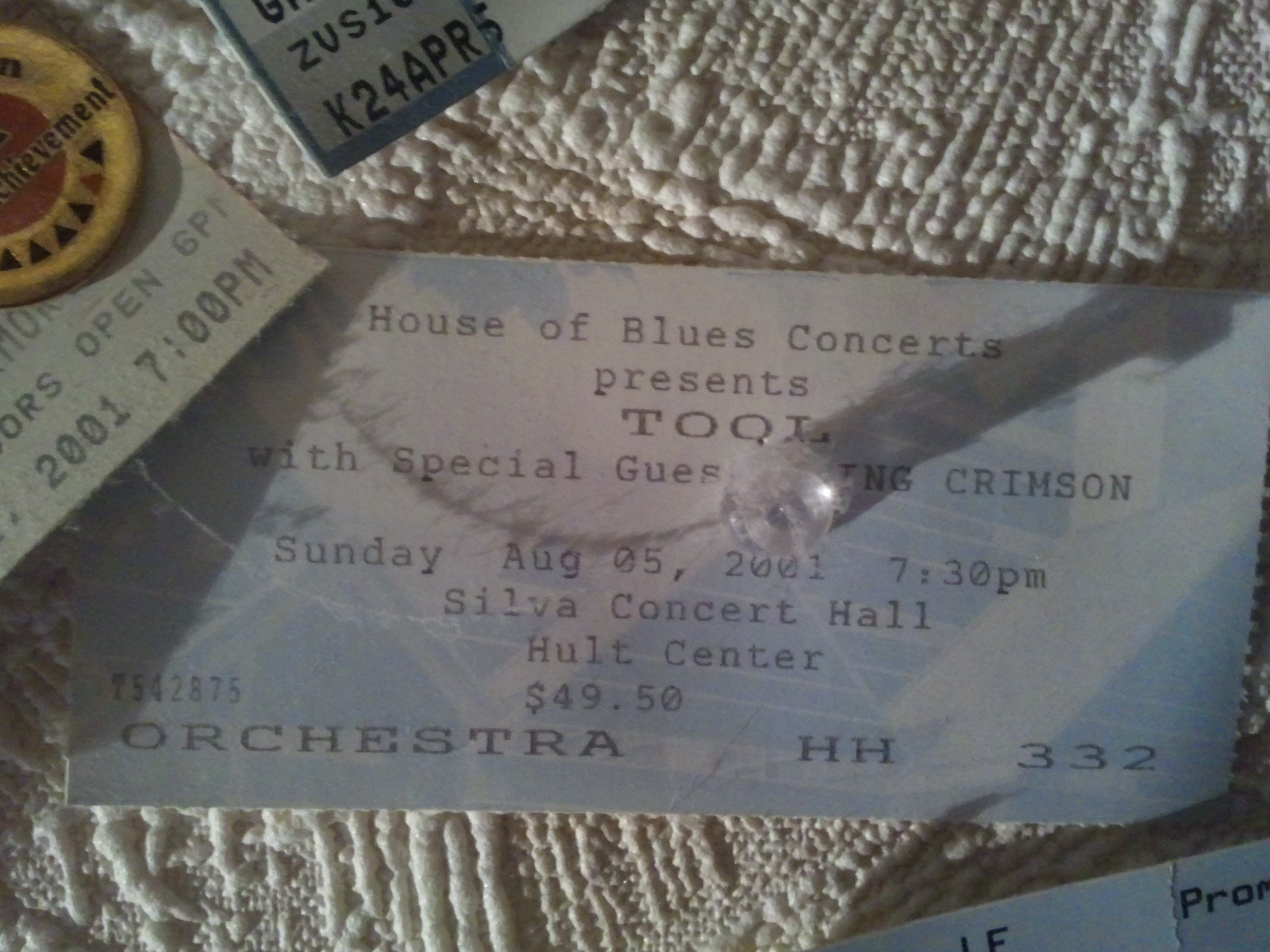
Adding to the general air of nostalgia that I personally felt was the fact that I had not seen Tool live since their show in Eugene back in 2001–a time before I even had a drivers license, which means that yes my mom indeed made the trip down and then had to figure out something to do on a midweek evening in Eugene on the fly. That show was a particularly mind-blowing experience, and not only because it was my first exposure to King Crimson (and that presented me with the opportunity to purchase this bad-ass t-shirt). I had arrived at the show an intrigued skeptic and left a full-fledged fan–at least by the standards of normal fans (spend any time in certain areas of the internet, and you are bound to find a Tool SuperFan, the kind that spends hours constructing YouTube videos breaking down the supposed allusions in Maynard’s lyrics and the symbology present in album artwork (and those are the more pleasant examples)).
We arrived in between the opener and the main event, partly due to an epic Blazers comeback (that fell short), and partly due to the ridiculous parking setup at the arena. After some shuffling around, we made our way down to the arena floor, where we found our seats–yes, this was a heavy metal show, but Tool was not going to allow us to get disorderly in any way. There were several people in official blue polo shirts that would make sure that chaos would be restrained, at least on the audience’s side, and please no photos or videos thank you. Having previously seen them at the Hult Center, which is home to the finer arts groups of Eugene, I remarked to my compatriots that it was not unexpected for us to have seats, and besides we were there to witness a full-fledged “experience”.
The one photograph I risked taking
Tool began the show in a fury, opening up with the rager “Hooker With A Penis” from Ænima, as the man in camo would have predicted if he was in attendance (I personally would not trust a person in a camo shirt in many situations, but the intricacies of the Tool setlist would mark one of the few exceptions). The band was all business, with minimal stage banter with the audience beyond a few brief words of thanks and a mention of the city’s name (though Maynard’s quip this time lacked the touch of the last appearance, where he acted as the party responsible for introducing the band to the city and vice-versa: “Tool, Eugene. Eugene, Tool.”). There was no encore, but a brief intermission midway through the set that was partnered with a countdown clock, giving you the exact knowledge of the targeted time to return with an overpriced beer. (Unfortunately, the intermission was not accompanied by their own song, “Intermission”.)
Each member was set in his traditional position: Adam and Justin up front and out to the sides, and Maynard and Danny in the back but centered. The setup of the band and their respective demeanor exemplified the interesting dynamic within the band. Maynard is a powerful frontman on record, with a charismatic and distinctive voice that stands out even in collaborations with other bands and lyrics that inspire careful study and feverish devotion in fans. However, Maynard’s stage placement de-emphasizes the position of the singer within the band, and puts him on an equal footing with everyone else. And Maynard’s performance and movements when singing also differ from the traditional frontman–he positions himself sideways to the audience, and always seems to act as if he is in combat with an unseen enemy, actions which often enhance his own lyrics.
Maynard is but one example of how Tool upends the traditional band structure within itself–the guitar generally does the work of keeping everyone grounded with the more basic rhythms, the bass provides a significant amount of the melody, and the drums are where most of the fireworks happen. I pondered whether or not to do a Feats of Strength post highlighting how this dynamic works, using the breakdown/solo of 46 & 2 as the example. If you listen closely, the guitar and bass go in and out of sync, alternating parts where they play in different time signatures. In those parts, the bass gets the melody while the guitar palm mutes the accent hits. And then Danny comes in with an amazing drum solo, syncopating his parts with amazing precision but also using his gigantic drum kit to actually create a melody that lines up with the guitar and bass perfectly. There’s a good reason that this song is a fan favorite, and we of course went nuts when the band played it–and believe me, all eyes in the audience were on Danny as he nailed that solo.
It’s that precision coupled with the complexity of the music which draws a lot of people in, but the moment that I remember most from the previous concert was the time where the crack was most apparent. It was one of the first performances of the Lateralus tour, and so the band was still getting a handle on how to play the songs live, including “Schism”. For the bridge/solo, they had Maynard pick up a guitar to handle the melody, but his inexperience was clear and he flubbed a couple of the notes. It was that little moment which made the band more human and less of a machine, and it actually made the rest of the set more impressive. There was no such moment this time, as Maynard played his part on a keyboard this time and was much more comfortable.
With no new songs to play, the question then was how much of the experience felt like a nostalgia act. The setlist hit some of the expected highlights, but the band also often did a great job in disguising a lot of what was coming up with interesting new intros and interstitial music. And combined with an even more elaborate video setup, with huge television screens playing some of their trademark bizarre art (at one point during “Lateralus”, the image could only be describe as a view from the back of a spiraling train of guys providing manual pleasure to each other), it made for a pretty memorable experience. At this point though, the time has passed for me to be a zealous follower, but I can still say that I’m intrigued by what is coming up next.
Metal is a genre that strangely enough, considering its dynamics and intensity, can lend itself to stagnancy and inertia. The problem is that sometimes no matter how theatrical and ferocious (or if you’re so inclined, fast and furious), it ends up just an echo of the same tricks that you’ve heard numerous times before. It’s the kind of feeling you might be familiar with after watching generic summer blockbusters year after year. The mere act of showing an explosion on a screen is not enough to sustain even passing interest for some people (for fuck’s sake, Michael Bay–how could you make giant robots fighting each other so boring?!).
So when a band uses Metal not as an endpoint, but as a pivot into a new direction, I’ll take notice. Guilty of Everything, the debut album of Nothing, does exactly that. Nothing combines the power and heaviness of metal with the vocals and lush textures of shoegaze. Yes, you read that correctly. True, other bands have been able to mix loud and soft dynamics, intertwining gorgeous vocals with thundering guitars and crashing drums before Nothing, but not necessarily to this extent. The Deftones have made a career of this, and thankfully have seemed to have influenced a new generation of bands.
Deafheaven received a lot of deserved acclaim last year by mixing black metal with elements of shoegaze and post-rock, and Nothing follows a similar approach, though perhaps working in reverse. The vocals are incomprehensible on both albums, but while Deafheaven goes in the loud direction with shrieks and howls, Nothing relies on the traditional shoegaze style of breathy vocals buried within the haze of guitars. The tempos and drumbeats on Guilty of Everything also are more in line with traditional shoegaze and rock, though I advise against making any assumptions based purely on that description. In one of the best moments on the album, Nothing recalls the epic breakdown from the Sigur Rós song “Popplagið”, as the drums go nuts underneath a gorgeous wall of guitars in the last two minutes of “B&E”.
The mixture between metal and shoegaze doesn’t always work, but when it does, like in “Somersault” and the title track, Nothing produces some of the most gorgeous music you’ll hear this year. The heaviness of the guitars combined with the whispery vocals that despite the inherent tension have an almost intoxicating effect, and it’s amazing that instead of working against each other that they blend so seamlessly. And while you’re enjoying the music, it’s worth reading up on the unusual story of the band.




 Rust Is Just Right