Recs

Built to Spill, Live at the Wonder Ballroom

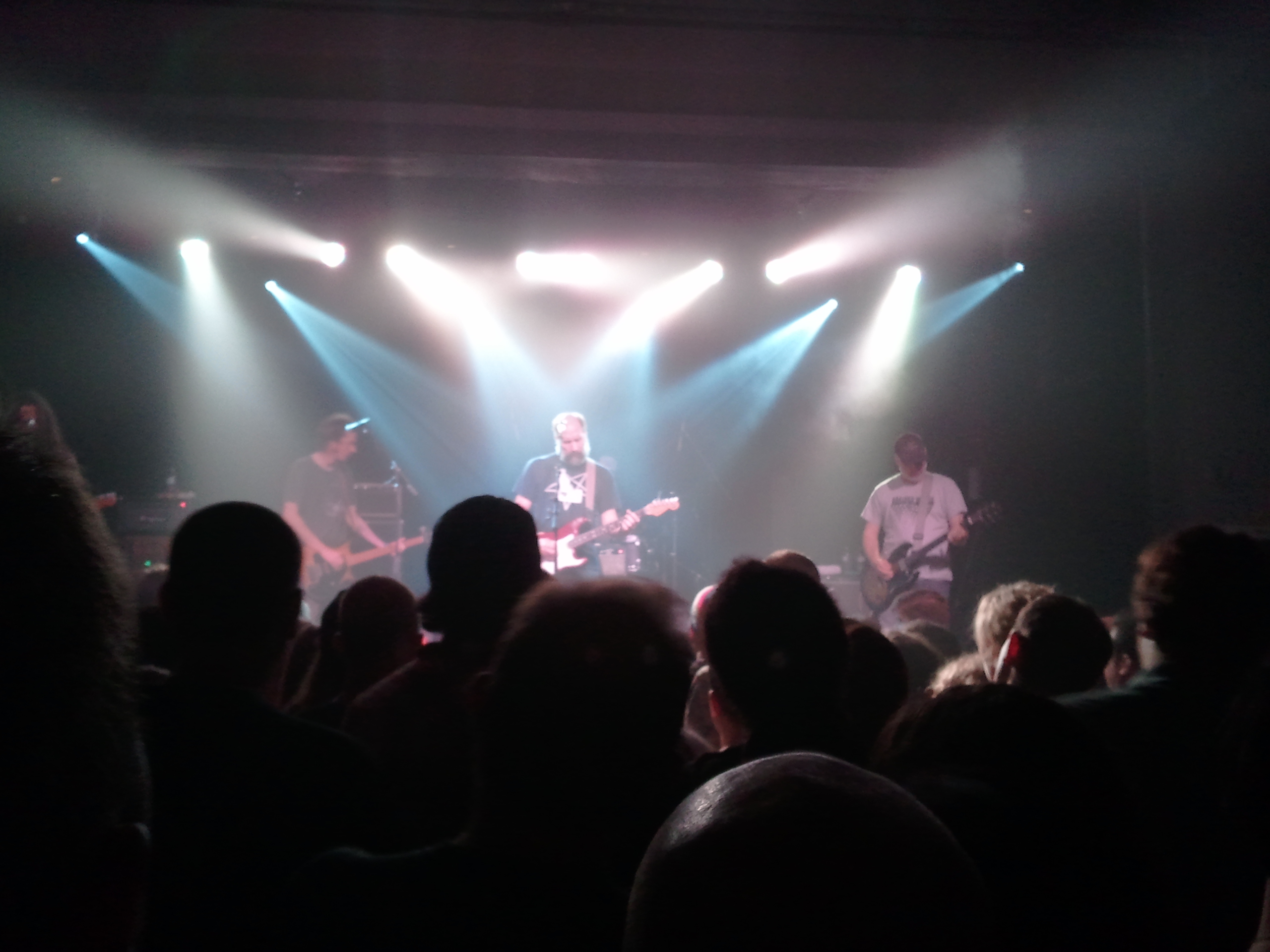
Built to Spill returned to their home-away-from-home last week, playing a two-night stand at the Wonder Ballroom in Portland.  We caught the band on the second night as they were finishing up their tour in support of their most recent album, the excellent Untethered Moon.  If the band felt weary after months on the road, they certainly did not show it on Thursday night, as the group played an energetic set that covered just about every part of their vast catalog, including a couple of surprise additions as well.

Outside the Wonder, with that late Oregon summer sunset.

Outside the Wonder, with that late Oregon summer sunset.

The show got off to a raucous start with Keep It Like A Secret opener “The Plan”, with the crowd immediately going nuts as soon as the opening chords were strummed.  We were lucky enough to have a great view of the full band, and were able to enjoy seeing guitarist Jim Roth’s dissonant slide-work create the song’s memorable solo.  From then on the band mixed in new material with old classics, and the crowd greeted the recent stuff with nearly the same approval as their favorites; singles “Living Zoo” and “Never Be The Same” featured some of the group’s catchiest hooks, and “So” has the spirit of many of the band’s brilliant guitar work-outs, so they were natural fits into the group’s standard set.

The band were able to seamlessly shift between different moods and tempos, such as when the group followed the mid-tempo ballad “Liar” with the raging “Pat”.  It would not be a Built to Spill show without a couple of covers thrown into the mix, and the group obliged by including “Virginia Reel Around the Fountain” (a song that I keep forgetting is a cover because of its many appearances in a BTS show, from a side project that Doug Martsch did with Calvin Johnson of Beat Happening called The Halo Benders) and part of “Orion”, which took a few minutes for me to place since they started it off at about the halfway point.  The band finished off the night with a rousing encore, first with the epic “Kicked It In The Sun” before rounding it out with early year favorites “Big Dipper” and “Stab”.

Doug Martsch and co. engaging in some guitar heroics

Doug Martsch and co. engaging in some guitar heroics

Opener Honey Bucket did a good enough job keeping the early crowd entertained with their take on garage rock, and Genders was a solid second act.  Their first song reminded me of post-punk revival in the vein of Interpol, especially with the way their bassist was making full use of the neck for counter-melodies, but the highlight for most of the crowd was their faithful cover of Mazzy Star’s classic “Fade Into You” (even if the guitarist decided that the song’s memorable leads could be mimicked without the use of a slide).  It was an intriguing counterbalance to the headlining act, but it is hard to overshadow Built to Spill when they are on top of their game.  The sound mix overall was excellent, with all three guitar parts balanced perfectly, and the group actually integrated a fairly effective light show into their set.  Overall, it was hard to find a better way to spend twenty dollars on a weeknight.

Review: Vaadat Charigim – Sinking As A Stone

We are slowly beginning to see a revival of the shoegaze genre, though to this point it was only members of the original movement that were bringing back the swirling guitars and lush soundscapes.  Legendary pioneers My Bloody Valentine began the charge with their release of m b v, the long-awaited follow-up to the classic Loveless, followed by the triumphant return of Slowdive, and continuing this year with a brand new album from Swervedriver and a newly-reunited Ride.  There have been several acts that have incorporated elements of shoegaze into their own sound since the genre’s heyday, but few bands fully embraced the style.  We had to look halfway around the world, but it is safe to say we finally found such a group with Israel’s Vaadat Charigim.

Unlike Nothing, which incorporated elements of metal into their version of shoegaze, Vaadat Charigim’s sound is a more direct descendant of the genre’s original practitioners.  Vaadat Charigim’s closest counterpart is Slowdive, as they emphasize melody and ethereal guitars on Sinking as a Stone, though propulsive drums reminiscent of Ride poke through the mix at key moments, like on the single “Ein Li Makom”.  Like other shoegaze albums, it is nearly impossible to listen to Sinking as a Stone at too high a volume, allowing for a more pleasurable experience as one searches through the haze and picks various details from the wall of sound; Sinking also benefits from modern recording techniques and mastering, so it is not as much of a chore to sift through the music as it was back in the 90’s.

Vaadat Charigim sings exclusively in their native language of Hebrew, so lyrical content will not be a primary concern for most American listeners.  Instead, most will be focused on the lush music marked by dreamy textures, with the vocals fitting in perfectly as an additional instrument to the mix.  The fact that the group can create such intricate and dense soundscapes with only three people is astounding.  For the most part, the band keeps the ambiance relatively light, allowing the listener to get lost in the music, but closer “Hashiamum Shokea” shows what the band can do when it adds in a bit of distortion.

It may be a difficult task to actually get your hands on this album (we had to wait several weeks for Amazon to ship it, and they had a limited supply to begin with), but it is easily worth the effort.  There will be few experiences as pleasurable as spending around forty-five minutes getting lost in Vaddat Charigim’s elaborately cultivated soundscapes.

Project Pabst 2015 Day 2 Recap

The first day of Project Pabst had a better lineup, but the second day offered just enough that made spending a second day in the heat a worthwhile proposition.  At least it never got as hot as it did the previous day, though there was little to no escape from the sun, aside from the odd bit of shade and the PBRcade.  Still, water refills were once again free, even if that did not make up for the fact the organizers made no adjustments overnight.

Alvvays delivered the most season-specific music

Alvvays delivered the most season-appropriate music

If there is one thing you can count on when you travel in Oregon, it is that random traffic jams will occur without any reason.  A massive slowdown on I-5 added another hour to our travel time, forcing us to miss the majority of Alvvays’s set, an unfortunate result considering we were really excited to see how one of our favorite new artists from 2014 performed live.  However, we can authoritatively state that, from what little we heard, Alvvays’s bouncy, shimmery pop-rock was a perfect soundtrack to a sunny outdoor festival.  Though attendance was lagging at this point in the day, at least there were a devoted few that sang along to closer “Archie, Marry Me”.

Aimee Man and Ted Leo had easily the best stage banter of the festival

Aimee Man and Ted Leo had easily the best stage banter of the festival

Though I have been a fan of Ted Leo for years, I had yet to give his collaboration with Aimee Mann a shot.  However, The Both won me over with their ripping set, with Aimee and Ted displaying a tight chemistry that was only matched by El-P and Killer Mike.  The music was an intriguing mix of the two styles, though I tended to prefer the moments when Ted would kick it up a notch with flashy-but-efficient guitar solos.  The stage banter between the two was a definite highlight, including a memorable bit where Aimee poked fun at Ted’s love of all things Tolkien, with Ted responding by totally owning it and singing an impromptu version of “Frodo of the Nine Fingers”.  Also, for the record, Ted can change a broken guitar string faster than any performer that I have ever seen.

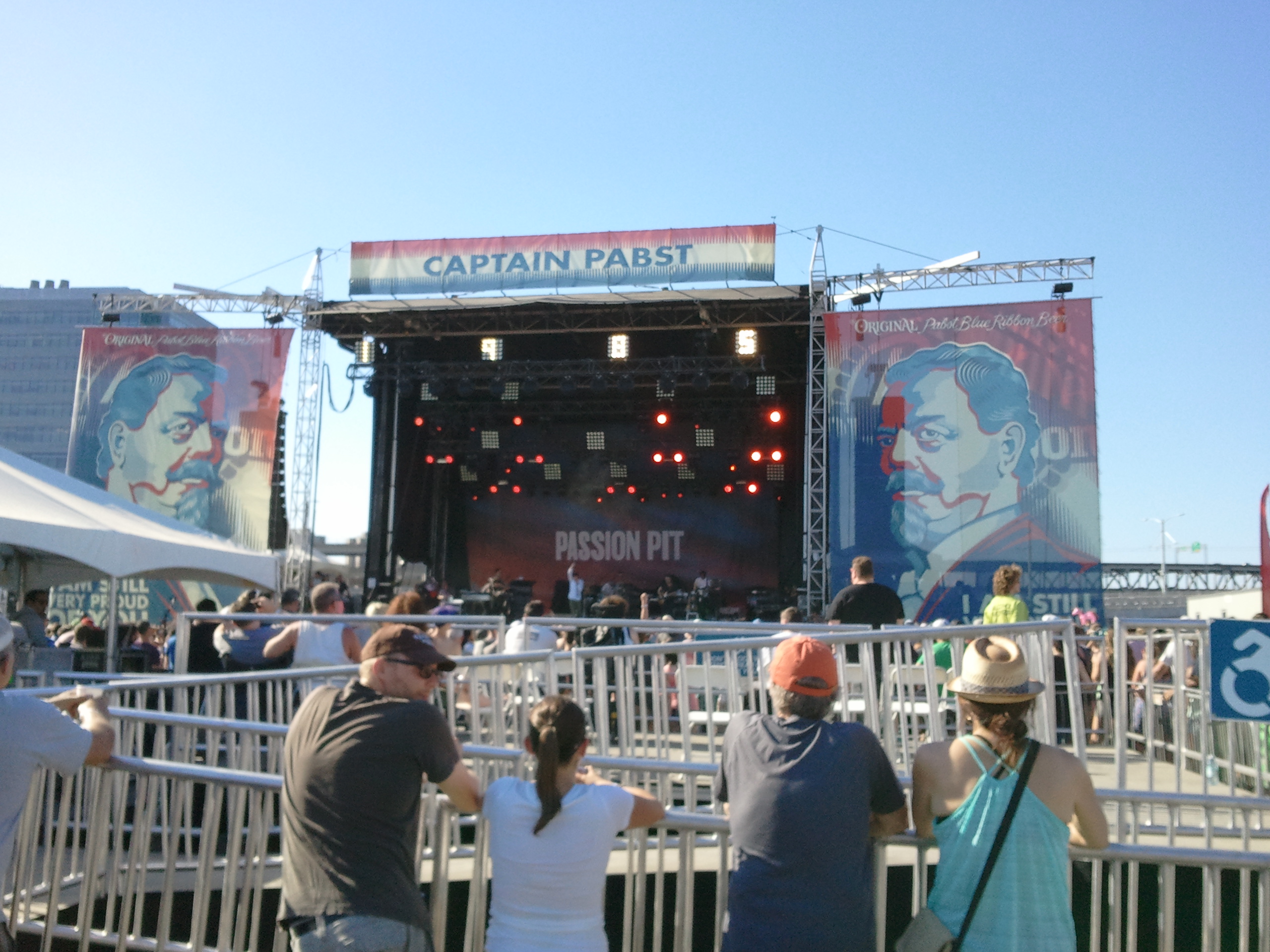
This was the act the crowd appreciated the most

This was the act the crowd appreciated the most

Passion Pit generated the best crowd response of the day, but my reaction to the group has always been the embodiment of the shrug emoji.

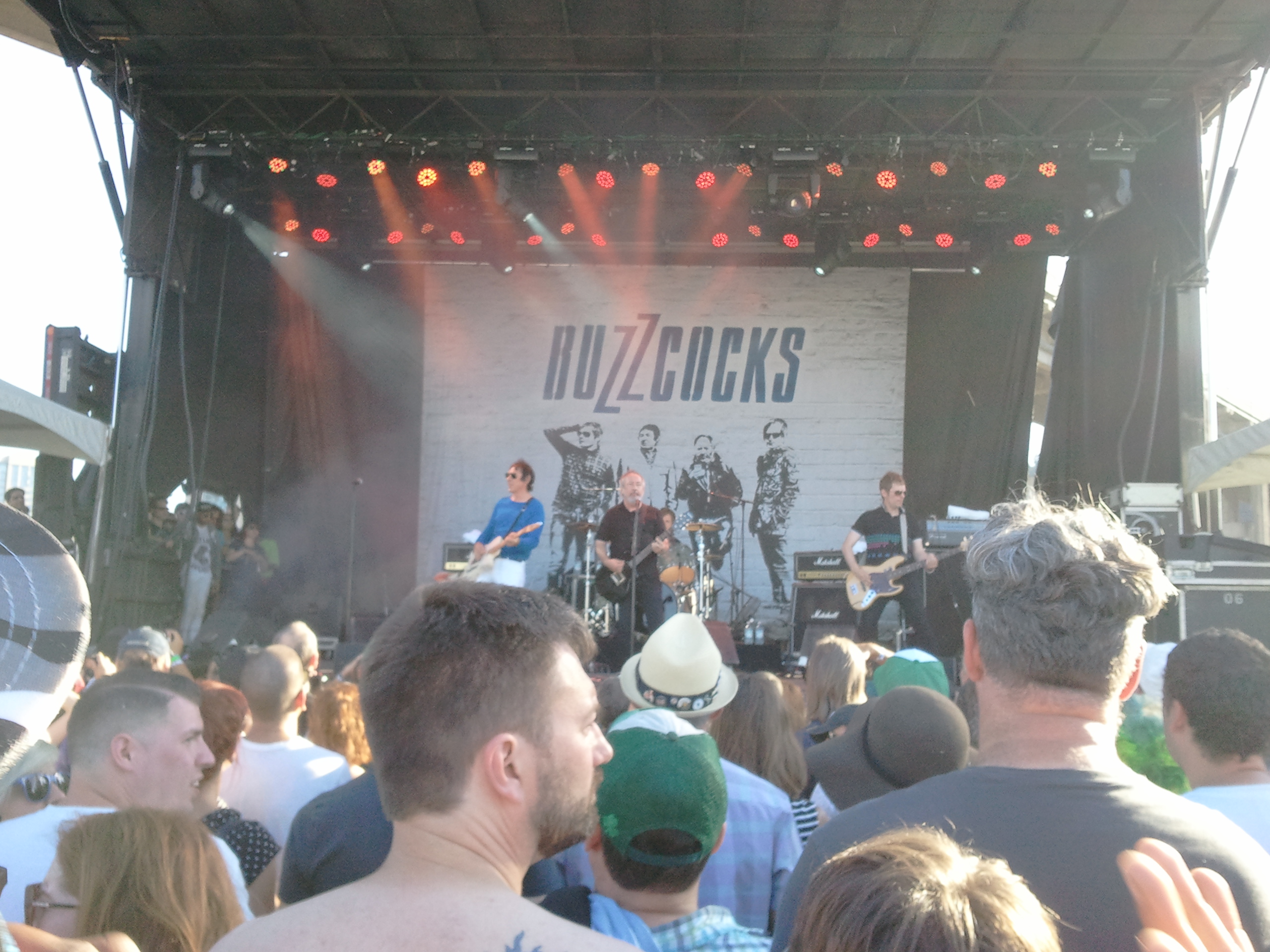
Buzzcocks still going steady

Buzzcocks still going steady

Since I spent several years listening to Singles Going Steady, a truly essential compilation for anyone who has ever dabbled in punk rock, the Buzzcocks were the “living legends” reunion I was looking forward to seeing the most at Project Pabst.  Judging by the packed backstage area, I was certainly not alone in this sentiment, as one could easily see other performers like Ted Leo singing along to the words of some of their classic hits like “Why Can’t I Touch It”, “What Do I Get?”,  and “Noise Annoys”.  The group tore through their discography at breakneck speed, with guitarist Steve Diggle constantly asking the sound mixer to crank up the volume.  Just hearing “Ever Fallen In Love” and “Orgasm Addict” live made Day 2 worthwhile in and of itself.

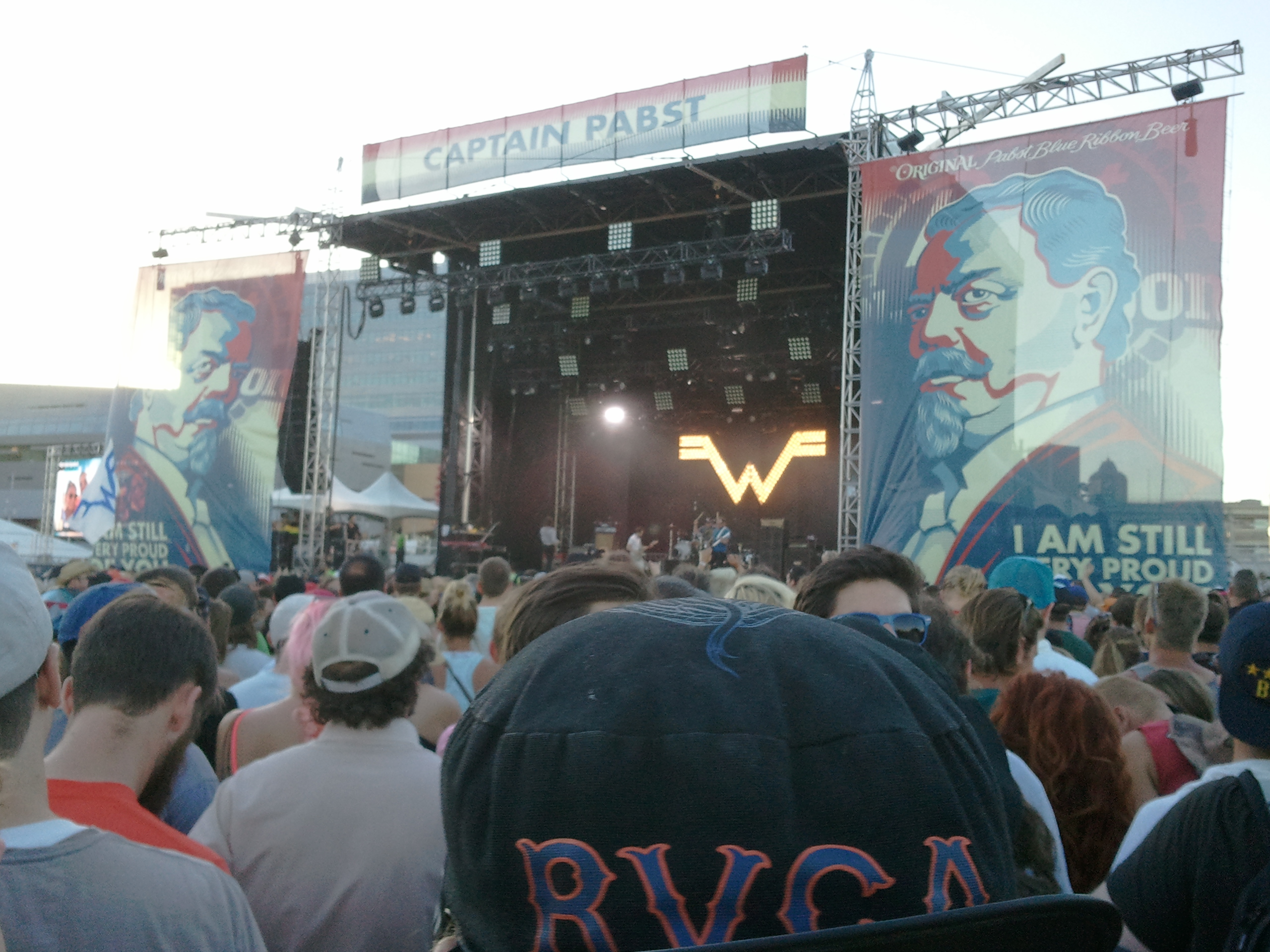
Weezer finished off Project Pabst with some flair.

Weezer finished off Project Pabst with some flair.

There are few bands with whom I have more of a love/hate relationship than Weezer, and considering my age it should be easy to spot exactly where that dividing line occurs in the band’s catalog.  I think the surest example of how people my age should not be lumped into the catch-all “millenial” generation is that we would never cheer as loudly for “Back to the Shack” as we would for “My Name Is Jonas” or “The Good Life”.  I ended up sticking around longer than I anticipated since the group did a good job of mixing in some of their genuinely great songs with their later hits that played well to certain segments of the crowd, and I can certainly admired the well-oiled machine that Weezer the performance act has become.

Project Pabst was a solid success this go-around, but hopefully they will learn from a few of their mistakes from this edition as they set up plans for next year.  Hopefully they can create a lineup as exciting and varied as the first two editions.

Random Notes

Number of free water refills: 2

Number of beards longer than mine: 1

Number of comments on my shirt (Dinosaur Jr. Green Mind cover): 2, including a “Best Shit EVER!”

Project Pabst 2015 Day 1 Recap

Last year’s Project Pabst was an unqualified success, so it made sense for the organizers to make the festival an annual event instead of a one-off celebration.  Even though it could be argued that this year’s lineup was a step below last year’s edition, Project Pabst offered easily the best selection from a burgeoning Portland festival scene.  And so once again, Rust Is Just Right made the trek up north to enjoy a weekend’s worth of music in a gravel pit.
Into the clown's mouth...

Into the clown’s mouth…

As great as many of the performances were throughout the weekend, the defining characteristic of Project Pabst was how goddamn hot the entire event was.  I feel ashamed to be complaining about the heat since I spent my childhood playing pickup basketball during the unbearable Louisiana summer months, but living in Oregon has unfortunately made me soft.  Temperatures hit triple digits on the first day, and the primary concern was locating shade wherever it was available, with making sure the sunscreen was still effective a close second.  Actually, the heat was not the problem–it was the sun beating down mercilessly upon all of our heads that contributed to the crowd’s relative misery more than anything.  This was in stark contrast to last year’s edition, which took place at the end of September, and it seems as if the organizers made no effort to alter the accommodations to prepare for the drastic change in weather.
Against Me! declares that "Gender Is Over"

Against Me! declares that “Gender Is Over”

The first set that we caught came from punk rockers Against Me! who delivered a fiery set that was better than their early-afternoon slot would indicate.  Variety is not Against Me!’s strong suit, and as a result their music tends to run a bit on the formulaic side especially when you focus on the drums and bass parts.  However, the band’s energy easily won me over, which is more than I could say for the heat-stricken crowd–I was surprised to see the relatively listless reaction to the band’s breakthrough hit “Thrash Unreal”.
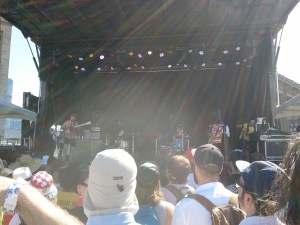
Why have one drummer when you can have two?

Why have one drummer when you can have two?

Thee Oh Sees kept the punk spirit rolling with their set, delivering their garage-rock at a breakneck speed and with an extra helping of pure cacophony.  The band would have won a trophy for “Most Treble” if any such award was given, which is somewhat ironic considering the number of intriguing bass lines that were sprinkled throughout their set.  For the most part, the group rarely exploited the fact that they had two drummers, choosing to have the two play duplicate parts instead of contrasting or complementary parts.  Their set quickly began to wear thin, with each short burst of fury practically indistinguishable from each other; a full hour was too much, a fact that the band acknowledged when they expressed surprise that they still had twenty-five minutes left in their set.   At this point, Thee Oh Sees became the soundtrack to a food break, where I opted once again for the mediocre Muffaletta sandwich.
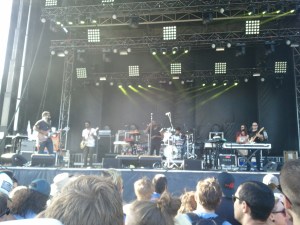
TV on the Radio attempt to beat the heat

TV on the Radio attempt to beat the heat

TV on the Radio put on one of the best shows of last year, so they were one of the bands I was looking forward to seeing the most this weekend.  Like many of the other acts, however, they were not prepared for the relentless heat, as seen by the fact that most of the band was dressed entirely in black.  The band performed with the same intensity and passion as they did last winter, though on occasion the sound mix was not as up to the quality of that previous show; this was most obvious during “Could You”, when the song was dangerously close to falling apart for most of its running time.  The thrilling finale of “Staring at the Sun” served as a microcosm of the set, as initial enthusiasm soon fizzled and the crowd began anticipating a move to the second stage.   The set did nothing to diminish TVOTR in my eyes, but due to the conditions outside of their control it is unlikely they earned many new fans with this performance.
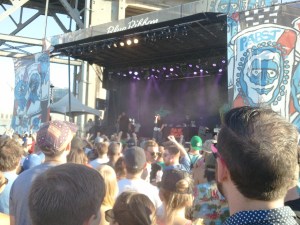
Run the Jewels owned the weekend.

Run the Jewels owned the weekend.

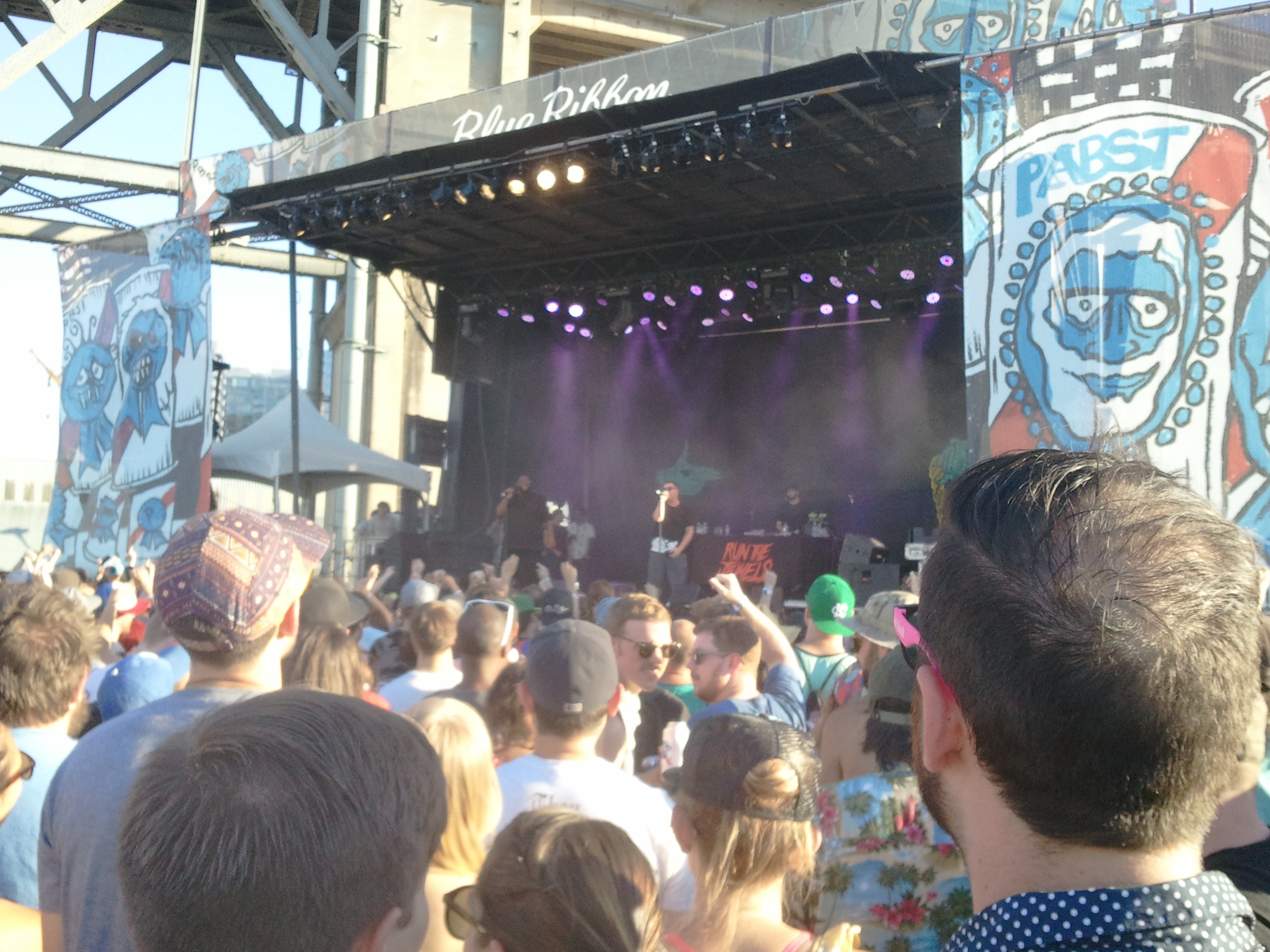
The unquestioned highlight of the whole weekend for me was the chance to finally see Run the Jewels live.  Killer Mike and El-P totally lived up to expectations, as they proved to be one of the most dynamic acts touring today.  In contrast with a lot of hip-hop sets, the duo was able to keep spirits high as they seemingly fed off each other’s energy, with Trackstar the DJ doing a fantastic job manning the 1 and 2.  The crowd ate it all up, with a majority ready to throw up the fist-and-gun hand gestures at a moment’s notice.  Two audience members who had a blast during the set were Del the Funky Homosapien and A-Plus, a fact that I realized when I saw them perform later that night.

Blondie bringing out the big guns...a keytar

Blondie bringing out the big guns…a keytar

Blondie was the headlining nostalgia act this year, taking over the spot held previously by Tears for Fears.  I was surprised at the lack of buzz that greeted these legends, especially in comparison to last year’s feverish anticipation for Tears for Fears, but it is not as if I was compensating for the lack of enthusiasm myself.  It was a strange and ragged set that managed to not only to display the variety of hits the band has had over the years but to include a random cover of “(You Gotta) Fight For Your Right (To Party!)” (mirroring last year’s TFF set).  Of all things, I felt that a random keytar solo during “Call Me” was the best summary of the performance.

This would have been a nice finale to the evening...

This would have been a nice finale to the evening…

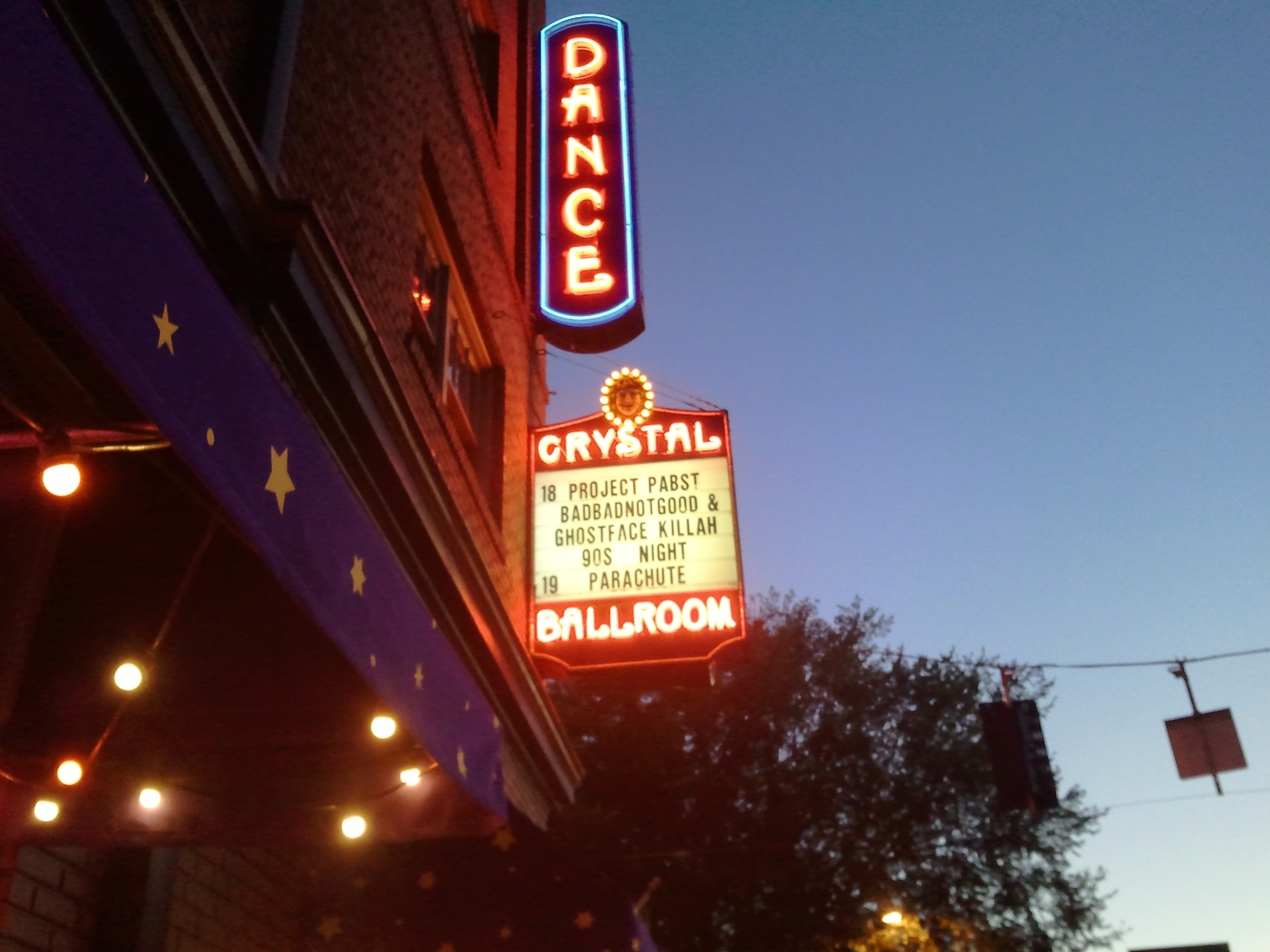
Saturday night was all set to have a thrilling conclusion with Ghostface Killah joining up with BADBADNOTGOOD to perform from their collaboration Sour Soul, except for the fact that Ghostface never showed up.  Stuff like this happens, but the way that the organizers of the show handled the situation was inexcusable.  There may not have been a hotter spot in Portland than the Crystal Ballroom that night, and the fact that the crowd was left in the dark for an hour before BADBADNOTGOOD had to reveal the bad news themselves was inexcusable; at least give the audience a chance to decide to bail or not, and inform them why they are suffering in the heat for so long.  BADBADNOTGOOD tried to make amends and delivered a technically-proficient and spirited jazz-fusion set, but it was impossible to overcome the letdown that the news of Ghostface’s absence had caused.

Random Notes

Number of free water refills: 4

Number of beards longer than mine: 3, including Kyp Malone of TV on the Radio

Number of comments on my shirt (Neutral Milk Hotel Gramophone/Aeroplane): 0

Review: Joanna Gruesome – Peanut Butter

Joanna Gruesome may have a ridiculous name (a moniker that serves as a horror movie parody of harpist Joanna Newsom does not exactly scream “lasting appeal”), but the band has delivered one of the most thrilling albums of the summer with their latest album, Peanut Butter.  It is a rollicking affair that effortlessly mixes effervescent pop and dissonant punk, all with a super-charged energy that will keep your head constantly bopping along over the course of its brisk twenty-one minute runtime.  Peanut Butter may not be the most important album you will listen to this summer, but its infectious nature might make it the one you listen to the most.

Much like they did on their debut, Weird Sister, Joanna Gruesome is able to seamlessly shift between the beautiful and the grotesque without coming across like a schizophrenic mess, alternating between melodies that are sugar sweet with moments of biting and grating dissonance.  The disparate styles actually work brilliantly in tandem, with the pop sensibilities and discordant punk attacks each enhancing the effect of the other, an intriguing marriage that brings to mind previous examples of this approach like British Sea Power’s The Decline of British Sea Power.  The brief moments of dissonance may be startling to the average listener at first and seem like digressions from the general flow of the songs, but over time these terse explosions reveal themselves to be not only a welcome change of pace but also brilliantly deployed punctuation of certain ideas.

Though few individual moments or songs leave any sort of lasting impression, it can be argued that the disposable nature of the music is a feature and not a bug.  There is no need for the listener to remember any particular melody or lyric when everything comes so fast and furious; what is more important is the general effect on the audience, which is “let’s play this record again and again.”

Review: Earl Sweatshirt – I Don’t Like Shit, I Don’t Go Outside

Despite the huge buzz and heavy praise that has surrounded him through his brief career so far, it has taken me some time to appreciate the artistry of Earl Sweatshirt, outside of his appearance providing the hook for Frank Ocean’s “Super Rich Kids”.  However, when the news came that he was releasing an album entitled I Don’t Like Shit, I Don’t Go Outside, I knew I would have to be tracking down a copy; the last time the mere mention of an album title had me scrambling like this, Atmosphere had just released When Life Gives You Lemons, You Paint That Shit Gold, and that became one of my favorite hip-hop albums of that year.  Much like Atmosphere’s record, I Don’t Like Shit is a deeply introspective and reflective album, though it is a much darker musical journey that is distinguished by its grim and spare production.

Earl’s often extremely laid-back flow can make a codeine user appear as hopped-up as a meth addict, but on many tracks the deliberateness of his delivery helps emphasize his lyrics.  The album begins on a bright and playful note with the intro “Huey”, but this mood is quickly replaced by a more ominous tone that haunts the rest of the record.  Earl creates drum tracks that are heavily processed to emphasize unnatural tones, and the eerie synths and other industrial touches recall early Wu-Tang solo records.

Considering the often bleak subject matter, Earl wisely restricts the running time on I Don’t Like Shit, wrapping up the album in a concise fashion in slightly less than half an hour.  Lyrics deal with death, anxiety, depression, and the emptiness of fame in a frank and honest manner, but the album avoids merely dwelling in misery.  Though it is dark, I Don’t Like Shit is never oppressive, which makes it easier to digest over repeated listens.

Earl’s ability to maintain a strict standard in his editing is something that his fellow Odd Future mate, Tyler, the Creator, needs to learn.  His latest, Cherry Bomb, starts off promising enough, with its nods to N.E.R.D.’s catalog that are fun and engaging, but the album slides off the rails by the end.  It is certainly an improvement over the practically unlistenable Wolf, but Tyler still has trouble harnessing some of the potential seen on Goblin.  Tyler has shown some great talent with his production over the years, and I often prefer his particular delivery when he raps, but he continually falls into the same traps over and over again.  Experimentation can be exciting, but not every idea needs to be heard, and shock tactics result in diminishing returns.

Review: Blur – The Magic Whip

Over on this side of the Atlantic, news of a long-awaited Blur reunion album has been greeted with a collective shrug.  It is a reaction that is indicative of the band’s general reception in the US, but not befitting of the group’s sustained greatness over the course of their career.  Most American listeners remember Blur more-or-less as a one-hit wonder (“oh yeah, those guys that did the ‘Woo-hoo!’ song!“), which is a shame because that particular attempt to taking the piss out of grunge is hardly indicative of the band’s diverse body of work.

Blur’s albums have been eclectic and sprawling affairs, with the band shifting effortlessly between different genres over the course of the record, and The Magic Whip follows that template as well.  Unlike the band’s previous work though, there are no big singles to be found on the new record; it is unlikely that a crowd favorite like “Tender” or “Beetlebum” or “To the End” will emerge from this set of songs.  Fans should not be discouraged however–though Blur does not reach the peaks that they have in the past, overall this is perhaps the band’s strongest group of songs since their self-titled release, and it improves with every listen.

It is rather remarkable how little The Magic Whip resembles the typical comeback album.  The effort compares favorably to the recent Dinosaur Jr. reunion, as Blur sounds like they never broke up in the first place; listening to The Magic Whip in conjunction with the rest of the band’s discography, the novice listener would have no idea that there was a sixteen-year gap between the new album and the previous full-lineup incarnation.  There are no attempts to cash in on any modern trends, nor are there any painful attempts to recapture the glory of their youth; perhaps this is the payoff for all that restlessness and genre-shifting from their previous albums earlier in their career.  Blur never really had a typical sound, so they are free to experiment however they would like.

Contrary to what one may expect, there is only a moderate influence that can be detected from Damon Albarn’s myriad side-projects since the band’s last album; there is a bit of dub that recalls The Good, The Bad & The Queen, a bit of the melancholy that marked his recent solo album Everyday Robots, but little that is reminiscent of Gorillaz.  Instead, it is a much more cohesive affair than what would have been predicted, especially considering the background behind the recording of the album (it was put together during the downtime of a cancelled music festival over the course of a few short days).  In general, The Magic Whip is a laid-back affair, and some of the album’s best moments are when the band takes it down a notch and stretches out a bit, such as in the drifting “Mirrorball” or the appropriately-named “I Thought I Was A Spaceman”.  Of course, Blur is never content to just stick around mining the same groove, so there are a fair number of uptempo numbers, most notably the cheery “Ong Ong”.  It is an effervescent song that is placed perfectly near the end of the album, serving as an excellent capstone to the record, and will have you singing along with its refrain of “I wanna be with you” long after the whole thing is over.

Review: Built to Spill – Untethered Moon

For a number of years, Built to Spill has been afflicted with the same curse as Spoon: consistent quality.  Like Spoon, who have released a string of exceptional albums since 2001’s Girls Can Tell, over the last decade-and-a-half Built to Spill have steadily produced a series of very good records since the one-two punch of the classics Perfect From Now On and Keep It Like a Secret made them heroes of the indie rock scene.  Both groups have a dedicated fanbase that has passionately welcomed each new release, but to some extent critics have begun to take the quality of the work they produce for granted.  At this point, excellence is to be expected.

Considering the circumstances, it is remarkable not only how comfortable and laid-back Untethered Moon is, but how neatly it fits within the band’s catalog.  In the six years since the release of There Is No Enemy, not only did Doug Martsch scrap an entire album, but longtime members Brett Nelson (bass) and Scott Plouf (drums) left the band.  Though it took some time for replacements Jason Albertini and Steve Gere to get acclimated to the group in their live performances, the transition is seamless on the album.  It is still true that the most important components of a Built to Spill song are Doug Martsch’s guitar parts followed by his trademark vocals, but the new rhythm section has seemingly injected some verve into the songs and rejuvenated Martsch to an extent, even if relatively few of their individual contributions stand out (the drum fills on opener “All Our Songs” and the bass melodies on “Never Be the Same” serving as notable exceptions).

What is most surprising about Untethered Moon is how restrained the guitar-playing is for the majority of the album.  Doug Martsch established himself as one of the Guitar Gods of the alternative scene because of his mastery of each fundamental part of the instrument; not only could Martsch rip out a brilliant and searing lead or create a catchy and memorable riff, but he also was able to precisely construct multiple-part epics that not only perfectly integrated those leads and riffs but managed to surprise listeners with their originality.  Consider how easily classics like “Carry the Zero” or “Kicked It In the Sun” shift between seemingly disparate sections that are nonetheless tied together by Martsch’s inventive songwriting, and how seamlessly Martsch blended multiple interweaving guitar parts.  There are only a few scattered moments that recall Martsch’s previous guitar heroics; instead it is a few select riffs or the occasional quick melody that leaves an impression on the listener.  With its tight, concise songwriting and the relative rawness of its fidelity, the closest analogue in the band’s discography is There’s Nothing Wrong With Love from just over two decades ago.  It is not as if the band has come full-circle though; they are just digging deeper into their repertoire for inspiration.

Untethered Moon lacks a memorable single like the ferocious live staple “Goin’ Against Your Mind” or a cathartic hidden gem like “Things Fall Apart” that are definite standouts, but instead has several strong tracks that will compete to be designated as the listener’s favorite.  When the band hits the road in support of the album, fans should look forward to hearing the band incorporate the new material into their live sets without a hitch, though the particular songs chosen may be a surprise.  Untethered Moon proves that Built to Spill is a well-oiled machine that keeps chugging along, replacing and assimilating new components without any problems whatsoever, and able to continue to produce quality albums well into their career.

Review: Alabama Shakes – Sound & Color

April has been an extremely busy month for new releases, with highly-anticipated albums by several noteworthy artists hitting the stores each week.  Several of these records have lived up to the hype, but the latest album from Alabama Shakes surpassed my wildest expectations to top them all.  Sound & Color sees the band expanding beyond their well-worn retro style, as they explore a wide variety of genres and captivate the listener with their passion and precision.

There is a reason why Alabama Shakes experienced massive success with the release of “Hold On”: the brilliant single was the perfect showcase for Brittany Howard’s powerhouse voice, and it was effectively supported by the band’s ability to reproduce old audience-pleasing blues-rock staples perfectly.  There is also a reason why despite the fact Boys & Girls was certified Gold off the strength of “Hold On”, the rest of the album failed to leave much of a mark.  While it was a perfectly pleasant record, Boys & Girls ended up being a somewhat forgettable album; each song failed to distinguish itself from one another and without a hook as memorable found on “Hold On”, everything eventually bled together.

The same cannot be said for Sound & Color, as Alabama Shakes digs deep into their record collection and delivers songs that filter in 70’s soul, funk, and even garage-rock influences into their blues-based style.*  The album never comes off as a series of dalliances with experimentalism though, and Alabama Shakes never sound like mere tourists,  since the band is able to find a common thread through each of these genres and infuses each song with their own distinct personality.  Each song allows the band to demonstrate their considerable musical chops, but the tracks are so well-composed that none of them sound like a technical exercise; Every guitar riff, organ flourish, and drum fill fit the song perfectly.  To top it off, not only is Howard’s dynamic voice as commanding as ever, she also displays a deft sense of control in fitting it within the style of each song.

Sound & Color fades a bit down the stretch, but the impact of the first three-quarters of the album more than makes up for it.  It is heartening to see Alabama Shakes improve upon the success of their debut by exploring different creative urges, and in the process they created a record that easily outshines their previous work.

*The easiest comparison I can make is to the new musical directions that the Black Keys took once they started collaborating with Danger Mouse, especially on Brothers and Turn Blue.  Though since this is only the second album from Alabama Shakes, the shift will probably be less jarring to the band’s fans.

Review: Speedy Ortiz – Foil Deer

After breaking through with their impressive debut, expectations were high for Speedy Ortiz’s follow-up to Major Arcana.  Fans of the group’s version of knotty, guitar-based mid-90’s indie rock will be glad to hear that Foil Deer fits perfectly alongside their previous work.  Though at times it is difficult to determine how it distinguishes itself from its predecessors, Foil Deer is still a showcase for the band’s greatest strengths: intricate guitar noodles delivered with a satisfying crunch, punctuated by powerful percussive outbursts.

The easiest musical comparison that critics rely on to describe Speedy Ortiz’s style is Pavement, but that is somewhat misleading, since Pavement’s catalog was more diverse than what most people remember; there is nothing on Foil Deer that recalls “Conduit For Sale” or “Range Life”, for example.  Instead, Speedy Ortiz for the most part is content to explore only one part of Pavement’s aesthetic (though not the same aspect in which Parquet Courts makes their living, for the record), namely the seemingly-aimless guitar melodies, prevalence of dissonant chords, and off-kilter rhythm section.  Vocally, Pavement and Speedy Ortiz share a similar approach, but with one key difference: though the two groups will never be heralded for the technical skills of their singers, Sadie Dupuis offers a more direct approach with her singing, unlike Stephen Malkmus, who more often than not hints at a song’s melody with his vocals.  In both cases the vocals are only a secondary concern.

Songs like the quotable “Raising the Skate” (numerous publications have cited the line “I’m not bossy, I’m the boss” as the exemplar of the album’s lyrical themes) shows the band adding the punch that the band displayed with the Real Hair EP released last year to their trademark sound, and “Swell Content” shows that the band can pack their sound into a tight, catchy, and concise package. However, the highlights of the album though are when Speedy Ortiz shifts away from their comfort zone, like when the band experiments with electronics on the groovy “Puffer” or dials the attack back a bit with the almost-ballad “Mister Difficult”, whose chorus may have the best hook on the album.  These tracks help stave off the potential for monotony and help elevate the second half of the album.

Foil Deer takes some time for the listener to unpack, as it takes multiple spins for particular details to emerge.  The good news is that with repeated listens, songs that initially seem like merely pleasant background music eventually reveal their depth, as it becomes easier to spot countermelodies and other sonic embellishments.  Speedy Ortiz may not have experimented much with the formula they developed for Major Arcana, but if the band keeps delivering solid results like Foil Deer their fans are unlikely to complain.