We do things a little differently around here when it comes to the traditional lists like “Best Albums of the Year”, since we like to take the extra time to see if we may have missed anything. But we admit we can’t resist the opportunity to look back on other highlights of the year, so it’s the perfect time to create an arbitrary ranking of the best concerts we saw this year.
Over the course of 2014 we saw a grand total of 32 different concerts (including two separate festivals), giving us close to an average of three different shows a month to see national touring acts. Considering that we had to travel at least an hour to and from all but one of these shows, allow us to shed our modesty for a second and say that this was quite the accomplishment. Luckily, not a single concert could be even remotely considered a dud, so it makes narrowing down the list to just ten shows that much harder. That said, we think that these shows are worthy of special recognition, and we invite you to use the tags to read up on our reviews for each performance.
Cloud Nothings put on a great show, but will have to settle for a spot just outside the top ten.
Honorable Mention for The Thermals playing a show in Salem and making the town seem like a real cool place for once.
10. The Men, live at Dante’s
9. Hamilton Leithauser, live at the Doug Fir
8. The National, live at the Les Schwab Amphitheater
7. Modest Mouse, headlining Project Pabst
6. TV on the Radio, live at the Crystal Ballroom
5. Queens of the Stone Age, live at the Keller Auditorium
4. Beck, live at Edgefield
3. Neutral Milk Hotel, live at the Crystal Ballroom
2. Death From Above 1979, live at the Crystal Ballroom
1. Slowdive, live at the Crystal Ballroom.
It’s no surprise that the top of the list is loaded with reunions, though the exact order goes against what probably would have been predicted at the beginning of the year; the biggest shock remains that shows at the Crystal Ballroom ended up being the venue to house the best shows, though that speaks to the ability of each of those groups to overcome any obstacles that tricky room could toss their way.
Let’s hope that any shows we see in the next year live up to the unbelievable standard that this past year has set!
Over the course of more than a decade and five albums into their career, there is still no band like TV on the Radio. They are sui generis, a singular entity that defies easy characterization but continually produces gorgeous and engaging music. As great as their studio output is, it gives but a glimpse of the true power of the band, and that’s its live show. Last Thursday’s show at the Crystal Ballroom was a thrilling experience that capped off not only a wonderful year of concerts, but proves that more than ever we need to be thankful for the band’s existence.
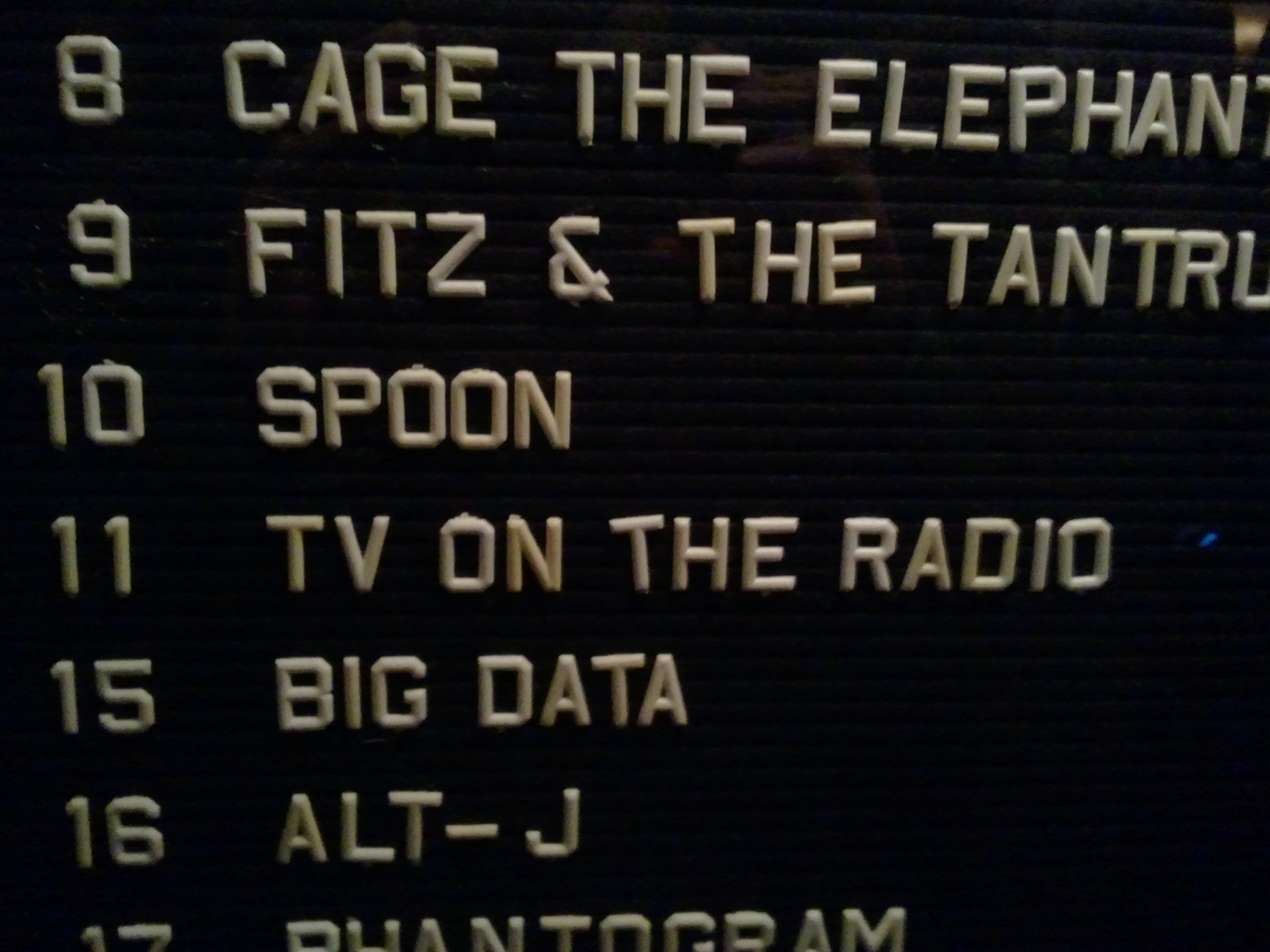
Inside, they don’t take as much care in lining up the names for the concert calendar
On record, TV on the Radio exerts an air of precision and carefulness; even when the songs are filled with hisses and layers of ambient haze, there is still the notion that this “noise” is meticulously constructed, with the particular vocal styles of Tunde Adebimpe and Kyp Malone also contributing to this perception. However, their live show moves away from their more artfully produced side and instead brings out their dormant punk rock tendencies. This was established in a dramatic fashion at the very beginning of the show, as waves of haze and noise filled the air like an aural fog machine before Tunde ripped through and delivered a thrilling rendition of one of their earliest songs, “Young Liars”. Though I have my doubts that most of the audience had an previous familiarity with the song, by the end of the first chorus it didn’t matter, and they provided an enthusiastic response.
Tunde was moving around the stage and wringing the emotion out of every note, often with the aid of his unique physical mannerisms that in the hands of a less capable performer would look ridiculous but were clearly genuine expressions on his part. Dave Sitek spent most of the set furiously strumming his guitar, and though it was nearly impossible to pick out his singular contributions it was clear that he was making an important contribution to the general atmosphere of each song; he stood in direct contrast to Kyp Malone on the other side of the stage, whose stillness amid the chaos portrayed an almost zen-like quality to his guitar-playing and vocal parts. In their live performance, the brilliance of the composition of the bass and drum parts become much more apparent, and Jaleel Bunton and Japhet Landis helped not only to keep everything grounded but offered thrilling personal touches of their own. While Landis seemed to struggle slightly with a couple of the turnarounds in “Lazerray”, he more than made up for it with his handling of the tricky rhythms of “Province”.
TV on the Radio performing “Golden Age”
The set focused mainly on the new album Seeds, with the band performing most of the album, including a stretch of four songs in a row that indicate the band’s confidence in the material. Considering we here at RIJR think it’s one of the top albums of the year, we were fine with this decision. The band sprinkled only a little bit from the rest of their catalog throughout, with Dear Science and Return to Cookie Mountain getting a handful of songs each. For the most part, the intention was to keep the energy up, and so fast-paced rockers like “Dancing Choose” and “Golden Age” dominated the setlist in favor of the band’s slower songs (though a re-working of “Blues From Down Here” showed the versatility of their more balladesque material). As expected, “Wolf Like Me” was a thrilling highlight, with the crowd absolutely losing its mind during the band’s ferocious performance.
The band seemed to genuinely enjoy their visit to Portland, and the crowd was glad to benefit from the extra shot of energy that comes with the final stop at the end of a tour. But there were other things that were understandably on the band’s mind, as Kyp and Tunde both took time between songs to express frustration with the recent current events and promote positive social awareness in the audience. This included a memorable segment that involved crowd participation about “light” and “dark” and Tunde running through and high-fiving the audience. All of this led up to the final song, the moment that I had been hoping all night to hear once again, and that was their electric performance of their early hit “Staring at the Sun”. It is one of the highlights of desperate youth, blood thirsty babes, but it takes on a whole new dimension when performed live that few bands in history can match. It was a sensational conclusion to not only a brilliant show, but to the year in general. Thanks to that performance, I’m going to have to reshuffle my list of top concerts of the year, but that’s a great problem to have.
After taking a five year break from visiting Portland, Spoon returned last night for their second show in less than six months, but even with the quick turnaround the fans last night were excited to see the one-time locals once again. Breaking free from the tentativeness of their previous festival-headlining slot at MusicFestNW, the band seemed energized to bring their show back to a more intimate venue with a devoted audience. It makes one wish that Spoon would stop by every month of the year.
Hopefully we won’t have to use this photo for the next concert as well.
It was clear almost immediately that the time spent touring in support of their excellent new album They Want My Soul was well-spent, as the band sounded crisper and more spirited than they did at their show this past summer. Even during moments when it seemed like not everyone was in sync, there was still a feeling of calm that they would let any temporary road bumps slide and they could line up again soon enough. This palpable sense of trust in each other allowed the band to flash some showier stage tricks (like Britt Daniel pulling a Johnny Cash and aiming his guitar as a gun to add an exclamation point to some of his licks) or recover quickly from quick fuckups (like Britt dropping the mic in “The Way We Get By”).
At this point it is nearly impossible for Spoon to come up with a bad setlist, considering they’ve released six stellar albums in a row, and as a result the band can choose freely from a deep catalog. Though it was a bit disappointing for me personally to have Girls Can Tell shut out, that was balanced out by hearing hidden gems like “They Never Got You” from Gimme Fiction and “My Little Japanese Cigarette Case”. Ga Ga Ga Ga Ga made up the lion’s share of the set, with a punched-up and dramatic version of “The Ghost Of You Lingers” being a standout of the early part of the set. Driving numbers like “You Got Yr. Cherry Bomb” and “Don’t Make Me A Target” got the crowd bouncing along, with more than a few totally cutting loose during main set closer “Got Nuffin'”.
Britt takes stock of the audience
The encore kicked off with the fantastic “Black Like Me”, though it was a bit disappointing to have the crowd not respond en masse with the “yeah”s and “oh yeah”s. I suspected that the cover that the band played was from The Cramps, and I was proud to see that my suspicions were confirmed as they indeed played their song “My TV Set” (while I try to be as knowledgeable as possible, my expertise is not perfect, and I only have a rudimentary knowledge of the band). Spoon finished the night with “a song that I wrote in Southeast”, and the audience was overjoyed to hear that the ebullient “The Underdog” was a local product. We can only hope that Britt comes back for more inspiration soon.
A Giant Dog were the first openers, and they were an energetic group that kept spirits high; it was nice to hear Britt plug their other show that night at Dante’s, noting though that if you saw him there to not talk to him because he wanted to truly take in their music. Future Islands, despite all the accolades they’ve received so far, did little to impress despite my intention to approach them with an open mind; instead, I feel as if it may be necessary to note specifically what it is that bothers me about their sound, but I don’t want to take away any more from the main act. Spoon delivered a superb show, and it’s wonderful to see their career continue to thrive.
It’s only been a few short months since we last saw The War On Drugs live in Portland, and the upgrade in venue from the Wonder to the Crystal matches their surging popularity over the course of this year. When we last saw them, the band had just released their latest album Lost In The Dream to stellar reviews and they seemed poised to break through into the mainstream; eight months later, as Lost starts appearing at the top of everyone’s lists for album of the year and the band has a bona fide radio hit with “Red Eyes” (which by kicking off KNRK’s “December to Remember” series of concerts last night confirmed), it’s clear that The War On Drugs have arrived. And just as they did back in the spring, the band came through with a spirited set that left an even larger audience buzzing.
Thanks to the bizarre layout mandated by the OLCC, a solid dead-center shot for this pic.
After months of touring, the band’s setlist is a well-oiled machine: a strong natural flow has developed between the ballads and uptempo material, and the transitions between songs have now been smoothed over to minimize the delay for tuning and pedal adjustments. As to be expected, material from Lost In The Dream dominated the setlist, with eight of the ten tracks represented (only the instrumental “The Haunting Idle” and the dirge-like “Suffering” failed to make the cut). The peppy “Burning” made for a strong opener and set the mood, but it took the opening clicks of “Under the Pressure” for the crowd to begin making some real noise. That was nothing however in comparison to their response to “An Ocean in Between the Waves”, which due in no small part to its extended solos received a generous applause and some hollers.
It’s clear that despite the affection the crowd had for the band and the new album, it didn’t inspire most of them to go back and pick up the early material, as cuts from Wagonwheel Blues and Slave Ambient were met with only the occasional cheer. It was during these songs that The War On Drugs fell victim to the Crystal Ballroom Curse, as the overlapping of several effects pedals and similar-ranged instruments created a dense morass that made it hard to distinguish what was being played, even beyond the hazy effect intended by the material. “These Arms Like Boulders” and “Come to the City” are gorgeous songs if you are familiar with them, but to the uninitiated can seem like mush, though the latter benefited from some nifty drumming that caught the eye of the crowd. As many who have been to shows at the Crystal can attest, you need a top-notch sound man handling the mix or else everything can turn to crap.
Tuning up amid the haze; fog machine was working overtime
Adam Granduciel kept the evening friendly with his crowd banter, talking about his love of Portland and how he was looking forward to seeing the Blazers play the next night at home (and he endeared himself to the crowd when some folks tried to correct him about the new name of the arena by saying, “It will always be the Rose Garden to me.”) It didn’t seem at all like the band was weary from touring consistently for nine months, but instead that they had just hit their stride and were generally appreciative of getting to play another show. The show still felt fresh, even if it was a similar script playing out each night. As one would expect, “Red Eyes” had the crowd going nuts, but as it happened at the Wonder, “Eyes to the Wind” was the true highlight, with the fans giving that performance a hearty cheer to end the main set. The encore left the casual fans a bit cold, but since they had heard what they came to hear, they couldn’t complain; meanwhile, I enjoyed going crazy at hearing “Baby Missiles” and its infectious beat once again. And that was enough to help make the walk out the door seem twenty degrees warmer than the one coming in.
As for the opener, Summer Cannibals delivered a killer set of garage-influenced punk, a bit of a more harder-edged version of the Dum Dum Girls. We had caught them earlier this year when they were the first openers for The Thermals down in Salem, but at least this time we were able to track them down and actually get their album. We’ll see if it’s as good as their live show.
It’s almost absurd that I have waited this long to formally write up a review of Seeds considering how often I have listened to it since it was released last month. This can be explained by the tension between how difficult it has been for me to attempt to intellectualize my love this album and how easy it has been just to cue it up on my iPod or keep it playing in my car stereo. So while I struggle where to objectively rank it within the TV on the Radio discography, I will at least declare how goddamn fun and beautiful and brilliant this album is.
TV on the Radio kick off Seeds seemingly mid-song with “Quartz”, a seemingly sly acknowledgement that while this has been the longest gap between records in their career so far, they have still been busy in the meantime, upheaval within the group and all (and taking it a step further from their similar gambit from Nine Types of Light, which began with “Second Song”). From there, the band slides easily into a joyous and ebullient first half, with the one-two punch of the sweet “Careful You” and the jubilant “Could You”. The latter is possibly the most irrepressible song in the band’s deep catalog, with its catchy melody line and brash backing horns (as well as an early lead guitar line that mimics those horns beautifully in a nifty bit of foreshadowing). “Happy Idiot” follows, and though not the highlight of the album, it’s easy to see why it was chosen for the lead single–it has a great hook, nice groove, and a driving beat that fits comfortably within a radio playlist but is still able to distinguish itself with some subtly intriguing touches (such as the “hey-hey-hey”-like sound effects leading into the chorus). Looking at the song from the context of the album as a whole, it also serves as a fulcrum between the different halves of the record, as one can sense some of the tinges of sadness that dominate the second side.
Seeds lulls a bit in the middle with the trio of “Test Pilot”, “Love Stained”, and “Ride”, though this is intentional. “Test Pilot” is a touching ballad that rests in a downbeat groove, with “Love Stained” tweaks the formula by riding an illusory double-time hi-hat/half-beat groove combo, creating an undercurrent of tension and serves as one of several instances of a push-and-pull dynamic that is found throughout the record. “Ride” is seemingly set up as the centerpiece of the album, with its two distinct halves–the first part is a slow gorgeous instrumental ballad that recalls a major chord version of Nine Inch Nails’s “The Frail” mixed with the lushness of the band’s own “Family Tree”, before switching gears into a second part that’s a bouncy and buoyant pop rock song, driven by an insistent Krautrock-like motorik drumbeat that brings to mind early-eraSecret Machines that sets up the rest of the album.
With their buzzsaw guitars, “Winter” and “Lazerray” find TV on the Radio rocking out harder than ever. The former uses a half-time beat in a similar fashion to “Love Stained”, creating the illusion as if the band is fighting through an invisible force attempting to drag them down, while the latter finds the band just flat-out letting loose in the most punk-rock fashion they’ve done since “Wolf Like Me”. The album closes out with the bittersweet “Trouble” and the hopeful title track, and it’s then that the album’s true theme pushes through, that of rebirth in the face of loss. After the death of bassist Gerard Smith, it wasn’t set in stone that the band would return, but it’s clear that TV on the Radio are working through the loss of a beloved friend. The overall result is a record that hits all possible emotions, but in a way that is consistently engaging and repeatable.
As for the original conundrum, I’m still not sure it matches the creative brilliance of their debut desperate youth, blood thirsty babes or Dear Science, it’s still more consistent than Return to Cookie Mountain and Nine Types of Light, though there is no single song that is the equal of “Wolf Like Me” or “Killer Crane”. I find it surprising that while the reviews of the album are still quite good, critics are ranking Seeds significantly below their previous work. Despite this, my prediction is that as people play the album more and more, its charms will become more apparent and its reputation will grow.
It is difficult to capture what makes Deerhoof such a unique and amazing live experience with mere words. They combine the explosive anarchy of punk with the precise timing and sophisticated musicality of jazz, topping off the combination with the innocently sweet vocals of Satomi Matsuzaki, and it can be a lot to take in at once for the novice. The effect is a spectacle that is unmatched in music today, and the crowd at the Doug Fir on Thursday night had a blast seeing it live at the best venue in Portland.
A view of the band in the intimate confines of the Doug Fir
The band kicked off their set with a run of songs from their latest album, La Isla Bonita; I often have trouble distinguishing a good portion of their catalog, but was able to pick out the early single “Paradise Girls” and the fiery “Exit Only”, which received a hearty applause. Though the record was only released a few weeks ago, it seemed that most people in the audience were already familiar with its songs–either that, or they did a really good job of faking like they knew what was going on. Deerhoof kept the energy up throughout their performance, with Greg Saunier’s insane drumming a definite highlight. Saunier is able to come up with a variety of sounds and textures using a fairly rudimentary kit, and no matter what insanity was going on around him melodically, the audience could tether themselves to his intricate rhythms to keep bouncing around in perfect time.
Greg Saunier bringing a halt to the set to deliver a trademark rambling talk to the audience
Deerhoof has a fairly extensive (and consistent) discography at this point in their career, and their setlist reflected that–though La Isla Bonita was represented with numerous selections, the band also selected songs from several of their other releases from this past decade. A boisterous version of “The Perfect Me” from Friend Opportunity was a personal highlight, which despite the lack of keyboards lost none of its charm; another great moment was when Greg and Satomi traded instruments for a song, though it was preceded by Satomi passing around handmade Deerhoof stickers from a devoted fan while using her newly-acquired drumsticks as chopsticks. Guitarists John Dieterich and Ed Rodriguez traded angular and complex guitar parts all night, and Satomi was a constant delight whether she was playing her bass or dancing around with a jam block; her moves varied widely from specific hand gestures that were reminiscent of hula in their apparent hidden meaning to recreating ninja moves with various bouncing kicks.
The show’s encore included a song featuring opener Busdriver, whose incredible delivery and innovative beats made for a compelling opening set in and of itself, but his lightning-quick rapping over a Deerhoof track probably inspired more than a few fans to wonder what a full-length collaboration would sound like. The finale was the pleasantly ridiculous “Come See the Duck”, and that pretty much summed up the whole night in a nutshell. Deerhoof is not for everyone, but for those that are willing to step outside of their normal comfort zone, they are as good a live experience as you can find.
Due to our special theme week, we didn’t have the chance to mention another new release we were eager to hear that happened to come out the same day last week. The latest album from …And You Will Know Us By The Trail Of Dead, IX, came out here in the US last Monday, but considering it had been released in various forms weeks earlier, it was easy for it to get lost in the mix, even for people that listen to Trail of Dead as much as the Foo Fighters. We’re still processing IX (in many ways the album it most resembles is Tao of the Dead, but we’re not ready to give a verdict beyond that initial comparison), but we decided to use this opportunity to defend their most unfairly-maligned album, Worlds Apart.
Like many fans, I first encountered …And You Will Know Us By The Trail Of Dead during their Source Tags & Codes days, and to this day that album still stands out as one of the landmark indie rock records of the 2000’s. I remember catching the premiere of “Another Morning Stoner” and being transfixed by their relentless yet melodic approach, with their catchy cyclical, arpeggiated guitar lines tied to an ever-rumbling drum pattern punctuated by insistent snare hits and rolls, as the emotional intensity of the vocals increased with every verse. At a time when rock music had become stagnant from a creative perspective, it was a revelation to see a band with this much energy and ambition creating a complete “album”, with shifting moods and repeating motifs that added up to a brilliant whole.
I wasn’t the only one enraptured by Source Tags & Codes, as it ended up at the top of numerous best-of lists for 2002, and it set expectations sky-high for their follow-up. Due to my living situation at the time (attending college in the middle of nowhere), I remember having to make arrangements for purchasing Worlds Apart as soon as possible, either borrowing a car or pre-ordering it online, although I think the preparations were probably rendered moot since we likely received advanced copies at the radio station. No matter how it was procured, the important point is that as soon as I played the album, it instantly proved to be a worthy successor to Source Tags & Codes and became one of my favorites. The ringing guitars and pounding drums of their earlier work were again both there in spades, but Worlds Apart was aided by crisper production and greater dynamic contrast; individual parts came in with greater clarity, and the band used its increased budget effectively with their expert layering of additional instruments (namely strings, piano, and extra percussion) to create added depth to their sound, as well as utilizing keener ear towards balancing the extremes in volume. Aside from these technical advancements, there were still plenty of great hooks and memorable melodies throughout the record, from the explosive “Will You Smile Again” to the anthemic “The Rest Will Follow” to the strident “Caterwaul”. I’ve found myself singing that one in particular for days on end.
Since I had established and reinforced my own opinion of the album through several repeated listens, I was surprised to learn that Worlds Apart received extremely mixed reviews. There were some that agreed with my assessment, that the band’s output had matched its ambition and that the music supported such a grand artistic statement, but there were others that felt that despite the herculean effort the results fell short. Then there was a third category that utterly trashed the album, though several of their reasons ultimately rang hollow–I can understand if you felt that the record was a little over-the-top or too bombastic, but to claim that it was a sell-out record when there were no obvious singles or that it was confused when everything flowed perfectly together seems more like anticipating the backlash than engaging the work on its own merits. We all have different tastes, but these criticisms seemed out-of-place with what I was hearing.
Though to this day I continue to listen to Worlds Apart on a regular basis, the band appears to have distanced itself from the album, with only “Will You Smile Again” and “Caterwaul” making regular appearances on setlists (which is a much better fate than what befell So Divided, which the band has apparently deemed unworthy of performance). And while Trail of Dead’s newer albums seem to focus on one aspect at a time (the overly-serious and histrionic The Century of Self, the energetic if shapeless Lost Songs, with Tao of the Dead a workable compromise between the two), it’s a shame that their work which best marries their epic tendencies with their raw emotions goes unrecognized at best or needlessly scorned at worst, as its fiercest critics are the loudest and insist on repeating its supposed failings years after the fact.
But I ask you to take a listen to Worlds Apart with fresh ears, because it has aged better than you might expect. Let your stereo explode with those big guitar lines, pound your head along with the multiple drumsets driving the beat, and get wrapped up in even the interstitial music (“To Russia My Homeland”, the end of “A Classic Arts Showcase”) which both maintains a connection between the songs and helps delineate their existence as well. Get lost in the grandiose “All White”/”The Best” one-two punch, sway with the ballad “The Summer of ’91”, or kick your heels to the biting and irreverent title track–the band’s got everything covered. If that doesn’t satisfy you, I don’t know what will; but at least I’ll feel better knowing that you gave this album another shot.
For a couple of hours last night, I felt both 14 and 40 simultaneously. It’s the kind of feeling you can only get when you’re watching a favorite band from your younger and more vulnerable years thrash away at an otherwise-unbearable volume. Sure, the body can take the abuse of the unruly masses for only a couple of songs these days, but it doesn’t compare to the euphoria of a fucking great performance.
Easily the high point of that lineup
I had been waiting ten years for this show, and I was not going to be content observing the proceedings from a safe spot in the middle of the crowd. I was one of the few people to give these guys radio play back when You’re A Woman, I’m A Machine first came out, and since then I had desperately wanted to see DFA1979’s furious intensity translated into a live setting. Instead, due to mostly just bad luck, I had to be content during that long wait to merely play their album hundreds of times or attempting to track down whatever live footage I could find (like their brilliant performance on Conan). A couple of years later, Sebastien and Jesse broke up, and it seemed like any chance to see the duo live was lost to history. Of course, we all know now that the band reunited a few years ago, but still I wasn’t any closer to seeing these guys. There was the initial insistence on playing far-flung festivals that I had no intention of attending, but even when circumstances conspired to put us in the same city at the same time, it wasn’t enough–I was there the year that they surprised SXSW with their reunification, but due to my outdated phone I heard the confirmation hours after their tiny venue had already overfilled well past capacity, and had to be content to learn the details secondhand the next day. So yeah, I was going to through caution and good sense out the window and get as close as possible, the terrors of the pit be damned.
As soon as the opening piano chords of “Turn It Out” were triggered, the crowd began to lose its (collective) mind as their anticipation reached a fever pitch. When the drums and bass finally kicked in, all hell broke loose and any chance that I had of being in control of my own movements went out the window, at least for the rest of the song; I found myself tossed from the far left of the stage all the way to the central barrier dividing All-Ages from Boozers with no idea how I got there, though I was jumping up and down to the beat the whole time. “Right On, Frankenstein” brought a similar pattern of events, but when a shoelace came undone, I decided that it was best to make a break off to the side and fix the issue for safety’s sake. And as a result of the wisdom that can only come with age, I took the opportunity to camp out at the side for the rest of the show, getting all the benefit of being close to the stage with much less wear and tear on the body.
It was all kind of a blur at the beginning
With the physical terror no longer a concern, I was able to focus more clearly on the music. The band placed an emphasis on the new material, playing all or nearly-all of The Physical World, and the crowd displayed a remarkable amount of enthusiasm considering the album was only released two months ago. Sebastien and Jesse played their parts brilliantly, as they were effortlessly able to recreate the sounds of the album, and showing that the years of touring experience have served them well. When the band dipped into their early songs, the audience found an extra gear and responded in an even more frenzied manner–during the climax of “Little Girl” one fan was able to launch himself completely above the crowd, as if shot from a cannon, to the delight/terror of those around him. It was also fun to see the duo take the opportunity to stretch certain sections out and play around with the structure of the old songs, breathing new life into decade-old material.
A safer angle
The Crystal Ballroom can be a fickle place to play for a lot of bands, with its wonky acoustics and expansive layout, but Death From Above 1979 was able to keep the feel of a punk club; all elements (bass, keyboards, drums, and vocals) came through with great clarity, and the band tried to keep all sections of the audience involved. Sebastien was surprised to see a balcony way in the back, opining that those people decided to sit so far back “just to get a look down the shirts of the audience below”; he also expressed bemusement at the strict separation as required by the OLCC, a sentiment with which we share. The stage show was modest, with their trademark logo being the sole decoration and a line of white strobe lights being the main effect, but this minimalism served them well when they expertly deployed a sudden shift to red lights during the chorus of “White Is Red.” But the coolest effect was probably the cheapest one possible–during the final song of the encore, Sebastien emptied a bottle of water onto his drumset before launching into the coda of “The Physical World”, and the effect of seeing the water splash high into the air during that brilliant finale was mesmerizing. Hundreds of cameraphones went up to capture that moment, but it felt better just to experience the moment on its own. So, sorry I have no actual footage of this–you’ll just have to see it for yourself when Death From Above stops by your town.
With the release of their eighth studio album Sonic Highways this week, Rust Is Just Right is celebrating with a week devoted to the Foo Fighters. Today we take a close look at their most beloved album, The Colour and the Shape.
Last week, one of my friends suggested to me that despite its initial popularity, The Colour and the Shape is “criminally under-appreciated today.” After spending some time contemplating the proposition, I wrote that I agreed with his assessment, while expanding on his point and making some minor modifications. I think most people would agree that it’s a very good album, but I also believe that a majority of those fans wouldn’t even begin to consider TCATS a “classic” or one of the best albums of the 90’s.
I would contend that there are a few reasons that The Colour and the Shape is not held up in the same regard as other classic albums of the era. First, the fact that the Foo Fighters are not only a still-functioning band, but have continued to be one of the most successful rock bands of the past two decades, works against them in this case. This prevents an appropriate distance from the album from being formed, so that we as an audience can stand back and reflect on its merits. The Foos have churned out a fairly consistent product over time, with good-to-very-good albums released every few years; there hasn’t been a need for fans to ask “hey, when are these guys going to get back to the formula of The Colour and the Shape” or for critics to say with each review “THIS is their best album since TCATS!” as they do with every Pearl Jam release since No Code. Fans today aren’t rediscovering the bands early work that they missed the first time around like they would with Pavement or the Pixies, as they just get caught up in the normal album cycle; the anticipation that builds up when a band may potentially reunite doesn’t create the same fervor for their early work as a normal album progression does.
And with Dave Grohl’s status as the Unofficial Mascot of Rock, even when the band takes time between album releases, their frontman is never far from the public’s consciousness. He’s the modern guy that musicians from all eras and genres call up, from living legends to standouts from the underground,* so we’re always hearing about him teaming up with this guy on this record or performing with those guys on that show. And in an era where there are fewer and fewer rock stars, he’s a consistent source for quotes and interviews–if Gene Simmons says something stupid about the state of rock, you’re damn sure Grohl will have a rebuttal.
This leads into a secondary issue that leads to people underrating The Colour and the Shape, and that it is a mainstream rock record. It’s not an underground classic waiting to be discovered (most everyone has heard the Big Singles from this album; at the very least “Everlong” was definitely featured at every single one of your middle school dances), so it doesn’t evoke a need in its fans to proclaim its greatness. Nor is it an album that will blow your mind with its experimental take on different genres or change your attitude as to what actually constitutes “music”, so there is no need to argue with detractors that “They just don’t get it, man.” I highly doubt that musicians would point to it as a highly influential record, beyond stating that they may have been really big fans; if there’s one takeaway to be had from TCATS, it would probably be that you can have songs with big hooks without being dumb, so maybe it was an inspiration for some in that regard. But there’s nothing exciting in being a person that cites The Colour and the Shape as a classic, especially as mainstream rock is caught between two competing trends in critical thought–that there is merit to pop music, as long as it isn’t rock, and that the best rock music is the stuff isn’t popular.** By sticking up for TCATS, you’re begging people to say, “Congratulations, you’re praising a record that went double-platinum and enjoy hearing when it comes on the radio. Have a cookie.”
Fine, I’ll take that cookie.
The Colour and the Shape is a brilliant guitar album, first and foremost: it’s packed with memorable riffs and great hooks, and guitars dominate the songs from beginning to end, whether they are electric or acoustic. Fans immediately remember that huge descending riff from “Monkey Wrench”, the delicate strums of “Everlong”, and that killer melody from “My Hero” when reminiscing about the album. Even the deeper cuts are defined by their guitars, from the arena-rock-ready lines “Hey, Johnny Park!” to the sugary-sweet melody of “Up In Arms”. But while these parts are so catchy that they sound easy, there’s a greater layer of complexity to these guitar parts than your standard garage-rock/bar-band fare. The Foos often use unique chords or uncommon voicings, altering your expectations just enough that you can’t predict a progression the first time you hear it but done in a manner that’s not so jarring that it affects your attention.
There is another area which shows the technical expertise of the record when you dig in a little deeper. The Colour and the Shape is a Drop-D album that doesn’t succumb to the laziness that is often inherent in the technique. Usually, down-tuning the bottom string invites guitarists to simply crank out a riff and then let the tuning give it a superficial depth, since they can easily turn a single-line melody into a chord by simply pressing one finger over multiple strings (though guitarists deserve credit if they use this convenience to write more intricate riffs than they would otherwise–then Drop-D is used appropriately). Instead, the band uses that tuning to create bigger-sounding chords, using the entire width of the neck and allowing for more individual voices to be heard and more complex melodic lines within a chord progression, and also to create unique chords in and of themselves, as in “Everlong”. The progression itself is not particularly complex, but by using the Drop-D it creates a more unusual and novel chord for each step of the phrase. That means when your roommate picks it out on his acoustic that it is not nearly as impressive as Grohl writing the progression in the first place, but good on roomie for trying to impress the audience with a great song.
The album is known to the masses for its big singles, and rightfully so. “Monkey Wrench” was a furious introduction as the lead single, and you can instantly connect with the anger and passion of the band’s performance, especially that all-shouted third verse. “My Hero” with its thunderous and epic intro was the perfect soundtrack to movie climaxes and sporting events, and its simple message of praising the ordinary heroes among us is one we can all recognize. And of course, there’s the monumental “Everlong”, which remains one of the totemic songs of the past twenty years. Even stripped down to its barest elements, just a hushed voice and a delicate guitar, one can feel the power of all the emotions associated that come with the experiences of first love, from the anticipation to the anxiety and everything in between (if the acoustic version has one flaw, is that it cuts out the fantastic bridge from the original electric version, but it’s a forgivable omission). I’m sure someone in the past decade has paired it with My Morning Jacket’s “Touch Me I’m Going To Scream Pt. 2” on a mixtape, and if they haven’t, I want to alert you that you’re missing a golden opportunity.
(I would also like to take a moment to praise the Michel Gondry-directed video, which in addition to being excellent and unforgettable, also is one of the few music videos that extends the song instead of cutting it short, making one wish that the band actually add an extra chorus to the end.)
But the true strength of the album is in its deeper cuts, the songs between the tentpoles that defined the album. As mentioned above, there’s “Hey, Johnny Park!” with its huge riffs and its gleeful willingness to toss in all sorts of goofy rock tricks, like slides up and down the neck and amusing manipulations (the effect used for the bridge being the most easily identifiable example), and “Up In Arms” with its catchy melody and the way that it inverts the seriousness of its intro by cranking up the volume and repeating everything in double-time. Then there are other fun tracks throughout that stay fresh after all these years, like the pounding “Wind Up” and “Enough Space” or the gentle bounce of “See You” or the delicate ballad “Walking After You”. But the true standout that all fans of the album would point to is “February Stars”, a song that should immediately rectify any prior misgivings that one may have had about the term “power ballad”. It earns its huge final chorus, and the band makes sure not to waste any of it by piling on layers and layers of guitars playing big, thick chords.
It’s not perfect, and I have a few minor quibbles–I’d end “Doll” on the sustained chord instead of resolving it, so as to build tension and use it as a true intro to “Monkey Wrench”, and I’d slide “February Stars” behind “Walking After You”, to provide a more natural trilogy with “Everlong”, creating a better flow between each of the songs as well. But these trivial issues aside, it’s an otherwise unimpeachable record. It’s at its base a simple rock record, just a few guys on guitars, bass, drums, and vocals, but it never feels limited by those potential constraints. And while it may be known for many of its quiet and sweet moments, there is still an edge to the album, and the Foos are never afraid to let loose and crank the distortion up. In that context, The Colour and the Shape shouldn’t be dismissed as a mere mainstream rock record, but should be praised as a quintessential example of the form. It’s not merely a good record, but an all-time great album.
*Just consider that Dave Grohl performed in a band with John Paul Jones (Them Crooked Vultures) AND with Paul McCartney, as well as . He’s the musical equivalent of Kevin Bacon–you’ll connect him with anyone from the past fifty years in less than six steps.
**That’s not to say that we here don’t tend to prefer less-mainstream fare, but instead that just because it’s obscure it doesn’t mean it’s good, and just because it’s popular, it doesn’t mean it’s bad.
Rust Is Just Right and Slowdive have a bit of a shared history, as our first story was an article discussing their surprise reunion earlier this year. At the time, we were unsure whether the reunification was a one-off deal, but luckily the band would not only launch a tour, but they would stop by our corner of the world here in Oregon. Considering we were too young to catch them during their initial heyday, we jumped at the opportunity to see the shoegaze legends live. As they proved Wednesday night, The Jesus And Mary Chain may have created the genre and My Bloody Valentine created its masterpiece, it was Slowdive that perfected the craft.
Slowdive up in lights.
Just seeing the headliners would have been enough of a treat, but we were blessed with the additional bonus of Low opening up the show. Low is definitely a band worthy of its own headlining tour (though they may not be playing in venues as large as the Crystal), but when given an invitation from icons like Slowdive, you take that gig in a heartbeat. As such, we tried to get in as close to the start of the show as possible, and despite a slight delay at the Will Call office due to some confusion with the customers in front of us, we were able to arrive as their first song faded and “Plastic Cup” began. This started a run of songs from their overlooked recent album The Invisible Way that the crowd ate up, leading me to suspect that there may have been more than a few people who bought tickets to the show on the strength of the opener alone. Low stuck with some of their heavier, more bombastic material, like “Monkey” and the sublime “Dinosaur Act”, which elicited cheers from the crowd as soon as the first hints of its melody drifted through the venue. The band finished up a tight set to thunderous applause, leaving the crowd wanting more, even though we were eagerly anticipating the headliners.
The interstitial music coming over the PA featured some inspired choices like The Shins’ “Caring Is Creepy” and Mazzy Star’s “Fade Into You”, which kept the audience in a suitably relaxed mood before the main act arrived. But even though we were prepared for an evening of gorgeous, dreamy music, that didn’t stop us from providing a rapturous welcome to Slowdive as they walked onto the stage. The band kicked the show off with some of their earliest songs, from the Slowdive EP, with the guitars swirling and Rachel Goswell’s and Neil Halstead’s vocals floating in and above the haze in a gorgeous, dreamlike state. Though those components are the hallmarks of the Slowdive aesthetic, in the live setting you get a full appreciation for Simon Scott’s drums, which not only provided a necessary tether to the ethereal songs, but also provided some brilliant beats in and of themselves. His contributions tend to go unnoticed on record, but they formed an integral part of the performance.
A glimpse of the psychedelic set
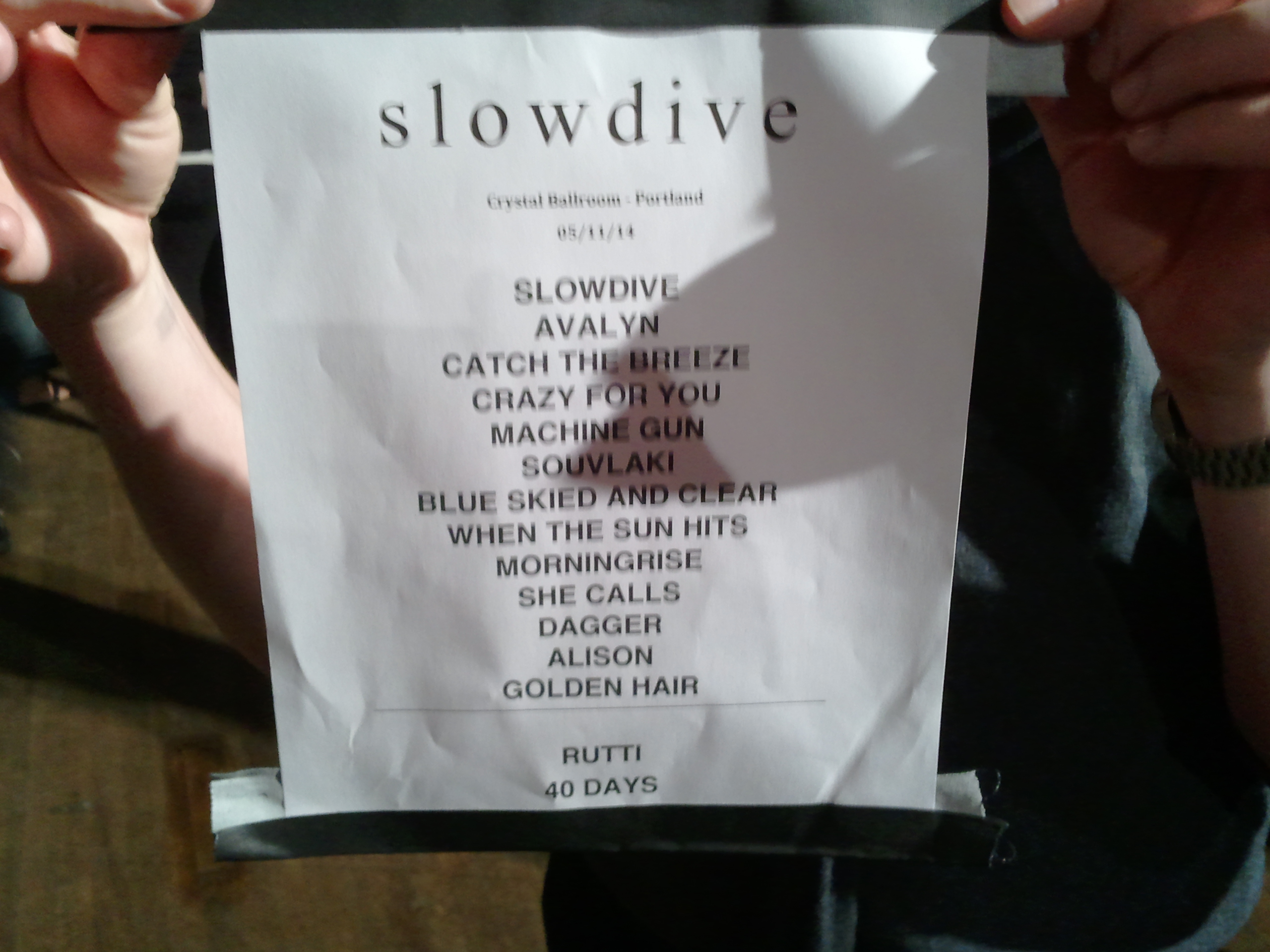
The early results were pleasing, but the band hit another level with “Catch the Breeze” from Just For A Day, with an exhilarating climax propelled by Scott’s thunderous drums enhanced by a delirious strobe effect, in perhaps the most effective use of the trick I’ve ever seen. It was this moment that confirmed that as wonderful as their albums are, it’s no comparison to Slowdive’s live show. Highlights included favorites from their classic Souvlaki like “Machine Gun” and “Alison”, which strangely enough were the only songs introduced by the band even though they rank as among the most recognizable. With all the pure noise generated from the several guitars over the course of most of the set, it made the delicate and sublime “Dagger” stand out even more, as all the reverbs, delays, wahs, filters, and phasers were stripped away for the mournful ballad, backed by a light setup that focused on various bulbs that enhanced the somber overtones of the song. Considering the respectful silence that greeted the song, I may have been a bit too excited in unleashing a “whoo” as soon as I heard its opening chords, but dammit I was happy to hear one of my favorite songs played live for the first time.
Setlist from an amazing show.
It was an amazing experience from beginning-to-end, and hopefully it inspires the group to continue–whether it be with new music, re-releasing out-of-print albums, remastering their old material (while we’re generally not in favor of the “loudness wars”, the Slowdive back-catalog would benefit greatly from a volume-boost), or just launching more tours. Because as I said after the show, Slowdive live was even more beautiful than I imagined.






 Rust Is Just Right