electronic music

Kraftwerk, Live at the Keller Auditorium

On Saturday night, legendary electronic act Kraftwerk put on a show that can be truly described as “unique”.  It is difficult to even call what we saw a “concert”, since it is unclear how much of what we heard was performed live.  However, the audience did not pay a fair amount of money just to hear some of their old favorite tracks, but for the totality of the experience, and in that regard Kraftwerk put on a memorable show.

Just four men and their podiums (or podia).

Just four men and their podiums (or podia).

The group constructed a career-spanning set, creating medleys from each distinct era of the band’s history, and the accompanying visuals provided the uninitiated with the appropriate notice as to what album was being covered.  The songs were not mere rote reproductions of what can be found on their records, but updated in a way that blended newer ideas with the basic elements that made up the classic Kraftwerk sound.  It was an intriguing combination, which evokes the fundamental paradox of Kraftwerk’s music as it exists in the 21st century–how does one continue to try to approximate the sound of the future when what was previously composed now sounds so retro?

The melding of old and new also was explored with the visual presentation.  The show was presented in 3-D, and there were several moments sprinkled throughout where the crowd was dazzled by the technical feats on display.  Yet at the same time, most of the visuals were fairly simple in design, as were many of the motions.  For instance, the section for Autobahn could be described as the most accurate depiction of the Out Run arcade game ever created.

The appropriate materials necessary for enjoyment of the show.

The appropriate materials necessary for enjoyment of the show.

Kraftwerk has always experimented with various levels of automation, and as such it was difficult for the audience to determine as to what exactly was “performed”.  For the entirety of the show, we were presented with four men standing behind wide podiums, with no real hint as to what each member was contributing to what was being heard; it was not until halfway through the set that I could tell that Ralf Hütter was in fact singing some of the lyrics, or that he was playing a synthesizer.  The sole exception was the beginning of the encore, where in a brilliant touch “The Man-Machines” were literally replaced by robots.  This is why I cracked up when audience members were giving ovations to specific members as they exited the stage one-by-one, because it was impossible to determine who was playing what.
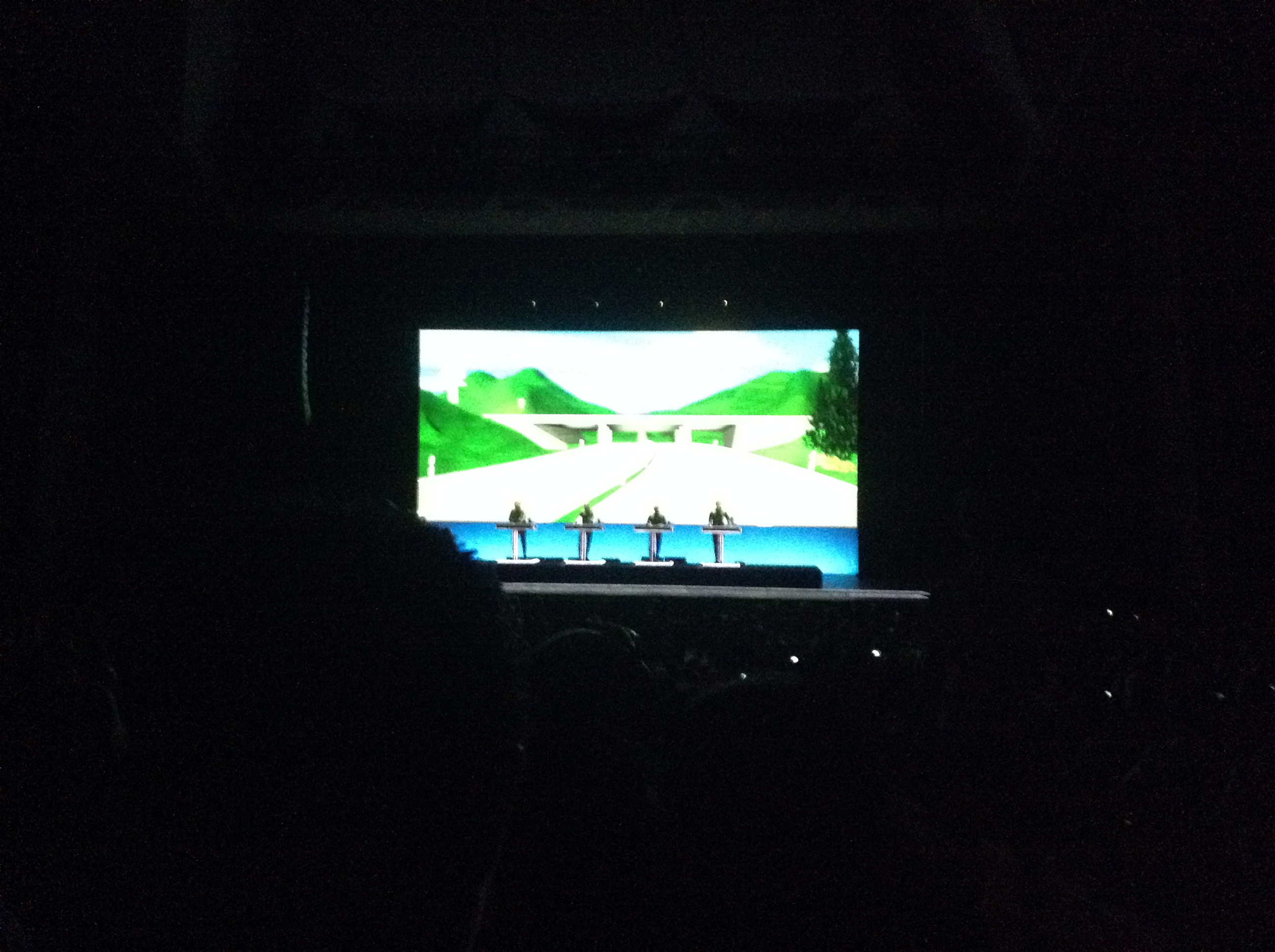
The most beautiful game of Out Run you have ever seen.

The most beautiful game of Out Run you have ever seen.

Overall, it was a very cool experience that anyone with a level of appreciation of electronic music should try to catch at some point.  Then you can also spend hours afterward contemplating the nature of time and space and man and machine and past and future and so on and so forth, all with a nice pulsing beat as background.

Review: Aphex Twin – Syro

It was worth the wait.  It had been over a decade since we last had a proper Aphex Twin release, but Richard James has rewarded us with the challenging but beautiful Syro.  It’s not a revolutionary new work, but more of a distillation of the best parts of Drukqs with flashes of the brilliance of his 90’s output that put him at the vanguard of the electronic music movement.

The liner notes that inventively catalogs the use of every bit of musical equipment on SYRO

The liner notes that inventively catalogs the use of every bit of musical equipment on SYRO

Now, I’ll be the first to admit that I’m not a huge fan of electronica, and not particularly an expert of the genre (though I’m sure I upset at least a few people by using the catch-all term “electronica).  I haven’t been a regular purchaser of electronic music since the Big Beat era; any forays into the area are usually based on the insistent recommendations of friends (Darkside) or from research into musicians with a penchant for experimentation (Tim Hecker).  The rise of EDM in the past few years has only been a source of confusion and frustration, as the entire movement seems to be merely a repackaging of sounds and ideas that Richard James perfected back in the 90’s.  Mix in the abrasiveness and breakbeats of “Come to Daddy” with the acid-jazz grooviness and distorted finish of “Windowlicker”, and you have 95% of the formula that’s racking up the big bucks at these raves.  Just toss in a trick as old as music itself (“the drop” of the bass has always been a trick in a band’s arsenal), apply it in a haphazard fashion, ignore any semblance of rhythm or conception of songcraft in general, and you’ve got yourself EDM.

The album artwork is a list of all the expenses that went into the production of the record

The album artwork is a list of all the expenses that went into the production of the record

But Richard James sets himself apart from his successors, because it’s clear to even the lay individual that has a much better understanding of the fundamentals of music itself.  Even when he’s trafficking in beats that are lined-up with pinpoint precision based on computer formulas and arranged in odd meters, you can still feel a beat.  It may be odd, it may be unfamiliar, but it’s not arrhythmic–there’s a method to the madness.  James also has an excellent grasp of songwriting, providing careful shape to each song and the album as a whole.  The album draws you in with a subtle and trippy beginning, before pumping up the energy with a frenetic middle, before drawing back down and ending with a beautiful, Satie-inspired epilogue (meaning a delicate, spare piano with the barest hints of chord progression and melody, but still capable of evoking immense beauty).

The entire list of expenses, which can be read after unfolding the album cover.

The entire list of expenses, which can be read after unfolding the album cover.

Whether you’re listening to Syro as background music or with intense concentration through headphones, it’s clearly apparent that each sound was created and applied with the greatest of care and precision.  Fans will recall many similar tones from the Richard D. James Album, but he also tosses in several new variations as well, with each perfectly calibrated to elicit a particular emotion.  It’s difficult to go into more detail, not simply because it’s practically impossible to refer to specific tracks without employing a significant amount of cutting and pasting (James really emphasizes the pointlessness in some respects of distinguishing certain tracks by employing random letters and signifying particular “mixes” for each song, as if we have access to alternative mixes and they’re not just holed up on his hard drive somewhere, though noting the BPM for each track is a nice touch), but also because of the sheer amount of notes and styles in each particular track.  Hence, the resort to generalities.

It should be clear then this is an electronic album that casual fans will appreciate.  And since the more specialized press seems to be in agreement that his is a great record, I can take comfort in the fact that my inexperienced perspective has at least some solid footing.  It won’t be the Kind of Blue of the genre, but definitely a worthy addition to Aphex Twin’s illustrious discography.