Recs

Review: White Reaper – White Reaper Does It Again

Summer still has a few weeks remaining, so there is plenty of time for you to enjoy the debut album from White Reaper in its proper setting.  White Reaper Does It Again is energetic, carefree garage rock delivered at a breakneck pace, which makes it perfect for blasting at full volume with the windows rolled down/pulled up/smashed open.  The music is unlikely to leave any lasting impact on the listener, but sometimes life is about the journey and not the destination, ya know, and why not make that journey as packed with adrenaline as possible?

White Reaper offers a simpler and more streamlined version of the garage rock that is currently enjoying its moment once again.  The guitars pound out simple riffs and chord changes, taking a backseat to the thunderous drums of Nick Wilkerson on most tracks who pushes the tempo and thrills with rollicking fills.  Tony Esposito’s vocals are processed to hell and back in a way that recalls Jay Reatard, and his melodies are often similarly pop-influenced.  White Reaper distinguish themselves from their brethren with the often over-the-top use of keyboards, but Ryan Hater’s contributions help add some much needed color to a formula that has the danger of otherwise feeling flat.

White Reaper Does It Again is an album whose sole focus is making sure the listener is having as much fun as can be packed into a half hour.  There is a disposable nature to the music, but even if its significance is merely ephemeral, there is still something to be said for enjoying the moment.  Just crank it up, bop your head, and revel in the folly/glory of youth.

Review: Titus Andronicus – The Most Lamentable Tragedy

If there was a musician that ever defined the term “his reach exceeds his grasp”, it is Patrick Stickles.  But goddammit, that is partly why I love his band Titus Andronicus so much.*  As a rule, double albums are bloated, overstuffed affairs, and rock operas are doubly so, and The Most Lamentable Tragedy fulfills those expectations accordingly.  But Stickles has poured his heart and his soul into this epic production, and has the requisite amount of chops to prevent the whole album from falling apart.  For that alone he should be commended; the good news is that Stickles should be praised not only for the audacity of the entire enterprise, but for writing several songs that rank among the band’s best work.

https://www.youtube.com/watch?v=QPnehcnDmGg

It is best to look at The Most Lamentable Tragedy as an attempt to rewrite the band’s entire history to this point.  Not only are there several callbacks to each of the band’s previous albums (for instance, there is the continuation of the “No Future” series that dates back to their debutThe Airing of Grievances, there is also second act closer “More Perfect Union” which refers to The Monitor‘s opener “A More Perfect Union”, and “Mr. E. Mann” which bears an obvious relationship with “(I Am The) Electric Man” as well as “I’m Going Insane” with “Titus Andronicus vs. the Absurd Universe (3rd Round KO)” from Local Business), but the narrative of the opera recasts many of the struggles that Stickles tackled before.  Even the rock opera concept is an extension of the Relationship as Civil War metaphor that defined the concept album The Monitor, which many regard as the band’s greatest work to date.  One does not have to be intimately familiar with the complete history of Titus Andronicus to enjoy the album, but as is the case with the many historical references and literary allusions that are sprinkled throughout the record, it certainly helps.

One should be fully prepared for the sprawling affair that is The Most Lamentable Tragedy just by glancing at the packaging, since the sticker announces it is a “29 song, 93 minute” opus, but even that simple declaration is playing a bit fast and loose with the facts–many of the tracks are seemingly arbitrarily cut up, and the album contains multiple “songs” of pure silence, including a seven minute “Intermission”.  The term “rock opera” also should serve as a huge warning sign, as the album suffers many of the same issues that plague previous attempts at the form, namely songs that are heavier on plot than hooks and drama rather than melody.  However, when Stickles indulges his most grandiose instincts, he creates some of the album’s finest moments, such as in the orchestral sweep of “More Perfect Union”.  When was the last time you heard a bass clarinet in a punk song?

There are other standouts that will easily become highlights of future Titus Andronicus shows, from the furiously energetic “Dimed Out” and “Lookalike”/”I Lost My Mind” combo to the multi-part epic “(S)HE SAID/(S)HE SAID”.  Another sure to be crowd favorite is the boisterous sing-along “Come On, Siobhán”, which in a change of pace for Titus recalls the Midwestern sounds of John Cougar Mellencamp instead of the standard Jersey influence of The Boss.  There are enough great Titus Andronicus songs scattered throughout the record that one is tempted to separate the wheat from the chaff and stuff it onto a disc with a fifty-minute runtime instead, but that would fly in the face of the entire point of the album.  It is a sprawling mess because manic depression is indeed a frustrating mess.  The Most Lamentable Tragedy is what it is, flaws and all.

Review: Ghostface Killah and Adrian Younge – Twelve Reasons to Die II

Ghostface Killah is probably long due for a vacation at this point, but it would seem unwise to stop an artist on such a creative hot streak.  Twelve Reasons to Die II is the third album Ghostface has released in less than a year, and the compelling and gripping record is not only a worthy sequel to the 2013 original, but probably the best of the recent trio.  Adrian Younge once again proves to be the ideal collaborator, backing up the imaginative and gritty storytelling of Ghostface with a musical accompaniment that is engrossing yet subtle.  Younge’s production never overshadows the emcees, but it is still packed with enough fascinating nuance and clever ideas that it begs for closer listening.

For the sequel, Ghostface tightens the narrative and simplifies the action, focusing purely on the revenge aspect from the original.  RZA helpfully provides narration of key plot points, but the bulk of the guest work is handled by Ghostface’s frequent partner Raekwon, who is enlisted for the role of fellow gangster “Lester Kane” and serves as the primary co-star in this saga.  This time around, there is a similar amount of violence and a bit more melodrama (plus a surprise twist at the end), and while there is not the same creative spark that characterized the original, it does set up nicely for a sequel.

Younge incorporates similar musical elements that he used on Twelve Reasons to Die (organ flourishes, vibrato guitar), but does so more sparingly this time.  The result is a production that is evocative of the original in spirit, but still stands out as its own work.  Younge tamps down on some of the campier elements, relying less on Italian horror-type themes from the first album and utilizing more 70’s-era soul and R&B grooves, as heard on tracks like “Get the Money”.

The great news is that compact disc versions of the album come with a free disc of all the instrumental parts, which really helps highlight the brilliance of many of Younge’s compositions.  But the album truly works as a collaboration, and it will likely leave you hoping for another installment to the saga to be released as soon as possible.

Wilco, Live at Edgefield

Edgefield is easily one of the best venues in Oregon, and it is too bad that we were unable to see more shows there this summer.  However, if it ends up that we only make it out to Troutdale one time this year, Wilco certainly did their best to make it worthwhile.  The band entertained the sold-out crowd with a career-spanning, thirty song set that captured every aspect of the group’s sound.

If you look closely, the cat from the Star Wars cover is hanging out by Glen.

If you look closely, the cat from the Star Wars cover is hanging out by Glenn.

Wilco kicked off the show with a mini-set of their entire new album, Star Wars, entering the stage to the noisy opener “EKG” before playing straight through the entire record.  The crowd ate it up, with a fair portion having already memorized many of the lyrics from last month’s surprise release.  The new material translated well live, with the band staying faithful to the record, besides Nels Cline adding some embellishments and Glenn Kotche indulging in an extended drum solo between songs.

To Jeff's delight, it finally got dark enough.

To Jeff’s delight, it finally got dark enough.

Once “Magnetized” closed out the “opening set”, Jeff Tweedy greeted the crowd and the band launched into a roaring version of “Handshake Drugs”.  For the most part, the band kept the energy up during the main set, flying through uptempo numbers like “Dawned on Me”, “Heavy Metal Drummer”, and “I’m the Man That Loves You”.  Wilco did not just stick with the fun, bouncy songs though, as they played a varied set that covered all the assorted genres the band has flitted with over the years.  The group delighted the crowd with their moody, noisy freakouts in “Via Chicago” and “Art of Almost” as well as the introspective favorite “Jesus, Etc.”, but the audience truly came alive with the epic, extended guitar workouts of “Spiders (Kidsmoke)” and “Impossible Germany”.

For the encore, Wilco went retro

For the encore, Wilco went retro.

For the encore, the band eschewed amps and went old-school with a full acoustic lineup, with even keyboardist Mikael Jorgensen picking up an axe at one point.  The band began with a solemn rendition of “Misunderstood”, featuring an ending that stood in stark contrast with the way the long-time live favorite has been performed–instead of an ever-escalating repetition of the “nothing” part in “I’d like to thank you all for nothing at all”, the band gradually played softer, with members dropping out, finishing with Tweedy whispering the final notes in a powerful moment.  Bassist John Stirratt then got a turn at the mic as the band played “It’s Just That Simple” from their debut A.M., followed by an even earlier selection as they played “We’ve Been Had” by pre-Wilco group Uncle Tupelo.  Special guests (and Portland residents) Peter Buck of R.E.M., Janet Weiss of Sleater-Kinney, and Scott McCaughey joined in for the second of two Mermaid Avenue selections, livening up “California Stars” with an extra dose of familial feeling, before the band closed out with a relaxed take on “A Shot in the Arm”.

Wilco proved once again why they have been consistently one of the great live acts of the past two decades, and we wish we could have seen more of Speedy Ortiz’s opening set.  Unfortunately, Portland’s terrible Sunday traffic only allowed us to see a handful of songs from one of our favorite new bands, but we liked what we heard, even if most of the crowd seemed relatively indifferent.

Review: Wilco – Star Wars

Wilco stunned the music world with the surprise release of their ninth studio album, Star Wars, a few weeks ago.  While we have seen some of the biggest pop stars on the planet undertake this kind of gambit (such as Beyonce and U2), it did not seem to be the kind of maneuver that the normally staid indie rock darlings would attempt.  However, the casual nature of the album’s release serves Star Wars well, as it fits the easy-going mood of the material; freed from the anxiety that comes with the build-up and anticipation of months of promotion, Wilco sounds as loose as it has ever been, and the result is the perfect album for a lazy summer afternoon.

Wilco reached their greatest commercial success with Yankee Hotel Foxtrot and A Ghost Is Born, albums that were intricately composed and fussily produced, but there has always been a part of the band’s identity that pushed back against that instinct and ease up a bit.  Jeff Tweedy most recently indulged in that tendency with his Tweedy side project he put out last year with his son, but unlike Sukirae or Wilco’s Sky Blue Sky, the looseness of Star Wars is based more on having fun than simple relaxation.  Even on moments like the sweet “Where Do I Begin”, the band is not afraid of blowing up a lovely ballad to explode in a noisy and triumphant finish.

In a stark contrast with the multi-part layered epics on The Whole Love, the music on Star Wars is stripped down to its basic elements, with songs rarely stretched beyond three minutes.  Guitars with a touch of fuzz distortion dominate the sound, with multi-instrumentalist Patrick Sansone making it a three-guitar attack for most of the record.  The shift in approach creates a sharper and more rocking feel to the album, which is apparent on such songs as “More…” and “Random Name Generator”.  The downside is that Mikael Jorgensen’s keyboards are often lost in the shuffle and minimized for the most part, save for a key role in shaping the closer “Magnetized”.

As a gift to fans, Star Wars is a perfect treat.  Those that longed for the carefree days of the early years circa Being There should be more than satisfied with the album, and those that appreciate the knottier and denser material can appreciate cuts like “You Satellite” that stand out after repeated listens.  Though there were many that took advantage of the generous free download opportunity, most will certainly feel compelled enough to give their thanks by purchasing the album when it goes on sale in the near future.

As for the mystery behind the title and the goofy cover art?  Jeff Tweedy can only respond, “I cry at the joke explained.”

Review: Tame Impala – Currents

It has become increasingly rare for indie rock bands to break through into mainstream success, and a psychedelic record about the comforts of isolation is probably the unlikeliest candidate to accomplish the feat.  Nevertheless, Lonerism became a hit and catapulted Tame Impala into the rarefied air of festival-headliners, and the pressure was on for Kevin Parker to see what he could accomplish next with his project.  For Currents, Parker has seemingly ditched synth-like-guitars for actual synths, giving his explorations into 70’s-era psychedelia a slick 80’s sheen, an initially jarring juxtaposition that reveals itself over multiple listens to be a smart approach to evolving the band’s signature sound.  The album does not provide the same gratifying pleasure of Lonerism, but Currents still provides an intriguing next step forward for Tame Impala.

The album kicks off with the absolutely stellar “Let It Happen”, a track that is a restless, pulsing, seven-and-a-half minute monster that is sure to be the highlight of any future Tame Impala live show.  It not only is a perfect example of Parker’s studio wizardry, but it is a compositional masterpiece–“Let It Happen” effortlessly shifts from one idea to the next, but never comes across as meandering, even as it effectively stops, restarts, and reverses itself mid-song.  While the song does an excellent job of not only setting the tone for the rest of the album, but preparing the listener for Tame Impala’s shift in style, it unfortunately overshadows everything else that follows.

Currents is a sonic marvel, and fans will deservedly pore over every note on the album.  The incorporation of dance elements and Prince-inspired R&B was an inspired choice, and the production on the album makes it the most modern-sounding retro album possible.  However, the album suffers from a saggy middle section, where compelling musical ideas are compromised by weak vocal melodies that fail to leave much of an impression.  Despite these flaws, the album picks up in its second half when it finds the groove again in songs like “Disciples” and “Reality In Motion”.

It is clear that Currents is a deeply personal record, and Parker’s passion really shines through the entire work.  Like other Tame Impala albums, it takes several listens to pick up on the nuances of Currents, but the music is fascinating enough on the surface that it never feels like a chore.  At the moment, it may not be the equal of Lonerism or Innerspeaker, but as it stands Currents is a welcome addition to the band’s catalog.

Review: Bully – Feels Like

We are seemingly living in a boom period for garage rock.  Perhaps this is merely a result of musicians branching off from the general 90’s indie rock revival,* as part of the general tendency of artists to look to the recent past for inspiration.  At the same time, bands are opting for a more stripped-down take on the “punk” music that dominated rock radio at the time, while at the same time .  Questions of origin aside, one finds that the bills at local shows are being filled out more and more by garage rock bands, and now with this wave we are seeing their records getting wider release.  The recent debut album from Bully is one of the most promising examples of this trend, as Feels Like is an exhilarating burst of adrenaline that stands out as one of the most exciting records of the summer.

Feels Like comes fast and furious at ten tracks in half an hour, with most songs hitting you in the gut immediately and then not making sure to overstay their welcome.  The drums pop and the guitars cut through with an almost-too-perfect amount of distortion, though the most distinctive element is easily Alicia Bognanno’s infectious yell, a perfect mixture of anger and vulnerability.  Listen to the pain and anguish of her vocals as Bognanno tears into opener “I Remember” as the band chugs along with barely-contained fury, setting the stage perfectly for the rest of the album.

Some critics and listeners may feel that the music on Feels Like is too derivative of their alternative idols, and it cannot be argued that Bully is trying to reinvent the wheel here.  However, there are enough hooks that are plowed through with the right amount of energy that should downplay the concerns of everyone but only the most steadfast detractors.  Even on post-grunge-by-numbers tracks like “Trying” the band displays a knack for hooks that is hard to resist.

Bully may not be a revolutionary act, but with Feels Like they have created one of the most infectious albums of the summer, proving sometimes it is best to listen to your gut instead of your mind.  There is no need to overanalyze the music–just strap yourself in and enjoy this blast of invigorating punk rock.

*See: Parquet Courts, Waxahatchee, Yuck, Speedy Ortiz, etc.

Review: Vaadat Charigim – Sinking As A Stone

We are slowly beginning to see a revival of the shoegaze genre, though to this point it was only members of the original movement that were bringing back the swirling guitars and lush soundscapes.  Legendary pioneers My Bloody Valentine began the charge with their release of m b v, the long-awaited follow-up to the classic Loveless, followed by the triumphant return of Slowdive, and continuing this year with a brand new album from Swervedriver and a newly-reunited Ride.  There have been several acts that have incorporated elements of shoegaze into their own sound since the genre’s heyday, but few bands fully embraced the style.  We had to look halfway around the world, but it is safe to say we finally found such a group with Israel’s Vaadat Charigim.

Unlike Nothing, which incorporated elements of metal into their version of shoegaze, Vaadat Charigim’s sound is a more direct descendant of the genre’s original practitioners.  Vaadat Charigim’s closest counterpart is Slowdive, as they emphasize melody and ethereal guitars on Sinking as a Stone, though propulsive drums reminiscent of Ride poke through the mix at key moments, like on the single “Ein Li Makom”.  Like other shoegaze albums, it is nearly impossible to listen to Sinking as a Stone at too high a volume, allowing for a more pleasurable experience as one searches through the haze and picks various details from the wall of sound; Sinking also benefits from modern recording techniques and mastering, so it is not as much of a chore to sift through the music as it was back in the 90’s.

Vaadat Charigim sings exclusively in their native language of Hebrew, so lyrical content will not be a primary concern for most American listeners.  Instead, most will be focused on the lush music marked by dreamy textures, with the vocals fitting in perfectly as an additional instrument to the mix.  The fact that the group can create such intricate and dense soundscapes with only three people is astounding.  For the most part, the band keeps the ambiance relatively light, allowing the listener to get lost in the music, but closer “Hashiamum Shokea” shows what the band can do when it adds in a bit of distortion.

It may be a difficult task to actually get your hands on this album (we had to wait several weeks for Amazon to ship it, and they had a limited supply to begin with), but it is easily worth the effort.  There will be few experiences as pleasurable as spending around forty-five minutes getting lost in Vaddat Charigim’s elaborately cultivated soundscapes.

Project Pabst 2015 Day 2 Recap

The first day of Project Pabst had a better lineup, but the second day offered just enough that made spending a second day in the heat a worthwhile proposition.  At least it never got as hot as it did the previous day, though there was little to no escape from the sun, aside from the odd bit of shade and the PBRcade.  Still, water refills were once again free, even if that did not make up for the fact the organizers made no adjustments overnight.
Alvvays delivered the most season-specific music

Alvvays delivered the most season-appropriate music

If there is one thing you can count on when you travel in Oregon, it is that random traffic jams will occur without any reason.  A massive slowdown on I-5 added another hour to our travel time, forcing us to miss the majority of Alvvays’s set, an unfortunate result considering we were really excited to see how one of our favorite new artists from 2014 performed live.  However, we can authoritatively state that, from what little we heard, Alvvays’s bouncy, shimmery pop-rock was a perfect soundtrack to a sunny outdoor festival.  Though attendance was lagging at this point in the day, at least there were a devoted few that sang along to closer “Archie, Marry Me”.

Aimee Man and Ted Leo had easily the best stage banter of the festival

Aimee Man and Ted Leo had easily the best stage banter of the festival

Though I have been a fan of Ted Leo for years, I had yet to give his collaboration with Aimee Mann a shot.  However, The Both won me over with their ripping set, with Aimee and Ted displaying a tight chemistry that was only matched by El-P and Killer Mike.  The music was an intriguing mix of the two styles, though I tended to prefer the moments when Ted would kick it up a notch with flashy-but-efficient guitar solos.  The stage banter between the two was a definite highlight, including a memorable bit where Aimee poked fun at Ted’s love of all things Tolkien, with Ted responding by totally owning it and singing an impromptu version of “Frodo of the Nine Fingers”.  Also, for the record, Ted can change a broken guitar string faster than any performer that I have ever seen.
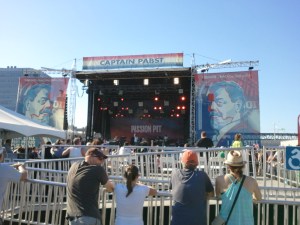
This was the act the crowd appreciated the most

This was the act the crowd appreciated the most

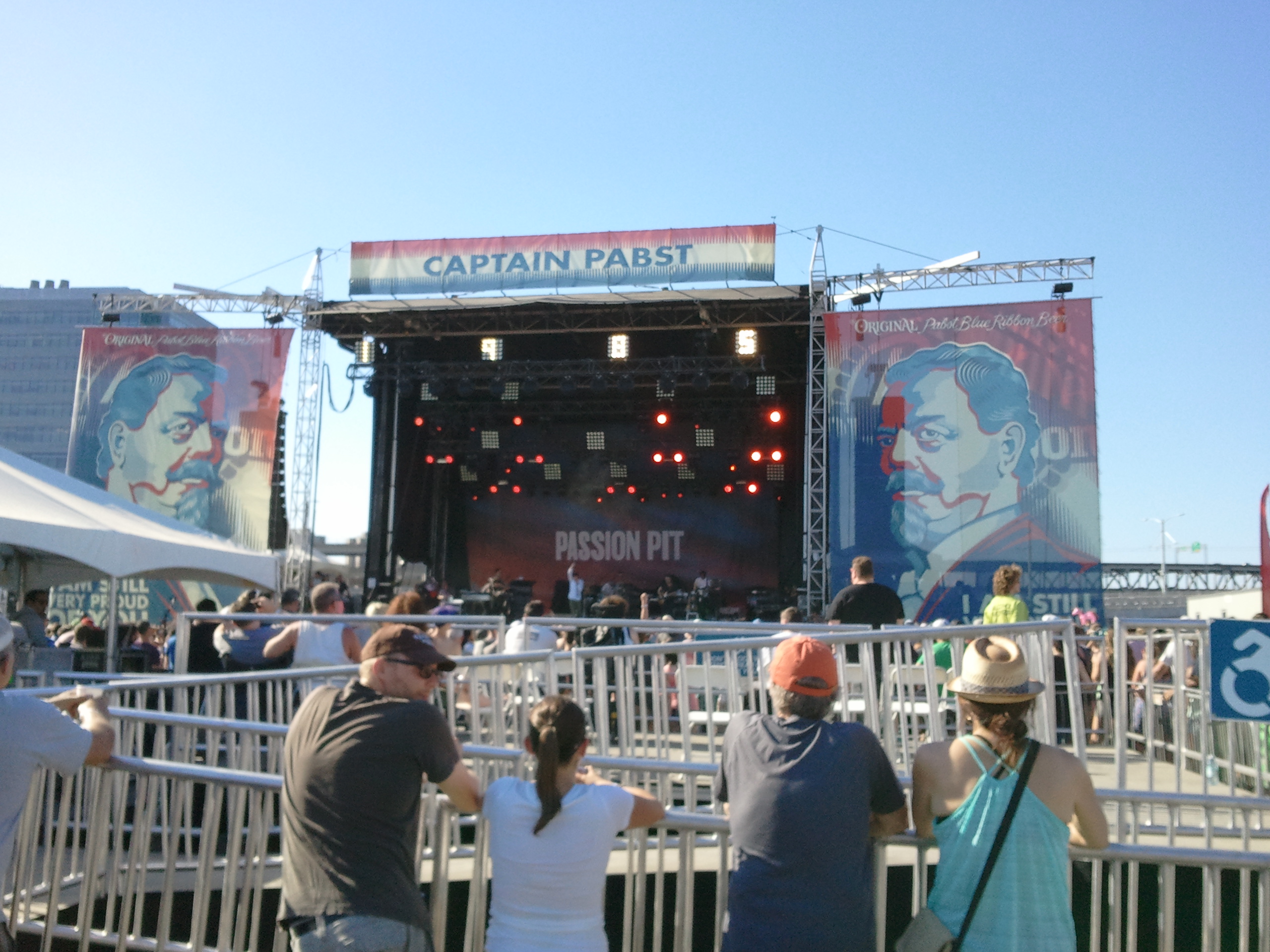
Passion Pit generated the best crowd response of the day, but my reaction to the group has always been the embodiment of the shrug emoji.
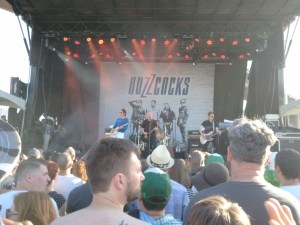
Buzzcocks still going steady

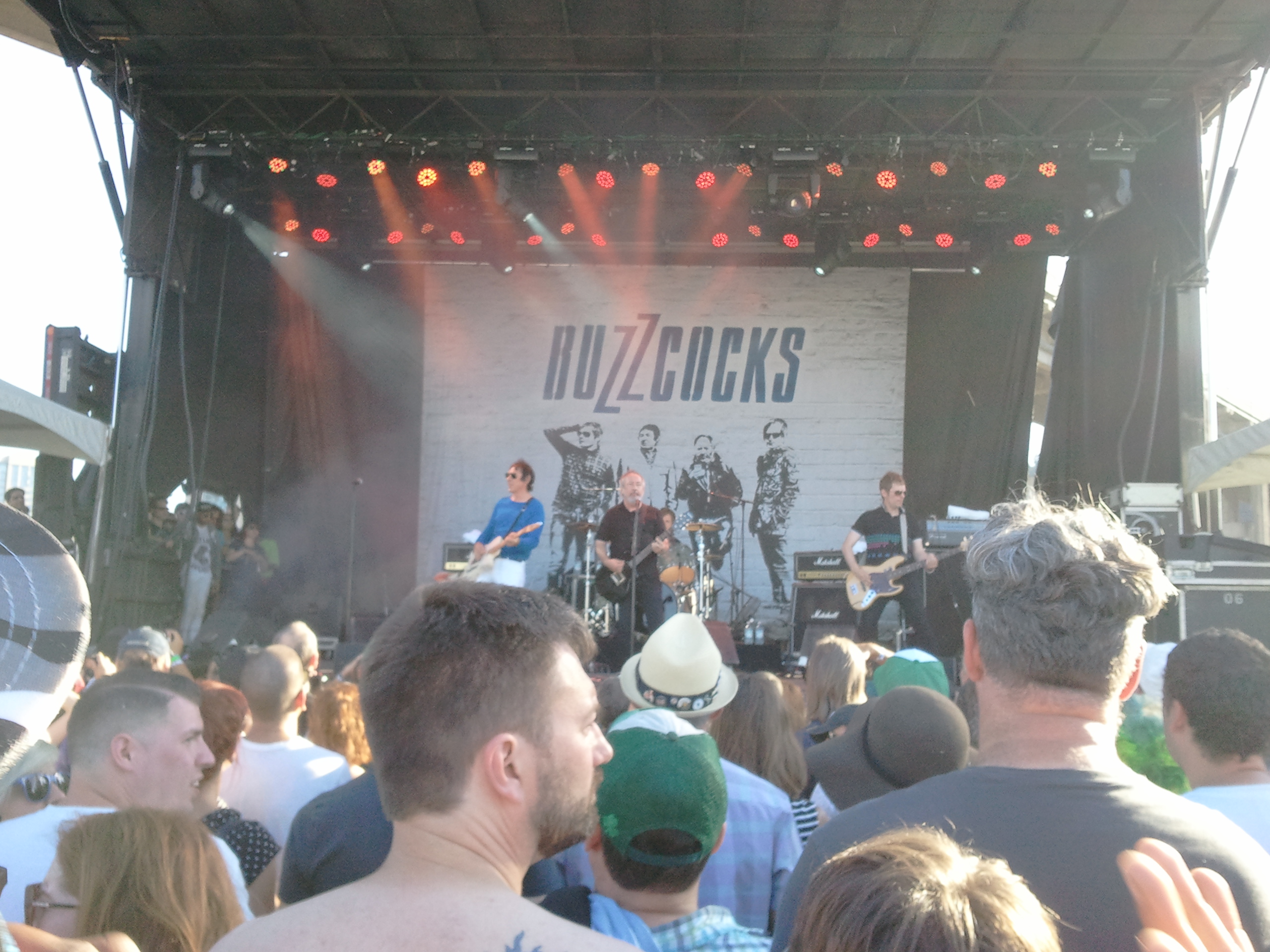
Buzzcocks still going steady

Since I spent several years listening to Singles Going Steady, a truly essential compilation for anyone who has ever dabbled in punk rock, the Buzzcocks were the “living legends” reunion I was looking forward to seeing the most at Project Pabst.  Judging by the packed backstage area, I was certainly not alone in this sentiment, as one could easily see other performers like Ted Leo singing along to the words of some of their classic hits like “Why Can’t I Touch It”, “What Do I Get?”,  and “Noise Annoys”.  The group tore through their discography at breakneck speed, with guitarist Steve Diggle constantly asking the sound mixer to crank up the volume.  Just hearing “Ever Fallen In Love” and “Orgasm Addict” live made Day 2 worthwhile in and of itself.

Weezer finished off Project Pabst with some flair.

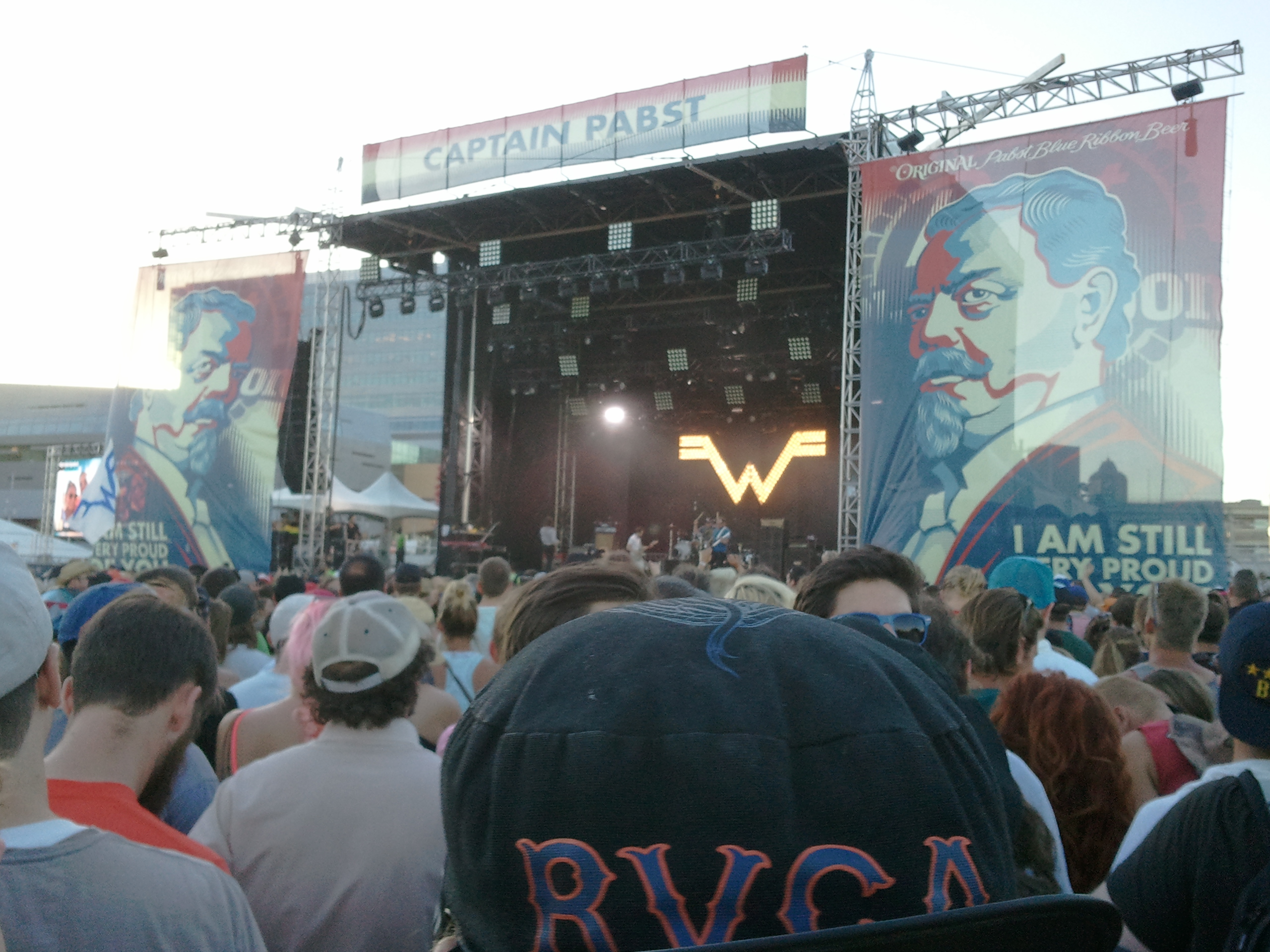
Weezer finished off Project Pabst with some flair.

There are few bands with whom I have more of a love/hate relationship than Weezer, and considering my age it should be easy to spot exactly where that dividing line occurs in the band’s catalog.  I think the surest example of how people my age should not be lumped into the catch-all “millenial” generation is that we would never cheer as loudly for “Back to the Shack” as we would for “My Name Is Jonas” or “The Good Life”.  I ended up sticking around longer than I anticipated since the group did a good job of mixing in some of their genuinely great songs with their later hits that played well to certain segments of the crowd, and I can certainly admired the well-oiled machine that Weezer the performance act has become.

Project Pabst was a solid success this go-around, but hopefully they will learn from a few of their mistakes from this edition as they set up plans for next year.  Hopefully they can create a lineup as exciting and varied as the first two editions.

Random Notes

Number of free water refills: 2

Number of beards longer than mine: 1

Number of comments on my shirt (Dinosaur Jr. Green Mind cover): 2, including a “Best Shit EVER!”

Review: Joanna Gruesome – Peanut Butter

Joanna Gruesome may have a ridiculous name (a moniker that serves as a horror movie parody of harpist Joanna Newsom does not exactly scream “lasting appeal”), but the band has delivered one of the most thrilling albums of the summer with their latest album, Peanut Butter.  It is a rollicking affair that effortlessly mixes effervescent pop and dissonant punk, all with a super-charged energy that will keep your head constantly bopping along over the course of its brisk twenty-one minute runtime.  Peanut Butter may not be the most important album you will listen to this summer, but its infectious nature might make it the one you listen to the most.

Much like they did on their debut, Weird Sister, Joanna Gruesome is able to seamlessly shift between the beautiful and the grotesque without coming across like a schizophrenic mess, alternating between melodies that are sugar sweet with moments of biting and grating dissonance.  The disparate styles actually work brilliantly in tandem, with the pop sensibilities and discordant punk attacks each enhancing the effect of the other, an intriguing marriage that brings to mind previous examples of this approach like British Sea Power’s The Decline of British Sea Power.  The brief moments of dissonance may be startling to the average listener at first and seem like digressions from the general flow of the songs, but over time these terse explosions reveal themselves to be not only a welcome change of pace but also brilliantly deployed punctuation of certain ideas.

Though few individual moments or songs leave any sort of lasting impression, it can be argued that the disposable nature of the music is a feature and not a bug.  There is no need for the listener to remember any particular melody or lyric when everything comes so fast and furious; what is more important is the general effect on the audience, which is “let’s play this record again and again.”