Recs

Clap Your Hands Say Yeah, Live at Mississippi Studios

Things had changed a bit since the last time Clap Your Hands Say Yeah visited Portland on an official tour–the band’s lineup had changed significantly, with only frontman Alec Ounsworth and drummer Sean Greenhalgh remaining from the original version.  The show also moved to the more intimate confines of Mississippi Studios, a shift from the larger (but grimier) Hawthorne Theatre.  Despite these changes, the venue was still packed with the faithfully devoted, and the band delivered with a live performance itself that was as good as ever.

The novice fan would probably be surprised to learn that the guys helping out on bass/synth and guitars/keyboards were new to the group, because the band as a unit was as tight as it’s ever been.  The band seamlessly moved between material from throughout their catalog; when listening to their records, each release is distinct from one another, but when performed live a common thread is more readily apparent (beyond the obvious connection of Alec’s distinctive voice).  It made for a cohesive show that kept the crowd consistently engaged, even if some of the most excited reactions were reserved for the early stuff.

Just barely able to get the whole thing to fit.

Just barely able to get the whole thing to fit.

The setlist emphasized both new material from their just-released album Only Run and their much-beloved self-titled debut, whose highlights like “In This Home On Ice”, “The Skin of My Country Yellow Teeth”, and “Upon This Tidal Wave of Young Blood” inspiring both raucous cheers from the crowd and a lot more dancing than per usual for a Portland show.  Though the band only played a couple of songs off of Some Loud Thunder and Hysterical, their inclusions in the set fit perfectly, with “Satan Said Dance” and “Ketamine + Ecstasy” causing the entire crowd to make the show a dance party.  However, the biggest surprise of the night was a totally re-worked version of “Some Loud Thunder”, which tossed out the jagged, heavily-distorted rock for the more bedroom-pop style of Only Run, with only the lyrics cluing in the audience as to what they were hearing (though considering how unclear they were in the original, it was a tough task in and of itself).  Though I’m a fan of the original, the new version was probably worth the price of admission on its own.
Keeping the Mississippi Studios crowd entertained

Keeping the Mississippi Studios crowd entertained.

The crowd was in a good mood, having enjoyed a bit of fun with the opener Adventurous Sleeping, a solo project of John Bowers from Nurses, though due to a miscommunication early in his set he was referred to as “Gron” for the rest of the evening.  We’ve been seeing a lot of solo acts relying on loops in recent years, but Gron kept it interesting with unusual melodies over spacey beats that intrigued and captivated the audience, and at the very least kept people in the room.  It was very much in line with the material from Only Run, so there was a nice connection between the opener and the main set.

Clap Your Hands Say Yeah’s albums themselves don’t immediately stand out as “must-see” live material, but I can say with confidence after seeing multiple shows over the years that the band consistently puts on a great show.  Songs that sound sparse or twee on record get an additional heft when played in a live setting, and the sparseness actually becomes a benefit because each distinct part is easier to appreciate, and you don’t have to worry about different instruments bleeding into each other.  The group also keeps the show light with a nice touch of self-deprecating humor, and it seems that they’re still genuinely appreciative of the fans that have kept following them over the years.  Let’s hope that devoted following remains strong.

The Mid-Year Reassessment; Or, “We Should Probably Mention These Albums”

Our primary goal here at Rust Is Just Right is to spread the love of good music, generally through a careful and informed examination of precisely what makes certain music “good”.  We like to think we’ve done a fairly good job of this, through detailed album and live reviews as well as features like “Feats of Strength”.  But even with our best efforts, we haven’t been able to share all the great music we’ve heard so far this year.  So, we’re going to put a twist on a standard practice of most other music publications: instead of posting a Best of the Year (So Far) list, we’re going to list albums that we love but for some reason or another haven’t given the proper attention.

Albums from bands that deserve more recognition, but this wasn’t the one that would put them over the top:

Tokyo Police Club – Forcefield

We Are Scientists – TV en Francais

Album from a band that we didn’t really appreciate before, but really liked their new stuff

Wye Oak – Shriek

Great album from a band where we know the drummer

Slow Bird – Chrysalis

Great Hip-Hop albums we love, but we really suck at writing about Hip-Hop

Atmosphere – Southsiders

The Roots – …And Then You Shoot Your Cousin

Great Heavy Metal album we love, but we really suck at writing about Heavy Metal

Mastodon – Once More ‘Round the Sun

Album that we meant to review as part of a larger feature, but haven’t yet

Clap Your Hands Say Yeah – Only Run

Album that is so great that we’re kicking ourselves for not writing about it sooner

Sun Kil Moon – Benji

Death From Above 1979: The Punks Throw A Dance Party

We here at Rust Is Just Right are plenty excited for the return of Death From Above 1979, so much so that the anticipation of their upcoming new album and ensuing tour has obviated our need for Caffeine Shots of Dubious Safety, as our energy needs are now fulfilled by the pure excitement of this news.  A couple of weeks ago we linked to the clip where BBC DJ Zane Lowe introduced the new single “Trainwreck 1979” for the first time, and noted how he did a great job of articulating the particular joy that this long-awaited return created for a specific segment of the music-loving population.  Then Zane did exactly what every other DFA1979 fan would do after playing the song–he hit the repeat button and played it again.

Death From Above 1979 never reached a broad audience when they first hit the scene a decade ago, and due to the specific nature of their sound, this is understandable.  But for those us that decided to give them a chance, the intervening years since their debut You’re a Woman, I’m a Machine the fanbase has only increased our rabid love for the band.  Somehow, the ultra-simple combination of bass, drums, and vocals were all we needed (okay sure, there was the occasional synth/keyboard, but this setup constitutes 95% of the album); the stripped-down, bare-bones approach was apparently all that was necessary to write songs that still held up ten years later.  To this day, You’re a Woman is in my regular rotation and serves as the perfect soundtrack to a workout or a road trip.

First, let’s give some credit to the guys (Jesse F. Keeler on bass and synth, Sebastien Granger on drums and vocals) for the name of the band and their debut album–both are immediate attention-grabbers that leave the listener intrigued as to what the music could possibly contain.  The phrase “Death From Above 1979” is partially the result of an early cease-and-desist from the DFA record label for infringement, but the tacked-on year ended up providing a compelling juxtaposition.  The addition of “1979” as almost a non sequitur helps to reassess the original phrase, which otherwise could seem kind of empty; it also in a way gives an indication of the music, signalling that the band is going back near the roots of punk and dance music.  The phrase You’re a Woman, I’m a Machine also helps clearly set the agenda of the band, providing a clear dichotomy both between Man and Woman and Human and Machine.  The album focuses a lot on relationships, set to music that is both rhythmic and emotional.  It’s a perfect description of the music.

The key to the band’s success is what at first glance may seem like a liability: their limited sonic palate.  While there have been some successful rock duos over the years (with many of them benefiting from DFA1979’s initial breakthrough, to be fair), the majority of them have opted for a guitar over a bass.  It’s a choice that makes sense, since a guitar gives a musician many more melodic options, and can even double as a bass on occasion (see Local H; “Seven Nation Army”).  The reverse is not the case–while the bass on You’re a Woman uses plenty of distortion, it can rarely be mistaken for a guitar.  It does however give DFA1979 a distinctive trademark sound, making their songs immediately identifiable.

DFA1979 doesn’t just get by on a signature sound, though; there is a purpose behind their reliance on bass and drums.  By focusing on those two instruments, it strips a song down to its barest elements, down to the closest we can get to the basic fundamentals of melody and rhythm.  By placing this restriction on their songwriting, it actually opens up the creative possibilities because it allows the group to specifically channel their ideas.  The duo is then able to focus on writing catchy riffs and propulsive beats, going beyond the simple verse-chrous-verse formula, without worrying about any other sonic details.   It’s what helps give the individual songs such a long shelf-life–you never get bored listening to a song, because each song moves quickly from one riff to the next without ever losing steam.

The approach also helped the band seamlessly blend the raw intensity of punk with the fun of dance music, even better than some of their more-celebrated counterparts in the early 00’s dance-punk movement.  While other bands like LCD Soundsystem, !!!, and The Rapture brought punk elements to a traditional rock/dance sound, Death From Above 1979 seemed to work from the other end of the spectrum, pushing punk towards dance music.  It made for a fantastic live show–even if the mix was muddy or they didn’t nail every note, their energy is infectious.  Just check out their legendary performance of “Romantic Rights” on Late Night with Conan O’Brien, with a memorable guest popping up midway through the song.  DFA1979 were never missing an edge, with their extremely-distorted bass and their lightning-quick tempos, but their songs also never lacked a danceable beat.  You could hear the elements of dance throughout their work, none more explicitly on the fantastic album-closer “Sexy Results”.

That’s why the band’s return is such an event, and how a generation of fans that were unable to see the band perform live the first time around (and didn’t feel like hitting the festival circuit in the last two years) are so excited.  And “Trainwreck 1979” is a fantastic appetizer for what is hopefully to come with The Physical World; if there was any justice in the music world, it would be universally deemed the mythical “song of the summer”.  We will be glad we can take DFA1979 off the “one-album wonder” list, and no longer have to wonder if the band could possibly follow up You’re a Woman, I’m a Machine.

Sharon Van Etten, Live at the Doug Fir

There’s always something to do in Portland.  One night you can go see Cloud Nothings play at a rundown theater behind a bar, and the next night you can go see Sharon Van Etten play in the cozy basement of the Doug Fir.  In two nights you get to see a couple of the best albums of the year, all within a picturesque town experiencing its finest weather of the year.

(To the outsiders, we’ll keep up the myth of the omnipresent rain (so they won’t move here), but 1). it’s never that much, and it’s usually only part of the day and 2). the summer almost never sees rain, and it’s the perfect temperature.)

They took down the marquee before I could take a picture, so you get this.

They took down the marquee before I could take a picture, so you get this.

The Doug Fir is my favorite venue in Portland: you get all the warmth and energy of a small club, but the sound system is excellent and you can hear all the necessary sonic details in perfect balance.  I have yet to see even a mediocre show at the venue, and it’s been home to some of my favorites over the years, including The Walkmen, British Sea Power, Los Campesinos!, Japandroids, and The Besnard Lakes.  Considering the quality of the acts that they book, my one concern is that I hope that the bands get enough of the gate that it makes their time coming out to Portland worthwhile.  It feels almost selfish that I get to see such great bands play in such a compact club.

The night kicked off with a set from Jana Hunter, touring apart from her regular gig with Lower Dens.  She had a decent set, augmenting 80’s synth-heavy beats (similar to those from the Drive soundtrack) provided by her laptop with heavily processed guitars (think early Jesus and Mary Chain or the most recent Dum Dum Girls record).  It was a perfectly pleasant way to start the evening, with a cover of “Maneater” lifting up the crowd’s spirits in particular.

Though Van Etten’s new album is notably bleak in several places, that didn’t mean that the show was a dour affair.  Sharon was both a spark and a soothing presence on stage, and in between songs she kept the mood light.  There were several fun jokes with the audience, including a discussion of her favorite ice cream (it involved multiple levels of peanut butter).  In other words, she was a complete delight.

Sharon Van Etten, a total delight

Sharon Van Etten, a total delight

Sharon bounced around between several instruments, trading guitars for various keyboard instruments and alternating spots on stage with her backing band.  Each member of the backing band did a great job, most notably the piano player (and Portland native!) who did excellent work in harmonizing with Sharon’s uniquely beautiful voice.  The set was heavy on material from the new album, which is perfectly fine considering how outstanding it is, but it was probably Tramp standout “Serpents” that generated the largest response from the crowd.  The new material sounded even better live, with some of the processed parts sounding more organic in this particular setting.  The show’s climax was the same as the one on Are We There, the heartbreakingly depressing yet beautiful “Your Love Is Killing Me”, and Sharon and her band were able to wrench every bit of emotion possible from that gorgeous lament.

As I mentioned before, the evening wasn’t just one giant downer.  It helped with Sharon’s jokes between songs, like “here’s another total bummer song”, said in a playful manner, or when she debuted a new song, an outtake from Are We There called “I Always Fall Apart”*, she made sure to mention that it didn’t aaalways happen.  The night ended on a cheerful note, as the last song was the light-hearted “Every Time The Sun Comes Up”, punctuated by comical pantomimes from Sharon.  Though I wish we could have heard some of my old favorites like “Warsaw” or “Magic Chords”, Sharon did more than enough to entertain the crowd in advance of the holiday weekend, and helped solidify the greatness of her new album with her excellent show.  Also, she succeeded in making me totally want to hang out with her.

*Not sure if this was the exact song title, since my memory is a little faded from last week (and Google is of no help), but it was along those lines.

Cloud Nothings, Live at the Hawthorne Theatre

It had been a long time since I’d seen Cloud Nothings live, back when I caught them on an Austin rooftop at SXSW in 2011.  Cloud Nothings morphed from a bedroom/pop-punk project of Dylan Baldi into a full-fledged band, first as a four-piece and now as a trio, with their albums Attack On Memory and Here and Nowhere Else grabbing the attention of both audiences and critics.  I was impressed with them back then, and their recent work enhanced their reputation even further in my mind, so I was eager to finally witness the band’s evolution on stage instead of just on record.

The night kicked off with The Wytches, a band that sometimes provided energy, and sometimes provided noise; melodies were strictly optional.  METZ in many ways followed the same pattern; the way I put it was that “METZ are really good at making a lot of noise at a quick tempo”.  It was a fiercely energetic punk rock, with music that alternated between dissonant chords or emphasizing a bended note for measures at a time, and vocals that were an indecipherable yell.  It reminded me a lot of Side 2 of Nevermind, and then I got a little depressed wondering if the band members were even alive when that album was released.  By the end of their set, they had won me over a bit, as I let the cacophony rain over me and thought “Sonic Youth really should’ve written some more hardcore songs”.

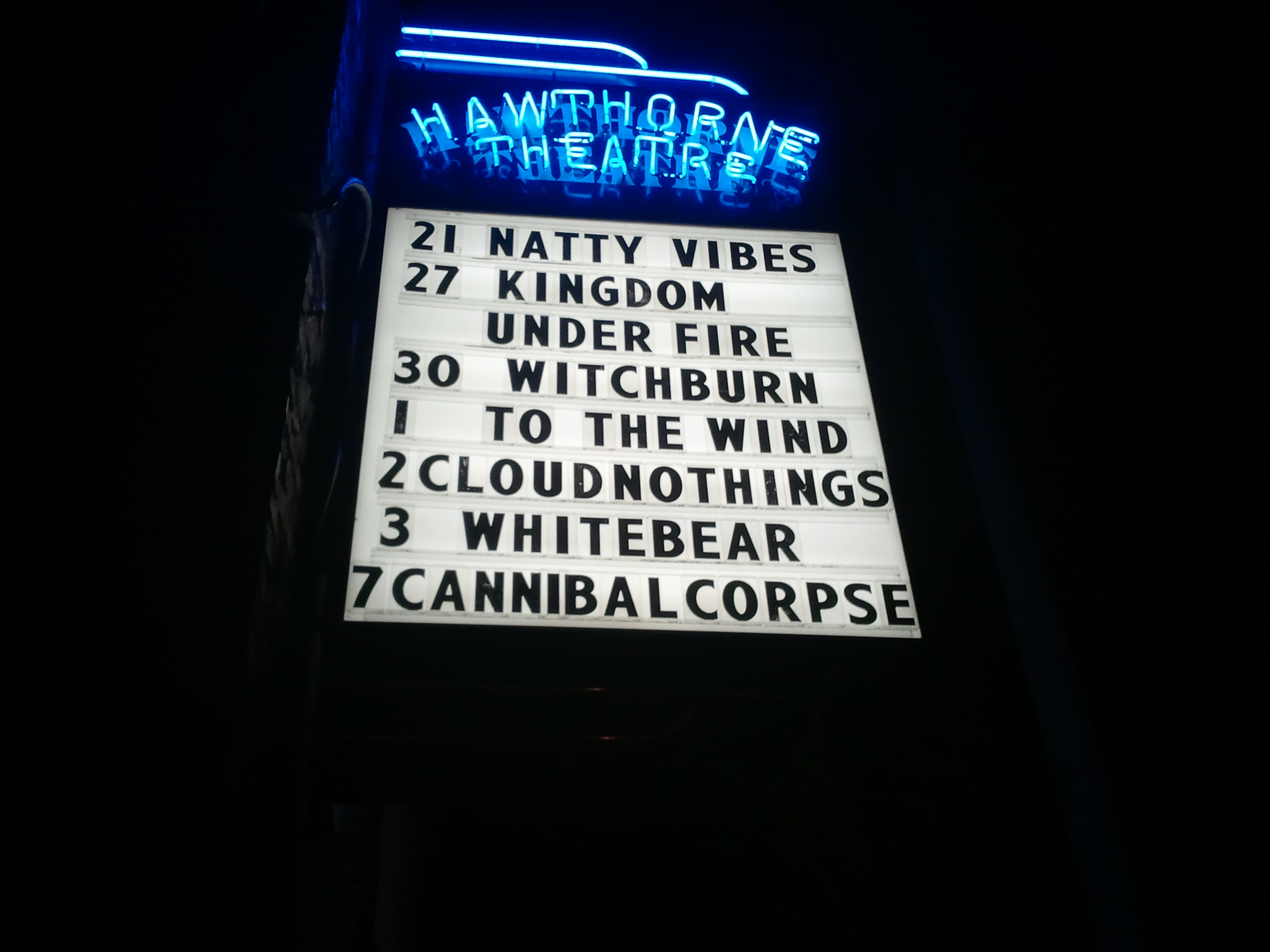
My phone can at least capture a pretty clear picture of the marquee

My phone can at least capture a pretty clear picture of the marquee

As we waited for the headliner to hit the stage, a quick look around the room gave me the impression that a significant portion of the crowd was even younger than the band members themselves.  I’m pretty sure I have some concert t-shirts that were older than many crowd members, and I’m still on the right side of 30 (though to be fair, we moved from the Adult Beverage section to the front in order to have a more proper experience of the show, so that easily skewed my perspective).  But you know, school’s out for the summer, so I’m perfectly fine with the Youth of America heading out to a punk rock show, especially for a band that’s influenced by the group that wrote an excellent album by that name (Portland’s very own The Wipers).

The more recent material from Cloud Nothings has been angrier and more cynical, but Dylan was a perfectly polite host, as he introduced the band to the crowd.  For the most part, the specific interaction with the audience was minimal, since there was business to attend.  The band tore through mostly newer stuff, rarely taking a breath or stopping to tune.  It certainly didn’t sound like the band was just kicking off a new leg of their tour after taking a short break, since the three guys were just about as tight as possible (when I informed my friend of this fact, he said he never would have guessed).

The lighting did me no favors.

The lighting did me no favors.

Each member turned in a great performance, with drummer Jayson Gerycz sounding as spectacular live as he does on record; the ridiculous acceleration marking the climax of “Psychic Trauma” being a particular highlight.  Dylan’s guitar-playing was also quite the sight, as his fingers performed some incredibly nimble gymnastics across the fretboard.  It’s clear that he uses a lot of interesting and unique chords to get that interplay between rhythm and lead, but to see it actually performed in action gave me a whole new appreciation for his composition skills.  Dylan also tore into a couple of fierce solos, with the one in “Stay Useless” energizing an already-amped crowd.

As could be expected, the sound mix wasn’t particularly good, with different parts burying each other.  The bass was especially brutal, often drenched in unintended feedback and overtones, the vocals were often muddy, and the guitar never really loud enough to hear all the necessary details.  The Hawthorne is not a particularly forgiving space, but the band still put on a great performance built on energy and crowd familiarity.  We didn’t need to hear every single note to know that we just heard a fantastic show.

The band has departed.

The band has departed.


Review: Peter Matthew Bauer – Liberation!

We’ve professed our love for The Walkmen on Rust Is Just Right on several occasions, but even we’re surprised at how much we’re enjoying all the new albums that have been released in the wake of the band’s recent hiatus.  A couple of weeks ago, we reviewed the stellar solo debut of frontman Hamilton Leithauser, and now we’re doing the same for bassist/organist/guitarist/etc Peter Matthew Bauer.  We had never heard Bauer sing before, but we were at least familiar with his presence–his bouncing form was a trademark sight at any Walkmen show, and his instrumental parts were the key components to several of the band’s best songs.  There were high hopes in anticipation of Liberation!, but it was difficult to imagine what the final product would be.

There are still some elements of Bauer’s previous band to be found, most notably the distinctive trebly guitars and the basic but powerful drumbeats (the latter of which can probably be attributed to the presence of Walkmen co-member Matthew Barrick on percussion).  These touches don’t overwhelm the song, but fans of the band should be able to pick them out and appreciate them.  The shambolic solo guitar intro to “Irish Wake In Varanasi (For Big Pete Devlin)” recalls the great hit “The Rat” before switching gears into solid, driving rocker, and first single “Latin American Ficciones” seemingly could have evolved from a lost Walkmen track, an experiment where the band decided to switch vocal duties along with instrumental ones.

But Bauer mixes in a wide variety of unexpected influences into that basic template, including field recordings, latin touches, and most notably a stream of Eastern Indian instrumentation that runs throughout the album.  The integration of these musical influences also mirrors many of the lyrics and narrative themes of the album, as Bauer recounts his unique experiences and encounters stemming from a variety of religious backgrounds, including Hinduism, Christianity, and Scientology.  The album doesn’t look only to the past, however; after its delicate instrumental intro, “Philadelphia Raga” shifts into a slightly bouncy but breezy folk, echoing some of the recent work of contemporaries Real Estate and Kurt Vile.

The title Liberation! does seem to fit the album well, even without consulting the lyrics; there is a definite road-trip feel to the album, as if it were a soundtrack to an aimless but fruitful wandering across the country (and not a direct reference to releasing a solo album, considering the presence of Barrick and musical callbacks).  Bauer acquits himself just fine as a vocalist, carefully not exceeding his range, and makes use of his flat style to deliver his tales of the road in a convincing manner.  Though there are few moments that match the highlights of his previous band, Liberation! is still a nice surprise that’s worth repeated listens.

Review: The Antlers – Familiars

It’s probably hard to discuss an album from The Antlers without comparing it to their previous work at this point, at least for me.  Familiars is an absolutely gorgeous album, one that’s well worth exploring for hours on end with headphones cranked as high as you can stomach, which should be enough to recommend it on its own merits.  But from a critical perspective, it begs to be analyzed in comparison with the band’s previous work.  Fortunately, in my opinion, that only enhances the excellence of the album, though I wonder how useful this perspective is for the novice.

The good news is that this should be easy to fix.  To those of you who are new to The Antlers, I recommend that you stop whatever it is that you’re doing and you immediately go and purchase a copy of Hospice, their breakthrough album (at least among the music critic intelligentsia; while it made several Top 10 lists in 2009, I would highly doubt that it sold more than a hundred thousand copies, much less went Gold or above).  I would prefer that you get in the car and drive to your closest independent record store, but I understand that may be a significant demand of some of our readers, so I will let a quick purchase online slide…this time.  It’s not a difficult listen, like most critics’ faves are; in fact, it’s filled with huge melodic hooks and incredibly moving instrumentals, all hanging on an easily digestible allegorical storyline of a disintegrating relationship between a nurse and a terminally ill cancer patient.  Though the subject matter is bleak (and the lyrics often make this abundantly clear–if you don’t feel at least the beginning of tears when listening to the bridge of “Two” or the end of “Wake”, then it is possibly that you are an android), The Antlers are able to provide enough hope through their music that the listener knows that just because these are the worst emotions you can deal with, that does not mean that this is the end; there is still the possibility of triumph, the chance that redemption is still possible.

Burst Apart dealt with similar emotions, this time substituting the dying patient narrative with a more conventional analysis of the end of a romantic relationship, while also expanding the band’s sonic palette.  Hospice often relied on toy instruments or thin sounds, but Burst Apart was built on expanding the sonic depth of each instrument.  It’s this path that The Antlers continue on with Familiars.  The musical exploration is not necessarily with chord progressions or melodies, but instead on textures and deepening the general sound.  Think of playing a piano, where instead of relying on three notes to determine the shape of a chord, instead the entirety of both hands is used to give the maximum amount of color with each chord.  It’s in this regard where we see the evolution of the band’s sound.  For example, the single “Hotels” in many ways would sound like it could easily fit on Burst Apart (in fact, it shares many melodic similarities with “I Don’t Want Love”), but there are enough nuances in the song that distinguish it from its predecessors.

There are numerous slight subtle musical touches that reveal themselves after multiple listens, especially on the second half of the album.  The upright bass on “Revisited” is a particularly striking example: the particular tone of the upright as opposed to the typical electrical bass provides an excellent counterpoint to the melodies occurring simultaneously over the top.  This is typical of the areas where The Antlers are content with exploring throughout Familiars, and rarely does the band attempt the big hooks found in either Hospice or Burst Apart.  All the choruses and climaxes are the result of slow burning builds instead of sudden explosions; that is to say there are no counterparts to say the fiery refrain of “Bear” or the catchy jangle of “Every Night My Teeth Are Falling Out”.  This can make it a disappointing listen at first, but hopefully it’s apparent that there is more lurking below the surface that’s worth exploring.  The band takes its time with each track, furthering the process the band began with the stop-gap Undersea EP, with nearly every track clocking in above the five-minute mark (with the two below it coming in at 4:59 and 4:56).  That said, the songs rarely lose focus and should hold the listener’s attention throughout.

I haven’t been able to deduce whether there is a coherent story or theme throughout Familiars, but it’s probably worth noting that the lyric sheet has alternating lyrics in italicized and normal print, indicating multiple viewpoints at the very least.  The good news is that the music underneath seems to be worthy enough of continued exploration that it’s still probably a productive use of time to determine the overarching story.  It’s hard for a band to continue to impress after an artistic triumph like Hospice, but The Antlers are providing a good roadmap on how it can be done.

Review: Parquet Courts – Sunbathing Animal

As you may have noticed with our various features and mentions of the band, we here at Rust Is Just Right are big fans of the band Parquet Courts.  Their album Light Up Gold made our Best Of 2013 list*, and when we heard that a follow-up was coming this year we were extremely excited.  We loved their incisive blend of Pavement-meets-Minutemen smart-ass punk, and were hoping for another quick blast of their nervy, no-frills guitar rock.  However, it seems that these expectations have only set us up for disappointment, and while Sunbathing Animal has its moments, too often it seems like we have to work to get its full rewards.

Part of what made Light Up Gold work so well was the willingness of the band to get to the point and then get out of the way.  Parquet Courts would write a couple of quick hooks, say their piece, and then end the song–Light Up Gold was a lightning-quick 15 track/33 minute album, with several songs less than two minutes.  When the band would stretch out on certain tracks, like “Master of My Craft” or “Stoned and Starving”, there was enough momentum to sustain your attention, and enough interesting ideas that made it worth your while to stick with it (we wrote a feature specifically about the latter’s use of making the mundane seem epic, and how the band used the relatively epic track length in comparison to the rest of the album to its advantage in our Feats of Strength feature).  On Sunbathing Animal, many of the tracks seem to stretch out a minute or so too long, at least if you have the Light Up Gold template on your mind.

There’s still a lot to recommend on Sunbathing Animal, however.  Yes, the comparisons to Pavement’s slacker-ish attitude and careful tunelessness are still apt, and those trebly guitars with minimal distortion are still on full display.  Songs like “Vienna II” and “Always Back in Town” keep up the uptempo, ramshackle spirit of their earlier work, and songs like “Black and White” and “What Color is Blood” show that the band can find new areas to explore within a similar sound.  It’s in songs like the title track that you can see the new emphasis of Parquet Courts, focusing on ideas like repeating patterns and unbreakable cycles.  “Sunbathing Animal” is one song where the longer-than-expected song length eventually works to its advantage, with the anticipation of some sort of resolution continually delayed, increasing the tension that the listener feels as the band bashes away and vamps on a single chord with barked-out vocals.  By the end, you’re ready to sing along with the words of the title, and somehow it provides a satisfactory conclusion even though the music itself doesn’t seem to resolve as you would expect.

But even knowing in advance the emphasis on repeated patterns can make the album a slog in certain places; the album practically dies with “She’s Rolling” in the middle, and “Raw Milk” kills all the momentum from the goofily fun “Ducking & Dodging”.  Then again, one of the highlights is “Instant Disassembly”, which somehow manages to ride a simple melody played at a languid pace over the course of its seven minute long running time; it certainly helps that while it may be basic, the melody is still catchy.  I imagine that the band had in mind the irony of naming their longest song “Instant Disassembly”; it’s possibly also why they named the song that almost stops the album dead in its tracks “She’s Rolling”.  I can admire their intent, but as a casual listener it’s not always a successful approach.  While Sunbathing Animal has grown on me with repeated listens, it’s unlikely to take the place of Light Up Gold in my car’s stereo.

*We know that technically Light Up Gold was released in 2012, but it was such a limited run that most people didn’t hear it until its 2013 re-release.  And if you claim that you were one of those few people who did hear it in 2012, you’re probably a liar.

Review: Fucked Up – Glass Boys

My introduction to Fucked Up was through their album The Chemistry of Common Life, and that initial listen was the first time since Refused’s The Shape of Punk to Come that I was excited about the direction of punk rock.  It’s hard to forget that opening of “Son The Father”, with the faint strains of flute dissolving into a gradual cascade of guitars to form an immense wall of sound, only to be punctured by the howling screech of Damian Abraham.  It was then that all hell broke loose, and the assault didn’t let up for the rest of the album.  It was amazing to hear hardcore punk escape from the box that it had built around itself over the years–here we had all the aggression and fury of the classics, but with music that didn’t focus on the same drumbeat or the same tired melodies.  It was clear Fucked Up wasn’t content with repeating the same old formula, and that’s what made them so exciting.

They reached for the stars with their next album, David Comes To Life, an epic rock opera with a complex and detailed storyline.  It scored rave reviews from critics, but personally I never fully connected with the album, simply due to its sheer length.  It may speak more to my diminished attention span more than anything, but it’s hard to keep engaged with an album that is going 110 mph for 80 minutes; after an initial giddiness that comes from listening to the first third of the record, songs started to bleed into each other and it became a chore to finish the album.  For someone like me who prefers to listen to full albums at a time, this is a problem.

Thankfully, Glass Boys is a leaner machine, and it works to the album’s benefit.  “Echo Boomer” begins the album in much the same way that “Son The Father” did, using an initial soft touch before packing a wallop; this time, with the flute replaced by a toy piano before the guitars kick in.  There’s a better sense of balance throughout the album as a whole, with a natural ebb and flow in tempo and dynamics.  “Sun Glass” opens up with the strumming of a summery acoustic guitar, before it kicks the door down with its call-and-response chorus.  “Sacred young, feel the sun, vermillion” are not the usual lyrics to a hardcore song, but it speaks to how the band is deciding how to view their place within the hardcore scene; later on, the line “We all get replaced, retconned and upstaged, life turns a page” states the fear directly.  It’s also one of the best lines I’ve heard all year.

The album hits a rough patch in the middle; the songs individually are fine, but when listening in context with the rest of the album and after the rousing opening, they suffer in comparison.  However, the album picks up again with the thrilling final three tracks.  “Led By Hand” has an intriguing minor-key melody that’s elevated by it’s sing-along background vocals, reminiscent of The Men in the Open Your Heart era.  “The Great Divide” ramps the tempo up and it sounds like it’s the most fun the band has had in years.  And the title track finishes the album with a blast, keeping the energy up but providing the cathartic resolution that the album needs with each repetition of “Glass Boys”.  The album ends as it began, with solo piano, but it captures a more subdued mood (if anything, it reminds me most of the end to Faith No More’s “Epic”–if that’s the inspiration, then it’s the perfect nod to conclude the album).

Glass Boys ends up being the album that fulfills the promise of The Chemistry of Common Life better than David Comes to Life did.*  Whereas Refused’s magnum opus showed how punk rock didn’t have to be confined to a specific genre, and could incorporate musical ideas ranging from electronica to jazz, Glass Boys shows that you can have all the intensity of hardcore without being constrained by the same formula time and time again.  Yes, Damian Abraham’s gruff bark will be the first thing that gets the neophyte’s attention, as well as the ferocity of the attack from the music.  But there is scope and sweep to the album behind it that helps amplify the band’s search for meaning, as they reflect on their place within the music world and their relationship with their audience.  It’s a coherent, cohesive statement, and despite the themes of the album, hopefully this is the beginning of a new chapter for Fucked Up.

*I saw this pointed out somewhere on the internet, but it is rather interesting that the artwork of David Comes to Life and Glass Boys seem to have been switched–the statue of David is used for Glass Boys, and two glass light bulbs are used for David Comes to Life (in the shape of a heart (fitting the Queen of Hearts character) or testicles (if held upside-down)).  Considering the time in between the albums and the tension within the band during that time period, it would be amazing to find out if this was indeed planned.

Review: Hamilton Leithauser – Black Hours

In a week filled with great new releases, it’s Hamilton Leithauser’s Black Hours that outshines them all.  The debut album from the former frontman of The Walkmen masters the tricky conundrum that plagues every artist that goes solo: satisfying old fans while justifying the decision to go solo.  Hamilton indulges enough touches and signifiers that recall the unique sound of The Walkmen, while experimenting with new ideas and leaving enough of his own personal imprint that makes Black Hours a work distinct enough from his previous output.

Hamilton’s voice is one of the most recognizable in indie rock, and the full range of his rough-around-the-edges style is showcased throughout Black Hours.  He switches effortlessly between an exuberant bark (“Alexandra”), to a joyful serenade (“11 O’clock Friday Night”), to a delicate croon (“St. Mary’s County”), and that’s within the space of three songs.  The performance on Black Hours is reminiscent of the more recent Walkmen albums, where Hamilton learned to use the right amount of restraint with his voice, and not let its power get out of control.  That said, he can still let it out when he needs to, as he does on the exhilarating “Alexandra”.

Listeners should be able to pick out specific instrumental touches throughout Black Hours that evoke the trademark work of The Walkmen.  Most notably, there is the clean, trebly guitar that appears in songs like “I Don’t Need Anyone” and “Bless Your Heart”, so it should be no surprise that it’s former bandmate Paul Maroon that helps out with guitar, strings, piano, and organ on eight of the ten tracks.  There are other small callbacks that should grab the attention of Walkmen fans, most notably a chorus form “11 O’clock Friday Night” of “You and me and everybody else” that seems designed to specifically evoke one of their best-received albums.

Even with all these details that hearken back to his previous band, Hamilton does enough to separate Black Hours from his previous work.  “5 Am” is a spare, haunting ballad that would fit nicely in Leonard Cohen’s back catalog, and “The Silent Orchestra” continues with that retro-ish feel with the use of a playful backing orchestra, a style befitting that of a classic Dean Martin or Sinatra record.  There’s the goofy marimba from “11 O’Clock Friday Night”, which sets the tone with a melody that rips off the old “Updated Score” sound from ESPN’s BottomLine ticker, and is soon matched by a prominent bass and embellished by the guitar.  The careful use of strings throughout the album add a new dimension to many of the songs, but most effectively on “Self-Pity”.  In the end, Hamilton doesn’t fully escape the identity of his old band; album closer “The Smallest Splinter” would fit perfectly within the tracklist for Heaven, and the careful, midtempo ballad is one of the highlights of the album.  But that’s okay–when you were a member of one of the best indie rock bands of the past decade, no one should complain that the new music sounds a little bit like the old stuff.