Recs

Bully, Live at Mississippi Studios

We here at Rust Is Just Right are big fans of Bully’s debut album, Feels Like, and we jumped at the opportunity to catch this exciting young group in action.  They stopped by one of our favorite Portland venues over the weekend, delivering a tight and energetic set at Mississippi Studios this past Saturday night.
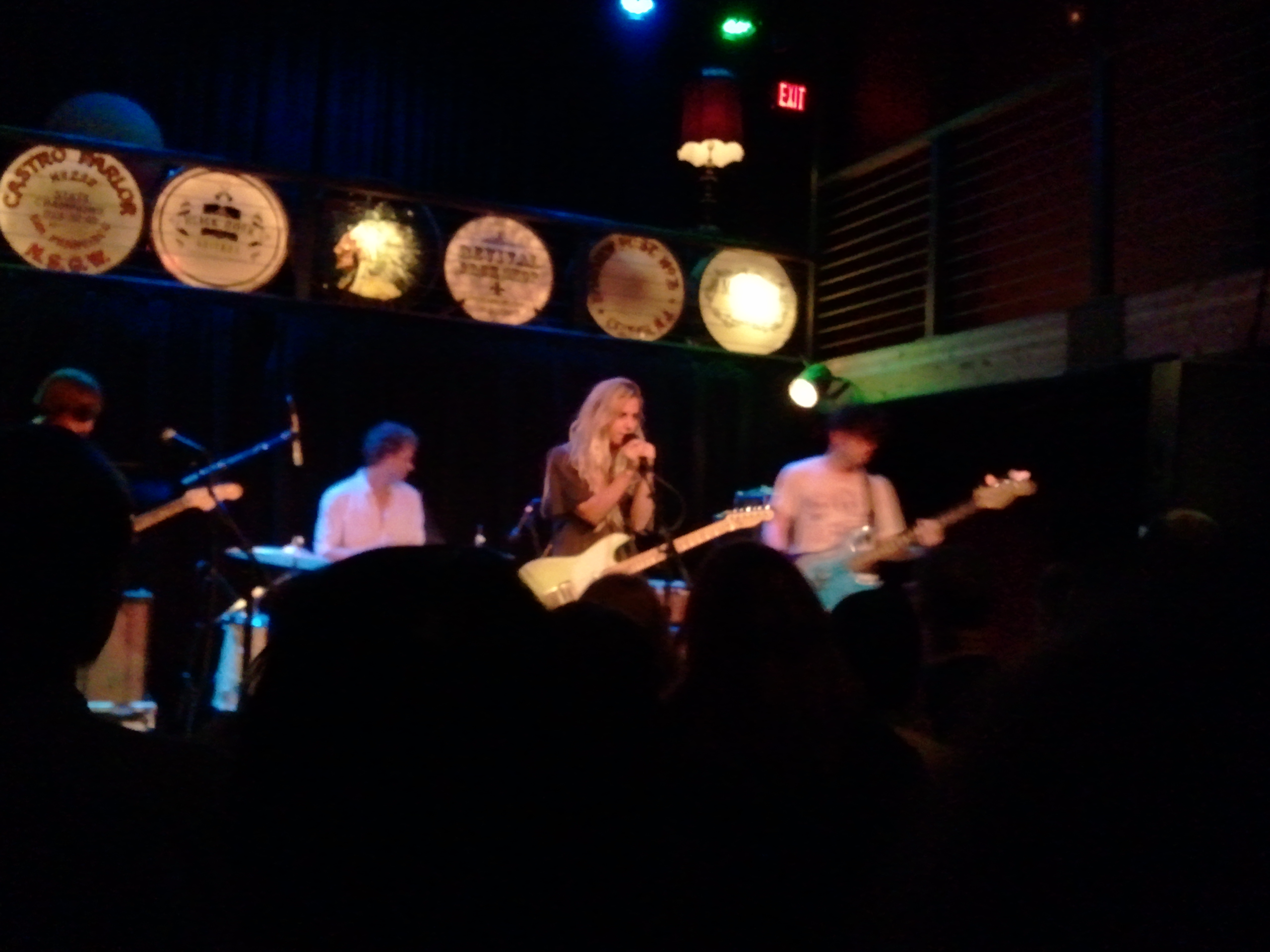
Bully, in the middle of "Trying"

Bully, in the middle of “Trying”

It is always strange when you see a headliner touring behind a single album, since you already know what the set will be.  There are only a few potential variables, namely whether or not any songs will be stretched out or whether any covers will be thrown into the mix, but beyond that everything else is known.  Considering Bully’s quick and punchy songs, there was almost no chance that we would see an extended jam session, but we did witness a couple of covers (which after some research seems to be “Black and White” from the dB’s and “Who Was in My Room Last Night?” from the Butthole Surfers), plus an impromptu “Happy Birthday” sing-along with the aid of the crowd for a member of the opening band.

As for the regular set, the band faithfully recreated what we heard on the record, and captured the spirit of the album.  Leader Alicia Bognanno’s yell was in perfect condition, and she also showed a nice delicate touch with her vocals during some of the softer moments.  Though they have only been touring behind this album for a few months, Bully sounded like a group of old pros.

Seems like a good motto.

Seems like a good motto.

Openers Dead Soft were a perfect fit for the bill, with their sound covering similar 90’s indie rock territory as Bully.  Heat was an intriguing second band, as they mixed several different influences from various eras of rock (including a strong Velvet Underground vibe in their first song).  However, their frontman could use a little more practice in doing some crowdwork, as he came off a bit standoffish when there was little reason for it.

Review: Wavves – V

Belying his slacker persona, Nathan Williams has been remarkably busy since the release of the last Wavves album two years ago.  Afraid of Heights was one of our favorite records of 2013, and reached the third spot in our inaugural Best Albums list; since then, Williams has formed an electronic side project with his brother (Sweet Valley) and released a collaborative album with Cloud Nothing’s Dylan Baldi (No Life For Me), and after the release of several extra Wavves tracks for various projects, was able to find some time to record a proper follow-up.  It seems that by dividing up his attention into pursuing all these different projects has allowed Williams to focus on a singular approach for Wavves, as V is the most streamlined album the band has released in years.

V is a giddy rush, blasting through eleven tracks in half an hour, but by relying on a particular formula leads to some diminishing returns as the album progresses.  Each song is amped up to eleven and played at a breakneck speed, and while individually each song is great and could be selected for a single, it can result in a numbing effect when listened to as a whole.  The album is missing some of those excellent mid-tempo numbers like “Demon to Lean On” or “Afraid of Heights” from their previous album, or those crazy studio experiments like “Baseball Cards” and “Convertible Balloon” from King of the Beach, both of which helped make for more cohesive records.

However, Williams shows once again that he can write a great hook, as V is absolutely stuffed with earworms that will immediately grab your attention.  As fans should expect at this point, all those sunny melodies and cheerful musical background serve as an excellent foil to lyrics that revel in self-loathing, though even in the wake of an apparent breakup the mood is a tad merrier than on Afraid.  The group also displays a remarkable capability to create the most artificial sounds possible with traditional rock instruments, and careful listening reveals a wealth of material lurking in the background of each track.

For a band that has a long history with the letter “v”, it is a fitting gesture to name the group’s fifth album with the Roman Numeral, and the record recaptures the energy of the band’s early years, but with a much better recording budget.  V may not reach the heights of its predecessors, but it can serve as a welcome shot of adrenaline or as a palette cleanser after some other more dour and serious records.

Review: Deafheaven – New Bermuda

Now this is how you follow up a masterpiece.  With New Bermuda, Deafheaven have matched the brilliance of their universally-beloved album Sunbather, and have created another record filled with thrilling, triumphant climaxes and breathtakingly gorgeous moments that show the power and diversity of metal as a genre.  New Bermuda works both as a cohesive whole as well as five fantastic individual tracks, as each listen prompts me to proclaim a new track as my definitive favorite.

To answer the first question that is on every non-metalhead’s mind when it comes to Deafheaven: yes, George Clarke still employs that banshee-yelling technique on every song.  In fact, the vocals are a bit more prominent in the mix than they were on Sunbather, but they might be an even better fit with the accompanying music on New Bermuda.  At the same time, while Clarke’s delivery is as harsh as ever, his “diction” has become clearer, with individual phrases easier to parse than before–to this day, the only phrase I can pick out from Sunbather is the line “I want to dream” from “Dream House”, and that was only after several listens and a careful look at the lyric sheet.  In other words, those turned off by this facet of Deafheaven’s sound are unlikely to be converted with New Bermuda, but those who appreciate/have made peace with it will have no problem.

While there are still several moments where Deafheaven incorporates elements of shoegaze into their black metal style, New Bermuda finds the band adding more concepts from traditional metal into their songs.  Whereas Sunbather was characterized by brick walls of guitars creating dense chords with shifting, underlying melodies, New Bermuda often focuses more on riff-based songwriting and single-note solos.  In terms of the tone and complexity of these riffs, the band finds a spot where early-Metallica and late-System of a Down meet, evoking Leviathan-era Mastodon as well with their furious churning nature.  In addition to the fantastic work from guitarist Kerry McCoy, who adds a wah-inflected solo and subtle slidework to his repertoire, drummer Dan Tracy shines once again with his furious but precise work behind the kit, alternating between blastbeats and more subtle grooves.

The post-rock interludes that distinguished Sunbather from other metal records are now integrated into the songs themselves, as they often dissolve into beautiful instrumental passages marked by guitars drenched in reverb and delay (among other effects) atop subtle, rolling drums.  These moments go beyond the usual Explosions in the Sky comparisons and recall some of the more lyrical moments of Slowdive, an intersection of post-rock and shoegaze that is especially evident in the outro to “Come Back”.  There is only one noticeable Godspeed-like field recording this time, a brief and cryptic snippet of a traffic announcement warning about the closure of the George Washington Bridge.

There is no single moment that approaches transcendence, as they were able to accomplish with “Dream House” and “The Pecan Tree” on Sunbather, but New Bermuda as an album is every bit as equal.  It is crazy that this is as close to criticism as I can get for this record, but New Bermuda is that much of an accomplishment.  Deafheaven have now firmly established themselves as one of the most important groups of the current era, and have laid the groundwork for a long and fruitful career.

Reviews: Quick Hits (Part 2)

Though we here at Rust Is Just Right try as hard as we can, it simply is not possible for us to review all the great new albums that come across our way.  However, since our goal is to highlight great music that you may have not discovered yet, we feel obligated to at least give a brief mention to some of the records that we have accumulated over the past few months that are worthy of your consideration.  With that in mind, we present another slate of albums.

Frog Eyes – Pickpocket’s Locket With their previous albums Tears of the Valedictorian and Paul’s Tomb: A Triumph, Frog Eyes showed a certain flair for the dramatic, delivering cracked indie rock epics that can overwhelm listeners with their passion and intensity while challenging their preconceived musical sensibilities.  For this album, Casey Mercer has pulled back a bit and offered a more stripped-down version of his group’s bombastic sound, but delivered with a similar fervor.  You still get Mercer’s unique voice, but this time it is often accompanied by strings.

HEALTH – Death Magic For their long-awaited follow-up to Get Color, noise-rockers HEALTH have decided to throw on the most depressing dance party ever.  Industrial affectations adorn slow, slinky beats, creating a menacing if alluring album.  The only downside is a tendency early in the album to borrow a melody from Vampire Weekend’s “Giving Up The Gun”, but that might be a problem that does not afflict everyone equally.

Lou Barlow – Brace the Wave It is really strange that two of the members of probably the loudest fucking band on the planet, Dinosaur Jr., enjoy making gorgeous acoustic music in their spare time, but such is the case for J Mascis and Lou Barlow.  To be fair, Barlow has shown this side for years, even on a handful of Dino songs, but Brace the Wave is an especially gorgeous collection of songs.  Recorded after the dissolution of a long marriage, there is the expected melancholic element, but it is balanced with several moments of fragile beauty.

Wire – Wire The old punks are still kicking, and they are as restless as ever.  Not content to rehash their early work that has inspired countless modern bands, Wire instead dives into a dour post-punk take on shoegaze.  That is probably a poor characterization of their sound, but goes to show how the band has always managed to defy description.

Wolf Alice – My Love Is Cool The band got some airplay with the aggro-indie track “Moaning Lisa Smile”, but the album as a whole exhibits far greater diversity than one might expect.  Wolf Alice shows a bit of love to multiple 90’s subgenres and trends, but avoids sounding like a rehash of that decade.  My Love Is Cool does not quite work as a cohesive album, but there should be plenty of stray tracks that fans will love.

Reviews: Quick Hits (Part 1)

Though we here at Rust Is Just Right try as hard as we can, it simply is not possible for us to review all the great new albums that come across our way.  However, since our goal is to highlight great music that you may have not discovered yet, we feel obligated to at least give a brief mention to some of the records that we have accumulated over the past few months that are worthy of your consideration.

Ceremony – The L-Shaped Man This album sounds like a lost collection of Joy Division/early New Order B-Sides, and I mean that with absolutely no snark at all.  That should come as no surprise, considering the band is named after the song that served as a bridge between the two bands, but this actually represents a shift in sound for a group that previously trafficked in a style closer to hardcore.  In other words, take every smartass remark made about Interpol and apply it to these guys, but we suggest that you refrain from over-intellectualizing and instead embrace the gloomy grooves.

Deradoorian – The Expanding Flower Planet Fans of the Dirty Projectors are well-acquainted with the beautiful, ethereal voice of former member Angel Deradoorian, and they should be delighted with her solo debut.  It is easy to get lost in the trippy, psychedelic journey that Deradoorian takes on this record, though at times it can make for a frustrating listen, despite the abundance of talent on display.

Ducktails – St. Catherine The side project of Real Estate guitarist Matt Mondanile shares many of the qualities that led fans to appreciate his main gig, namely easy-going vibes and slick, pretty leads.  However, Mondanile does get to indulge a bit and explore other sounds, venturing towards the synthpop side of the music spectrum.

Ratatat – Magnifique There is nothing quite like this distinctive instrumental duo, who blend electronic beats and catchy inventive guitar riffs.  For this go around, Ratatat shows off their sunnier side, incorporating elements of surf music into their trademark sound.  The album seems to drag on a bit longer than it should, but it would be hard to cut out any specific track, because that would mean missing out on some excellent hooks.

The Sonics – The Is The Sonics The garage-rock pioneers have returned with a vengeance, proving that the old guys still have the energy to blow the young folks out of the water, so to speak.  In other words, this is not your typical embarrassing reunion of fogies who are long past their sell-by date–there is some serious verve and passion to this record.

Titus Andronicus, Live at Mississippi Studios

It may have taken a few years longer than we would have liked, but Titus Andronicus finally returned to Portland as headliners on Friday night for a thrilling set in the intimate confines of Mississippi Studios.  Fresh off the heels of the release of their sprawling rock-opera The Most Lamentable Tragedy, Patrick Stickles & Co. delivered a spirited set to an energetic crowd, seamlessly weaving songs from across their four albums into a series of mini-epics.  The band left the audience so amped up by the end that a trip to one of Oregon’s brand new legal dispensaries was probably necessary, though there were probably only a few that needed such an excuse to indulge.

Classy marquee inside the venue

Classy marquee inside the venue.

After a brief explanation as to why the group made an exception to their policy of performing all-ages show, frontman Patrick Stickles began the night with a solemn version of “Upon Viewing Brueghel’s ‘Landscape with the Fall of Icarus'” backed by a mournful keyboard, then effortlessly segued into a spirited full-band version of the similarly-titled and locale-appropriate “Upon Viewing Oregon’s Landscape with the Flood of Detritus”, setting the tone for the rest of the night.  Perhaps inspired by the format of their most recent release, the group blended songs from throughout their career into unpredictable but brilliant suites.  Stickles made sure to spotlight guitarist Adam Reich and give him kudos for his “Pearl Jam-like” ability in constructing the setlist.  For those unfamiliar with the reference, it is heady praise indeed.

The band found the right mix between professional and loose, able to knock out such difficult maneuvers as a dual tapping-solo guitar attack for “A More Perfect Union” while also avoiding any stiffness from attempting to pull off these complex tricks, and just letting mistakes slide by–as referenced by Stickles, who said he didn’t need to hear any more of his guitar in the monitors so he could ignore any flubs.  The audience ate up both the old and new material, with many singing along to songs from Tragedy, though the response to early tracks like “Albert Camus” and “Fear and Loathing in Mahwah, NJ” generated the fiercest reaction.  The recent legalization of commercial sale of marijuana also prompted a short speech on the “evils” of pot, and spurred a spirited take on “Tried to Quit Smoking”–only to pull a fast one a couple of songs later by throwing in a cover of Bob Dylan’s “Rainy Day Women #12 and 35”, to which everyone sang along to the memorable chorus of “Everybody must get stoned.”

Deciding on an encore song.

Deciding on an encore song.

After a furious finish with “Dimed Out”, the crowd was able to goad the band into a quick encore, despite the show pushing well past midnight at this point.  Eventually, as a nod to both the baseball playoffs and their upcoming trip into the Great White North, the crew indulged the crowd with an enthusiastic take on Neil Young’s “Walk On”, before ending the night with “I Saw Her Standing There” from The Beatles.  Though it would be difficult to beat what we witnessed, here’s a suggestion for the guys if they need a Portland-specific cover for their next trip into town (which will hopefully be as soon as possible): you can’t go wrong with anything from the Wipers.

My Morning Jacket, Live at the Keller Auditorium

Over the years, My Morning Jacket has built a reputation as one of the best live acts in the world, an assertion with which I would emphatically agree, based on the several MMJ concerts I have witnessed over the years.  Though there were a few moments that came close to reaching the peaks of past shows, the overall experience from Wednesday night was more of a mixed bag, with a generally tentative performance that saw the band attempting to shake off some rust in kicking off the fall leg of their tour.  Then again, that may be merely the complaints of an overly pessimistic critic/spoiled fan; it is hard to come away disappointed when you get to hear beautiful rarities like “Bermuda Highway” or rock out to “Mahgeetah” and “One Big Holiday”.

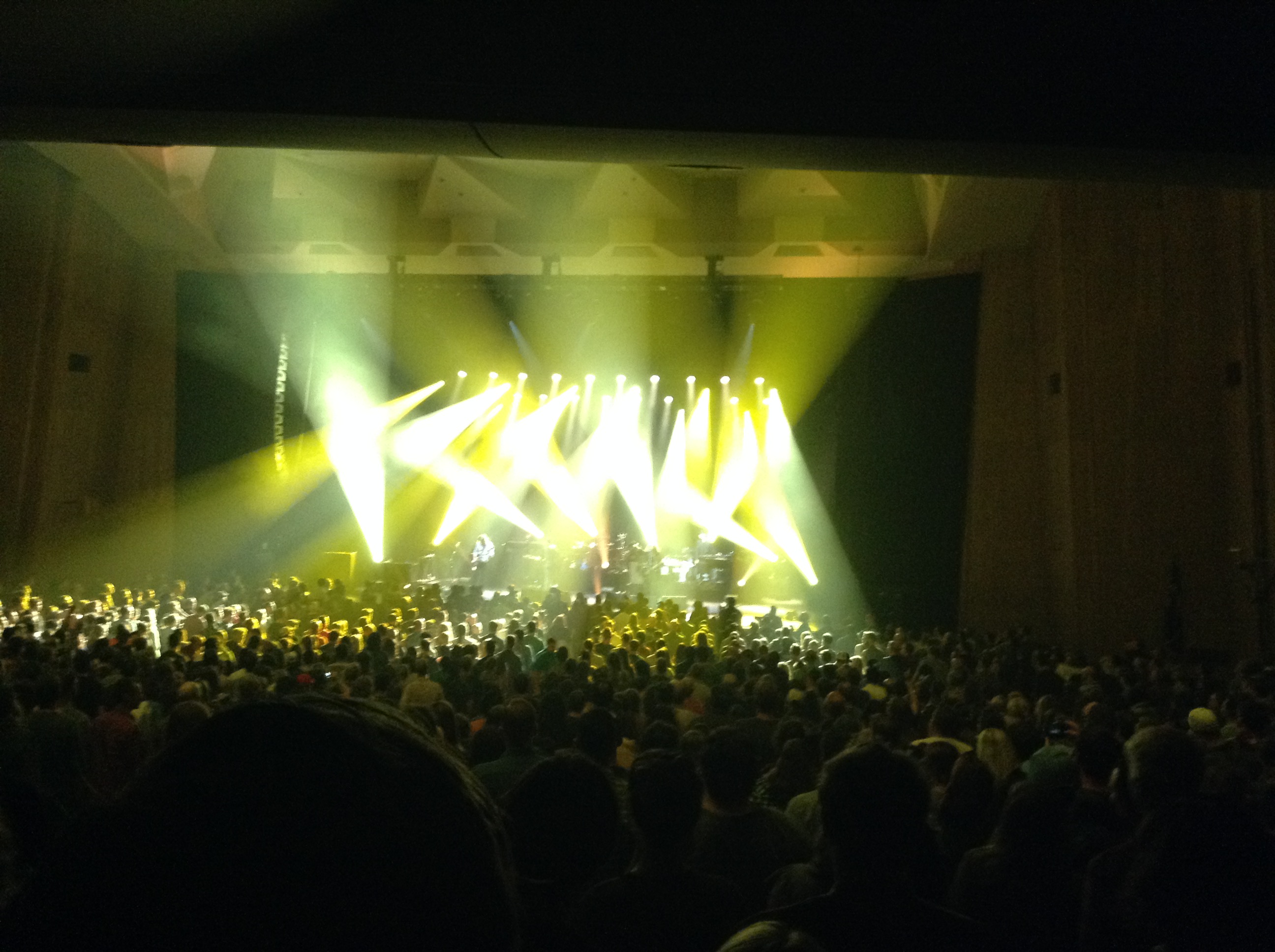
An attempt to capture one of the more spectacular lighting effects.

An attempt to capture one of the more spectacular lighting effects.

Perhaps we are speaking from a mild case of bitterness, since as a part of “My Morning Jacket Week” we highlighted the song “Lay Low” and the group’s ability to rip out some amazing covers, and ended the night with neither.  But it does speak to the depth of the band’s catalog that they could leave out staples like “Steam Engine”, “Phone Went West”, or “Dondante” and still construct a solid setlist.  The show was heavy on material from their latest album, The Waterfall, and while there is still a lot to that record that feels underwhelming, the songs do gain an additional spark in a live setting.  The album’s best tracks, “Tropics (Erase Traces)” and “Only Memories Remain”, sound even better live, with the former exploding with energy and the latter stretched to an epic length and augmented by some excellent solos.

The band did not say a word to the crowd the entire night, and frontman Jim James was cautious with his movements, with a slowed-down version of the duckwalk being his sole bit of showmanship (aside from the traditional donning of the cloak for “Touch Me I’m Going To Scream Pt. 2”).  There were a couple of moments where different members missed a line or added a beat, or even failing to figure out when a song should end, and the soundboard had problems with the mix for most of the night.  But there were several moments where everything synced up perfectly, such as the dazzling light display for “At Dawn” or the dip into crowd favorites from the Z era with “Wordless Chorus” and “Off the Record”.  And once again, the band showed their knack for reworking their older material, with thrilling renditions of “Master Plan” and “Knot Comes Loose”.

A view of "At Dawn" from approximately Hillsboro.

A view of “At Dawn” from approximately Hillsboro.

Opener Strand of Oaks impressed the early crowd and made several new fans that night.  They initially impressed with some excellent metal-leaning chops, and then won over the audience with their tale of driving 31 hours from Champaign, Illinois to make the gig that night to play with their heroes.  They took a risk with some of their more downbeat material that followed, but finished up with a fantastic slow-building closer that had the crowd amped for the main event.

Review: Low – Ones and Sixes

What Low has accomplished over the course of their two-decade-plus career is truly astonishing.  Not only have they never come close to releasing a mediocre album, but they still sound as vibrant as ever, with their creative spark still burning bright.  Though as pioneers of the “slowcore” genre they are known for their minimalist tendencies, Low still is finding new sounds to explore and ideas to develop, which makes Ones and Sixes an excellent addition to their brilliant discography.

Ones and Sixes is an excellent summation of the different paths the band has pursued since the release of Things We Lost In The Fire.  The band alternates between the warmer milieu of their recent work (C’mon and The Invisible Way) with a dip back into the icier moods of albums like Drums and Guns. The influence of that often-overlooked album really shines through with the incorporation of electronic drums on tracks like “Congregation” and “Gentle”, the latter of which evokes a more downbeat version of With Teeth-era Nine Inch Nails.

These dark, mysterious tracks fit perfectly alongside soaring guitar-based ballads, like the dazzling “Lies”, which may have one of the most gorgeous climaxes that the band has ever recorded.  This sublime moment is immediately followed by the epic “Landslide”, which is possibly Low’s heaviest work to date.  With its heavy distortion and extended dissonant outro, it is sure to be a highlight of the group’s upcoming live show.

There are other intriguing subtle production touches on Ones and Sixes, most notably the use of some natural distortion in the recording and mixing process that gives a rawer feel to certain moments, providing a nice contrast to the otherwise pristine tone found throughout the record.  In addition to their inspired instrumental experimentation, Low once again makes great use of the harmonies of the husband-and-wife team of Alan Sparhawk and Mimi Parker, with each also given their own time to shine.  Their hauntingly alluring vocals are perfect complements to the exquisitely constructed melodies, and that combination together should be more than enough to draw in new listeners.  Of course, this should come as no surprise to old fans, since Low has been consistently excellent for a number of years, but they will certainly be pleased to hear that the band has created an excellent capstone for their fine work of the past decade.

Random note: I have not seen an explanation of the title, but my guess is that “Ones and Sixes” is a reference to dice, and the minimum/maximum that one can get; therefore, the record might be seen as an exploration of highs and lows.  Just a theory.

Kraftwerk, Live at the Keller Auditorium

On Saturday night, legendary electronic act Kraftwerk put on a show that can be truly described as “unique”.  It is difficult to even call what we saw a “concert”, since it is unclear how much of what we heard was performed live.  However, the audience did not pay a fair amount of money just to hear some of their old favorite tracks, but for the totality of the experience, and in that regard Kraftwerk put on a memorable show.

Just four men and their podiums (or podia).

Just four men and their podiums (or podia).

The group constructed a career-spanning set, creating medleys from each distinct era of the band’s history, and the accompanying visuals provided the uninitiated with the appropriate notice as to what album was being covered.  The songs were not mere rote reproductions of what can be found on their records, but updated in a way that blended newer ideas with the basic elements that made up the classic Kraftwerk sound.  It was an intriguing combination, which evokes the fundamental paradox of Kraftwerk’s music as it exists in the 21st century–how does one continue to try to approximate the sound of the future when what was previously composed now sounds so retro?

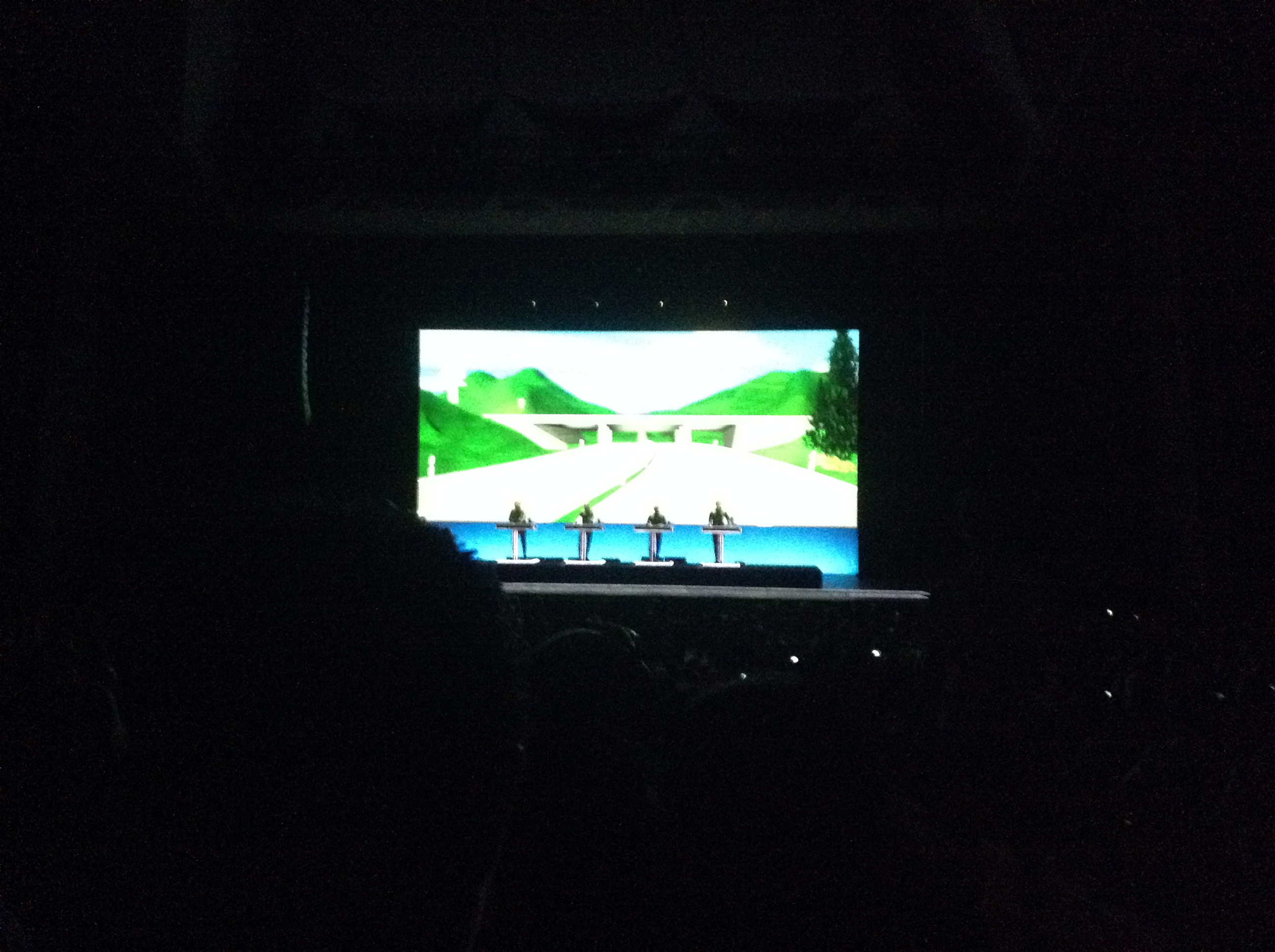
The melding of old and new also was explored with the visual presentation.  The show was presented in 3-D, and there were several moments sprinkled throughout where the crowd was dazzled by the technical feats on display.  Yet at the same time, most of the visuals were fairly simple in design, as were many of the motions.  For instance, the section for Autobahn could be described as the most accurate depiction of the Out Run arcade game ever created.

The appropriate materials necessary for enjoyment of the show.

The appropriate materials necessary for enjoyment of the show.

Kraftwerk has always experimented with various levels of automation, and as such it was difficult for the audience to determine as to what exactly was “performed”.  For the entirety of the show, we were presented with four men standing behind wide podiums, with no real hint as to what each member was contributing to what was being heard; it was not until halfway through the set that I could tell that Ralf Hütter was in fact singing some of the lyrics, or that he was playing a synthesizer.  The sole exception was the beginning of the encore, where in a brilliant touch “The Man-Machines” were literally replaced by robots.  This is why I cracked up when audience members were giving ovations to specific members as they exited the stage one-by-one, because it was impossible to determine who was playing what.

The most beautiful game of Out Run you have ever seen.

The most beautiful game of Out Run you have ever seen.

Overall, it was a very cool experience that anyone with a level of appreciation of electronic music should try to catch at some point.  Then you can also spend hours afterward contemplating the nature of time and space and man and machine and past and future and so on and so forth, all with a nice pulsing beat as background.

Tokyo Police Club, Live at the Doug Fir

Last night’s Tokyo Police Club show at the Doug Fir captured the vibe of being packed into a basement for a house party, except for the fact that floors were not nearly as sticky and the band was way more professional and polished than whomever Dave could bribe to play for a case of cheap domestic.  The devoted showed up in full force last night, ready to sing along to to tracks that date back to the group’s first EP, and the group complied with an enthusiastic and lively set.

David Monks mid-rock-out maneuver

David Monks mid-rock-out maneuver

The band kicked off the show with a modification to their recent setlist by opening with “Breakneck Speed”, slightly altering the lyrics to say “it’s good to be back in Portland” in a nice bit of showmanship.  “Hot Tonight”, an effervescent highlight from their most recent album Forcefield soon followed, and set the mood for the evening.  The new material mixed in well with the old material, with the group focusing heavily on songs from the Champ era in filling out a twenty song set.

We were even treated to a couple of new songs, with bassist/singer David Monks giving a bit of the backstory for “PCH”, noting that the events of the romance took place on that highway that was, to paraphrase, not that far off from here.  Another highlight was fan-favorite “Bambi”, complete with an extended intro that did a great job in disguising what was to come, as well as early cuts like “Nature of the Experiment” and the infectious “Your English Is Good”.  For the encore, we were even treated to a cover of Kelly Clarkson’s “Since U Been Gone”, which managed to accomplish the difficult task of captivating this crowd packed with hipsters.

A good look at the friendly fellows

A good look at the friendly fellows

Openers The Domestics did a great job with their pop-rock set, effectively setting the mood for the rest of the night.  The local act kept the audience’s attention with a varied setup, switching between instruments and vocalists, all the while delivering punchy and engaging songs.  They will definitely be a highlight on many bills around town.